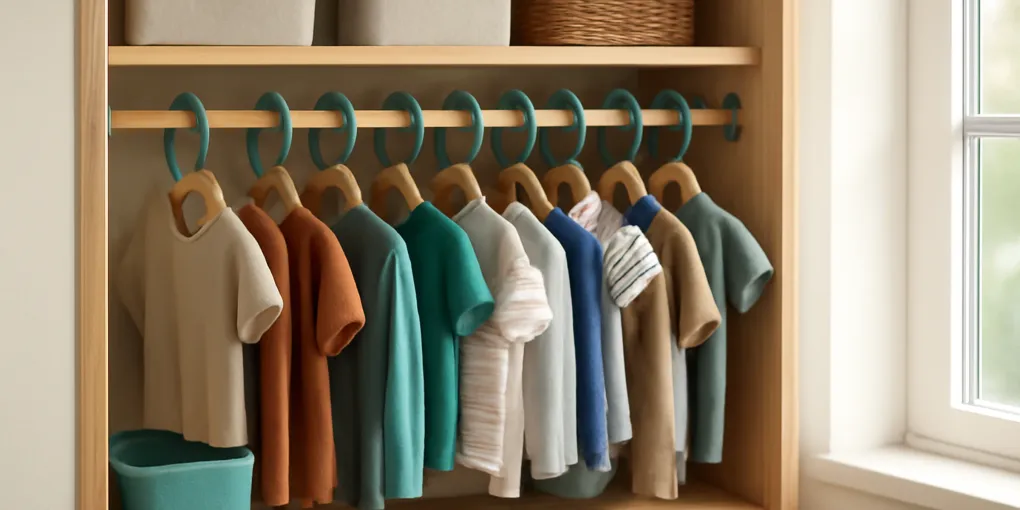
Best Closet Rod Dividers for Kids' Clothes: Size Labels That Stop the Laundry Guessing Game
Buyer's GuideBlissful Diary newborn-to-24-month closet dividers
Best nursery starter setBest For: Newborn through toddler size separation on standard rods
Quick picks
| Product | Key Specs | Pros / Cons |
|---|---|---|
| See price on Amazon |
|
|
| See price on Amazon |
|
|
| See price on Amazon |
|
|
Product availability, certifications, and retailer details can change; check the current Amazon page before buying.
Kids’ clothes create a specific kind of clutter: sizes overlap, brands fit differently, relatives give next-size-up outfits, and laundry returns faster than the closet can absorb it. Closet rod dividers help only when they make the next size decision obvious. Decorative rings that hide behind hangers or use vague labels become nursery clutter.
If your children’s storage problem is toys rather than clothes, see our toy rotation bin protocol for small apartments and toy small-parts quarantine bin protocol. This guide is for hanging clothes, hand-me-downs, and size transitions.
Quick product shortlist
- Best nursery starter set: Search Amazon for Blissful Diary newborn closet dividers when baby sizes need fast visual separation.
- Best reusable option: Search Amazon for Mifoci white round size dividers when you want labels that can change with the child.
- Best giftable set: Search Amazon for Parker Baby Co. closet dividers when the closet is visible and the dividers need to feel sturdy.
Choose by the label system first. The cutest divider is not useful if it cannot handle too big now, fits this month, and outgrown without confusion for the person putting laundry away.
What matters in a kids’ closet divider
Visibility is the first requirement. A divider must stick out far enough to see when hangers are full, but not so far that it catches sleeves or blocks the rod. Thin acrylic or sturdy printed cards work when the closet is not packed. Thicker wood dividers can be easier to see but may steal rod space in a small closet.
Label flexibility is the second requirement. Baby dividers often come printed with newborn, 0-3 months, 3-6 months, and similar ranges. That is convenient for a new baby closet, but clothing brands do not fit the same. A child may wear one brand’s 12-month sleeper while still fitting another brand’s 9-month pants. Reusable blank dividers let you switch to fits now, next size, and too big when month labels stop matching reality.
Durability is the third requirement. Closet dividers get bumped by hangers, laundry baskets, and rushed morning decisions. Paper-thin dividers can bend. Very thick dividers can jam. Look for a smooth opening that fits your rod and edges that will not snag delicate fabrics.
Best for baby closets: printed size divider set
A printed baby divider set is the easiest starting point when a nursery closet holds gifts, registry outfits, hand-me-downs, and several future sizes. It gives every outfit a temporary address and makes it less likely that a newborn size outfit is discovered after the child has outgrown it.
Use printed month labels for the first pass, but do not treat them as law. Add a small try soon clip or bin for clothes that look smaller than the label suggests. Check that divider opening fits your closet rod; some nursery closets use thicker rods or built-in systems that do not match every divider.
Best long-term option: blank acrylic dividers
Blank acrylic dividers are less charming but more adaptable. You can label them by size now, then relabel by school uniforms, church clothes, sports jerseys, dance gear, or seasonal jackets later. This matters in shared sibling closets where the system changes every few months.
Use a label maker, removable vinyl, or wet-erase marker that stays legible. Keep the labels short. 5T now, 6 next, and outgrown work better than detailed age ranges. If two children share a rod, use color labels or initials only if everyone can understand them quickly.
Best decorative option: wooden dividers
Wooden dividers can be sturdy and easy to see in an open nursery closet. They make sense when the closet has enough rod space and the divider set matches how the clothes are actually sorted. The risk is bulk. A thick divider every few inches can turn a small rod into a crowded display.
Buy wooden dividers when they solve a real retrieval problem, not because they photograph well. If the closet door stays closed and the rod is tight, a thinner reusable divider will usually be more practical.
Size labels versus bins
| Clothing situation | Better tool | Why |
|---|---|---|
| Hanging baby outfits in several sizes | Rod dividers | Sizes are visible while browsing hangers |
| Pajamas, socks, and onesies | Drawer bins | Folded basics do not need hanger labels |
| Next-size-up hand-me-downs | Lidded bin plus date label | Future clothes should not crowd daily choices |
| Two kids sharing one closet | Reusable dividers | Labels can separate child, size, or uniform type |
| Outgrown clothes waiting to donate | Separate outbox | They should leave the active rod quickly |
Rod dividers should reduce laundry decisions. If they only decorate a rod that is already overfull, move some clothing out first.
How to label sizes without making the closet worse
The most useful divider labels are short, current, and tied to action. For babies, month labels can be a starting map, but many families need one extra category: try soon. Put outfits that look smaller than their tag in that section so they get tested before the child outgrows them. For toddlers, switch from brand-size precision to action labels such as fits now, next size, too warm, and donate.
Avoid labels that require a parent to remember a hidden rule. Grandma clothes, later, or misc will not help during a rushed laundry reset. If two adults or an older sibling put laundry away, the divider must make sense to all of them without a separate explanation. That is why blank acrylic dividers can beat decorative printed sets after the first year: the label language can change as the closet job changes.
Shared sibling closets need different dividers
A shared closet is not just a larger baby closet. It has two retrieval questions at once: whose clothes are these, and are they ready to wear now? If two children use the same rod, use dividers to separate child first, then size or clothing job inside each section. Color can help, but only if the color meaning is obvious and consistent.
Do not use a single long row of size labels when siblings are close in age. A 4T divider beside a 5T divider does not say which child owns the sweatshirt. Instead, create zones such as Maya now, Maya next, Leo now, and Leo next. Hand-me-downs that are more than one size away should leave the active rod and go into a dated bin. Otherwise the daily closet becomes a storage archive.
When not to buy closet dividers
Skip rod dividers if most clothing is folded, if the rod is already packed tightly, or if the closet has no consistent hanger system. In those cases, the divider will hide behind fabric and make the rod harder to slide. Start with fewer hanging items, a donation outbox, or drawer bins for pajamas and basics.
Also skip fixed printed baby dividers if your household mostly receives secondhand clothing from many brands. Brand sizing varies enough that month labels can create false confidence. Reusable blank dividers or bin labels are safer when the real question is fits this week rather than the number printed on the tag.
Before keeping a printed set, run one laundry-load test. Hang five freshly washed outfits in the section where you think they belong, then ask whether the next person would put them in the same place. If the answer depends on knowing a brand’s fit history, switch the label to a simpler action category.
Fit checklist before buying
- Measure rod diameter and clearance above the rod.
- Count how many categories actually need hanging separation.
- Decide whether fixed month labels will work or blank labels are safer.
- Check whether hangers slide past the divider without catching.
- Leave one temporary category for
try soonornext size. - Keep outgrown clothes off the active rod after the weekly laundry reset.
- Put the most-used size at the easiest reach point, not necessarily at the left end of the rod.
- Recheck the divider labels after each growth spurt, seasonal clothing swap, or hand-me-down delivery.
- Remove any divider that no longer controls a real group of clothes; empty labels make the system look more complete than it is.
Practical score
| Factor | Weight | What matters |
|---|---|---|
| Label clarity | 30% | The next laundry decision is obvious. |
| Rod fit | 25% | Dividers fit the rod and do not jam hangers. |
| Reusability | 20% | Labels can evolve beyond baby month ranges. |
| Durability | 15% | Material survives hanger bumps and closet traffic. |
| Space discipline | 10% | Dividers do not excuse keeping too many sizes active. |
Closet-divider FAQ
How many size dividers do I need?
Use the fewest categories that match your closet. For a baby, five to seven sizes may help. For an older child, three categories may be enough: current, next, and special occasion.
What should I do with clothes that almost fit?
Create one try soon section or bin. Review it every two weeks so almost-fit clothing does not disappear behind the current size.
Are closet dividers better than labels on hangers?
Usually yes for grouped sizes because one divider controls a whole section. Individual hanger labels are harder to maintain after laundry.
Sources and safety notes
- HealthyChildren.org childproofing guidance for household access and reach planning: https://www.healthychildren.org/English/safety-prevention/at-home/Pages/Childproofing-Your-Home.aspx
- NIST visual communication and usability research context: https://www.nist.gov/itl/iad/visualization-and-usability-group
Frequently Asked Questions
- They are worth it when multiple sizes hang together or hand-me-downs arrive early. They are less useful if most clothes live folded in drawers.
- Use size for babies and toddlers, then switch to season, school uniform, sports, or next-size-up categories as clothes become less size-fragmented.
- Usually yes if the divider opening fits the rod and there is enough hanger clearance. Measure rod diameter and vertical space first.