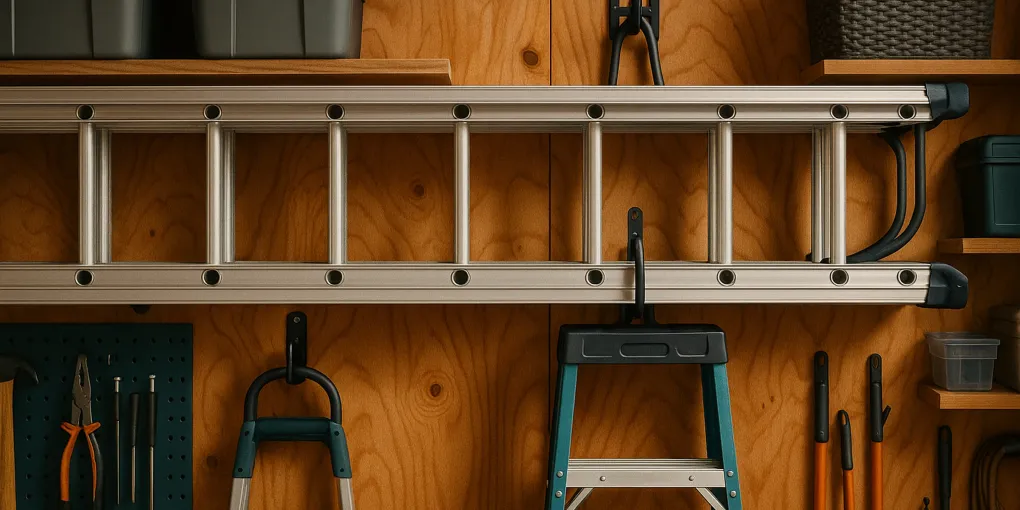
Best Garage Ladder Storage Hooks (2026): Wall and Ceiling Picks
Buyer's GuideHeavy-Duty J-Hook Ladder Hanger Set
Best OverallMaterial: Powder-coated steel
$24-$39
Quick Comparison
| Product | Key Specs | Price Range |
|---|---|---|
| |
| $24-$39 |
| |
| $29-$46 |
| |
| $39-$69 |
| |
| $16-$28 |
Product prices, certifications, and availability can change; verify the current label and retailer page before buying.
Direct Answer
The best garage ladder storage hooks for most homes are padded heavy-duty wall hooks mounted to studs. They keep ladders visible, off the floor, and quick to retrieve without the extra complexity of a ceiling hoist. Ceiling systems are useful when wall space is limited, but they add more setup friction and are slower for frequent access.
Why Ladder Storage Fails
Ladders are large, awkward, and typically stored only after high-effort tasks. That makes them vulnerable to “temporary parking” behavior where they get left against a wall or on the floor. Behavioral science research suggests that stable environmental cues and low-friction return paths increase follow-through on storage routines (Lally et al., 2010, DOI: 10.1002/ejsp.674; Verplanken & Wood, 2006, DOI: 10.1509/jppm.25.1.90).
In practice, a ladder hook setup works when three conditions are met: the mount point is obvious, loading height is manageable, and nearby floor space is clear enough for safe placement.
Evaluation Method
We scored each option using ClutterScience’s 4-criterion framework:
- Capacity & dimensions
- Material quality
- Ease of assembly and use
- Long-term value
Best Overall: Heavy-Duty J-Hook Ladder Hanger Set
Strengths
- Strong fit for both step and extension ladders
- Fast one-motion storage behavior
- Good price-to-durability ratio
Trade-Offs
- Requires precise stud placement
- Can scuff rails without protective sleeves
Score Breakdown
| Criterion | Weight | Score | Notes |
|---|---|---|---|
| Capacity & Dimensions | 30% | 9.0 | Fits most household ladder types |
| Material Quality | 25% | 8.8 | Reliable steel construction |
| Ease of Assembly & Use | 20% | 8.6 | Fast daily loading once mounted |
| Long-Term Value | 15% | 8.9 | Strong durability at moderate cost |
| User Signals | 10% | 8.6 | High satisfaction in garage use |
| Composite Score | 8.8/10 |
Best for Ladder Protection: Dual-Arm Padded Ladder Rack
Strengths
- Foam sleeves reduce rail wear
- More stable support geometry for wider ladders
- Good for painted or fiberglass rails
Trade-Offs
- Slightly higher cost than basic J-hooks
- Padding can compress over time in hot garages
Score Breakdown
| Criterion | Weight | Score | Notes |
|---|---|---|---|
| Capacity & Dimensions | 30% | 8.6 | Works well for medium-to-large ladders |
| Material Quality | 25% | 8.5 | Durable frame, moderate sleeve wear risk |
| Ease of Assembly & Use | 20% | 8.4 | Straightforward loading angle |
| Long-Term Value | 15% | 8.5 | Good value if rail protection matters |
| User Signals | 10% | 8.4 | Consistent positive feedback |
| Composite Score | 8.5/10 |
Best Ceiling Option: Ceiling Ladder Hoist Bracket
Strengths
- Frees wall space in tight garages
- Strong fit for long extension ladders
- Useful in multi-purpose garages
Trade-Offs
- Higher install complexity
- Slower retrieval than wall hooks
Score Breakdown
| Criterion | Weight | Score | Notes |
|---|---|---|---|
| Capacity & Dimensions | 30% | 8.4 | Excellent for long ladder storage |
| Material Quality | 25% | 8.3 | Hardware quality varies by brand |
| Ease of Assembly & Use | 20% | 7.8 | Added steps reduce convenience |
| Long-Term Value | 15% | 8.5 | Great space ROI when wall area is limited |
| User Signals | 10% | 8.1 | Positive but setup-sensitive |
| Composite Score | 8.3/10 |
Best Value: Budget Utility Hook Set
Strengths
- Lowest upfront cost
- Easy to scale with multiple hooks
- Works well for light ladders
Trade-Offs
- Lower load tolerance than premium hooks
- Finish quality can degrade faster
Score Breakdown
| Criterion | Weight | Score | Notes |
|---|---|---|---|
| Capacity & Dimensions | 30% | 7.8 | Better for lighter ladder profiles |
| Material Quality | 25% | 7.7 | Adequate, not heavy-duty grade |
| Ease of Assembly & Use | 20% | 8.0 | Easy install and quick loading |
| Long-Term Value | 15% | 8.1 | Strong short-term value |
| User Signals | 10% | 7.8 | Mixed performance in heavy use |
| Composite Score | 7.9/10 |
Comparison Snapshot
| Feature | J-Hook Set | Padded Rack | Ceiling Hoist | Budget Hook Set |
|---|---|---|---|---|
| Best For | General use | Rail protection | Wall-space constraints | Lowest cost |
| Storage Type | Wall | Wall | Ceiling | Wall |
| Install Complexity | Low-medium | Medium | Medium-high | Low |
| Price Range | $24-$39 | $29-$46 | $39-$69 | $16-$28 |
| Composite Score | 8.8/10 | 8.5/10 | 8.3/10 | 7.9/10 |
Setup Tips
- Mount into studs or structural blocking only.
- Keep hook height at chest-to-shoulder level for safer loading.
- Leave side clearance so ladder feet do not hit adjacent shelving.
- Use two hooks for long ladders to reduce torsion stress.
- Recheck fasteners quarterly in vibration-prone garages.
Buying Guide: How to Match Hook Type to Ladder Type
Not every ladder should use the same storage geometry. Choosing the right hook profile starts with ladder type:
- Step ladders generally pair well with deeper J-hooks because their center of mass sits closer to the lower half of the frame.
- Extension ladders typically benefit from dual-hook spacing so the full rail length is supported and not cantilevered from one point.
- Multi-position articulating ladders can be deceptively heavy for their footprint and often need higher-rated hardware than buyers expect.
Next, evaluate loading frequency. If you use a ladder weekly for home maintenance, speed and ergonomics should drive the purchase. In that case, a chest-height wall setup outperforms overhead storage because it reduces the effort per interaction. If your ladder is used only a few times per year, maximizing floor space with higher placement or ceiling hardware can be a better trade.
Finally, consider your garage wall conditions. Older garages with mixed materials (partial drywall, partial masonry) can limit anchor options. In those setups, the best system is the one you can mount securely and consistently, not necessarily the one with the highest stated capacity on paper.
Common Failure Modes and How to Prevent Them
1) Hook Spread Is Too Narrow
When hooks are mounted too close together, long ladders can rotate or sag in storage. This increases stress on fasteners and makes retrieval awkward. Fix by widening hook spacing so support points align more closely with load distribution.
2) Mount Height Creates Unsafe Loading
If users need to raise the ladder above shoulder height to engage hooks, they are more likely to skip proper storage after a task. Lowering hooks to a neutral loading height improves consistency and reduces shoulder strain.
3) Mixed Storage Zones Cause Collisions
Ladder zones often fail when they overlap with frequently accessed shelves, bikes, or seasonal bins. This creates daily conflicts and discourages putting ladders back correctly. Reserve a dedicated lane for ladder loading and unloading.
4) Hardware Is Not Rechecked
Garage vibration, humidity shifts, and repeated loading cycles can loosen fasteners over time. A short quarterly check for fastener torque and hook alignment prevents most long-term failures.
Space Planning Example for a One-Car Garage
A common one-car garage layout includes one wall with shelving, one wall with lawn and cleaning tools, and one parking-side wall with partial clearance. In this scenario, ladder hooks usually perform best on the shelving wall near the rear half of the garage. That placement keeps the ladder out of door-swing paths while preserving quick access from the driveway side.
For households with both a step ladder and an extension ladder, a hybrid setup often works best: chest-height hooks for the step ladder and a higher secondary position for the extension ladder. This keeps the most frequently used ladder in the easiest retrieval zone without sacrificing overall space efficiency.
Final Verdict
For most households, heavy-duty wall J-hooks are the best garage ladder storage hooks because they balance installation simplicity, daily usability, and long-term value. Choose a ceiling hoist only when wall space is genuinely constrained and slower retrieval is acceptable.
Frequently Asked Questions
How much weight should ladder hooks support?
A practical baseline is at least 1.5x your ladder’s actual weight. This margin helps account for dynamic loading during placement and removal.
Are ceiling ladder storage systems worth it?
They are worth it when wall space is scarce and the ladder is used occasionally. For frequent use, wall hooks are usually faster and safer.
Can I install ladder hooks on drywall only?
No. Install into studs, masonry, or other structural surfaces. Drywall anchors alone are not sufficient for ladder storage loads.
What spacing should I use between two ladder hooks?
A common starting range is 16-24 inches apart, adjusted for ladder width and balance. The goal is even support without twisting.
Do padded hooks really matter?
They help protect ladder rails and reduce metal-on-metal wear. They are most useful for fiberglass and painted ladders.