Best Mudroom Basket Organizers by Entryway Use Case (2026)
Buyer's GuideSeagrass or Water-Hyacinth Cubby Basket
Best Decorative Open BasketBest fit: Hats, gloves, scarves, and dry personal accessories
$22–35
Quick picks
| Product | Key Specs |
|---|---|
| See price on Amazon |
|
| See price on Amazon |
|
| See price on Amazon |
|
| See price on Amazon |
|
| See price on Amazon |
|
| See price on Amazon |
|
| See price on Amazon |
|
Product availability, certifications, and retailer details can change; check the current Amazon page before buying.
Mudroom baskets work best when they are chosen by job: one bin for winter accessories, one for pet leashes, one for each child’s school extras, one for grab-and-go sports gear, and one overflow basket that gets reset before it turns into permanent clutter. A beautiful woven basket can make an entry feel finished, but the best mudroom basket organizer for a snowy family entryway may be a washable plastic bin or an open wire basket that lets damp gear breathe.
This guide refreshes our mudroom basket picks around real entryway use cases rather than a generic list of baskets. If you are building a complete entry zone, pair these baskets with a wider system such as mudroom sports gear storage, mudroom cubby systems, or a full mudroom setup from scratch. For adjacent storage overflow, our guides to garage sports equipment storage, closet storage bins, and plastic storage drawers cover the items that should not live in the entryway year-round.
Quick Decision Table: Match the Basket to the Mudroom Job
| Mudroom use case | Best basket style | Why it works | Watch-out |
|---|---|---|---|
| Dry hats, gloves, and scarves | Open woven basket | Looks warm in visible cubbies and keeps accessories easy to grab | Natural fibers do not like wet gear |
| Per-person family cubbies | Labeled cubby bin set | Repeats the same visual language and makes responsibility clear | Measure cubby clearance before buying a set |
| Muddy kid gear or wet gloves | Washable plastic basket | Can be wiped or rinsed after bad-weather use | Looks more utilitarian than woven storage |
| Balls, pads, and practice gear | Open wire basket | Airflow and visibility help sports gear dry and leave on time | Small loose items can fall through wire gaps |
| Off-season accessories | Lidded basket | Hides low-frequency clutter and keeps dust down | Too much friction for daily-use items |
| School papers and small kid items | Kid-height labeled bin | Children can use it without adult sorting | Needs a weekly reset to avoid paper piles |
| Dog leashes and walk supplies | Small washable or lined basket | Keeps harnesses, bags, towels, and wipes near the door | Damp leashes should not sit in unlined wicker |
Measure the Drop Zone First
Before buying baskets, measure the actual place where the basket must live. Standard-looking mudroom cubbies vary enough that a basket that is technically 12 inches wide may scrape, snag, or become annoying if the opening is also close to 12 inches. Leave one to two inches of side clearance and at least two inches of top clearance if people will pull the basket forward daily.
Also measure behavior, not just woodwork. A basket for car keys can be shallow because it holds low-volume items. A winter basket needs more airspace because gloves, gaiters, neck warmers, and hats expand quickly. A sports basket should be wide enough that gear lands in it without a perfect aim. A basket that demands careful folding or stacking will fail in the arrival-home moment when everyone is tired.
For narrow homes or apartments, start with one landing-zone basket and one outbox instead of trying to copy a built-in mudroom. The same principle appears in our small entryway storage ideas: reduce the number of decisions at the door, then move overflow to closets, garage shelves, or seasonal bins.
Open vs. Lidded Baskets
Open baskets win for daily mudroom use because they reduce friction. You can drop gloves, hats, dog bags, and sunglasses into the right place with one motion. That matters more than perfect concealment. A lid adds one more step, which sounds minor until a household repeats the routine several times a day.
Lidded baskets still have a role. They are useful for off-season accessories, spare reusable bags, sunscreen, picnic blankets, and infrequent pet items that make a mudroom look messy when exposed. Use lidded storage above eye level or below a bench where you do not need immediate access. Do not use lidded baskets for the item you are trying to train a child, guest, or tired adult to put away automatically.
Labels and Family Assignments
A label only works if it answers the question a person has in the moment. “Emma,” “Dog walk,” and “Winter hats” are better than broad labels such as “miscellaneous” or “gear.” For family mudrooms, per-person baskets are often easier to maintain than category-only baskets because each person owns the small clutter that accumulates in their zone.
Use durable tag labels on woven baskets and adhesive labels or clip-on holders on plastic bins. If your system changes seasonally, avoid permanent labels until you know the categories are stable. The guide to labeling storage containers is useful if you want a consistent label system across mudroom, closets, pantry, and garage.
Wet Gear and Washable Materials
Mudrooms see water, salt, soil, pet hair, and sports-field grit. That is why basket material matters. Seagrass, wicker, and water hyacinth look better in visible entryways, but they should be protected from soaked gloves, wet leashes, and muddy shoes. Plastic and coated wire look less decorative, but they tolerate quick wipe-downs and accidental dampness.
If you love woven baskets, use them for dry accessories and put a washable tray, plastic liner, or separate utility bin nearby for wet gear. If your household regularly enters with cleats, hockey gear, rain jackets, or dog towels, choose plastic or wire for the messiest category first, then add one decorative basket for the items that stay dry.
Small Entryway Alternatives
Not every home has a dedicated mudroom. In a small entry, baskets work best when they attach to existing furniture: a narrow console shelf, a bench cubby, a wall shelf, or the bottom of a coat closet. One basket per job is still the rule, but the basket count should be smaller.
Try this compact setup:
- One shallow open basket for keys, sunglasses, and transit cards.
- One low bin for shoes or slippers.
- One labeled family basket for winter accessories during cold months.
- One hook or hanging pouch for pet leashes and bags.
- One overflow basket that gets emptied every weekend.
If sports gear is the main problem, use the small-entryway approach in how to organize sports equipment in a small entryway rather than forcing every ball, pad, and cleat into decorative baskets.
Product and Basket-Type Notes
Seagrass or Water-Hyacinth Cubby Basket — Best Decorative Open Basket
Best for: dry accessories in visible cubbies, especially hats, gloves, scarves, and small seasonal items.
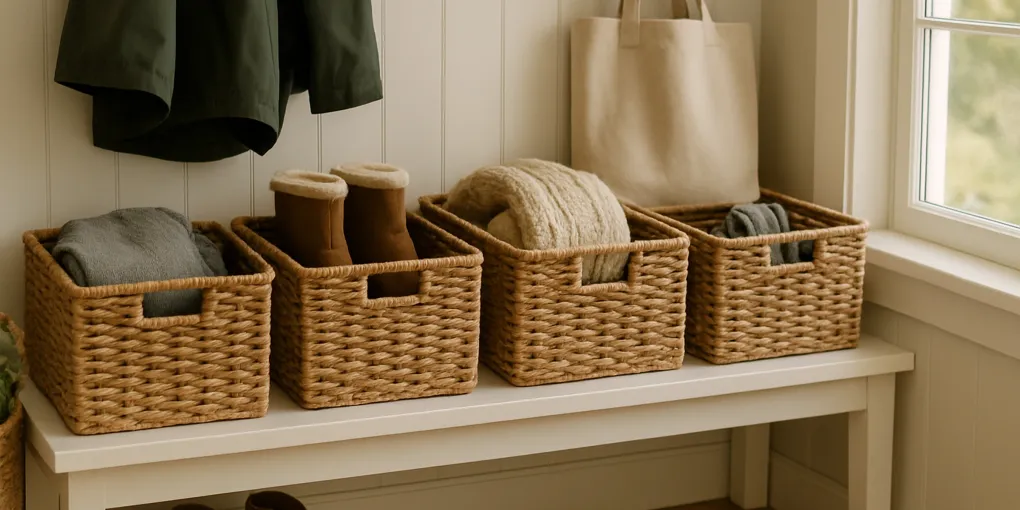
A seagrass or water-hyacinth basket is the choice when the mudroom is also part of the home’s first impression. Natural texture softens cubbies and coordinates with wood benches, woven rugs, and neutral entryway design. The practical requirement is sizing: look for baskets around 10–12 inches wide if your cubbies are roughly 12–13 inches wide.
The trade-off is moisture. A woven basket can handle normal use, but it is not the right landing spot for soaked mittens, muddy towels, or wet pet leashes. Use it for dry gear or add a removable liner.
Compare woven cubby baskets on Amazon
Wicker Storage Basket Set — Best Labeled Cubby Bin Set
Best for: per-person baskets and family systems where visual consistency matters.
A coordinated wicker set helps a mudroom look intentional instead of pieced together. Mixed sizes also help you avoid using one oversized catchall for every category. Assign larger baskets to bulky accessories and smaller ones to shared items such as sunscreen, spare bags, or dog-walk supplies.
The main limitation is fit. Basket sets rarely match every cubby perfectly, so measure first and leave clearance for handles and uneven woven edges. If the basket will be pulled out daily by children, choose reinforced handles and labels that will not tear off.
Compare labeled wicker basket sets on Amazon
mDesign Plastic Stackable Organizer Basket — Best Washable Plastic Basket
Best for: wet-weather homes, kid gear, pet gear, and any basket that needs frequent cleaning.
Plastic baskets are not the warmest-looking option, but they solve the biggest mudroom problem: the basket has to survive real life. A rigid plastic bin can hold damp gloves, sunscreen, loose balls, muddy accessories, and dog supplies without absorbing moisture. Stackable versions are also easy to move during cleaning.
Use plastic in the messiest zone, even if you use decorative baskets elsewhere. That split system often works better than trying to make one material handle every entryway job.
Compare mDesign plastic organizer baskets on Amazon
Open Wire Basket — Best Airflow Basket
Best for: sports gear, damp hats, and items that benefit from visibility.
Wire baskets are useful when airflow and quick scanning matter. They work well for balls, gloves, pads, and seasonal accessories that otherwise disappear into opaque bins. A wire basket also prevents the “closed box mystery” problem where nobody remembers what is inside.
The drawback is containment. Small items can slip through wire gaps, and metal baskets can scratch delicate shelves if they are dragged. Use felt pads or shelf liners if the basket sits on a painted bench or cabinet.
Compare wire baskets with handles on Amazon
Lidded Basket — Best Visual-Clutter Control
Best for: off-season accessories, spare bags, and low-frequency entryway items.
A lidded basket is not ideal for the things your household touches every day, but it is excellent for the items that make an entryway feel cluttered even when they are technically organized. Use it for backup gloves, rain ponchos, picnic blankets, shoe-care items, or seasonal gear that only comes out occasionally.
Choose plastic if the basket may hold damp items. Choose fabric or woven material when the contents are dry and the basket sits in a visible spot.
Compare lidded entryway baskets on Amazon
Kid-Height Label Bin — Best for School Gear
Best for: backpack accessories, library books, forms, hats, and the daily school exit routine.
Kids use systems they can reach and understand. Put the basket low, label it with a name or picture, and keep the category narrow. A single “school” bin works better than several tiny bins if children are young; older kids can handle separate baskets for sports, winter gear, and papers.
The key is a reset rhythm. A kid-height bin will collect papers and random objects unless it is emptied before the next week starts.
Compare kid storage bins with labels on Amazon
Pet-Gear Basket — Best for Leashes and Walk Supplies
Best for: leashes, harnesses, waste bags, paw towels, wipes, and outdoor pet accessories.
A pet basket should sit near the door used for walks. Keep it smaller than you think; oversized pet baskets quickly become mixed household clutter. If leashes come back wet, use plastic or a lined woven basket and let fabric items dry before closing them into any lidded storage.
A nearby hook can hold the primary leash while the basket stores backup bags, towels, and seasonal items.
Compare pet leash storage baskets on Amazon
Five-Step Mudroom Basket Setup Workflow
- Sort by person or use case. Put everything currently landing in the mudroom into piles: each person, pet gear, winter accessories, school items, sports gear, shoes, and items that belong somewhere else.
- Choose basket sizes after sorting. Do not buy seven matching baskets before you know which categories are bulky. Winter gear and sports accessories need more volume than keys or sunscreen.
- Place the highest-use baskets at hand height. Daily-use baskets should be visible and reachable. Off-season or backup baskets can move higher or under a bench.
- Add labels that match the decision. If the decision is “whose item is this,” use names. If the decision is “what job is this item for,” use category labels.
- Set an overflow and seasonal reset rule. When a basket fills past the top edge, empty it before adding more. At the end of each season, move unused gear to closet, garage, or long-term storage.
This workflow is simple, but it is what keeps a basket system from becoming a prettier pile.
How We Score
Clutter Science evaluates organizers using a five-factor composite scoring method. For this refresh, we prioritized entryway behavior and product transparency over decorative appeal alone.
| Factor | Weight | What We Assess |
|---|---|---|
| Research | 30% | Breadth of comparable basket styles reviewed and fit against common mudroom use cases |
| Evidence Quality | 25% | Reliance on visible product details such as material, dimensions, handles, cleanability, and merchant-disclosed specs |
| Value | 20% | Cost relative to basket count, durability, and whether one purchase solves multiple zones |
| User Signals | 15% | Practical friction points seen in real household use: labeling, reach, moisture, overflow, and reset behavior |
| Transparency | 10% | Clear limits around no third-party testing where available claims, no invented ratings, and affiliate-link safety |
Scores are directional product-category scores, not lab-test results.
| Basket type | Best fit | Category score |
|---|---|---|
| Wicker storage basket set | Coordinated family cubbies | 8.4/10 |
| Washable plastic organizer basket | Wet or kid-heavy mudrooms | 8.2/10 |
| Seagrass/water-hyacinth cubby basket | Decorative dry accessory storage | 8.0/10 |
| Open wire basket | Sports and airflow needs | 7.9/10 |
| Kid-height label bin | School routines | 7.8/10 |
| Pet-gear basket | Leashes and walk supplies | 7.7/10 |
| Lidded basket | Off-season visual clutter | 7.5/10 |
FAQ
What is the best way to use baskets in a mudroom organization system? Use baskets as labeled landing zones inside a larger entryway system rather than as one catchall bin. Assign baskets by person or use case, keep them close to the drop zone, and set an overflow rule so baskets do not become permanent junk bins.
What size basket fits a standard mudroom cubby? Many residential cubbies are roughly 12–13 inches wide, 10–12 inches deep, and 12–14 inches tall. A basket around 10–12 inches wide, 8–10 inches deep, and 6–9 inches tall usually leaves enough clearance to slide in and out without scraping.
Are open or lidded baskets better for mudrooms? Open baskets are better for daily-use items because they reduce friction: hats, gloves, leashes, and school items can be dropped in quickly. Lidded baskets are better for visual clutter control and off-season items, but they are usually too slow for everyday arrival and departure routines.
How do I keep kids’ school gear from taking over the mudroom? Give each child a low, labeled basket for small items and reserve hooks or a bench cubby for backpacks. Keep school forms and library books in one visible bin, then do a weekly reset before the next school week.
Which mudroom basket material is best for wet winter gear? Washable plastic or coated wire is usually better than wicker or seagrass for wet winter gear. Natural-fiber baskets look warmer, but they should be reserved for dry accessories or used with a removable liner.
Where should pet leashes go in a mudroom? Keep the primary leash on a hook near the exit and use a small washable or lined basket for backup bags, paw towels, wipes, and extra harnesses. Do not store damp leashes in unlined natural-fiber baskets.
How do I stop mudroom baskets from becoming junk bins? Use narrow labels, limit each basket to one job, and add a reset trigger. If a basket fills past the top edge, the owner empties it before adding more. Seasonal gear should move to longer-term storage when the season changes.
Conclusion
The best mudroom basket organizer is not a single product style. It is the basket that matches the job. Choose woven baskets for visible dry accessories, washable plastic for wet and kid-heavy zones, wire baskets for sports gear and airflow, lidded baskets for off-season visual clutter, and small labeled bins for school or pet routines.
If you are starting from scratch, measure the cubbies, sort by use case, buy fewer basket types than you think you need, and label the system around real household behavior. A mudroom basket system should make the next departure easier, not just make the entryway look organized for a photo.