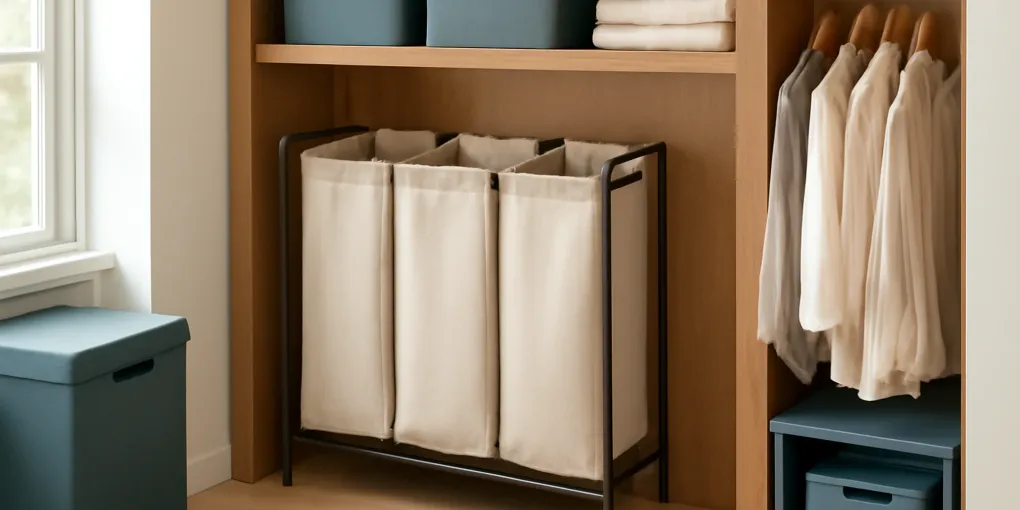
Best Slim Laundry Sorters for Apartment Closets: What Actually Fits
Buyer's GuideNarrow 2-Bag Rolling Laundry Sorter
Best overall fitBest For: One or two adults sorting lights and darks
$35-60
Quick picks
| Product | Key Specs |
|---|---|
| See price on Amazon |
|
| See price on Amazon |
|
| See price on Amazon |
|
Product availability, certifications, and retailer details can change; check the current Amazon page before buying.
If your laundry sorter lives in an apartment closet, the normal buying advice is too vague. A sorter that looks compact online can still block the door, catch on hanging clothes, or leave you carrying an awkward half-full bag down the hall. The best slim laundry sorter is not simply the narrowest one. It is the one that fits the actual closet geometry while preserving enough capacity to prevent overflow before laundry day.
The closet test is stricter than the laundry-room test. A laundry room can tolerate a 30-inch cart that rolls into open space. A reach-in closet may have sliding tracks, bifold hinges, baseboards, shoe racks, long coats, low shelves, or a vacuum stored in the same bay. That is why this guide focuses on product categories that work in narrow apartment footprints: rolling two-bag sorters, slim vertical hampers, and compact tilt-out cabinets.
For the larger routine around when to empty, reset, and restage clothes, pair the right sorter with our weekend laundry reset system. The sorter solves the physical bottleneck. The reset solves the timing bottleneck.
Quick picks for apartment closets
- Best overall fit: See current Amazon options for narrow 2-bag rolling sorters. Choose this if you have roughly 18 to 24 inches of clear width and need to move laundry to a shared room.
- Best for ultra-narrow closets: See current Amazon options for slim vertical hampers. Choose this for a 10 to 16 inch gap beside shelves or behind a closet door.
- Best hidden option: See current Amazon options for compact tilt-out hampers. Choose this when the sorter lives in a visible bedroom alcove.
How to measure before choosing
Measure the closet with the door open and the laundry routine in mind, not just the empty floor. Start with clear floor width at the baseboard, then measure the usable width above the baseboard because some frames flare or bags bulge. If the closet has sliding doors, measure the opening you can actually reach through, not the full wall-to-wall width.
Depth matters just as much. Many apartment closets are deep enough for hangers but not deep enough for a cart that needs to turn. Standard adult hangers often occupy about 18 inches from back wall to front edge. If a sorter is 16 inches deep and sits under shirts, it may work. If it is 20 inches deep and has handles that stick out, it can press against clothing and make the closet feel jammed even when the published width seems fine.
Height is the forgotten measurement. Under hanging shirts, a sorter under 28 inches often works. Under dresses, long coats, or a low second rod, even a short hamper can interfere. If the sorter has a lid, add clearance for opening it. If it has removable bags, test whether you can lift the bag straight up without hitting a shelf.
Finally, allow a margin for real life. A cloth bag bows outward when full. A metal frame can wobble if squeezed between a wall and shoe rack. A rolling model needs enough clearance for casters to face forward. For closets, a one-inch margin is not generous; two or three inches is safer.
Narrow 2-bag rolling laundry sorter
A narrow two-bag rolling sorter is the best default for most apartment closets because it balances sorting, capacity, and transport. Two bags are enough for the highest-frequency split, usually darks and lights or clothes and towels. The frame stays narrower than most three-bag carts, and each bag remains large enough to be useful instead of becoming a decorative mini-bin that overflows after two days.
The strongest versions use a rectangular steel frame, two removable fabric bags, and four casters. The removable bags are the key apartment feature. If you use shared laundry, you can pull one bag and carry it without rolling the whole frame through a hallway. If your washer is inside the apartment, you can roll the sorter from closet to machine and avoid a second basket entirely.
Look for a published width between 18 and 24 inches, smooth bag handles, and a frame that does not rely on thin plastic corner connectors. Check the listed height with casters installed. Some carts appear closet-friendly until wheels add two or three inches and push the bag into hanging clothes. If you have carpet, choose larger casters or plan to carry bags rather than roll the full unit.
The main trade-off is stability. A slim rolling cart can tip if one bag is overloaded and the other is empty, especially when pulled sideways. It also needs a parking spot where the wheels do not drift. If the closet floor slopes or the sorter sits on a slick tile threshold, locking casters are worth prioritizing.
Shopping option: See current Amazon options for narrow 2-bag rolling laundry sorters.
Slim vertical laundry hamper
A slim vertical hamper gives up sorting flexibility in exchange for true small-footprint reliability. It is the category to consider when a rolling sorter simply does not fit. Most good slim vertical hampers are tall, rectangular, and light enough to pull forward with one hand. Some include a lid, some use a removable liner, and a few have internal dividers, though divided versions usually sacrifice capacity.
This category works because apartment closets often have leftover vertical pockets rather than wide open floor. A 12-inch gap beside a shelf stack is useless for a conventional basket but ideal for a tall hamper. A lidded model also keeps the closet visually calmer, which matters when the closet is in a bedroom and the door is open often.
The risk is overstuffing. Tall narrow hampers can become unstable when packed above the rim. If the base is too light, the hamper may lean or tip when you pull out clothes. Breathability also varies. Woven synthetic bodies, perforated plastic, and fabric with vented panels are better for weekly laundry than sealed plastic with a tight lid.
Choose this category when fit is the constraint, not when sorting is the goal. If you need separate darks, lights, delicates, and towels, a single vertical hamper will move the sorting work to laundry day. That may still be the right compromise if the alternative is a too-wide cart that blocks the closet.
Shopping option: See current Amazon options for slim vertical laundry hampers.
Compact tilt-out laundry cabinet
A compact tilt-out laundry cabinet is not the most space-efficient option by pure volume, but it can be the best choice when the sorter lives where you see it every day. Instead of an exposed bag or basket, dirty laundry sits behind a hinged front. The top can sometimes hold folded towels, a catchall tray, or a small basket of laundry supplies.
The best apartment use case is an open closet alcove or a bedroom wall where a fabric hamper looks messy. A narrow tilt-out cabinet can create a cleaner visual boundary: laundry goes behind the door, supplies sit on top, and the zone looks intentional. Some models include one large bin; others split into two smaller compartments.
Fit is more complicated than with a fabric hamper. You need enough depth for the cabinet body and enough front clearance for the tilt-out door to open. In a tight reach-in closet, the door may hit the closet track or your knees before it opens fully. Assembly quality also matters. Cheap particleboard cabinets can loosen at hinge points if the bin is pulled hard or overloaded.
Choose this category for concealment, not maximum portability. If you walk laundry to a shared room, confirm that the inner bag lifts out easily. If it does not, you will still need a separate basket. Also check whether the cabinet needs wall anchoring.
Shopping option: See current Amazon options for compact narrow tilt-out hamper cabinets.
What actually fits in common apartment closets
For a sliding-door reach-in closet, the safest choice is usually a vertical hamper or a two-bag sorter no wider than the open door panel. Sliding doors make half the closet difficult to access at any moment. If the sorter sits behind the fixed panel, it becomes annoying quickly.
For a bifold-door closet, you may have more front access but less side clearance near the hinges. Avoid carts with wide side handles that can catch on the folded door. A two-bag rolling sorter can work well if it parks in the center bay and rolls straight out.
For a walk-in apartment closet, the deciding factor is aisle width. A slim rolling sorter is excellent if it can roll out without turning around inside the closet. If the aisle is narrow, place the sorter at the end of the run rather than along the side where it narrows the walking path.
For a closet with double hanging rods, vertical space is limited. Measure from the floor to the lowest hanging garment, not the rod. A short two-bag sorter may fit under shirts, while a tall lidded hamper may collide with the lower tier.
Fit checks that matter
Choose the sorter by closet clearance, bag capacity, ventilation, wheel behavior, and whether laundry can be separated without blocking the door track.
| Fit check | What to verify |
|---|---|
| Fit and safety | Product-category review, closet measurements, and apartment layout scenarios. |
| Verifiable details | Observable specs such as dimensions, materials, caster design, ventilation, and removable liner construction. |
| Value and capacity | Capacity and durability relative to price, including whether the product eliminates a second basket. |
| Daily friction | Owner patterns around tipping, bag sag, wheel performance, odor, assembly, and long-term use. |
| Listing clarity | Clarity of dimensions, scale photos, material disclosures, and return-window confidence. |
| Product type | Fit confidence | Spec clarity | Value | Owner signals | Buying transparency | Composite |
|---|---|---|---|---|---|---|
| Narrow 2-bag rolling sorter | 9.1 | 8.6 | 8.8 | 8.3 | 8.4 | 8.7/10 |
| Slim vertical hamper with lid | 8.5 | 8.1 | 8.7 | 8.0 | 8.2 | 8.3/10 |
| Compact tilt-out laundry cabinet | 8.0 | 7.7 | 7.4 | 7.6 | 7.5 | 7.7/10 |
The narrow two-bag rolling sorter wins because it solves the most apartment-specific problem: moving sorted laundry without requiring a full laundry room footprint. The slim vertical hamper scores close behind because it fits where almost nothing else does. The tilt-out cabinet ranks lower on value and portability, but it remains the best answer when visual concealment is the main constraint.
Features worth paying for
Removable bags or liners are worth more than decorative details. In apartments, laundry often travels through a hallway, down stairs, or to a shared room. A removable liner turns the sorter into a transport system rather than just a holding bin.
Accurate published dimensions are essential. A product listing should show width, depth, and height, ideally with the frame and bags installed. Be cautious with listings that show only package dimensions or use vague terms like slim without numbers.
Ventilation matters if laundry waits several days. Fabric, mesh, perforated plastic, and open-top designs reduce trapped moisture. A lid is useful for visual calm, but it should not turn damp laundry into a sealed container.
Stable bases are more important than maximum height. Tall narrow hampers can be efficient, but a weighted or broad base reduces tipping. If the hamper is light, place heavier items low and avoid stuffing above the rim.
Setup protocol
First, empty the closet floor completely and mark the sorter footprint with painter tape. Live with that taped rectangle for a day. Open the doors, pull out shoes, remove jackets, and reach for shelves. If the tape feels annoying, the sorter will feel worse.
Second, assign categories before buying extra compartments. Most apartment households only need two active categories: everyday wash and special handling. If a category does not create a separate wash load, it probably does not need its own permanent compartment.
Third, place the sorter where the deposit motion is easy. If you have to slide a door, move a vacuum, lift a lid, and pull a bag forward just to drop in a shirt, clothes will land on the floor. The best sorter location is the one you can use while tired.
Fourth, set a fill line. Apartment hampers fail when they become compression storage. Once a bag is about three-quarters full, it should trigger a load or a scheduled laundry session. That prevents bag sag, frame strain, and the familiar pile that forms beside an overflowing hamper.
FAQ
What width laundry sorter fits most apartment closets?
Most reach-in apartment closets do best with a sorter between 10 and 24 inches wide. The right end of that range depends on the door type and what else lives on the closet floor. If you have sliding doors, measure the open panel width, not the full closet width.
Is a rolling sorter worth it in a small apartment?
Yes, if laundry travels beyond the room where the sorter sits. Rolling is especially useful for elevator buildings, long hallways, and in-unit laundry closets across the apartment. It is less useful if the wheels make the sorter too tall or unstable.
Should a small-space sorter have two or three sections?
Two sections are usually the better apartment choice. They create useful sorting without forcing the frame too wide or the bags too narrow. Three sections are best reserved for closets with generous width.
How do you keep a closet laundry sorter from smelling?
Use breathable materials, avoid storing wet towels in a closed bin, and empty the sorter before it becomes tightly packed. Wash or air out removable liners and leave lidded hampers open briefly after removing laundry.