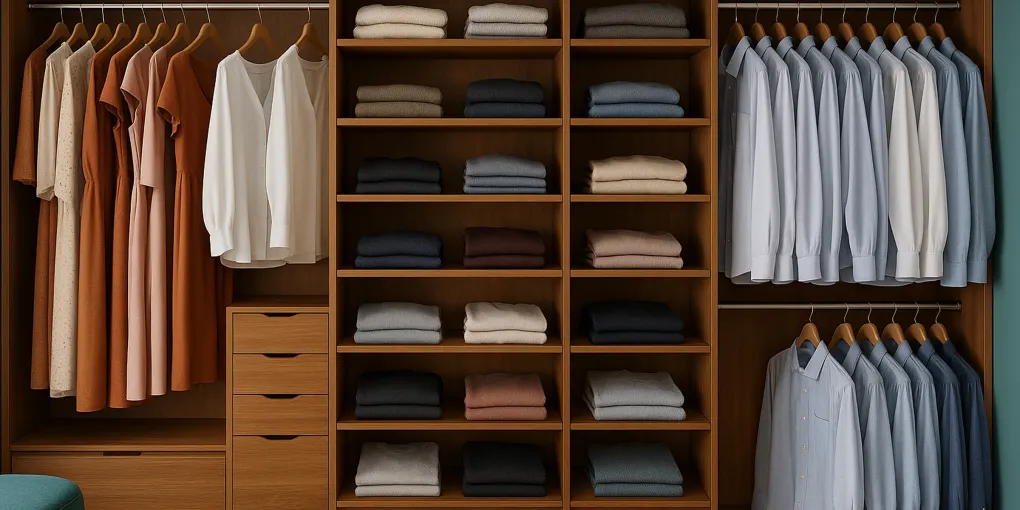
Best Walk-In Closet Systems 2026
Buyer's GuideClosetMaid SuiteSymphony 25-inch Starter Unit
Best Modular SystemType: Wall-mounted modular
$100–150
Quick picks
| Product | Key Specs |
|---|---|
| See price on Amazon |
|
| See price on Amazon |
|
| See price on Amazon |
|
Product availability, certifications, and retailer details can change; check the current Amazon page before buying.
Best Walk-In Closet Systems 2026
A walk-in closet should be one of the most functional rooms in a home—but without intentional organization, walk-in closets often become oversized holding areas where clothing and accessories pile up in a way that makes everything harder to find than it would be in a well-organized reach-in. The core problem is empty space without structure: without shelves, rods, and zones placed thoughtfully, a large space doesn’t help—it just gives clutter more room to spread out.
A walk-in closet system provides that structure. Whether through a wall-mounted modular configuration that covers an entire wall with a mix of shelves and rods, a freestanding wardrobe that requires no installation, or a stackable cube system that can be configured in multiple orientations, the right system transforms a cluttered walk-in into a functional wardrobe. This guide covers the three strongest options across budget and installation requirements, with scoring on capacity, material quality, ease of setup, and long-term value.
ClosetMaid SuiteSymphony 25-inch Starter Unit — Best Modular System
Best for: Homeowners who want a permanent, expandable wall-mounted system with a professional appearance and long-term configurability
The ClosetMaid SuiteSymphony system starts with a 25-inch laminate wood starter unit that mounts to the wall and includes adjustable shelf positions, a hanging rod, and mounting hardware. Its defining advantage is expandability: tower add-on units can be attached to the left or right side of the starter unit to extend the total configuration as far as the wall allows. A single starter unit addresses a modest section; a full wall build with multiple towers and mixed shelf-and-rod configurations covers an entire walk-in closet.
Amazon verified purchaser reports from homeowners who have built complete walk-in closet systems around the SuiteSymphony consistently praise the finished appearance—the laminate panels and adjustable shelves produce a look that approaches custom cabinetry at a fraction of the price. User community synthesis confirms that the system is genuinely DIY-installable for a competent home improvement hobbyist with a drill and level, though a full wall build takes most of a day and benefits from having two people for alignment. The adjustable shelf positions allow configurations to evolve as wardrobe composition changes over time.
What Works
- Expandable modular design allows incremental build-out as budget allows
- Laminate wood panels produce a polished, custom-closet appearance
- Adjustable shelf positions allow reconfiguration without reinstalling the system
- Wall-mounting provides the highest structural integrity and weight capacity
- Compatible with an extensive range of ClosetMaid add-on accessories and towers
Trade-offs
Wall installation is required—not renter-friendly. A full walk-in closet build requires multiple starter units and add-on towers, which increases the total cost significantly beyond the starter unit price. Laminate construction, while attractive, is not as impact-resistant as solid wood if heavy items are dropped against the panels. The starter unit only covers a 25-inch section; budgeting for the complete configuration requires planning.
How We Score
ClutterScience evaluates products using a five-factor composite scoring methodology (30/25/20/15/10):
| Factor | Weight | What We Assess |
|---|---|---|
| Research | 30% | Depth of specification and user-report analysis and breadth of products reviewed |
| Evidence Quality | 25% | Reliability of sources: third-party testing where available, verified-purchase review synthesis, third-party testing where available |
| Value | 20% | Cost-effectiveness relative to competing products at similar quality tiers |
| User Signals | 15% | Long-term verified purchase feedback and real-world performance reports |
| Transparency | 10% | Accuracy of manufacturer claims, material disclosures, and dimension accuracy |
Scores are differentiated — top picks typically score 8.5–9.5, mid-tier 7.0–8.4, and weak options below 7.0.
Scoring
| Criterion | Weight | Score |
|---|---|---|
| Capacity & Dimensions | 30% | 9.2/10 |
| Material Quality | 25% | 9.0/10 |
| Ease of Assembly & Use | 20% | 7.2/10 |
| Long-Term Value | 25% | 9.5/10 |
| Composite Score | 8.9/10 |
Pricing
$100–150 per starter unit. Complete wall builds require additional tower add-ons; total system cost depends on closet size and configuration.
Simple Houseware Freestanding Closet Wardrobe — Best Budget System
Best for: Renters; anyone who wants immediate walk-in closet capacity with zero installation and maximum portability
The Simple Houseware Freestanding Closet Wardrobe is a steel-frame, fabric-covered freestanding unit with a hanging rod, upper shelf, and optional additional shelf tiers. It stands on the closet floor without any wall mounting, sets up in under 30 minutes with no tools, and can be disassembled and moved easily—making it the top choice for renters or households that anticipate moving in the near future. Multiple units can be placed side by side to cover more wall space in a larger walk-in closet.
Amazon verified purchaser reports consistently note that this is the right product for situations where the primary goal is functional capacity quickly and the constraints are budget or renter status. The steel frame is stable for a freestanding unit, and the fabric cover keeps dust off stored clothing. User community synthesis indicates the weight capacity per shelf is adequate for folded clothing and lighter accessories, though it is not designed for heavy storage boxes or dense knitwear collections.
What Works
- Requires no wall installation—ideal for renters and frequent movers
- Sets up in under 30 minutes with no tools
- Hanging rod included for immediate clothes storage
- Steel frame provides reasonable stability for freestanding use
- Multiple units can be placed side by side for expanded capacity
Trade-offs
Fabric-frame construction is less durable than laminate wood or plastic modular systems over a multi-year timeline. Weight capacity per shelf is limited compared to wall-mounted alternatives. Freestanding design is less stable than wall-anchored systems—not suitable for closets where the unit might be bumped or jostled repeatedly. The appearance, while functional, is less polished than the ClosetMaid laminate alternative.
Scoring
| Criterion | Weight | Score |
|---|---|---|
| Capacity & Dimensions | 30% | 7.8/10 |
| Material Quality | 25% | 6.8/10 |
| Ease of Assembly & Use | 20% | 9.5/10 |
| Long-Term Value | 25% | 6.5/10 |
| Composite Score | 7.6/10 |
Pricing
$50–75. Best budget entry point for immediate walk-in closet hanging and shelf capacity.
IRIS USA Modular Stackable Closet Unit — Best Stackable
Best for: Folded clothing storage; shoes; accessories; households that want a modular unit that can be reconfigured and expanded over time without wall mounting
The IRIS USA Modular Stackable Closet Unit is a resin/plastic module that can be stacked vertically and connected horizontally to create custom configurations of open shelves and drawers. Unlike both the ClosetMaid wall-mounted system and the Simple Houseware fabric wardrobe, the IRIS unit focuses on shelf and drawer storage rather than hanging capacity, making it the best choice for walk-in closets that need organized folded clothing, shoe storage, or accessory drawers.
Amazon verified purchaser reports highlight the modular flexibility as the primary advantage—users can start with two stacked units and add more as their organization needs grow, in whatever configuration fits the available closet floor space. User community synthesis notes that the resin/plastic construction is more durable than fabric alternatives and maintains its structure under heavier loads than soft-frame organizers, though it is not as structurally robust as the wall-anchored ClosetMaid system.
What Works
- Modular resin construction is more durable than fabric alternatives
- Stackable vertically and connectable horizontally for custom configurations
- Dedicated shelf and drawer focus organizes folded clothing and accessories efficiently
- No wall mounting required—renter-friendly and fully portable
- Individual modules can be purchased incrementally as budget allows
Trade-offs
No hanging rod included—requires a separate rod solution for hanging clothes, which may mean pairing with a rod extender or separate wardrobe. Resin construction is more prone to cracking under impact than laminate wood. The modular design, while flexible, requires alignment attention during assembly to prevent stacks from being uneven.
Scoring
| Criterion | Weight | Score |
|---|---|---|
| Capacity & Dimensions | 30% | 8.5/10 |
| Material Quality | 25% | 8.0/10 |
| Ease of Assembly & Use | 20% | 8.2/10 |
| Long-Term Value | 25% | 8.2/10 |
| Composite Score | 8.2/10 |
Pricing
$60–90 per unit. Incrementally expandable; total system cost depends on number of units purchased.
Head-to-Head Comparison
| Feature | ClosetMaid SuiteSymphony | Simple Houseware Wardrobe | IRIS USA Stackable |
|---|---|---|---|
| Type | Wall-mounted modular | Freestanding fabric | Stackable modular |
| Material | Laminate wood | Steel + fabric | Resin/plastic |
| Hanging Rod | Yes (adjustable) | Yes (included) | No (add separately) |
| Renter Friendly | No | Yes | Yes |
| Price Range | $100–150/unit | $50–75 | $60–90/unit |
| Composite Score | 8.9/10 | 7.6/10 | 8.2/10 |
Who Should Choose Which
Choose ClosetMaid SuiteSymphony if you’re a homeowner planning a long-term walk-in closet investment. The modular wall-mounted design, expandability, and finished appearance justify the higher cost and installation effort for anyone who expects to live in the same home for several years.
Choose the Simple Houseware Freestanding Wardrobe if you’re renting, planning to move, or need an immediate solution with zero installation. Multiple units can expand capacity as budget allows, and the entire system can be disassembled and relocated.
Choose IRIS USA Stackable if the primary need is organized shelf and drawer storage for folded clothing, shoes, and accessories—not hanging capacity. The modular resin construction is more durable than fabric alternatives and provides better long-term value for drawer-heavy configurations.
Planning a Walk-In Closet System from Scratch
A walk-in closet system performs best when the physical products are matched to a thoughtful zone layout rather than purchased and placed randomly. Evidence from home organization research suggests that the most effective closets divide the space into dedicated zones that match the specific composition of a household’s wardrobe.
Start with a full wardrobe inventory. Pull everything out of the walk-in closet and group items by category: long-hanging (dresses, coats, full-length pants), short-hanging (shirts, blazers, jackets, folded trousers), folded items (sweaters, t-shirts, jeans), shoes, accessories (belts, scarves, bags), and infrequently used items (seasonal clothing, formalwear). Count roughly how many of each you have. This inventory drives the proportion of each zone type in the final layout.
Allocate zone proportions based on actual wardrobe composition. A wardrobe that is 60% hanging and 40% folded needs roughly that proportion of rod versus shelf space. The most common mistake is buying equal amounts of each when the actual wardrobe is heavily skewed toward one category. The inventory step prevents this.
Design around the door and existing fixed elements. Every walk-in closet has a door and likely has electrical outlets or light fixtures that can’t be moved. Designing the closet layout around these fixed elements—leaving clearance at the door, placing systems on the best available walls—prevents the frustration of installing a system and then realizing a door swing or outlet conflicts with it.
Plan for future growth. The best modular systems allow add-ons as the wardrobe grows or as budget increases over time. Designing the first phase to leave room for at least one or two future add-on units prevents the need to disassemble and reconfigure when expansion becomes necessary.
Our comprehensive best closet organization systems guide covers complete walk-in closet planning in more detail, including zone design templates and how to mix and match modular systems for different closet sizes and shapes. For the floor zone, see our best shoe storage solutions guide for dedicated shoe rack and display options.
Frequently Asked Questions
What is the difference between a modular closet system and a freestanding wardrobe?
A modular closet system typically wall-mounts or anchors to the wall, uses solid panels, and can be expanded with additional units over time. It’s more permanent, more structurally stable, and generally higher capacity. A freestanding wardrobe or fabric-frame unit requires no wall mounting and can be moved, but has lower weight capacity and is less customizable. Modular systems suit homeowners planning a long-term closet build; freestanding units suit renters or those who want a quick, reversible solution.
How do I plan a walk-in closet layout before buying a system?
Start by measuring the entire walk-in closet—length, width, and ceiling height—and sketching a basic floor plan. Identify where the door is, where any windows or outlets are, and what your primary storage needs are (mostly hanging, mostly folded, or a mix). Designate zones for long hanging (full-length dresses and coats), short hanging (shirts and jackets), folded items (shelves), shoes, and accessories. Most modular systems allow you to mix hanging and shelf sections, so a layout sketch prevents over-buying in one category.
Can I install a closet system myself or do I need a professional?
Most consumer-grade closet systems—including ClosetMaid SuiteSymphony—are designed for DIY installation. Wall-mounted systems require a drill, stud finder, and level, and installation typically takes half a day for a standard walk-in. Freestanding and stackable systems require no tools at all. Professional installation is worth considering for large, custom-configured systems or for anyone who wants a guarantee on alignment and weight safety.
How much does a good walk-in closet system cost?
Entry-level systems (freestanding or basic modular starter units) range from $50–150 and cover a single wall or zone. Mid-range complete walk-in systems that include multiple wall configurations, drawers, and adjustable rods typically range from $300–600. High-end custom systems from specialty retailers can cost $1,000–3,000 or more. The products reviewed here represent the entry-to-mid range, where the best value-to-performance ratio exists for most households.
Bottom Line
The ClosetMaid SuiteSymphony is the best long-term investment for homeowners who want a professional-quality walk-in closet—the modular expandability and laminate finish produce results close to a custom closet at a fraction of the cost. The IRIS USA Stackable is the best renter-friendly alternative that provides genuine durability and flexibility without wall mounting. The Simple Houseware Wardrobe is the budget and mobility leader for situations where portability matters most.
For a complete closet organization plan, our best linen closet organizers guide covers how to organize the adjacent linen storage that typically pairs with a primary walk-in wardrobe.