Floating Shelves vs Bookcases: Capacity, Cost, and Best Rooms (2026)
Buyer's GuideHeavy-duty floating shelf set
Best for light displayBest for: Decor, plants, small baskets
$25–70 per set
Quick picks
| Product | Key Specs |
|---|---|
| See price on Amazon |
|
| See price on Amazon |
|
| See price on Amazon |
|
Product availability, certifications, and retailer details can change; check the current Amazon page before buying.
Floating Shelves vs Bookcases: The Core Trade-Off
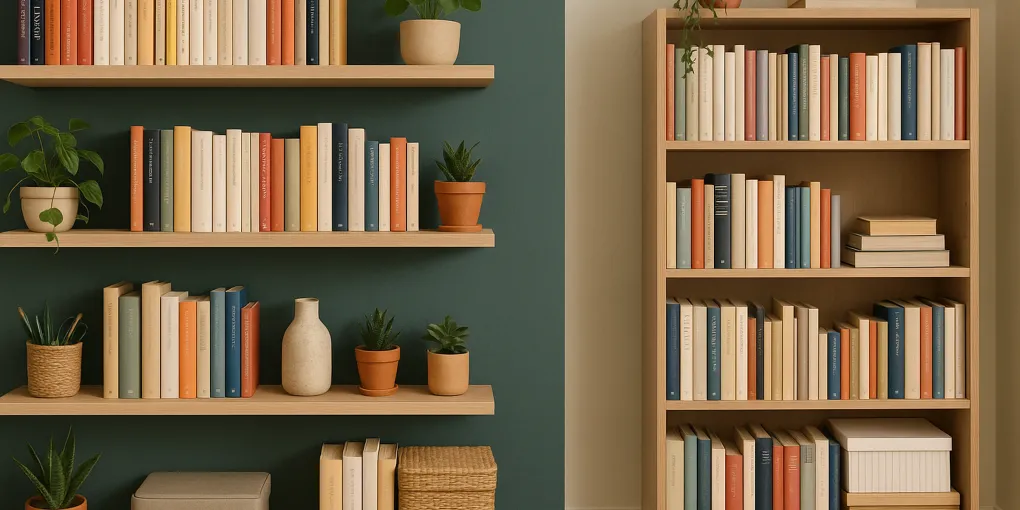
Two of the most common solutions for book, display, and general storage in living rooms represent genuinely different philosophies about how space should be used. Floating shelves treat walls as prime real estate to be activated; bookcases treat floor space as the substrate for portable, flexible storage. Both approaches work—but they serve different people, different spaces, and different organizational goals.
The psychology here draws on research into spatial cognition and perceived room size. Studies in environmental psychology consistently show that keeping floor space open makes rooms feel larger, while wall-mounted storage that draws the eye upward increases perceived ceiling height. Floating shelves, by definition, keep the floor clear and emphasize vertical space. This makes them psychologically significant in small rooms where spatial anxiety is a real factor in how comfortable people feel day to day.
Bookcases, on the other hand, offer what organizational researchers call cognitive chunking—they group a large volume of items into a single, bounded unit that the brain processes as one “organized object.” A wall of floating shelves, even neatly arranged, requires more visual processing than a freestanding bookcase because the brain must track each shelf individually. This is why heavily loaded floating shelf walls can feel visually busy even when each shelf is organized, while a single bookcase loaded with the same items reads as “one organized piece of furniture.”
Neither is inherently better. The right choice depends on floor space availability, wall construction, aesthetic goals, and how frequently the storage arrangement needs to change.
Floating Shelves: What They Are and When They Win
Floating shelves are wall-mounted shelves without visible brackets—the hardware is either concealed within the shelf or uses a hidden ledger board system. They appear to “float” off the wall, creating a clean, architectural look that integrates storage directly into the room’s structure.
The primary advantage of floating shelves is floor space preservation. In small apartments, narrow hallways, and compact bedrooms, every square foot of floor space matters. Floating shelves add storage capacity using vertical wall space that would otherwise be unused, without requiring any floor footprint. A wall of floating shelves in a 10x10 bedroom might add 30+ linear feet of storage capacity without consuming a single square foot of walking space.
Floating shelves also offer aesthetic flexibility that bookcases can’t match. You can install them at any height, in any width configuration, in asymmetric arrangements, around windows and doorways, and in combinations that suit the specific proportions of your room. For homeowners who want storage to feel architectural—like it was designed into the house rather than added as furniture—floating shelves are the superior choice.
The ability to install floating shelves at any height is also practically significant. Very high shelves for rarely accessed items, mid-height shelves for daily use, and low shelves for children’s reach can all coexist on the same wall. Bookcases fix all shelves within a finite height range determined by the unit’s size.
Floating shelves excel in rooms where display and decoration is as important as storage. Framed photos, plants, candles, small sculptures, and decorative objects all look best on floating shelves where the open sides and clean face create a gallery-like presentation. A bookcase puts a frame around everything; floating shelves give items room to breathe against the wall.
The main limitations: floating shelves require wall installation (and therefore wall damage), have lower individual weight capacity than bookcases, are permanent or semi-permanent, and become problematic in rental situations or for people who reorganize frequently.
Bookcases: What They Are and When They Win
Freestanding bookcases come in every size from compact 3-shelf units to floor-to-ceiling library walls. They stand on their own, require no wall installation (though anchoring is recommended for tall units), and can be moved when you reorganize or relocate.
The defining advantage of bookcases is total storage volume per dollar. A quality 5-shelf bookcase in the $100–$200 range holds an enormous quantity of books, binders, baskets, and storage boxes. To match its capacity with floating shelves, you’d spend more on hardware alone, before accounting for installation time. For volume storage, bookcases offer better value.
Bookcases are also portable and non-damaging. In rental apartments, homes undergoing renovation, or households that reorganize frequently, bookcases can be relocated, reconfigured, or removed without touching the walls. This flexibility is operationally significant—a new bookcase can be in a different spot next week without any patching, painting, or remounting.
For renters specifically, bookcases are often the only practical option for significant storage capacity. Floating shelf installation in rental situations creates wall damage that may affect security deposits, while a bookcase leaves no permanent trace.
Bookcases also work well in kids’ rooms and home offices where high-volume storage is more important than aesthetics. A bookcase lined with baskets, binders, and toy bins stores far more than a set of floating shelves in the same wall footprint. The contained structure of a bookcase also makes it easier to implement categorization systems—each shelf can be assigned a category, and the visual boundaries of the unit reinforce the organization.
For serious book collections, a well-made bookcase with adjustable shelves and proper shelf depth (at least 10 inches for standard books) is simply more practical than floating shelves. Books need support along their full length to avoid warping; deep floating shelves can provide this, but the installation effort and cost scales up dramatically for book-weight loads.
Head-to-Head Comparison
| Feature | Floating Shelves | Bookcases |
|---|---|---|
| Cost | $30–$200+ per shelf | $60–$500+ per unit |
| Floor space used | None | 12–18 inches deep footprint |
| Wall damage | Yes (mounting holes) | None (if freestanding) |
| Total capacity | Variable (installation-limited) | High (400+ lbs for large units) |
| Best for | Display, small rooms, aesthetics | Volume storage, renters, flexibility |
| Installation difficulty | Moderate to hard | Easy (unbox and place) |
| Adjustability | Fixed once installed | Shelf heights often adjustable |
When to Choose Floating Shelves
Choose floating shelves when floor space is genuinely scarce. Studio apartments, small bedrooms, narrow hallways, and home offices in converted rooms all benefit from the floor-clearance advantage floating shelves provide. When every square foot of floor counts, wall-mounted storage is the rational choice.
Choose floating shelves when aesthetics are a primary concern and the storage will be in a prominently visible location. A curated wall of floating shelves in a living room or dining area is a design statement that a freestanding bookcase can’t replicate. The architectural integration of floating shelves communicates intentional design rather than furniture placement.
Floating shelves also make sense when you need custom configurations around architectural features: above windows, flanking fireplaces, following staircase angles, or spanning large wall areas in asymmetric arrangements. Bookcases are confined to rectangular footprints; floating shelves follow the room’s geometry.
If you own your home and plan to stay for several years, floating shelves are a worthwhile investment. They improve the space, can add resale value when well-executed, and provide storage that integrates with the architecture rather than sitting in front of it. Our best bedroom shelf organizers article covers floating shelf options tailored to bedroom use, including narrow profiles ideal for tighter spaces.
When to Choose Bookcases
Choose a bookcase when maximum storage volume is the priority and floor space is available. For book collections, a home office with binders and reference materials, or a playroom with a large toy and game collection, a bookcase’s volume-per-dollar advantage is decisive.
Choose a bookcase when portability matters. Renters, people who move frequently, and households that reorganize regularly all benefit from furniture-based storage over wall-mounted storage. A bookcase can follow you to a new apartment without leaving marks on the walls.
Bookcases are also the right choice when you’re uncertain about the final arrangement. New homeowners settling in, parents whose children’s storage needs are evolving, and anyone who’s still figuring out how they use a space should start with a bookcase that can be repositioned rather than floating shelves that commit to a specific layout.
For home offices, bookcases with adjustable shelf heights accommodate the full range of work-related storage: tall binders, short books, boxed equipment, and collections of smaller items. A floating shelf wall in a home office works beautifully but requires careful height planning that a bookcase sidesteps.
Consider our guide to best closet organization systems if you’re evaluating shelf options specifically for closet interiors—both shelf types have versions optimized for that context.
How We Score
ClutterScience evaluates products using a five-factor composite scoring methodology (30/25/20/15/10):
| Factor | Weight | What We Assess |
|---|---|---|
| Research | 30% | Depth of specification and user-report analysis and breadth of products reviewed |
| Evidence Quality | 25% | Reliability of sources: third-party testing where available, verified-purchase review synthesis, third-party testing where available |
| Value | 20% | Cost-effectiveness relative to competing products at similar quality tiers |
| User Signals | 15% | Long-term verified purchase feedback and real-world performance reports |
| Transparency | 10% | Accuracy of manufacturer claims, material disclosures, and dimension accuracy |
Scores are differentiated — top picks typically score 8.5–9.5, mid-tier 7.0–8.4, and weak options below 7.0.
Product Recommendations
Best Floating Shelves
Rustic State Wall Mounted Floating Shelves (Set of 3) $45–$65. Solid pine construction with a hand-finished rustic texture makes these shelves genuinely attractive rather than merely functional. Each shelf measures 24x5.5 inches and comes with a full mounting hardware kit including a wall template. Rated for 30 lbs per shelf when stud-mounted—appropriate for books, plants, and display objects.
| Criterion | Weight | Score |
|---|---|---|
| Capacity & Dimensions | 30% | 7.5/10 |
| Material Quality | 25% | 8.8/10 |
| Ease of Assembly & Use | 20% | 8.2/10 |
| Long-Term Value | 25% | 8.5/10 |
| Composite Score | 8.2/10 |
AMADA HOMEFURNISHING Floating Shelves Set of 4 $38–$55. A budget-friendly set of four shelves in white melamine, ideal for living rooms, kitchens, or bathrooms needing consistent display storage. The hidden bracket system gives a truly seamless look. Each shelf holds up to 22 lbs. The white finish coordinates with virtually any paint color.
| Criterion | Weight | Score |
|---|---|---|
| Capacity & Dimensions | 30% | 7.0/10 |
| Material Quality | 25% | 7.2/10 |
| Ease of Assembly & Use | 20% | 8.5/10 |
| Long-Term Value | 25% | 7.0/10 |
| Composite Score | 7.4/10 |
Best Bookcases
IKEA Billy Bookcase (80x28x202cm) $80–$130. The Billy is the world’s best-selling bookcase for reasons that compound over time: adjustable shelf heights every 32mm, a 66-lb per shelf rating, expansion capability with add-on units, and clean lines that work in almost any room. The white and birch finishes coordinate broadly. Add-on doors and glass doors are available for a built-in look.
| Criterion | Weight | Score |
|---|---|---|
| Capacity & Dimensions | 30% | 9.5/10 |
| Material Quality | 25% | 8.0/10 |
| Ease of Assembly & Use | 20% | 7.8/10 |
| Long-Term Value | 25% | 9.2/10 |
| Composite Score | 8.8/10 |
Prepac 5-Shelf Bookcase $95–$140. This solid-looking bookcase in classic white or black laminate offers five fixed and adjustable shelves with a total weight capacity of 200 lbs. The clean, simple styling works in home offices, living rooms, and bedrooms. Assembly is straightforward with cam lock fasteners. Slightly deeper at 13 inches than average, which accommodates oversize books and storage boxes.
| Criterion | Weight | Score |
|---|---|---|
| Capacity & Dimensions | 30% | 8.8/10 |
| Material Quality | 25% | 8.2/10 |
| Ease of Assembly & Use | 20% | 8.5/10 |
| Long-Term Value | 25% | 8.5/10 |
| Composite Score | 8.5/10 |
The Verdict
Floating shelves and bookcases solve different problems, and the best choice comes down to three questions: How much floor space can you give up? Do you need portability? And is the aesthetic integration worth the installation effort?
Choose floating shelves when you’re optimizing a small or visually significant space, when the storage will be prominently displayed, and when you’re committed to a specific room layout. The investment in installation pays off in spaces you inhabit daily—a beautifully executed floating shelf wall in a living room is genuinely transformative.
Choose a bookcase when volume storage is the priority, when you rent or move frequently, when you’re still figuring out how you use the space, or when kids and high turnover make adjustability more important than aesthetics. A good bookcase is one of the most flexible pieces of storage furniture you can own.
For most living rooms, the ideal solution is both: one or two bookcases for volume storage (books, bins, baskets), supplemented by a curated set of floating shelves for display items and frequently accessed objects. The two types complement each other when used with intention.
Frequently Asked Questions
- A standard 36-inch floating shelf properly anchored into studs holds 50–80 lbs. A full bookcase with 5 shelves holds 200–400 lbs total. Bookcases offer substantially more total capacity, but floating shelves can be installed across an entire wall to match or exceed bookcase capacity.
- Yes, if properly installed into wall studs with rated hardware. Floating shelves anchored only into drywall are not safe for heavy loads—they will eventually pull out. Always locate studs or use toggle bolts rated for the expected load.
- Tall bookcases (over 48 inches) should always be anchored to the wall using anti-tip straps or L-brackets. Unanchored tall furniture is a significant safety hazard, especially in homes with children, and can cause serious injury if tipped.
- Floating shelves leave wall holes from mounting hardware. Stud-mounted shelves leave larger holes that require patching and repainting. For renters or those planning frequent reorganization, bookcases are preferable since they leave no wall damage.
- Floating shelves are generally better for small rooms because they don't occupy floor space, visually open the room by keeping the floor clear, and can be arranged to follow the room's lines. A bookcase in a small room can feel imposing, though a narrow vertical bookcase can work well too.