IRIS 6-Case Scrapbook Storage Cart Review: Is It Worth the Floor Space?
ReviewThe IRIS 6-case scrapbook storage cart is worth considering if your craft clutter is mostly flat: cardstock, scrapbook paper, vinyl sheets, stickers, school projects, or keepsake pages. It is less compelling for heavy tools or bulky supplies. Its real value is movable category separation, not maximum capacity.
Quick Verdict
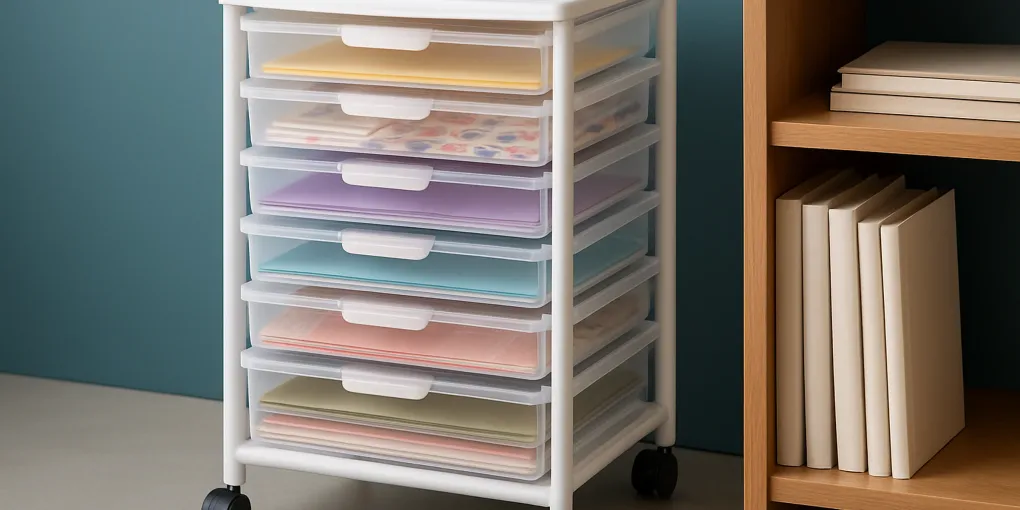
The IRIS 6-case scrapbook storage cart solves a common craft-room problem: flat materials are easy to damage when they are stacked loosely, but they become hard to access when stored in one deep bin. Six separate cases create category boundaries. The rolling frame makes the system movable. The clear case format makes inventory visible without opening every drawer.
That combination is useful for scrapbookers, Cricut users, teachers, parents managing school papers, and households that craft at a dining table rather than in a dedicated studio. The cart is not a magic craft-room fix. It will not hold every tool, and it should not become a heavy hardware cart. But for paper-heavy categories, it is a practical middle ground between loose piles and a full cabinet.
Because direct ASIN verification was not completed during drafting, this review uses a compliant fallback search link: IRIS 6 case scrapbook storage cartAffiliate link: we may earn a commission. This does not affect scoring..
What the Product Is Designed to Do
The cart is built around removable clear cases, typically used for scrapbook paper and flat craft supplies. Instead of one large drawer, each case acts as a separate project or category container. That is the main design advantage. You can pull one case to the table, work from it, then return it to the frame.
This format is especially helpful for supplies that spread: patterned paper, cardstock, sticker sheets, vinyl, stencils, flat labels, and unfinished pages. These items do not belong in deep baskets because they bend, hide, and mix. They also do not always need a permanent drawer cabinet. A case cart gives them a movable home.
The rolling frame is useful if the craft zone changes by day. Some households craft at the dining table, store supplies in a closet, and move everything out only during projects. A cart reduces setup friction. That matters because systems are more likely to last when the next action is easy.
Capacity and Dimensions: Best for Flat Categories
The capacity is strongest for flat, lightweight supplies. Think in layers rather than volume. One case can hold a color family of cardstock, one project in progress, one child’s school artwork category, or one vinyl type. If you mix too many categories in one case, you recreate the pile problem inside a prettier container.
Before buying, measure your largest flat supply. Many scrapbook products are based on 12x12-inch paper, but packaging, tab dividers, and project folders can add width. Also measure the storage location. A rolling cart needs parking space, handle clearance, and room to pull cases out.
The cart is not ideal for tall bottles, glue guns, punches, heat tools, or jars. Those items need vertical storage, drawers with more depth, pegboards, or open bins. If your craft clutter is mostly three-dimensional, a standard rolling utility cart may work better.
Material Quality and Durability Expectations
Clear plastic cases are useful because they show contents, but they can scratch, flex, or crack if overloaded. The frame should be treated as light-to-medium craft storage, not garage shelving. Dense stacks of paper get heavy quickly. Six cases packed with heavy cardstock will be harder to move than the product photo suggests.
The most likely wear points are case latches, case corners, wheels, and frame rails. For long-term value, the cart should roll smoothly on the flooring where you will actually use it. Hard floors are easier than thick carpet. If the cart will stay parked, wheel quality matters less. If it will move daily, wheel quality matters more.
Use labels even though the cases are clear. Clear visibility helps identify broad contents, but labels prevent category drift. A case labeled “blue cardstock” is easier to maintain than a case that quietly becomes blue paper, stickers, receipts, and random school photos.
Ease of Use: The Removable Case Is the Point
The removable cases are the strongest usability feature. You can bring one category to the work surface without dragging the whole cart into the room. That helps keep active projects bounded. Instead of spreading all paper across the table, you pull only the case needed for the current project.
The reset is also simple: return supplies to the same case, close it, and slide it back. If cleanup requires sorting through one giant bin, it often gets postponed. If cleanup means closing one labeled case, it is much more likely to happen.
The tradeoff is that cases can become over-specific or under-specific. Six categories is enough for many hobbyists but not enough for every possible craft supply. Start with broad categories: cardstock, patterned paper, vinyl, stickers, active projects, keepsakes. Adjust after two weeks of actual use.
Who Should Buy It
Buy it if your craft storage problem is mostly flat supplies, if you need supplies to move between rooms, or if you want project cases that can come off the cart. It is a strong fit for scrapbook paper, kids’ art in progress, classroom materials, card-making supplies, sticker sheets, vinyl sheets, and lightweight keepsakes.
It is also a good fit for small homes where a permanent craft cabinet is unrealistic. The cart can live in a closet and roll out for project time. That makes it more useful than a beautiful shelf that is too far from the actual work area.
Who Should Skip It
Skip it if your main supplies are heavy tools, paint bottles, clay, sewing machines, large punches, or bulky yarn. Those categories need different storage geometry. Skip it if you need archival storage for irreplaceable photos or documents; clear craft cases may be useful for sorting, but long-term archival storage requires more careful material choices.
Also skip it if you are trying to hide craft supplies in a formal room. The cart is functional, not furniture-like. If it will live in a living room full time, a closed cabinet or storage ottoman may fit the space better.
Scoring Breakdown
ClutterScience scores the product using capacity and dimensions, material quality, ease of assembly and use, and long-term value.
| Criterion | Score | Notes |
|---|---|---|
| Capacity & dimensions | 8/10 | Strong for flat 12x12-style supplies, weaker for bulky tools |
| Material quality | 7/10 | Clear cases are useful but should not be overloaded |
| Ease of assembly & use | 8/10 | Removable cases make setup and reset easier |
| Long-term value | 8/10 | Good if it replaces piles and protects flat materials |
| Composite score | 7.8/10 | Best for paper-heavy craft storage, not universal craft storage |
The score is high but not perfect because the format is specialized. For the right household, specialization is the point. For the wrong household, it becomes a cart full of supplies that never quite fit.
Comparison: Cart vs Shelf vs Utility Cart
| Storage option | Best for | Weakness |
|---|---|---|
| IRIS 6-case scrapbook cart | Flat paper categories and movable projects | Limited bulky-tool storage |
| Fixed shelf with paper trays | Permanent craft rooms | Less portable |
| Three-tier utility cart | Bottles, tools, mixed supplies | Flat paper can bend or disappear |
| Filing cabinet or flat file | Archival paper and high-volume sheets | Larger footprint and higher cost |
A fixed shelf is better if supplies never move. A utility cart is better for bottles and tools. A flat file is better for high-volume or archival paper. The IRIS cart earns its place when removable flat cases are more useful than maximum capacity.
Setup Tips
Label each case before filling it. Put the label on the front edge so it is visible while cases are in the frame. Use broad categories first. If one category overflows, split it. If two categories stay half-empty, combine them.
Keep a strict “active project” case. That case holds only the current project, not every unfinished project in the house. When a project pauses, return unused supplies to category cases and keep the project parts together. This prevents the cart from becoming a time capsule of abandoned hobbies.
Do a monthly reset. Remove paper scraps, recycle packaging, return stray tools, and check whether the categories still match how you craft. Craft systems drift quickly because projects change. The cart should adapt without becoming miscellaneous storage.
Safety and Placement
Park the cart where it will not block a walkway. Keep heavier cases low. Do not let children climb or pull on the frame. If the cart lives in a closet, leave room to roll it out without scraping walls or tipping other items.
If you use sharp tools, adhesives, or heat tools, store them separately and safely. This cart is for organizing categories, not for making hazardous items child-safe.
Long-Term Organization Strategy
The cart works best when every case has a category that can be reset without thinking. Good labels include “cardstock,” “patterned paper,” “vinyl,” “stickers,” “active project,” and “school keepsakes.” Weak labels include “miscellaneous,” “craft stuff,” and “later.” A miscellaneous case may be useful for one week, but if it becomes permanent, it will absorb the whole cart.
Use color or project dividers inside cases only when they reduce retrieval time. Too many subcategories can make cleanup slower. The sweet spot is usually one broad category per case with a small divider for active scraps. If a case takes longer than a minute to reset, the category is too broad or the case is too full.
For families, assign ownership. One case can belong to a child, one to a parent project, and one to shared supplies. Shared carts fail when nobody knows who is allowed to edit which case. A simple label solves that social friction.
Value Compared With Buying More Supplies
Craft clutter often feels like a supply shortage when it is really an inventory problem. Paper gets buried, duplicate stickers get bought, and unfinished projects disappear under new materials. A case cart can save money by making inventory visible and by protecting flat supplies from bending.
The value is strongest if it changes how you shop. Before buying more cardstock or vinyl, pull the relevant case and check what you already own. If the cart becomes part of the shopping routine, it pays back more than a generic bin. If it sits in a closet unopened, it is just another container.
The cart should also reduce project setup time. If starting a card-making session means finding paper in one drawer, stickers in another, and scraps under a pile, the hobby feels heavier. A removable case lowers that activation energy, which is often the difference between using supplies and storing aspirations.
How We Score This Review
ClutterScience uses a 30/25/20/15/10 composite score for reviews: research fit 30%, evidence quality 25%, functional value 20%, user signals 15%, and transparency 10%. For the IRIS 6-case scrapbook cart, capacity, case access, rolling stability, and realistic floor-space tradeoffs matter more than a tidy product photo.
Frequently Asked Questions
What fits in the IRIS 6-case scrapbook storage cart?
It works best for flat supplies: scrapbook paper, cardstock, vinyl sheets, stickers, stencils, school projects, and lightweight keepsakes. Bulky tools and bottles usually need a different organizer.
Is the IRIS scrapbook cart good for heavy supplies?
It is better for light-to-medium paper categories than dense heavy tools. Heavy supplies can make the cases harder to slide and may stress the frame or wheels.
Is a scrapbook storage cart better than a shelf?
A cart is better when supplies move between rooms or projects need removable cases. A shelf is better for a permanent craft room with heavier supplies and higher capacity needs.
Bottom Line
The IRIS 6-case scrapbook storage cart is a good buy for flat, paper-heavy craft clutter. Its value comes from removable cases, visible categories, and mobility. Skip it for heavy tools or bulky supplies, and use it only if the floor space is worth the easier setup and reset.
Frequently Asked Questions
- The cart is designed around flat scrapbook-style cases, so it works best for 12x12 paper, cardstock, vinyl sheets, sticker sheets, school projects, and flat craft categories.
- It is better for paper and light craft categories than heavy tools. Dense items can make clear cases harder to slide and may stress the frame over time.
- A cart is better when supplies need to move between rooms. A shelf is better when you want maximum stability, higher weight capacity, and a permanent craft zone.