Mail Triage Station Countertop Protocol
ProtocolA counter-friendly mail triage protocol that turns daily paper into action, archive, recycling, or outbound tasks. This guide uses a small-test approach: make the next action visible, keep capacity honest, and buy only when a specific friction point is proven.
Use this with our weekly home reset station when mail is one part of a household reset, and review why label systems fail before naming slots in private shorthand.
G6 Composite Score
For mail triage, prioritize visible action categories, a short review loop, recycling access, bill/payment separation, and a spot that does not swallow the whole counter.
| Score Component | Weight | How it applies here |
|---|---|---|
| Research | 30% | reduces visual competition and unfinished decisions |
| Evidence Quality | 25% | uses observable behavior, capacity limits, and reset cues |
| Value | 20% | prioritizes inexpensive fixes before specialized products |
| User Signals | 15% | addresses common household failure points |
| Transparency | 10% | names tradeoffs, returns, and maintenance needs |
Quick Picks
Only add countertop tools after a dry run shows which paper step repeatedly jams: sorting, shredding, outbound returns, bills, or filing.
The first useful product is usually the one nearest the exit path, not the one with the most compartments. Put recycling beside the sorter before adding extra slots; then add one tool only when a paper category still waits after the daily sort.
| Shop this option | Useful item | When it helps |
|---|---|---|
| Search Amazon | Vertical mail sorter | incoming categories need to be visible; avoid it if deep pockets hide old paper |
| Search Amazon | Slim paper tray set | short-term action papers need a boundary; avoid it if the stack grows above one week |
| Search Amazon | Desktop shred bin | sensitive junk mail blocks recycling; avoid it if children can access it unsafely |
| Search Amazon | Label tabs for sorters | shared labels need to be readable; avoid it if categories change too often |
Capture Mail at the First Landing Point
When letters land on the counter because the real file cabinet is too far away, use a smaller category.
The first station is not a permanent archive. It is a decision ramp. Keep it shallow, visible, and close to recycling so junk mail exits immediately.
Use Action Labels Instead of Storage Labels
When paper piles grow because every item looks important enough to keep, move the cue closer.
Good labels include pay, sign, schedule, file, shred, recycle, and outbound. Bad labels include later, important, or household. Action labels make the next step visible even when you are tired.
Build the Weekly Paper Block
When a daily sort creates neat piles but not finished tasks, rename the landing spot.
Choose one weekly block for paying, scanning, filing, and calendar updates. Keep the block short enough to complete. If it takes more than 30 minutes, the categories are too broad or the station is holding too much archival paper.
Product Placement
When a large desktop organizer becomes a decorative paper warehouse, rename the landing spot.
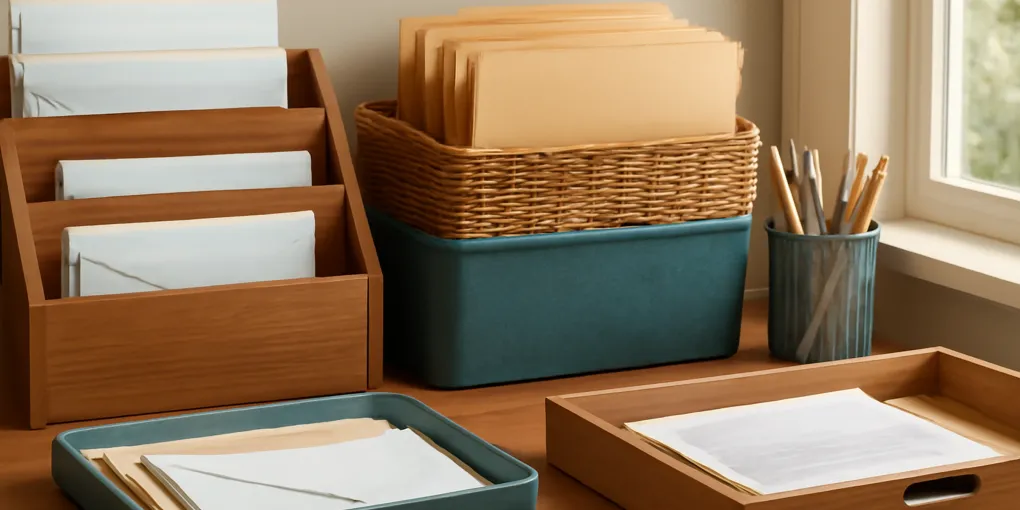
A vertical sorter, slim paper tray, label tabs, and small shred bin are enough for most homes. Avoid expanding capacity before the weekly block works. More slots can hide procrastination instead of solving it.
Failure Modes
When coupons, school forms, bills, and returns share one pile, rename the landing spot.
If papers disappear, the station is too hidden. If papers overflow, the weekly block is missing. If nobody uses it, the category names are private knowledge. Rewrite labels in household language and remove one slot.
Privacy, Returns, and School Papers
Mail stations fail when they mix private documents with public household reminders. Put sensitive papers in a covered action folder or a vertical slot facing away from guests. Keep recycling and shredding close enough that junk mail leaves on the first pass. If a paper needs a password, account number, or signature, it belongs in the weekly action slot rather than an open tray.
Returns need their own micro-category because they combine paper, packaging, and deadlines. Use a small outbound basket for return labels, receipts, and items waiting to leave the house. Place it near the door only after the return is packed; otherwise it becomes another entryway pile.
School papers deserve a different path from bills. Permission slips and event notices are calendar tasks first and archives second. Put the date on the calendar, sign the form, and return it to the backpack or outbound slot before deciding whether the paper deserves longer-term storage.
Paper Categories to Avoid
Avoid creating a slot called maybe, later, or ask someone. These names preserve indecision and make the station look organized while work remains unfinished. If a paper cannot be assigned in ten seconds, create a temporary question folder and empty it during the weekly block. The folder is a tool for decisions, not a permanent archive.
Two-Minute Daily Sort
The daily sort has only four moves: recycle junk, place bills or forms in action, put reference papers in file, and move outgoing items to outbound. Stop there. Paying bills, scanning documents, and making calls belong to the weekly block. Separating sorting from action keeps the station from feeling too heavy to start.
If the daily sort takes longer than two minutes, the station is holding old work. Empty the oldest slot first and reduce the number of categories until the first pass feels easy again.
Digital Backup Without Scanning Everything
Not every paper deserves a scan. Scan or photograph documents that are hard to replace, connected to a deadline, or needed away from home. Recycle or file routine notices after their action is complete. A scanning habit that tries to capture everything usually collapses because the queue becomes too large.
Use calendar entries for dates, not paper piles. A school concert flyer, renewal notice, or pickup reminder should become a calendar item first. The paper can then be recycled, filed, or placed in outbound if it must travel. This one move removes many papers from the counter without losing the information.
For shared households, write the weekly paper block on a visible calendar. Paperwork systems fail when one person silently owns every decision. A visible block tells everyone when forms, bills, and returns will be handled, which reduces repeated reminders and last-minute searches.
Weekly Review Checklist
During the weekly paper block, start with deadlines. Pay or schedule bills, sign forms, add dates to the calendar, and package returns. Then file documents that truly need retention. End by emptying recycling and shredding so the station begins the next week with spare capacity.
Keep the checklist visible inside the sorter or under the top tray. The point is not to create office bureaucracy; it is to remove the small decisions that make paper feel heavier than it is. A consistent checklist makes the station usable even after a chaotic week.
Decision Notes Before Checkout
Choose mail-station gear for the paper step that actually breaks: a visible bill slot when payments miss the weekly block, a signature tray for school forms, an outbound tray for return labels, or a nearby shred bin when sensitive junk mail blocks recycling. If the problem is only “mail clutter,” start with recycling access and one action slot before adding more compartments.
Measure the counter footprint, cabinet clearance, paper-tray depth, and distance to recycling before buying. A sorter that looks compact online can still steal prep space, and a tray that only works with perfectly squared paper will fail after one busy mail day.
Practical Measurement
Photograph the counter before mail arrives and after the two-minute sort. The useful evidence is whether junk mail exited, bills reached action, outbound items stayed visible, and reference papers stopped spreading across the kitchen.
Leave at least one empty slot or tray-height buffer for the day a school form, insurance notice, and return label arrive together. If every paper category is full immediately, the next envelope will land beside the station and restart the pile.
Purchase Timing
Wait to buy until the same mail problem repeats twice. If sensitive junk mail blocks recycling, add a shred bin; if bills disappear, add one visible action slot; if returns drift, create an outbound tray near packing supplies rather than expanding the whole station.
Field Test
Paper systems improve when old decisions leave quickly. Put recycling within reach, keep the shred step small, and file only documents with a real retention reason. The station should not reward keeping every envelope just because it once looked important.
Example Reset Scenario
Picture the counter after a normal mail drop, a package return, and a school notice, not after an office-style cleanout. The next minute should be clear: recycle, shred, sign, pay, file, or move outbound.
The best mail-station products support that minute of decision. A plain vertical sorter and nearby shred bin can outperform a large organizer if they make old envelopes leave and urgent papers stay visible.
Final Selection Filter
If two mail organizers look similar, choose the one that makes discarding easiest and keeps only active decisions visible. Countertop paper systems fail when the product stores hesitation better than it supports the next action.
For mail specifically, choose the organizer that makes discarding easiest, not the one with the most slots. A small sorter plus nearby recycling can outperform a large command center because most incoming paper should leave the counter within minutes. Keep only active decisions in the station.
Before checkout, simulate one week with envelopes or sticky notes for each category. If the action slot cannot show the oldest deadline at a glance, the organizer is too deep. If the outbound area has no connection to tape, returns, or the door, it will stall. Buy for the handoff that actually fails, not for a fantasy command center with more labels than weekly decisions.
Evidence Notes
- Visual attention research such as McMains and Kastner’s work on clutter and attention supports keeping active counters free of competing paper piles.
- Home environment research by Saxbe and Repetti helps explain why unresolved mail can feel like unfinished household work.
- Implementation-intention research supports tying mail triage to fixed cues such as arriving home, trash day, or a weekly bill block.
- Product guidance here is based on paper flow, privacy, counter footprint, and exit routes, not brand sponsorship.
Bottom Line
A good mail station is a decision ramp, not a paper warehouse. It works when recycling, shredding, action, filing, and outbound tasks remain obvious after the first chaotic mail week.
Frequently Asked Questions
- Use action, pay, file, shred or recycle, and outbound categories; avoid broad piles labeled miscellaneous.
- Place it where mail first lands, not where you wish paperwork would happen, then keep the station small enough to reset weekly.
- A two-minute daily sort plus one weekly action block prevents the station from becoming another paper archive.