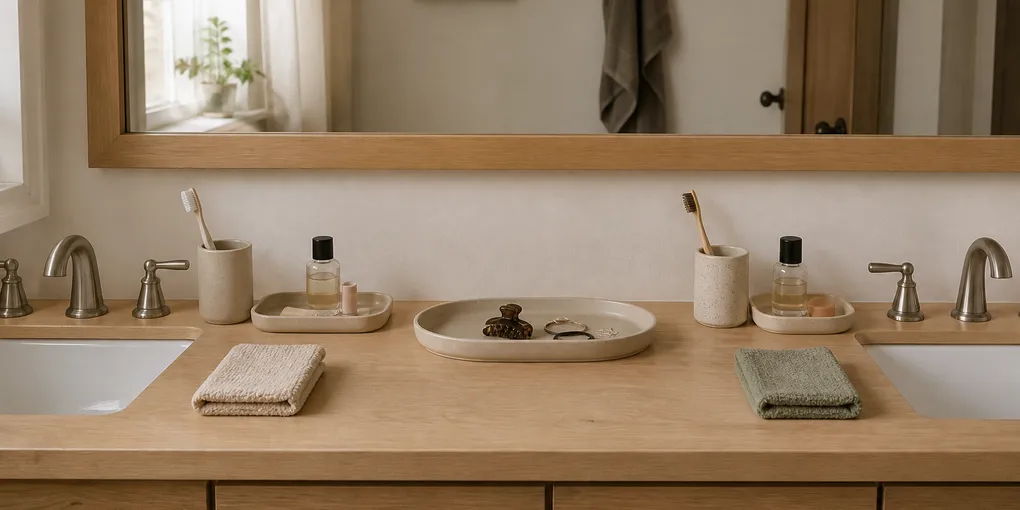
How to Divide a Shared Bathroom Counter into Useful Zones
ProtocolA shared bathroom counter works best when it stops being one unclaimed landing strip. Give each person one small daily-use zone, then place a single shared reset tray where both people can reach it. The first zone answers “where does my morning stuff go?”; the second answers “what needs to leave the counter before the next person arrives?”
That division is deliberately plain. It prevents an overflowing collection of bottles, clips, cords, and half-finished routines from becoming everybody’s problem without requiring matching containers or a decorative overhaul.
Start with the counter’s traffic pattern
Stand where each person usually uses the sink and look at the path from drawer or cabinet to mirror. The usable zone is the stretch that can be reached without crossing the other person’s sink, elbow room, or towel.
On a double vanity, that often means a left zone, a right zone, and a narrow center strip. On one long counter with a single sink, make the division by routine instead: one zone on each side of the sink, with the shared tray at the back or on the less-used end.
Do not begin by filling every bare inch. Leave a clear patch around the sink for ordinary use. A counter can look organized and still feel crowded when the daily items force someone to set down a toothbrush, hairbrush, or hand towel in a new place each time.
Give each person a daily-use boundary
Each personal zone needs a visible edge. A shallow tray, a small bin, or even a defined section of the counter can do the job. The boundary should be large enough for the few items used most days, not large enough to store every personal-care item in the bathroom.
Put the regular sequence inside that boundary. For one person, that might be a toothbrush cup, face wash, and a small bottle used every morning. For another, it might be a brush and a contact-lens case. Keep items that are used only occasionally in a drawer, cabinet, or another room.
The useful test is simple: if an item remains on the counter after the routine ends, can its owner name the zone it belongs to? If not, it is probably a reset item rather than a daily-use item.
Reserve the middle for shared decisions
The shared reset zone is not a second storage area. It is a small, neutral place for the items that have no business sitting in either person’s territory: a loose hair tie, a borrowed tool, a bottle waiting to be returned to a cabinet, or an object somebody needs to ask about.
Keep this zone smaller than either personal zone. Its limited size makes the next decision visible: return it, hand it to its owner, or agree on a permanent home. If the tray turns into a long-term pile, reduce what is allowed there rather than replacing it with a larger container.
For shared basics, choose one location before they start moving around. A hand soap dispenser may live at the sink; a shared toothpaste tube may live in a specific cup or drawer. The point is not to create rules for every object. It is to make the handful of genuinely shared items predictable.
Match the boundary to the item, not the décor
Trays, boxes, and small baskets are commonly made for bathroom counters, drawers, shelves, and hooks, so the practical choice can be a simple container that fits the space you already have. IKEA’s bathroom organizer range and The Container Store’s countertop options show the variety; neither source needs to dictate how your counter is divided.
Choose a shallow boundary when you need to see every item at once. Use a cup only for upright objects such as toothbrushes or brushes. Skip stacked organizers on a crowded vanity: they add a second layer of retrieval when the real problem is that too many things are staying out.
If the counter has only a few inches beside a sink, a defined parking spot may be enough. A small folded washcloth or tray can mark the line without introducing another object to manage. The purpose is ownership and retrieval, not a particular material or product format.
Make the reset happen at a real cue
Pick a point that already occurs: after the evening routine, before the first person leaves in the morning, or when a towel is hung up. At that cue, each person returns anything that escaped their daily zone and clears the shared reset tray.
Keep the pass short. Put away the obvious items first, then leave any disputed object in the reset tray until its owner can decide. A five-minute sorting session every night is unnecessary if two or three returns keep the counter open for the next routine.
When a zone repeatedly overflows, treat it as a clue. Either the zone is holding too many occasional items, or the person needs a closer drawer or cabinet home. Moving the extra items out of the daily zone works better than adding a larger tray and calling the counter solved.
Use a small setup for a small counter
For a narrow vanity, keep only one personal item group on the surface at a time. A toothbrush cup and one shallow tray may be the whole arrangement; everything else can wait in the drawer below.
For a family counter, make the daily zones consistent in shape or position rather than trying to give everyone identical containers. A child’s zone might be a low, open bin near the sink, while an adult’s zone is a tray on the opposite side. The shared reset zone stays neutral and small in either case.
For a counter used by guests as well as household members, leave the central space open and give household items a personal zone at the edges. That preserves a place to wash hands or set down a guest’s toiletry bag without rearranging anyone’s routine.
Reset the zones, then stop
- Clear the counter down to the items used in a normal daily routine.
- Mark one reachable zone per person.
- Add one small shared reset tray between or near those zones.
- Choose a home for the few items both people use.
- Return stray items at one existing daily cue.
If the counter is still hard to use, remove one more item from each daily zone before adding a new organizer. The counter is successful when both people can begin their routine without asking where their things went.
Evidence boundary
This is a shared-space organization approach, not advice about sanitation, cosmetic storage, or the suitability of any item for bathroom conditions. Follow product instructions and use a different storage location whenever an item’s maker requires one.
Sources
- IKEA: Bathroom countertop & drawer organizers
- The Container Store: Clear countertop & sink organization
Frequently Asked Questions
- Start with one daily-use zone for each person and one small shared reset zone. Add another zone only when it has a distinct job, such as a place for a family member’s toothbrushing supplies.
- Keep only the items used in the daily routine at that counter. Backup supplies, occasional tools, and items that belong elsewhere should have a different home so they do not compete with the daily zones.
- Agree on the boundary of each personal zone, decide which few items are genuinely shared, and use a short reset at a predictable point in the day. The boundary is more important than matching containers.