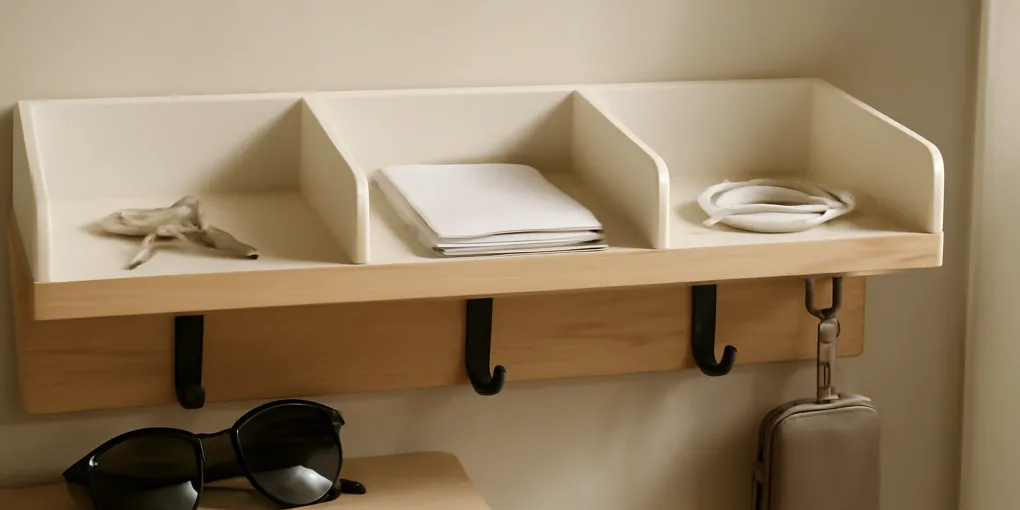
ADHD-Friendly Open Bin Landing Pads: A Low-Friction Clutter Protocol
ProtocolQuick picks
| Product | Key Specs |
|---|---|
| See price on Amazon |
|
| See price on Amazon |
|
| See price on Amazon |
|
Product availability, certifications, and retailer details can change; check the current Amazon page before buying.
An ADHD-friendly landing pad is a visible, reachable place for the objects that usually become mystery clutter. It is not a full entryway makeover. It is one open bin, hook, tray, or wall pocket placed where keys, mail, chargers, glasses, bags, and returns already drop.
This protocol is for households where closed cabinets, perfect drawers, and complicated categories fail after two days. If paperwork is the main pile, pair it with our paperwork command center protocol. If the problem is digital files rather than objects, use the desktop clutter folder-naming guide.
Better product starting points
- Low-friction catchall: Search Amazon for open front storage cubes when daily items need a visible drop zone.
- Visible paper lane: Search Amazon for acrylic wall pocket organizers when forms vanish in stacks.
- Key and bag support: Search Amazon for small entry hook racks when the floor is becoming the storage system.
Buy fewer pieces than you think. A landing pad succeeds because it removes steps, not because it fills a wall with containers.
Why hidden storage fails here
Many organizing systems assume that a person will notice an item, remember the category, open the right container, put the item away, and remember the location later. That is too many steps for objects used several times a day. The National Institute of Mental Health describes ADHD as involving patterns of inattention, impulsivity, and difficulty with organization and sustained tasks (NIMH ADHD overview). At home, that often means the best storage is the one that keeps the next action obvious.
Open bins are not magic. They are an environmental cue. If sunglasses always land on the kitchen counter, a small open bin on the counter may work better than a drawer in the hall. If school forms disappear under mail, a clear wall pocket beside the backpack hook may beat a neat filing cabinet.
The four-item landing pad test
Choose one clutter cluster and list the four objects that cause the most friction. Do not start with every item in the room.
Common clusters:
- Keys, wallet, badge, sunglasses.
- Mail, school forms, return labels, receipts.
- Charger, earbuds, watch cable, tablet stylus.
- Dog leash, waste bags, harness, towel.
- Reusable bags, outgoing packages, donation items, library books.
The landing pad should hold the active four, not every related object. If the bin has to hold twenty things, it becomes an archive.
Build the system in 15 minutes
Minutes 0 to 3: Place it where the clutter already appears
Do not choose the prettiest wall. Choose the real drop point. If everyone unloads pockets at the kitchen island, start there. If bags land beside the door, put hooks or a bench-side bin there. A system that requires walking to a different room is a memory task, not a storage task.
Minutes 3 to 7: Choose open, shallow, and visible
Open front cubes, trays, clear wall pockets, shallow baskets, and small hook racks are better than deep lidded boxes for active daily items. The item should be visible enough to retrieve without rummaging. If privacy matters, use the visible landing pad only for non-sensitive items and move documents to safer storage during a scheduled reset.
Minutes 7 to 11: Name the exit rule
A landing pad cannot hold everything forever. Add one exit rule before using it:
- Mail leaves the tray every Monday and Thursday.
- Receipts stay until the return window ends.
- Chargers live here unless attached to a device.
- Donation items move to the car every Saturday.
- School forms are signed the same evening they enter the wall pocket.
The exit rule is the difference between a landing pad and a pile with better lighting.
Minutes 11 to 15: Test with real objects
Put the four target items in the landing pad and walk through the next use. Can a tired person drop keys without opening anything? Can a child see where the form goes? Can a charger be removed without tangling three cords? If not, change the container now.
Practical score
| Factor | Weight | What matters |
|---|---|---|
| Visibility | 30% | The item can be seen without opening or digging. |
| Step count | 25% | Drop and retrieval take one motion whenever possible. |
| Category size | 20% | The bin holds a small active set, not an entire room category. |
| Reset cue | 15% | There is a named time or trigger for emptying it. |
| Household fit | 10% | Labels, height, and placement match the people who use it. |
This score favors simple open systems that remove decisions at the moment clutter appears. A beautiful cabinet scores poorly if no one opens it.
What to avoid
Avoid deep opaque bins for active items. For keys, earbuds, badges, and glasses, a shallow tray or open-front cube usually beats a 12-inch-deep basket because the item remains visible from standing height. Avoid labels that sound organized but do not guide action, such as miscellaneous, later, or important. Use action labels instead: returns, school forms, charge tonight, or keys and wallet.
Avoid placing the landing pad in a room people wish they used. If backpacks drop beside the kitchen island, put the hook rail or open bin within one step of that landing zone, not in a hallway closet. Also avoid buying a complete matching set before testing one station. If the first station fails, the problem is usually placement, category size, or reset rhythm, not a lack of bins.
ADHD landing pad FAQ
Is this just permission to leave things out?
No. It is permission to store active objects where use actually happens. The boundary is that each landing pad gets a small category and an exit rule.
What if other people dislike visible bins?
Use cleaner-looking open trays, clear pockets inside a cabinet door, or a shallow basket on a shelf. Keep the one-motion drop, but choose a visual style the household can tolerate.
How do I know a landing pad is working?
The target objects are found faster, the old pile shrinks, and the reset takes under five minutes. If the bin overflows every week, split the category or make the exit rule more frequent.
Sources
- NIMH: Attention-Deficit/Hyperactivity Disorder
- CHADD: Managing money and ADHD for practical examples of externalizing reminders and reducing missed household tasks.
Frequently Asked Questions
- Open bins reduce the steps between noticing an item and putting it away. The tradeoff is that bins need small categories and frequent quick resets.
- Start with one landing pad where clutter already appears. Add another only when a different item category consistently lands elsewhere.
- Use whichever cue is noticed fastest. Some homes do better with color, clear bins, icons, or a sample item visible at the front.