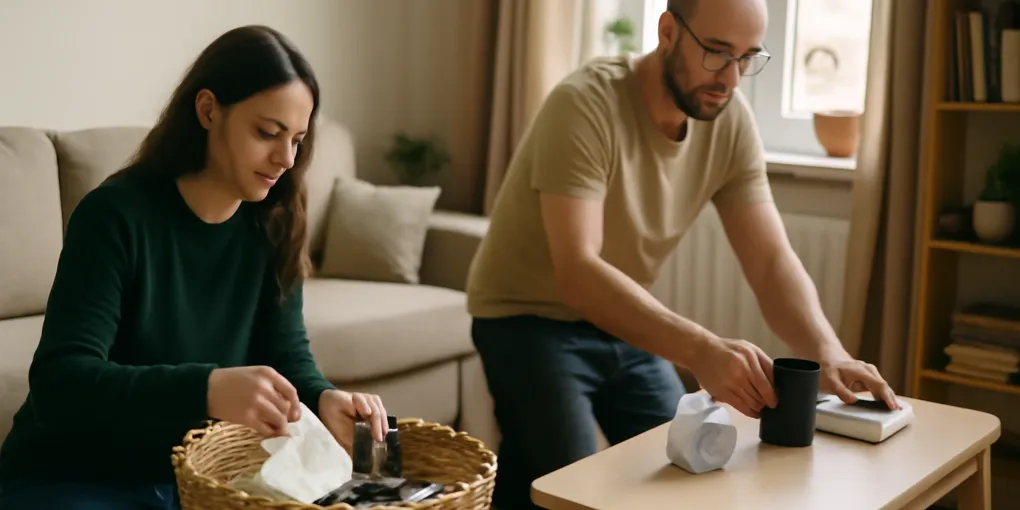
ADHD Body Doubling for Home Organization: A 25-Minute Reset That Keeps the Task Visible
Evidence ExplainerQuick picks
| Product | Key Specs |
|---|---|
| See price on Amazon |
|
| See price on Amazon |
|
Product availability, certifications, and retailer details can change; check the current Amazon page before buying.
Body doubling can make a home task easier to start because another person makes the session concrete: there is a start time, a shared location, and someone who can notice when the task drifts. It is not a treatment and it does not make every organizing system ADHD-friendly. It is a practical support for one bounded job.
CHADD’s guidance for organizing home and office space recommends reducing distractions, using containers, assigning places to items, and breaking organization into manageable work. Those principles fit a body-doubling session only when the reset stays small and visible (CHADD home and office organization guidance).
This reset is for a counter, chair, table, or one patch of floor. It is not a whole-room declutter.
What each person actually does
The person doing the reset owns every keep, move, donate, or discard decision. The body double supplies presence and structure, not pressure.
Before the timer starts, agree on four rules:
- Name one surface or floor boundary.
- Define the photographable finish, such as “the dining table is clear except for the fruit bowl.”
- Choose whether the body double works silently, sorts an agreed category, or only checks in.
- Decide what happens when the timer ends.
A good body double can say, “That belongs in another room, so put it in the return basket.” A poor body double opens drawers, expands the project, debates sentimental objects, or starts telling the other person what should be thrown away.
The two-tool setup
You need a visible countdown and one open return basket.
- A phone timer works if the phone will not become a distraction. Check the current Time Timer MOD price and options on Amazon when a shared visual countdown is more useful.
- Use any existing open laundry basket or tote for objects that belong elsewhere. If you need a compact dedicated option, check current IRIS USA open basket options on Amazon.
Do not buy a cart, label maker, or set of matching bins for this session. The test is whether two simple cues help complete one reset.
The 25-minute body-doubling reset
Minutes 0 to 2: point to the boundary
Stand where both people can see the entire task. State the finish aloud. Put the return basket at the edge of the zone, not in the middle of the walking path.
Minutes 2 to 7: remove obvious exits
Trash goes in trash. Dishes go to the sink or dishwasher. Laundry goes into the existing hamper. Objects that belong in another room go into the return basket. Do not walk each item away yet; repeated room changes invite a new task.
Minutes 7 to 18: restore items that belong here
Handle the largest objects first so the visual change is obvious. Put current-use items in their assigned home. If an item belongs in the zone but has no home, place it together with similar homeless items in one small section. Do not shop for storage while the timer is running.
Minutes 18 to 22: make one container decision
If the same category keeps spreading, give it one physical boundary. Mail might need one upright file. Game controllers might need one shallow tray. Hair tools might need one heat-safe bin after they cool. Use a container already in the house for the first week.
Minutes 22 to 25: empty the return basket
The body double gives a five-minute warning. Carry the return basket through the house once and put items into their existing homes. If an object still has no home, write down that single unresolved category. Do not leave the basket full, because a temporary basket that never empties becomes another clutter location.
Take a finish photo only if it is motivating and does not expose private papers or screens.
Pick the right kind of body double
| Situation | Body double role | Avoid |
|---|---|---|
| Starting is the barrier | Join at the exact start time and stay visible | Sending vague encouragement by text |
| Decisions cause conflict | Work silently on a separate task | Commenting on every object |
| The task keeps expanding | Repeat the named boundary and park new tasks on a note | Opening closets or cabinets |
| Time disappears | Keep the timer visible and announce five minutes left | Repeated time warnings |
| Shame is high | Use neutral language about objects and locations | Jokes, photographs, or surprise disposal |
A friend can join by video if the camera can show the work zone without exposing documents, family photos, or other private material. Keep the call focused on presence rather than a tour of the mess.
When body doubling is the wrong tool
Skip this method when another person’s presence increases distress, conflict, or rushed decisions. Do not use a body-doubling reset for medication disposal, sharp tools, hazardous cleaning chemicals, financial records, or a relative’s possessions without the owner’s participation.
It is also the wrong tool when the physical volume exceeds the available storage. Twenty-five minutes can restore a table; it cannot make six shelves of books fit into two shelves. That task needs a separate keep-and-release decision.
What success looks like after one week
Repeat the same zone once or twice, then check three facts:
- Did the session start at the agreed time?
- Was the exact boundary finished?
- Was the return basket empty at the end?
If yes, keep the setup. If the task still expands, cut the boundary in half. If the phone timer causes detours, use a standalone timer. If the body double gives too much advice, change their role to silent parallel work.
For a separate low-friction storage setup, see the ADHD-friendly open-bin landing pad protocol. Use that article for daily object homes; use this one when presence and a fixed finish line are the missing supports.
Frequently Asked Questions
- Body doubling means working while another person is present. For home organization, the partner can work quietly nearby, sort a separate pile, or check in at the start and finish.
- No. Their useful job may simply be staying present, protecting the task boundary, and giving a five-minute warning. They should not take over decisions without permission.
- Start with 25 minutes or less and one visible outcome. A completed counter or cleared chair is more useful than an open-ended promise to organize the whole room.