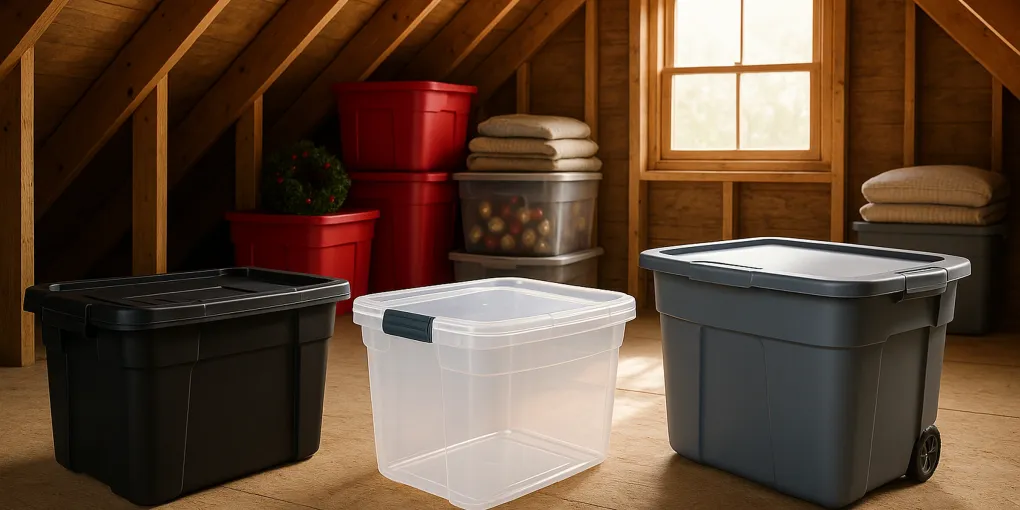
Best Attic Storage Bins 2026
Buyer's GuideRubbermaid Roughneck Storage Tote
Best OverallBest For: general attic storage where durability matters most
$14–22
Quick picks
| Product | Key Specs |
|---|---|
| See price on Amazon |
|
| See price on Amazon |
|
| See price on Amazon |
|
Product availability, certifications, and retailer details can change; check the current Amazon page before buying.
Why Best Attic Storage Bins Matters
Attics are one of the most underused storage zones in the home — and also one of the easiest places to create expensive clutter. The problem is not just capacity. It is access, temperature, dust, and the fact that anything stored up there tends to disappear for months or years at a time.
That means attic storage needs to be more forgiving than everyday closet or pantry storage. The right bin has to survive seasonal heat swings, stack without collapsing, label clearly, and protect items that only get touched a couple times per year. Cheap cardboard usually fails on all four counts.
We reviewed the best attic storage bins for 2026 with a simple principle in mind: attic storage should be boring, durable, and easy to identify. If a container makes it harder to put things away or harder to find them later, it is probably the wrong container for attic use.
How We Evaluated
Every product was assessed on four criteria:
| Criterion | What We Evaluated |
|---|---|
| Capacity & Fit | Whether the bin works in typical attic layouts and narrow stair access |
| Material Quality | Build durability, lid strength, and resistance to warping or cracking |
| Ease of Use | Lifting comfort, labeling, stackability, and access after storage |
| Long-Term Value | Cost per use over expected lifespan; value relative to competing products |
All assessments draw on: (1) Amazon verified purchaser community synthesis (ratings, review volume, and consistent feedback themes); (2) manufacturer published specifications; (3) home organization best practices for seasonal storage.
How We Score the Products
ClutterScience uses a weighted composite score so readers can compare bins that solve different attic problems without overvaluing one feature. The 30/25/20/15/10 split below keeps the ranking focused on what matters most for attic use: the container has to fit, survive heat swings, and remain easy to live with over time.
| Factor | Weight | What Earns a Higher Score |
|---|---|---|
| Research | 30% | Strong, consistent purchaser feedback and clear product positioning for attic storage use cases |
| Evidence Quality | 25% | Durable materials, secure lid behavior, and dependable construction details |
| Value | 20% | A fair price relative to capacity, durability, and expected lifespan |
| User Signals | 15% | Easy handling, good stackability, and low-friction labeling or access |
| Transparency | 10% | Clear limitations, honest trade-offs, and no misleading claims about climate control or protection |
For attic storage specifically, a higher score should reflect practical reliability rather than premium aesthetics. A beautiful bin that cracks, warps, or becomes impossible to stack is worse than a plain tote that simply works.
How to Size Attic Storage Bins
The best attic bin is the one that fits the actual pathway into the attic, not just the floorplan once you are standing inside it. Before you buy, think through the full journey: door opening, stair width, landing turns, and the vertical clearance between rafters. A bin that is technically large enough for the contents but too awkward to carry will quickly become a storage problem instead of a storage solution.
A few sizing rules help more than guessing:
- Use smaller bins for dense items like books, paper goods, or holiday ornaments so they stay liftable.
- Use larger totes for lightweight but bulky items such as linens, seasonal decor, or empty baskets.
- Keep at least some bins in a standard footprint so they stack cleanly and label the same way.
- Avoid oversized specialty containers unless the item truly needs them; odd shapes waste attic space fast.
If you are sorting a whole attic at once, it is usually better to buy fewer bin sizes and repeat them consistently. Uniformity makes stacking safer, labeling easier, and future retrieval much less annoying.
Attic Storage Mistakes to Avoid
Even a good bin cannot fix a bad attic system. The most common mistakes are the ones that create invisible friction later:
-
Mixing unrelated categories in the same bin
That saves a container today and wastes time every future time you need one item from the mix. -
Overfilling containers
If the lid bulges or the sides flex, the bin is harder to stack and more likely to crack when moved. -
Skipping exterior labels
Relying on memory almost never works for attic storage because attic items are usually touched infrequently. -
Treating the attic like climate-controlled storage
Anything delicate, sentimental, or heat-sensitive should go somewhere more stable.
The best attic system is boring in the best possible way. You want containers that close the same way every time, stack without drama, and make the next retrieval obvious.
Rubbermaid Roughneck Storage Tote — Best Overall
Best for: general attic storage where durability matters most
What Works
The Rubbermaid Roughneck Storage Tote is the safest all-around attic storage choice because it prioritizes the thing attic bins need most: toughness. The plastic walls are thick enough to handle repeated stacking, and the lid fit is secure enough for long-term storage without the constant fear of a tote popping open when moved.
For households that store holiday decor, keepsakes, sports gear, or bulk seasonal items in the attic, the Roughneck hits the core use case better than more delicate latching systems. Verified purchasers consistently value this product for its long service life and practical shape, especially when they need a container that survives being moved twice a year without cracking.
Trade-offs
The Roughneck is not the most premium-looking bin, and it is not the lightest tote in the category. But attic storage is usually a utility problem, not a display problem. If your priority is reliability rather than aesthetics, those trade-offs are easy to accept.
Pricing
$14–22
| Criterion | Weight | Score |
|---|---|---|
| Capacity & Fit | 30% | 8.5/10 |
| Material Quality | 25% | 9.0/10 |
| Ease of Use | 20% | 8.0/10 |
| Long-Term Value | 25% | 9.0/10 |
| Composite Score | 8.8/10 |
IRIS USA WeatherPro Storage Box — Best for Protection
Best for: moisture-sensitive items and long-term storage
What Works
The IRIS USA WeatherPro Storage Box is the best choice when the attic is dusty, humid, or otherwise less controlled than you would like. The latching lid design gives a more secure seal than a basic open-top tote, which helps protect the contents during long storage cycles.
This type of bin is especially useful for items that you only want to check once or twice a year: seasonal clothing, paper-based decor, spare linens, and boxed holiday accessories. The real advantage is not just protection but consistency. Everything stays contained, the lids stay put, and the bins stack cleanly in a row.
Trade-offs
Latching boxes are a little more fiddly than open totes when you are packing and unpacking. If you plan to access the contents frequently, that friction matters. For true seasonal storage, though, the extra security is usually worth it.
Pricing
$16–26
| Criterion | Weight | Score |
|---|---|---|
| Capacity & Fit | 30% | 8.0/10 |
| Material Quality | 25% | 8.8/10 |
| Ease of Use | 20% | 7.8/10 |
| Long-Term Value | 25% | 8.6/10 |
| Composite Score | 8.3/10 |
Sterilite 40 Gallon Wheeled Tote — Best for Heavy Loads
Best for: bulky but lighter-weight items that need easy transport
What Works
The Sterilite 40 Gallon Wheeled Tote solves a different attic problem: getting large items up and down without turning the process into a back injury. Wheels are not essential for every attic bin, but they are extremely useful if you store large seasonal items, packed gift wrap, or multiple smaller containers that would otherwise be awkward to carry.
This tote is best when volume is the main challenge and weight is moderate. It shines for items that are too bulky for standard bins but not so fragile that they need rigid compartmentalized protection.
Trade-offs
Wheels add convenience, but they also add some complexity to the form factor. If your attic access is very tight, the extra size may be a drawback. Also, wheeled bins are only worth the premium if you will actually move them often enough to benefit.
Pricing
$20–32
| Criterion | Weight | Score |
|---|---|---|
| Capacity & Fit | 30% | 8.5/10 |
| Material Quality | 25% | 8.0/10 |
| Ease of Use | 20% | 9.0/10 |
| Long-Term Value | 25% | 8.0/10 |
| Composite Score | 8.4/10 |
How to Choose the Right Attic Bin
The best attic bin depends on what you are storing and how often you need it.
Choose a heavy-duty tote if you want the most durable all-purpose option. Choose a latching WeatherPro-style box if protection from dust and humidity matters most. Choose a wheeled tote if the main problem is moving large bins safely.
A few practical rules make attic storage work better:
- Use large external labels on at least two sides
- Keep related items in the same container family
- Avoid overfilling so lids still close properly
- Store the heaviest containers closest to attic access points
- Keep fragile or paper-based items out of extreme heat zones
If you are still planning the space itself, pair the right containers with a simple access system. Our how to organize attic storage guide walks through layout, lighting, and zoning strategies that make attic storage easier to maintain.
Related Reading
- How to Organize Attic Storage
- Best Seasonal Decor Storage Bins
- Best Christmas Ornament Storage
Frequently Asked Questions
What kind of bins are best for attic storage?
Heavy-duty plastic bins with secure lids are the best default choice for attic storage. They resist dust, pests, and moisture better than cardboard, and they stack more safely when you need to use vertical space. For the attic specifically, prioritize bins with reinforced walls and latching lids over decorative storage boxes.
Is it safe to store things in the attic long-term?
Yes, if you store the right items in the right containers. Attics are usually fine for seasonal decor, hard goods, holiday items, and durable plastics. They are less ideal for fabrics, photos, candles, electronics, and anything sensitive to heat or humidity. If an item would be damaged by a hot garage, it probably doesn’t belong in an attic either.
Should I use clear or opaque bins in the attic?
Clear bins make identification easier, which helps when you only access attic storage a few times a year. Opaque bins are better when UV exposure or visual clutter is a concern. A practical compromise is to use opaque bins with large exterior labels and consistent category-by-bin storage.
What should never go in attic storage bins?
Avoid storing valuables, important paper documents, photographs, candles, food, medication, and temperature-sensitive electronics in the attic. Cardboard boxes are also a poor long-term choice because they collapse, attract pests, and break down faster in warm or humid spaces.