How to Organize an Attic for Long-Term Storage 2026
Buyer's GuideQuick picks
Sterilite 18-Gallon Tote Box with Latching Lid (6-Pack)
TRINITY 3-Tier NSF Certified Wire Shelving Unit
Mr. Beams Wireless LED Ceiling Light with Motion Sensor
Quick picks
These are the products referenced in the guide; check dimensions, material, and installation limits before ordering.
- Recommended product: See current price on Amazon
- Recommended product: See current price on Amazon
- Recommended product: See current price on Amazon
Why Attic Organization Is Worth the Investment
The attic occupies a unique psychological territory in most homes: it is both the storage space of last resort and a source of low-grade anxiety for the people who own it. Items sent to the attic rarely come back down. The attic becomes a kind of organizational black hole — things go in, but the darkness, inaccessibility, and disorganization mean that retrieval is so difficult that items are functionally lost.
This has real costs beyond the abstract sense of disorder. Families buy replacement items — holiday decorations, seasonal tools, sports equipment — because they cannot find what they already own. Items stored in improper containers degrade and need to be replaced. Memory of what is stored in the attic fades, and the space becomes unmanageable to the point where homeowners eventually avoid it entirely.
A well-organized attic is a meaningful financial asset. It holds seasonal inventory that does not need to live in active living spaces. It provides legitimate long-term storage for items with ongoing but infrequent use. And when organized correctly, it is navigable — meaning its contents are actually accessible and usable rather than theoretically stored.
The principles that make attic organization work are the same principles that apply to any storage system: zones, containers, labels, and maintenance. The attic adds two additional variables — climate extremes and weight load — that require specific attention. This guide covers all of it.
For additional large-space organization, see our guides on how to organize a garage by zone and the best garage storage solutions.
Step 1: Safety Assessment Before You Store Anything
Before organizing an attic, two safety assessments are non-negotiable. Skipping either one can lead to costly damage or personal injury.
Structural assessment: Attic joists are typically designed to support insulation and minimal incidental loads, not the concentrated weight of a fully loaded storage system. Before adding shelving or stacking heavy containers, assess whether the floor structure can bear the intended load. The general rule is to distribute weight across multiple joists and to use plywood panels spanning several joists rather than placing containers directly on individual joists. If you have any doubt about structural capacity, consult a contractor.
Climate and moisture assessment: Attics are the most thermally extreme spaces in most homes. Summer temperatures can exceed 130°F and winter temperatures can drop below freezing, depending on climate and insulation quality. Before storing anything, assess whether the attic’s temperature range is compatible with your intended storage. Photographs, electronics, vinyl, artwork, and many other categories should not be stored in an uninsulated attic. Check for evidence of moisture intrusion — staining on rafters, mold, or dampness — before any storage system is installed.
Pest assessment: Look for evidence of rodents, insects, or birds. Droppings, nesting materials, chewed wood or insulation, and entry points around eaves and roof penetrations are indicators. Any evidence of pest activity should be addressed before storage begins, since stored items attract and shelter pests.
Also assess lighting and access. A dark attic that requires navigating with a flashlight is an attic that will not be maintained. Install battery-powered LED motion-sensor lights along the main access paths before installing storage. The lighting investment is modest and pays dividends in usability.
Step 2: Sort and Declutter Before Moving Anything Up
The temptation in attic organization is to organize what is already there — to sort through the existing accumulation and impose order on it. This is the wrong approach. Most attic contents include items that should not be in the attic at all, items that should have been discarded years ago, and items that are already damaged beyond salvage by poor storage conditions.
Pull out every item currently in the attic and sort it into four groups: keep and store in attic, keep and relocate to a more appropriate storage location, donate or sell, and discard.
The discard pile is typically the largest. Cardboard boxes that have been in the attic for years are often damaged by moisture and heat cycles and should be replaced with proper containers if the contents are worth keeping. Items degraded beyond use by heat or moisture go. Items that were put in the attic “just in case” but have no realistic future use go.
The relocate pile should include anything that is stored in the attic primarily because it was convenient to get it out of the main living space, but which would be more logically stored elsewhere. Documents belong in a filing system, not in a cardboard box in the attic. Tools that are used seasonally belong in a garage or utility closet.
After sorting, photograph the keep pile before loading it into containers. This photograph becomes the foundation of your attic inventory — a reference that tells you what is up there without requiring a physical visit.
Step 3: Design Zone-Based Storage
Attic storage zones should be designed around three variables: how often you need to access the items, how heavy or bulky the items are, and what temperature sensitivity they have.
Primary access zone (near the hatch or stairs): This area should hold items you access seasonally — typically one to four times per year. Holiday decorations, seasonal sports equipment, camping gear, and seasonal clothing are common items in this zone. These should be on shelving or in clearly labeled bins at easy reach.
Secondary storage zone (deeper into the attic): Items accessed less than once per year — keepsakes, archive materials, long-term memorabilia, family documents. These go further in but must still be in properly sealed and labeled containers.
Pathway: Maintain a clear walking path through the attic that allows access to all zones without climbing over items. This sounds obvious but is the first thing to collapse in an unorganized attic. A three-foot pathway between storage zones dramatically improves safety and usability.
Temperature-sensitive exclusion zone: Identify the hottest and most moisture-prone areas of the attic — typically the perimeter under the roof surface — and avoid storing anything there except the most climate-tolerant items (plastic totes can go here; photographs and textiles cannot).
Label each zone on a simple hand-drawn map. Tape the map to the underside of the attic hatch or the wall near the entry point. This map is the navigation tool that makes the attic usable for everyone in the household, not just the person who organized it.
Step 4: Install Shelving and Standardize Containers
An organized attic needs shelving. Items stored on the floor are difficult to access, accumulate moisture, and become a habitat for pests. Free-standing shelving units that stand on the attic floor and store containers at multiple levels dramatically improve accessibility and capacity.
Choose shelving rated for the weight you plan to load. Metal wire shelving or heavy-duty plastic shelving units are both appropriate. Ensure that the shelving feet rest on plywood panels spanning multiple joists rather than sitting directly on individual joists.
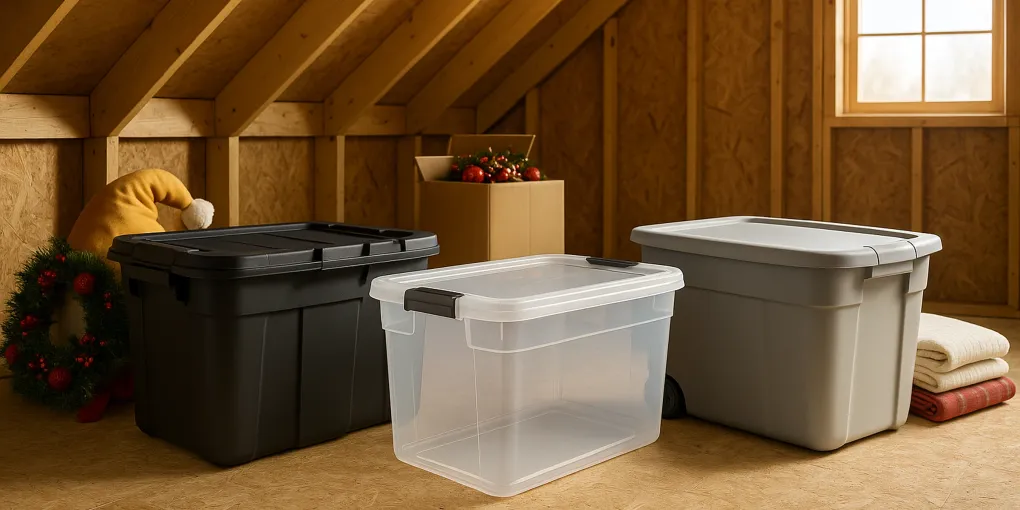
Standardize containers before purchasing them in bulk. Choose one or two sizes of heavy-duty plastic totes and buy enough of them to hold all attic contents. Standardized containers stack consistently, are easier to label and inventory, and create a visual uniformity that makes the attic feel organized rather than chaotic. Avoid cardboard boxes entirely — they collapse under weight, absorb moisture, and are easily damaged by pests.
Label every container on three sides: front, top, and at least one end. Attic containers are often viewed from multiple angles during retrieval. A label visible from only one direction is a label that requires moving the container to read. Use a label format that includes the category, the specific contents, and the date the container was last updated: “HOLIDAY — Christmas Ornaments — Updated 2025.”
Step 5: Create the Attic Inventory and Maintenance System
An attic without an inventory is an attic that loses things. Because attic access is infrequent, memory of what is stored there fades rapidly. Without an inventory, households buy replacement items for things they already own and accumulate duplicate stock over years.
Create a simple attic inventory: a document (paper or digital) that lists every container in the attic, its zone location, and its contents at a summary level. This does not need to be exhaustive — “Holiday — Christmas ornaments, lights, garland, wrapping supplies” is sufficient. The goal is to be able to search the inventory and identify which container to retrieve without a physical attic visit.
Keep the inventory accessible. A shared note in a family notes app, a document on the family computer, or a laminated sheet taped near the attic entry point all work. The critical requirement is that it is findable and updatable by any household member.
Update the inventory every time a container is added, removed, or modified. A five-minute update habit prevents the inventory from becoming outdated and useless.
Annual maintenance: once per year, inspect the attic for signs of moisture intrusion, pest activity, and container integrity. Check that all containers are properly sealed, that labels are still readable, and that the shelving is stable. This annual inspection should take about an hour and prevents the slow deterioration that turns organized attics back into chaos over the span of several years.
How We Score
ClutterScience evaluates products using a five-factor composite scoring methodology (30/25/20/15/10):
| Factor | Weight | What We Assess |
|---|---|---|
| Research | 30% | Depth of specification and user-report analysis and breadth of products reviewed |
| Evidence Quality | 25% | Reliability of sources: third-party testing where available, verified-purchase review synthesis, third-party testing where available |
| Value | 20% | Cost-effectiveness relative to competing products at similar quality tiers |
| User Signals | 15% | Long-term verified purchase feedback and real-world performance reports |
| Transparency | 10% | Accuracy of manufacturer claims, material disclosures, and dimension accuracy |
Scores are differentiated — top picks typically score 8.5–9.5, mid-tier 7.0–8.4, and weak options below 7.0.
Product Recommendations
For attic storage organization, these products deliver the best results:
Sterilite 18-Gallon Tote Box with Latching Lid (6-Pack)
Best for: Primary attic storage containers across all categories $48–60. Amazon verified purchasers consistently praise the latching lids that stay securely closed even when containers are stacked heavily, preventing contents from shifting or spilling during access.
| Criterion | Weight | Score |
|---|---|---|
| Capacity & Dimensions | 30% | 9.2/10 |
| Material Quality | 25% | 8.9/10 |
| Ease of Assembly & Use | 20% | 9.0/10 |
| Long-Term Value | 25% | 9.1/10 |
| Composite Score | 9.1/10 |
TRINITY 3-Tier NSF Certified Wire Shelving Unit
Best for: Attic shelving that holds heavy loads safely $85–110. Purchasers highlight the weight capacity of up to 600 lbs per shelf across the full unit, the tool-free assembly, and the adjustable shelf heights that accommodate different container sizes.
| Criterion | Weight | Score |
|---|---|---|
| Capacity & Dimensions | 30% | 9.3/10 |
| Material Quality | 25% | 9.1/10 |
| Ease of Assembly & Use | 20% | 8.6/10 |
| Long-Term Value | 25% | 9.2/10 |
| Composite Score | 9.1/10 |
Mr. Beams Wireless LED Ceiling Light with Motion Sensor
Best for: Attic lighting without electrical work $22–28. Verified buyers note that the motion-sensor activation makes the light practical in a space you enter with full hands, and the battery life of 12+ months under normal use means minimal maintenance.
| Criterion | Weight | Score |
|---|---|---|
| Capacity & Dimensions | 30% | 7.5/10 |
| Material Quality | 25% | 8.7/10 |
| Ease of Assembly & Use | 20% | 9.5/10 |
| Long-Term Value | 25% | 8.4/10 |
| Composite Score | 8.5/10 |
Maintenance: Keeping Your Attic Organized Long-Term
The attic’s most important maintenance challenge is preventing the “temporary storage” creep that is the primary cause of attic disorganization. This happens when items are placed in the attic with the intention of organizing them later, or when items that do not belong in the attic are sent there because dealing with them in the moment is too difficult.
The solution is a strict entry policy: nothing goes into the attic unless it has an assigned container and a label. If an item does not have a labeled container ready to receive it, it does not go in the attic until one is prepared. This policy adds about three minutes to each attic deposit but prevents the gradual accumulation of unlabeled, loose items that makes attics unmanageable.
Annual inspections keep the structural and environmental integrity of the storage system intact. Beyond checking for moisture and pests, the annual inspection is also the time to reassess the zone system, update the inventory, and remove items that are no longer needed. Family needs change year to year, and an attic that is reassessed annually remains a functional resource rather than an ever-growing burden.
Involve the whole household in the organization system. When everyone knows the inventory exists and how to use it, the attic becomes a shared resource rather than one person’s organizational responsibility. A spouse who knows how to find the camping gear in the attic is a spouse who is more likely to put it back in the right container after the camping trip.
Frequently Asked Questions
- Attics experience extreme temperature swings — from freezing cold in winter to over 130°F in summer in some climates. Avoid storing electronics, photographs, candles, wine, medications, vinyl records, latex paint, rubber items, and anything with adhesives. These all degrade significantly in extreme heat or humidity.
- Heavy-duty plastic totes with tight-fitting lids are best for attic storage. They resist moisture, protect contents from pests, and withstand temperature extremes better than cardboard. Look for containers rated for outdoor or storage use, not standard household bins.
- In most homes, attic joists are designed for insulation and light storage, not heavy loads. Consult a structural engineer or contractor if you plan to store heavy items. Distribute weight across joists, never concentrate heavy items in one spot, and use plywood boards to span multiple joists.
- Yes. Inadequate lighting is one of the most common reasons attic storage systems fail — when the space is dark, people become reluctant to navigate it and start shoving items without attention to organization. Battery-powered LED motion-sensor lights are an easy, wiring-free solution.
- Sealed rigid plastic containers are the primary defense. Avoid cardboard boxes entirely. Cedar blocks or sachets placed inside containers deter moths. Check for and seal any exterior gaps or cracks in the attic that allow entry. An annual inspection for signs of pest activity is essential.