Best Basket Label Clips for Open Shelves: What Actually Stays Readable
Buyer's GuideMetal Clip-On Basket Label Holders
Best overallBest For: Woven baskets, cube shelves, and mudroom bins
$10-18 per set
Quick picks
| Product | Key Specs |
|---|---|
| See price on Amazon |
|
| See price on Amazon |
|
| See price on Amazon |
|
Product availability, certifications, and retailer details can change; check the current Amazon page before buying.
Open shelves look simple until every basket becomes a mystery bin. Basket label clips solve a small but important problem: they turn opaque containers into visible categories without forcing you to replace the baskets you already own.
Use this best basket label clips for open shelves product comparison as the shopping shortlist, then check the measurements, mounting limits, cleaning friction, and return terms against the room or cabinet described below.
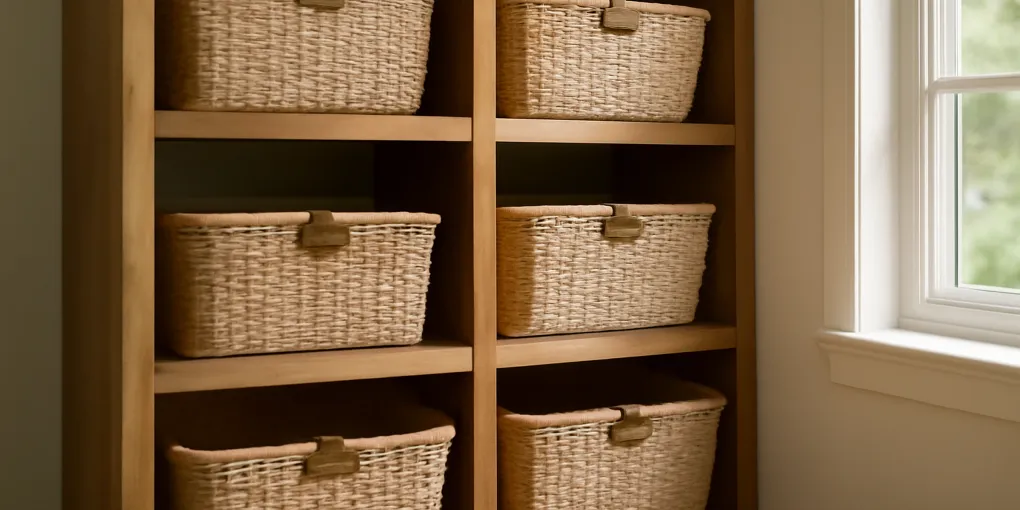
The best basket label clips for open shelves are metal clip-on label holders with replaceable paper inserts. They stay flat against woven baskets, look tidy on cube shelves, and let you change a category without peeling adhesive off the basket. Use tie-on tags when the basket has a soft handle or an uneven rim, and use reusable chalkboard labels only when categories change often enough to justify the smudge risk.
If your shelves also collect mail, keys, and small items, pair labels with a simple landing-zone rule like the one in our entryway landing strip protocol. Labels work best when each basket already has a bounded job.
Quick picks for basket label clips
- Best overall: Search Amazon for metal basket label clips. Choose these for woven baskets, cube shelves, and categories that need a clean front-facing label.
- Best for fabric bins: Search Amazon for tie-on basket labels. Choose these when a clip would dent the rim or slide off a soft handle.
- Best for changing categories: Search Amazon for reusable chalkboard basket labels. Choose these for toy rotations, seasonal shelves, or kids’ systems that change every few weeks.
Do not buy labels before naming the categories. Empty one shelf, group the contents, and write the shortest label that would help someone put an item back without asking where it belongs.
What makes a basket label readable?
A good basket label is visible from the normal decision point. For an entryway shelf, that may be standing with shoes on and a bag in one hand. For a linen shelf, it may be reaching above shoulder height. Small script labels can look charming in a product photo but fail when a tired person is trying to find gloves, pet leashes, or spare washcloths.
Readable labels usually have four traits:
- High contrast between the insert and the text.
- A short category name, ideally one to three words.
- A holder that faces forward instead of drooping.
- A repeatable position on every basket in the shelf row.
The goal is not decoration. The goal is faster return. Research on visual attention shows that crowded scenes compete for attention; McMains and Kastner (2011, DOI: 10.1523/JNEUROSCI.3766-10.2011) describe how multiple objects compete in visual processing. A clear label reduces that search problem by telling the eye where to go first.
Metal clip-on basket label holders
Metal clip-on holders are the safest first choice for open shelving with woven baskets. The frame clips over the basket rim and holds a paper insert behind a small window. That format is useful because the insert can be replaced when the category changes from winter hats to sunscreen, guest towels, or dog gear.
Check rim thickness before buying. A clip that fits a thin wire bin may not fit a thick hyacinth or rope basket. A very tight clip can also scratch a painted shelf or snag loose basket fibers. For cube shelves, measure the front opening and make sure the label will not hit the shelf above when the basket slides out.
Best use cases include mudroom baskets, linen closet shelves, pantry overflow bins, and toy categories that are stable for months at a time.
Shopping option: Search Amazon for metal clip-on basket label holders.
Tie-on basket tags
Tie-on tags are better when the basket does not have a clean rim. Fabric bins, rope baskets, and soft canvas handles often reject clip labels. A tag attached with string, elastic, or a small chain can hang from the handle without crushing the material.
The tradeoff is movement. A dangling tag can flip backward, hide between baskets, or swing when the basket is moved. For shelves used by kids, choose a tag with a short attachment point rather than a long string. For high shelves, use a larger tag because the label is farther from eye level.
Tie-on tags work well for blanket baskets, laundry-sorting baskets, seasonal accessory bins, and soft nursery storage.
Shopping option: Search Amazon for tie-on basket labels.
Reusable chalkboard basket labels
Reusable chalkboard labels make sense when the basket category changes often. They are useful for a rotating toy shelf, craft supplies, or seasonal entryway gear. Instead of printing a new insert, you wipe and rewrite the category.
The weakness is durability. Chalk marker can smudge when fingers brush the label, and some surfaces leave ghost marks after repeated cleaning. If the basket is handled every day, a printed insert in a clip holder may stay readable longer. If the shelf changes monthly, reusable labels can prevent a drawer full of obsolete paper inserts.
Use thick, plain category words. A label that says “markers” will be used. A label that says “creative expression supplies” will be ignored.
Shopping option: Search Amazon for reusable chalkboard basket labels.
Fit checks that matter
Choose basket labels by rim fit, readable insert size, smudge resistance, and whether the clip stays facing forward on the shelf you actually use.
For basket label clips, Research rewards matching the label format to basket material and shelf height. Evidence Quality looks for observable features: rim fit, insert size, contrast, smudge resistance, and whether dimensions are listed clearly. Value compares the cost of the label set with the number of baskets it can label cleanly. User Signals emphasize complaints about clips sliding, tags flipping backward, or chalk labels smearing. Transparency rewards product pages that show the clip mechanism, insert size, and compatible basket types.
Metal clip-on holders usually work best for open shelves because they keep the label stable and replaceable. Tie-on tags usually work best for soft bins. Chalkboard labels make sense only when categories truly change often.
Sizing and placement rules
Put the label where the basket is viewed, not where it looks symmetrical in your hand. On a low cube shelf, center-front placement works. On a high shelf, place the label low enough on the basket face that it can still be read from below. On a narrow shelf, keep labels aligned on the same side so the eye can scan vertically.
Use category names that describe the next action. “Returns” is better than “misc.” “Dog walking” is better than “pet.” “Guest towels” is better than “linens” if the shelf also stores sheets. If a basket needs a two-line explanation, the category is probably too broad.
Basket clip buying questions
How many basket labels should I buy?
Count the baskets that already have stable contents, then buy one small set more than that. Do not label empty baskets just because they match. Empty labeled containers invite low-value categories.
Can I use adhesive labels on baskets?
Adhesive labels can work on smooth plastic bins, but they often fail on woven, fabric, or textured baskets. Clips and tags are safer because they do not depend on a clean flat surface.
What should I write on open-shelf basket labels?
Use concrete household categories: hats, gloves, dog walking, guest towels, chargers, returns, craft paper, or school forms. Avoid vague labels such as extra, random, or stuff.
Are label clips worth it for decorative baskets?
They are worth it when the basket hides useful items or several people use the shelf. If a basket is purely decorative or holds one obvious item such as throws, a label may add visual noise without helping retrieval.
Shelf-by-shelf examples
For an entryway cube shelf, label by the decision someone makes while entering or leaving: dog walking, winter hats, returns, sunglasses, or library books. A basket called accessories is too broad because gloves, sunscreen, earbuds, and masks all compete inside it. A basket called dog walking tells the next user exactly where the leash and waste bags return.
For a linen closet, labels should separate use cases rather than fabric types. Guest towels, daily washcloths, backup sheets, and beach towels are easier to maintain than towels, cloths, and linens. If one basket is pulled down by a guest, the category should still make sense without a tour of the closet.
For kids’ shelves, use labels that match cleanup language. Blocks, dress-up, cars, and art paper are stronger than play, fun, or favorites. If pre-readers use the shelf, pair the word with a simple color or consistent basket position instead of adding tiny decorative details that adults can read but children ignore.
For pantry overflow, label by buying pattern rather than container shape. Baking backup, lunch refills, breakfast overflow, and unopened snacks tell the household when to shop the basket before buying more. A shape-based label such as bins or extras does not prevent duplicate purchases.
Sources
- McMains, S. A., and Kastner, S. (2011). Interactions of top-down and bottom-up mechanisms in human visual cortex. DOI: 10.1523/JNEUROSCI.3766-10.2011.
- Wilson, T. D., and Gilbert, D. T. (2002). Affective forecasting. DOI: 10.1016/S0065-2601(02)80006-2. This supports designing systems for real future behavior rather than ideal reset-day behavior.
- American Academy of Pediatrics. Preventing furniture and TV tip-overs: https://www.healthychildren.org/English/safety-prevention/at-home/Pages/Preventing-Furniture-and-TV-Tip-Overs.aspx. Use stable shelves and avoid overloading high baskets.
Frequently Asked Questions
- A metal clip-on label holder usually works best on woven baskets because it grips the rim and keeps the label facing forward. Check rim thickness before buying.
- Tie-on tags are better for fabric bins, rope baskets, and handles that are too thick or soft for a clip. Clips are better when the shelf front needs a consistent label line.
- Printed labels are easier to read from a few feet away, but neat handwritten labels work if the category name is short and high-contrast.
- Labels help when baskets are opaque or used by multiple people. They reduce the need to pull every basket forward just to check what is inside.