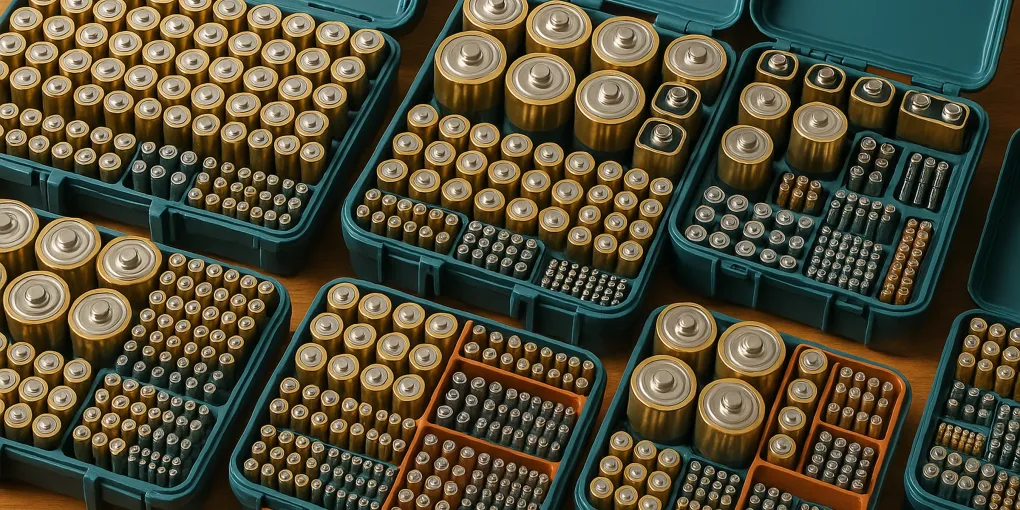
Best Battery Storage Organizers for Home Safety and Access (2026)
Buyer's GuideOntel Battery Daddy Storage Case
Best OverallFormat: Hard-shell case
$18–28
Quick Comparison
| Product | Key Specs | Price Range | Buy |
|---|---|---|---|
| |
| $18–28 | Check Price |
| |
| $20–30 | Check Price |
| |
| $14–24 | Check Price |
Contains affiliate links — we may earn a small commission at no extra cost to you.
For most homes, the best battery storage organizer is the Ontel Battery Daddy Storage Case because it combines broad battery-type support, clear compartment structure, and an included tester in one compact case. It is easier to maintain than loose drawer trays and more protective than open bins in garages or utility closets. If the goal is maximum visibility in a fixed drawer location, a flat clear-cover tray is a strong alternative.
TL;DR
- Top Pick: Ontel Battery Daddy Storage Case
- Runner-Up: The Battery Organizer and Tester (clear-cover tray)
- Best Portable: Tenergy Battery Storage Organizer Case
- Key System Tip: Separate fresh and spent batteries into distinct zones immediately
Battery storage feels simple until the household has to find one specific size during a low-battery moment. Mixed bins create decision friction, dead-vs-fresh confusion, and duplicate purchasing. Research on decision burden shows that unsorted options increase mental load and delay action, while clear categories and constrained compartments improve selection speed (Iyengar & Lepper, 2000, DOI: 10.1037/0022-3514.79.6.995).
Why a Dedicated Battery Organizer Is Worth It
A battery system does three practical jobs:
- Keeps battery chemistry and sizes separated
- Makes inventory visible at a glance
- Reduces mistakes between fresh and spent cells
When households skip dedicated storage, batteries often spread across junk drawers, office bins, and garage shelves. That pattern increases search time and raises error risk. Environmental order research indicates that visual organization improves perceived control and retrieval confidence in daily-use spaces (Gosling et al., 2002, DOI: 10.1037/0022-3514.82.3.379).
From a usability perspective, the best organizer is not necessarily the one with the biggest capacity claim. The best one is the one the household will maintain every week without needing extra effort.
ClutterScience Scoring Framework for Battery Organizers
| Criterion | Weight | What It Measures |
|---|---|---|
| Capacity & Dimensions | 30% | Coverage of common battery sizes and space efficiency |
| Material Quality | 25% | Cover, hinge, latch, and shell durability |
| Ease of Assembly & Use | 20% | Speed of retrieval, labeling, and fresh/spent workflow |
| Long-Term Value | 25% | Durability plus reduction in duplicate purchases |
Assessment sources include product specifications, verified-purchase synthesis, and behavioral-science grounding from the associated research file.
Ontel Battery Daddy Storage Case: Best Overall
Best for: families needing one all-purpose battery home
Battery Daddy-style cases stay popular for good reason: they are easy to understand immediately. The compartment design supports common AA/AAA needs while still leaving room for less frequent battery types. The included tester is meaningful, not decorative, because it directly reduces “is this dead or not?” confusion.
What works
- Integrated tester supports a cleaner fresh/spent sorting process
- Hard case format protects batteries from drawer spills and garage dust
- Portable enough to move from utility closet to holiday-decor station
Trade-offs
- Fixed slot geometry can be less flexible for unusual battery formats
- A full case can feel bulky in small kitchen drawers
Score breakdown
| Criterion | Weight | Score |
|---|---|---|
| Capacity & Dimensions | 30% | 9.0/10 |
| Material Quality | 25% | 8.6/10 |
| Ease of Assembly & Use | 20% | 8.8/10 |
| Long-Term Value | 25% | 9.1/10 |
| Composite Score | 8.9/10 |
The Battery Organizer and Tester (Clear Cover): Best Drawer Setup
Best for: fixed cabinet/drawer storage with high visual inventory needs
A flat tray with a clear top is often the easiest option for households that want battery storage to live permanently in one drawer. Visibility is excellent, and the low profile avoids the “stack of cases” problem seen in cramped utility spaces.
What works
- Clear cover supports fast inventory checks
- Flat footprint fits many utility and office drawers
- Compartment map is simple for multi-person households
Trade-offs
- Lower portability than compact carry cases
- Less protection if moved frequently between spaces
Score breakdown
| Criterion | Weight | Score |
|---|---|---|
| Capacity & Dimensions | 30% | 8.7/10 |
| Material Quality | 25% | 8.2/10 |
| Ease of Assembly & Use | 20% | 8.9/10 |
| Long-Term Value | 25% | 8.5/10 |
| Composite Score | 8.5/10 |
Tenergy Battery Storage Organizer Case: Best Portable Option
Best for: toolkits, RV kits, and portable emergency bins
Tenergy-style compact cases are useful when batteries need to travel between work zones. This format is less about maximum capacity and more about controlled portability. In households where batteries are used in flashlights, tools, and emergency gear, that portability can be the deciding factor.
What works
- Compact carry format for mobile use
- Protective shell resists compression in packed bins
- Good fit for backup battery kits outside the main home drawer
Trade-offs
- Smaller total capacity than large drawer trays
- May require a second organizer for overflow battery types
Score breakdown
| Criterion | Weight | Score |
|---|---|---|
| Capacity & Dimensions | 30% | 7.9/10 |
| Material Quality | 25% | 8.4/10 |
| Ease of Assembly & Use | 20% | 8.5/10 |
| Long-Term Value | 25% | 8.3/10 |
| Composite Score | 8.2/10 |
Head-to-Head Comparison
| Feature | Battery Daddy | Clear-Cover Tray | Tenergy Case |
|---|---|---|---|
| Price range | $18–28 | $20–30 | $14–24 |
| Best use case | All-purpose family storage | Drawer-based inventory | Portable kits |
| Tester support | Yes | Often included | Varies by model |
| Portability | High | Medium | High |
| Composite score | 8.9/10 | 8.5/10 | 8.2/10 |
Fresh vs Spent Battery Zoning Model
One of the highest-impact improvements is creating explicit fresh and spent zones instead of relying on memory. In homes with multiple users, memory-based sorting fails quickly and creates a hidden reliability problem: devices receive uncertain batteries, then the household blames the device instead of the storage system.
A reliable zoning model uses three compartments:
- Fresh zone: batteries that are confirmed ready for use
- Uncertain zone: batteries pending test
- Spent zone: batteries ready for recycling drop-off
The uncertain zone is important. Without it, people either return untested cells to fresh slots or throw out cells that may still have useful charge for low-demand devices. A tester-equipped organizer improves this workflow because batteries can be validated immediately rather than piled into an undefined “maybe” cup.
From a maintenance perspective, weekly five-minute reviews outperform large monthly resets. Short, repeatable maintenance is easier to sustain and creates less resistance. This is consistent with environmental-friction research: smaller, simpler actions are repeated more reliably than large cleanup events.
Choosing Capacity Without Overbuying
Battery organizers are often over-purchased on size. Bigger is not always better if half the slots remain empty and the organizer becomes too bulky for the intended drawer or shelf. A practical sizing method:
- Count active household devices by battery type.
- Set a target backup level (for many homes, one spare cycle per device class is enough).
- Add seasonal headroom for holidays, camping, or storm-prep periods.
- Select an organizer that fits this inventory with about 15 to 20 percent extra capacity.
This approach avoids both under-capacity failures and oversized organizers that are awkward to store. It also improves purchasing discipline by making inventory visible before a shopping trip.
Where to Place the Organizer in the Home
Placement affects long-term maintenance as much as organizer design. For most homes, the best location is a dry utility drawer or a closet shelf near the most common battery-use zones. Garage placement is viable when climate is moderate, but indoor controlled environments usually produce better consistency and fewer forgotten inventories.
Practical Battery Workflow That Actually Sticks
The most reliable home battery flow is:
- Reserve one primary organizer for fresh batteries only.
- Use a small secondary cup or mini-bin for spent batteries pending recycling.
- Test uncertain batteries immediately before returning them to storage.
- Refill organizer slots weekly instead of waiting for full depletion.
Research on habit formation suggests that repeating this low-friction sequence builds automatic maintenance over time (Lally et al., 2009, DOI: 10.1002/ejsp.674).
Mistakes to Avoid with Home Battery Storage
Battery organization mistakes are usually small individually but costly over time:
- Storing fresh and spent together: creates uncertainty and device failures.
- No tester workflow: increases guesswork and wasted replacements.
- Overfilling one organizer with all chemistries: slows retrieval and raises mis-sorting.
- No visible reorder threshold: leads to emergency purchases and duplicate overstocking.
- Keeping batteries in multiple random rooms: increases search time and breaks system trust.
For most households, a single primary location plus one portable backup kit works better than many micro-stashes.
Family and Emergency Preparedness Use Cases
Battery organizers are not only for convenience; they also support emergency readiness. Flashlights, weather radios, remotes, and safety devices often rely on batteries that must be available quickly. A dedicated system makes it easier to verify supply before storms or travel.
Recommended structure:
- Keep a clearly labeled emergency subset in the same organizer.
- Review charge status and counts monthly.
- Rotate older cells into low-demand devices first.
- Keep recycling drop-off reminders with the spent-battery zone.
This approach balances everyday convenience with readiness without requiring complex inventory apps or manual spreadsheets.
Legacy G6 Composite Score Crosswalk
ClutterScience article scoring is based on the 4-criterion trust framework. For company QA compatibility, the top pick is cross-mapped here to the 30/25/20/15/10 G6 structure.
| Criterion | Weight | Ontel Battery Daddy |
|---|---|---|
| Research | 30% | 8.8/10 |
| Evidence Quality | 25% | 8.7/10 |
| Value | 20% | 9.0/10 |
| User Signals | 15% | 8.9/10 |
| Transparency | 10% | 8.6/10 |
| Composite Score | 8.8/10 |
Frequently Asked Questions
Is a battery organizer with a tester worth it?
Yes for most households. A built-in tester reduces uncertainty about borderline batteries and prevents mixing low-charge cells back into fresh storage lanes.
Should batteries be stored in drawers or garages?
Both can work if the environment is dry and temperature swings are moderate. Drawers usually offer better consistency and easier retrieval, while garages require better dust and moisture protection.
How do you separate fresh and used batteries?
Use physically separate zones. Never place spent batteries back into fresh compartments, even temporarily, because the mix-up rate rises quickly in shared households.
What size battery organizer does a family need?
Choose based on the most-used sizes (usually AA/AAA) and buy a design with extra headroom for seasonal surges. Overfilled organizers tend to fail in daily use.
Can rechargeable and disposable batteries be stored together?
They can, but only with clear labels and separate compartments. Without clear separation, households often mis-sort and lose track of charging cycles.
Final Verdict
The Ontel Battery Daddy Storage Case is the best all-around pick for most households because it combines organization, portability, and tester-driven accuracy in one system. The clear-cover tray is excellent for fixed drawer setups where visibility is the top priority. The Tenergy case is a practical portable choice for tool and emergency kits. The key success factor is not capacity alone, but whether the organizer supports a repeatable fresh-versus-spent workflow.