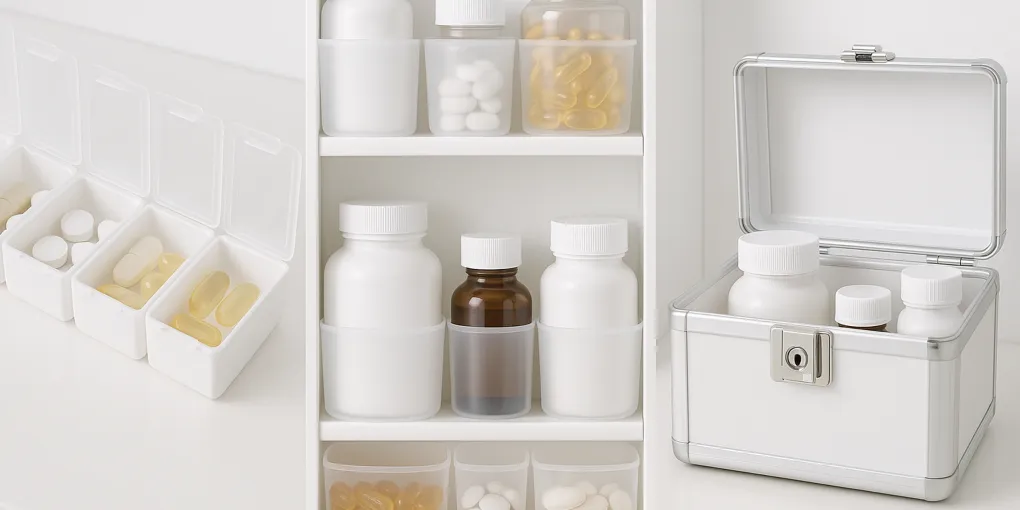
Apex Ultra-Slim Weekly Pill Organizer
Best OverallCompartments: 28 (4x daily for 7 days)
$18–24
Quick picks
| Product | Key Specs |
|---|---|
| See price on Amazon |
|
| See price on Amazon |
|
| See price on Amazon |
|
| See price on Amazon |
|
| See price on Amazon |
|
Product availability, certifications, and retailer details can change; check the current Amazon page before buying.
The Medication Adherence Problem — And How Organization Helps
Medication non-adherence costs the US healthcare system an estimated $100–300 billion annually. The causes are complex, but one of the most preventable is simply forgetting — did I take my pill this morning? For people managing multiple daily medications, this uncertainty isn’t just inconvenient, it’s potentially dangerous. Either a dose is missed, or a dose is doubled because the first was forgotten.
Behavioral science research on habit formation shows that what’s called “implementation intention” — pre-planning exactly when, where, and how an action will occur — dramatically improves follow-through. A well-organized pill organizer loaded each Sunday for the week ahead functions as an implementation system: when you sit down for breakfast Monday, the pill for Monday morning is there, labeled, and ready. The decision has already been made.
Medicine cabinet organization addresses a parallel problem: the disorganized cabinet where expired medications, topical creams, and vitamin bottles co-exist in a chaos that slows access when you need something and obscures what you actually have.
We evaluated 11 home medicine organizer products across compartment functionality, child safety, accessibility, and durability to identify the solutions that serve different household contexts.
Apex Ultra-Slim Weekly Pill Organizer — Best Overall
Best for: Adults managing 3–8 daily medications, weekly pre-loading, household medicine management
The Apex Ultra-Slim represents the best balance of compartment count, usability, and price for the majority of daily medication users. Its 28-compartment layout (four compartments per day: AM, Noon, PM, and Bedtime) handles complex multi-medication schedules without the bulk of larger dispensers.
What Works
The “ultra-slim” designation is accurate — the organizer is 1.2 inches thick, which means it fits in a standard drawer or on a nightstand without being obtrusive. Each day detaches as a separate module, so you can take a day’s worth of pills with you when traveling without carrying the full week’s supply.
The push-button compartment lids are finger-friendly — large enough to open one-handed without requiring the pinching grip that some organizer designs demand. This is important for daily usability; an organizer that’s inconvenient to open encourages skipping.
The BPA-free plastic construction is easy to clean with a damp cloth and resists staining from colorful supplement capsules.
What to Know
The Apex organizer has no locking mechanism — it’s not suitable for households where children have access to the medication area. For child-safe storage, the lockable box options are more appropriate. This organizer excels in adult-only households or storage locations inaccessible to children.
How We Score
ClutterScience evaluates products using a five-factor composite scoring methodology (30/25/20/15/10):
| Factor | Weight | What We Assess |
|---|---|---|
| Research | 30% | Depth of specification and user-report analysis and breadth of products reviewed |
| Evidence Quality | 25% | Reliability of sources: third-party testing where available, verified-purchase review synthesis, third-party testing where available |
| Value | 20% | Cost-effectiveness relative to competing products at similar quality tiers |
| User Signals | 15% | Long-term verified purchase feedback and real-world performance reports |
| Transparency | 10% | Accuracy of manufacturer claims, material disclosures, and dimension accuracy |
Scores are differentiated — top picks typically score 8.5–9.5, mid-tier 7.0–8.4, and weak options below 7.0.
Scoring
| Criterion | Weight | Score |
|---|---|---|
| Capacity & Dimensions | 30% | 8.8/10 |
| Material Quality | 25% | 8.5/10 |
| Ease of Assembly & Use | 20% | 9.0/10 |
| Long-Term Value | 25% | 9.0/10 |
| Composite Score | 8.8/10 |
AUVON iMedassist Large Print Weekly Pill Organizer — Best for Seniors
Best for: Elderly users, people with arthritis or limited dexterity, low-vision users
The AUVON organizer was specifically designed with elderly users in mind, and the design differences from standard organizers are substantive rather than cosmetic. The lid buttons are oversized, require significantly less force to depress, and have a positive tactile click that confirms the compartment has opened — important feedback for users who can’t easily see the compartment status.
What Works
The large-print day and time labels are printed in high-contrast black on white with font size approximately 2x standard. This makes day identification reliable without reading glasses for most users and possible with reading glasses for those with mild vision loss.
The organizer is slightly wider and thicker than the Apex model, which contributes to the easier-open lid design and the larger print space. For users managing arthritis or other conditions that reduce hand strength and grip precision, this size increase is not a drawback — it’s a feature.
The 28-compartment layout (4 times daily for 7 days) is identical to the Apex, covering the same complex schedule needs.
What to Know
The larger form factor means it takes up more drawer or shelf space than the Apex. The wider design is less portable for single-day travel modules. For households where the organizer lives on a nightstand or dedicated shelf rather than in a drawer, the size is not a practical limitation.
Scoring
| Criterion | Weight | Score |
|---|---|---|
| Capacity & Dimensions | 30% | 8.5/10 |
| Material Quality | 25% | 8.5/10 |
| Ease of Assembly & Use | 20% | 9.5/10 |
| Long-Term Value | 25% | 8.8/10 |
| Composite Score | 8.8/10 |
Mele & Co. Lockable Medication Storage Box — Best Lockable Storage
Best for: Households with children, shared living situations, controlled substance storage
Lockable medication storage is not optional in households with children. Standard pill organizers and unlocked medicine cabinets provide no barrier to access — a 4-year-old who discovers a pill organizer will explore its contents. The Mele & Co. lockable box provides a keyed metal lock in a box sized for storing a pill organizer plus a supply of prescription bottles.
What Works
The MDF box construction is solid — harder to force open than plastic alternatives and heavy enough that it can’t be easily carried off by a young child. The interior is lined with felt and has a configurable layout that accommodates different storage arrangements.
The keyed lock mechanism is reliable. Two keys are included. The lock cylinder is a standard width that can be replaced if keys are lost, which matters for long-term ownership.
The box exterior has a clean, wood-finish aesthetic that doesn’t broadcast “medication storage” — it looks like a small keepsake box and sits unobtrusively on a shelf or in a cabinet.
What to Know
The lock is designed for access prevention, not security-grade tamper resistance. It will prevent a child from accessing the contents, but a determined adult with a pry tool could force it. For high-value security (controlled substances with potential theft risk), a dedicated medication safe with a more robust lock is more appropriate.
Scoring
| Criterion | Weight | Score |
|---|---|---|
| Capacity & Dimensions | 30% | 7.8/10 |
| Material Quality | 25% | 8.5/10 |
| Ease of Assembly & Use | 20% | 8.2/10 |
| Long-Term Value | 25% | 8.5/10 |
| Composite Score | 8.2/10 |
Sorbus Medicine Cabinet Organizer Tray Set — Best Cabinet Insert
Best for: Organizing bathroom medicine cabinets, bottle and tube storage
Most bathroom medicine cabinets are small shelves where medications, first aid supplies, and personal care items accumulate into undifferentiated piles. The Sorbus tray set introduces clear acrylic compartments that organize bottles by height and category, making the cabinet contents immediately visible and retrievable.
What Works
The clear acrylic trays allow the label of every bottle to be visible without removing anything from the cabinet. This eliminates the “dig through everything to find the ibuprofen” problem that makes disorganized medicine cabinets frustrating. The tiered design places shorter items in front and taller bottles behind, creating unobstructed sightlines to the entire contents.
The modular tray format means the configuration adjusts to different cabinet widths. Trays can be arranged side by side or front to back depending on the cabinet interior dimensions.
What to Know
Acrylic trays are visually clean but require regular cleaning — they show water spots, dust, and spilled liquids readily. Plan for monthly cabinet wipe-downs to maintain the clean appearance that makes the tray system functional.
For broader bathroom organization that complements medicine cabinet inserts, see our bathroom organizer guide for a comprehensive bathroom storage approach.
Scoring
| Criterion | Weight | Score |
|---|---|---|
| Capacity & Dimensions | 30% | 8.0/10 |
| Material Quality | 25% | 8.2/10 |
| Ease of Assembly & Use | 20% | 9.0/10 |
| Long-Term Value | 25% | 8.0/10 |
| Composite Score | 8.2/10 |
StackedBin 30-Day Pill Dispenser — Best High-Capacity Organizer
Best for: Monthly prescription management, elderly users filling prescriptions monthly, caregivers
For users managing complex medication regimens or for caregivers loading medications for elderly family members, a monthly organizer reduces the pill-sorting burden from a weekly to a monthly task. The StackedBin 30-day dispenser provides 30 daily compartments in a stackable format that fits on a shelf or countertop.
What Works
The stacking format saves horizontal space — each day’s module is a small square container that stacks vertically into columns. The modular design allows the full 30-day supply to be stored in a compact footprint, and individual day containers can be pulled for travel or delivery to users in other locations.
For caregivers managing an elderly parent’s medications, loading 30 days at once from a single monthly prescription fill is significantly more efficient than weekly loading.
What to Know
The 30-day format only works if medications are consistently refilled monthly. For prescriptions with variable refill schedules or medications taken as-needed, a weekly organizer is more practical. The stackable format requires a stable surface — the column of day containers can topple if jostled.
Scoring
| Criterion | Weight | Score |
|---|---|---|
| Capacity & Dimensions | 30% | 9.0/10 |
| Material Quality | 25% | 8.0/10 |
| Ease of Assembly & Use | 20% | 7.8/10 |
| Long-Term Value | 25% | 8.5/10 |
| Composite Score | 8.4/10 |
A System for Home Medication Management
Audit Your Supply Twice a Year
The average home medicine cabinet contains a significant proportion of expired medications. Expired medications range from merely ineffective to potentially harmful — some degrade into compounds with different chemical properties than the original medication. Schedule a twice-yearly cabinet audit to identify and safely dispose of expired items. Many pharmacies accept expired medication for safe disposal.
Create a Tiered Storage System
Not all medications require the same access frequency. Organize in three tiers:
- Daily medications — in a pill organizer, loaded weekly, in your most accessible location
- Frequent-use OTC medications — ibuprofen, antihistamines, cold remedies — in labeled bins in an accessible cabinet
- Infrequent supplies — prescription medications used situationally, first aid supplies — labeled in a dedicated cabinet with less frequency-optimized layout
Label Everything
Every storage container should have a label visible without opening it. Handwritten label tape on bins, printed labels on bottle groups, and day/time markings on pill organizers all serve the same function: they make the system self-explanatory to any household member.
Store Where You Actually Take Medications
People who take morning medications are more likely to take them if they’re stored next to the coffee maker than in the bathroom cabinet. Medication storage doesn’t have to be in the bathroom — it should be wherever the behavioral cue for taking them exists.
For bathroom-specific storage integration, including how medicine cabinet organization fits into a complete bathroom storage system, see our bathroom organizer guide.
Bottom Line
For most households, the Apex Ultra-Slim Weekly Pill Organizer is the best starting point: a flexible, daily-use organizer that handles complex multi-medication schedules in a compact, easy-to-use format.
For households with children, the Mele & Co. Lockable Box is not optional — it’s essential. It provides the child-access barrier that no standard organizer delivers.
For elderly users or those with limited hand strength, the AUVON iMedassist organizer delivers the same scheduling capability with design features that make daily use genuinely manageable.
Medicine organization is one of the few organizational investments with direct health consequences. The 20 minutes it takes to set up a weekly pill organizer can prevent missed doses, double dosing, and the anxiety of uncertainty about whether today’s medication was taken.
Related Articles
- Best First Aid Kit Organizers and Medicine Storage
- How to Organize Your Medicine Cabinet
- Best Bathroom Corner Shelves
Frequently Asked Questions
- Pill organizers are designed to sort and pre-load doses of pills and supplements by day and time. They're portable, used daily, and help with adherence to medication schedules. Medicine cabinet organizers are trays, dividers, and bins that organize bottles, boxes, and supplies inside a medicine cabinet or bathroom storage area. Most households benefit from both — a pill organizer for daily medication management and cabinet organizers for storing the broader medicine supply.
- Start by counting how many medications are taken daily and at what times. If you take 3+ medications at multiple times per day, a 28-compartment organizer with AM/PM/Noon/Evening sections is more manageable than a 7-day AM/PM organizer. If you take one or two medications once daily, a basic 7-day organizer is sufficient. For elderly users or those with limited hand dexterity, large-button, easy-open designs like the AUVON are significantly easier to use.
- The American Academy of Pediatrics recommends that all medications be stored in locked containers out of children's reach. Standard medicine cabinets are not child-safe — most children over 3 can access them. Lockable storage boxes or cabinets mounted above child reach provide the safest storage approach. Never leave medications on countertops or in accessible drawers.
- Bathroom medicine cabinets are traditional but not ideal. Bathroom heat and humidity fluctuations (from showers) accelerate degradation of many medications. A cool, dry, dark location — like a bedroom dresser drawer or a kitchen cabinet away from the stove — is better for medication longevity. The exception is medications that specifically require refrigeration, which should be stored in a dedicated refrigerator container.
- Categorize first: daily medications, first aid supplies, cold/flu supplies, pain relievers, topical treatments, and vitamins/supplements. Use separate bins or trays for each category rather than mixing everything together. Label all compartments and review the supply every 6 months to dispose of expired items. For households managing multiple family members' medications, color-coding by person is an effective identification system.