Best Board Game Storage Bags and Shelves for Family Rooms
Buyer's GuideFurinno Luder 3-tier cube bookcase
Best for familiesBest For: Heavy game boxes that need to stay visible and reachable
$45-140
Quick picks
| Product | Key Specs |
|---|---|
| See price on Amazon |
|
| See price on Amazon |
|
| See price on Amazon |
|
Product availability, certifications, and retailer details can change; check the current Amazon page before buying.
Board game clutter is not just a stack problem. It is a parts problem. A family-room shelf can look tidy while dice, cards, tokens, batteries, and small magnets migrate into couch cushions and toy bins. The best board game storage keeps the box or bag easy to recognize, keeps pieces with the game, and keeps small parts away from children who are too young for them.
This guide focuses on storage products that help a real household play and clean up faster: low cube shelves, clear zip game bags, card cases, and small parts boxes. If the wider room is the problem, start with best living room bookshelves or why toy bins hide small parts.
Quick picks
- Best family shelf: Search Amazon for Furinno Luder cube bookcases. Choose a low unit that can be anchored if children use the room.
- Best broken-box fix: Search Amazon for EOOUT board-game storage bags. Use one bag per complete game, including instructions.
- Best card-game reset: Search Amazon for IRIS USA photo keeper cases. Keep travel decks and expansion packs from spreading.
Safety and fit checks before buying
Safe Kids Worldwide warns that small toy parts can be choking hazards for young children and recommends keeping small objects away from kids who still mouth items (Safe Kids toy safety). The CDC also notes that falls are a major home injury risk for older adults, which matters when boxes become floor piles in walkways (CDC falls prevention).
For board games, the practical rule is simple: store heavy boxes low, keep walkways clear, and put tiny pieces in closed containers. A beautiful tall game tower in a narrow hallway can be worse than the original stack if it tips, blocks a path, or encourages children to climb.
Pick 1: low cube shelf for intact boxes
A low cube shelf is the best default for families with several intact board game boxes. The cube format keeps games visible without creating a tall leaning stack. It also gives larger boxes a defined limit. When a cube is full, the household has to rotate or donate games instead of piling more on top.
Look for 13-inch cubes if your games include square party-game boxes or large family games. Check depth before buying; shallow shelves leave boxes hanging out, while very deep shelves hide smaller games in the back. In kid spaces, use the manufacturer’s anchoring hardware or choose a lower, heavier unit that is less tempting to climb.
Skip a cube shelf if most of your boxes are already crushed. A shelf will display the damage but will not keep pieces contained.
Pick 2: clear zip bags for damaged boxes
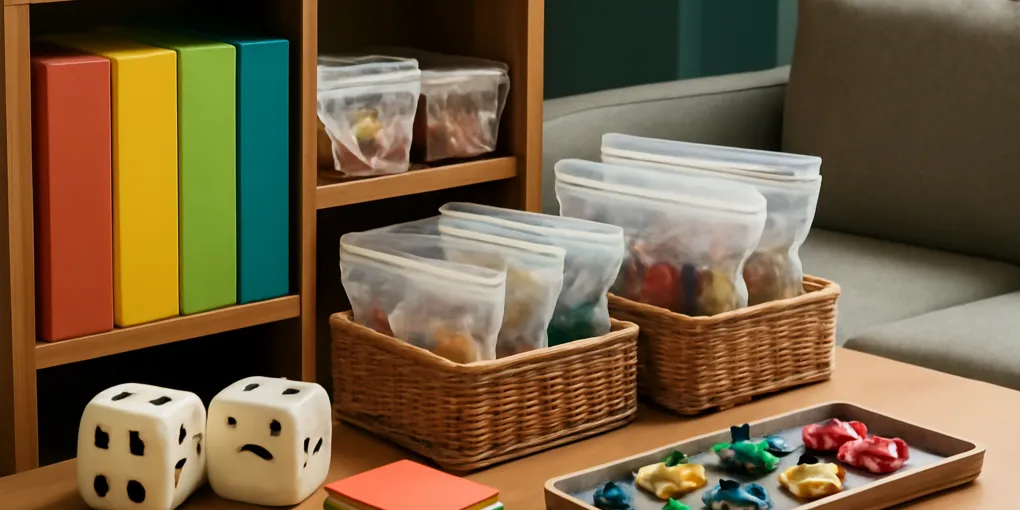
Clear zip board game bags solve a different problem: the game is still useful, but the cardboard box no longer closes. The best bags are large enough for the board, instructions, cards, and token bags. Slider closures are easier for kids than stiff press seams, but the closure must stay shut when the bag is stored upright.
Do not split one game across several tiny pouches unless you are storing expansion content with an adult hobby system. For family cleanup, one game should equal one container. If the board is too large for a bag, keep the board with the bag in a labeled cube or shallow bin.
Pick 3: photo keeper or card case for small games
Card games fail when decks spread into junk drawers, backpacks, and toy boxes. A photo keeper-style case gives each deck its own small case inside a larger latching box. It works well for Uno-style decks, matching games, trivia decks, and travel games.
The caution is labeling. Do not rely on memory if the deck art is no longer visible. Put the original instruction card or a small title card inside each case. For games with tiny tokens, use a case with a secure latch and store it above toddler reach.
Pick 4: small parts box for tokens and dice
Some games need internal sorting more than external storage. A small craft parts box can separate dice, coins, meeples, timers, and scoring pieces inside a larger game bag or box. Choose shallow compartments that close tightly. Avoid tackle-style boxes with removable dividers if thin cards or tokens can slide underneath.
This product is not for every game. Over-sorting a simple children’s game makes cleanup slower. Use parts boxes for games that are currently abandoned because setup takes too long or pieces are always missing.
Board game storage decision matrix
| Problem | Best product | What to measure |
|---|---|---|
| Heavy boxed games slide into a floor pile | Low cube shelf | Box height, shelf depth, anchoring location |
| Boxes are crushed but pieces are complete | Clear zip game bags | Board size and instruction sheet size |
| Card games lose decks | Photo keeper or card case | Deck thickness and number of decks |
| Tokens mix between games | Small parts box | Largest token and compartment closure |
Setup that keeps pieces with the game
Before loading the new storage, audit one game at a time. Remove games missing essential pieces unless you can replace them immediately. Bag dice, tokens, and small parts inside the game container. Keep instructions with the game, not in a separate binder that nobody checks during cleanup.
Then assign a shelf rule. Family favorites go in the easiest cube. Adult strategy games go higher or in a closed cabinet. Small-piece games that are not safe for younger children should not live in the same open bin as preschool toys.
How to choose by room
A living-room game shelf should look calm enough to stay public. Use one low cube or cabinet zone for games that adults and kids play together. Put the heaviest boxes in the bottom row, party games at eye level, and small card cases in a bin that can be carried to the table. If the shelf is near a walkway, avoid baskets that stick out beyond the shelf face.
A playroom needs stricter sorting. Keep preschool games, puzzles, and large-piece games low. Move marble games, dice-heavy games, trivia games with tiny tokens, and adult games to a closed upper cabinet. The product choice is not just about neatness; it is about matching reach to age and supervision.
A closet can store overflow games, but it should not become a game graveyard. Use clear zip bags or labeled bins only for games that still get played. Seasonal or holiday games can live higher. Weekly favorites should not require moving coats, linens, or vacuum attachments.
What to avoid
Avoid giant mixed tubs. They feel efficient during cleanup, but they destroy game identity. Once cards, boards, and tokens separate, the household stops choosing those games because setup becomes a search project.
Avoid over-decanting hobby games into unlabeled plastic boxes unless one adult owns the system. Family cleanup works best when the game is recognizable from the outside. If a child or guest cannot tell where the game goes, it will land on the closest flat surface.
Avoid storing heavy stacks above shoulder height. Large boxes slide when someone pulls from the middle, and falling game boxes can scatter pieces across a room. If tall storage is unavoidable, put lightweight party games higher and heavy strategy boxes lower.
A simple buying sequence
Start with the shelf or cabinet zone, not the pouches. Count the games that still have usable boxes and measure the largest three. Buy a low shelf only if those boxes need a visible home. Next, buy clear zip bags for damaged boxes that are otherwise complete. Last, buy card cases and small parts boxes for games that fail because pieces spread, not because the outside storage is wrong.
This sequence prevents a common mistake: buying dozens of pouches when the real issue is a shelf that is too high, too deep, or too crowded. Products should match the failure point. A crushed box needs a bag. A lost deck needs a card case. A floor pile needs a shelf. A choking hazard needs higher or closed storage. If one product does not remove a specific cleanup failure, skip it and spend the money on replacing the game that actually gets played or on a shelf location the family can reach daily and return without fuss.
Board Game Storage FAQ
How many board games should fit in one cube?
Enough that each game can be removed without unloading the whole cube. If boxes have to be wedged in, the shelf will become a floor pile after one game night.
Are clear bags safe for all children’s games?
No. Bags are useful for containment, but games with small parts still need age-appropriate storage and supervision. Keep choking hazards away from younger children.
Should I throw away damaged boxes?
Only after you have moved the title, instructions, board, and all pieces into a durable replacement bag or case. The box art is often the only quick identifier.
Sources
- Safe Kids Worldwide, Toy Safety: https://www.safekids.org/safetytips/field_risks/toy-safety
- CDC, Falls Prevention: https://www.cdc.gov/falls/prevention/index.html
Frequently Asked Questions
- Use a low reachable shelf for intact boxes, clear zip bags for broken boxes, and small cases for card games. Keep tiny pieces out of toddler reach.
- Sturdy boxes can stand vertically if pieces are bagged inside. Weak boxes and games with loose trays usually do better flat or in zip bags.
- Bags are better for damaged boxes and travel. Shelves are better for browsing, heavy games, and keeping family favorites visible.