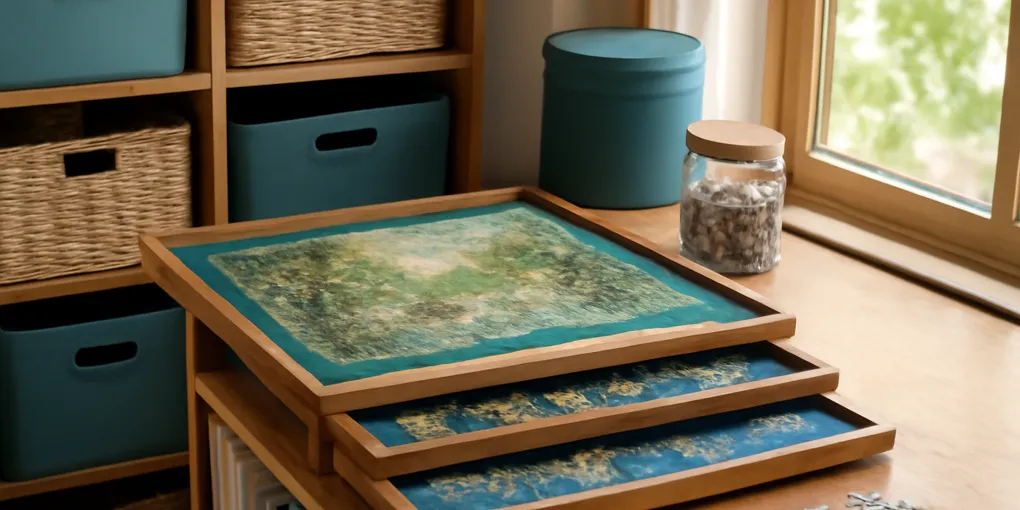
Best Jigsaw Puzzle Storage Boards for Unfinished Puzzles
Buyer's GuidePortable puzzle board with cover
Best table saverBest For: Households that need to move an unfinished puzzle off the table
$35-90
Quick picks
| Product | Key Specs |
|---|---|
| See price on Amazon |
|
| See price on Amazon |
|
| See price on Amazon |
|
Product availability, certifications, and retailer details can change; check the current Amazon page before buying.
An unfinished jigsaw puzzle becomes clutter when it claims a table longer than the household expected. The best jigsaw puzzle storage board is not the fanciest one. It is the surface that lets you pause the puzzle, protect the edge work, and move the project without turning loose pieces into a second mess.
This guide is for adults and families who build puzzles over several days. If your game shelf is the larger problem, start with our best board game storage guide first. Puzzle storage solves a different job: a project in progress, not a closed box on a shelf.
Quick picks
- Best table saver: Search Amazon for puzzle boards with covers. Choose this when the dining table must clear between puzzle sessions.
- Best low-cost option: Search Amazon for roll-up puzzle mats. Choose this for occasional puzzles and shallow closet storage.
- Best piece control: Search Amazon for puzzle sorting trays. Choose this when edge pieces, sky pieces, and nearly identical colors keep mixing.
- Best closed storage: Search Amazon for puzzle storage cases. Choose this when pets, kids, or dust make an open board risky.
Best overall: a portable puzzle board with a cover
A good puzzle board gives the puzzle a defined footprint. Look for a smooth work surface, raised edges, a cover sheet or lid, and enough stiffness that the board does not flex when moved. If the board folds, check whether the fold line crosses the build area. Fold seams can disturb large connected sections.
Measure before buying. A 1,000-piece puzzle is not one standard size. Many finished puzzles are around 20 by 27 inches, but panoramic and specialty puzzles can be much wider. The product listing should show usable surface dimensions, not just outside frame dimensions.
Best budget option: a felt roll-up mat
A roll-up mat works when storage space matters more than perfect piece stability. It usually includes a felt or fabric surface, an inflatable or foam tube, and straps. The advantage is obvious: the whole project can slide behind a sofa or into a closet. The tradeoff is that partially connected sections can shift during rolling.
Use a roll-up mat for puzzles with clear color zones and larger pieces. Skip it for delicate wooden puzzles, very loose-fitting puzzles, or projects where you need the edge frame to stay exactly square.
Best add-on: sorting trays that stack
Sorting trays reduce the table spread. Instead of five piles across the work surface, edge pieces and color groups get shallow containers. Stackable trays are useful because they can close the session quickly without dumping every group back into the box.
This is also where safety matters. Small puzzle pieces are easy to scatter. Safe Kids notes that small parts can be a choking hazard for young children (Safe Kids toy safety). If toddlers visit, choose lidded containers or store trays out of reach rather than leaving sorted pieces on a coffee table.
Best for pets and dust: a closed puzzle case
A zippered or latching puzzle case protects the project better than an open board. It is useful if a cat jumps on tables, a dog tail sweeps low surfaces, or the puzzle sits in a dusty room. The case should open flat and close without compressing tall or uneven sections.
Check the handle orientation. Some cases carry vertically, which can slide loose pieces to one side. If you need to transport the puzzle between rooms often, a rigid board that stays horizontal is safer than a soft case carried like a briefcase.
Fit matrix
| Puzzle problem | Better product path | Avoid |
|---|---|---|
| Dining table must clear nightly | Rigid board with cover | Bare cardboard sheets that flex |
| Tiny apartment storage | Roll-up mat | Oversized framed board with nowhere to live |
| Many color groups mix together | Stackable sorting trays | Open bowls that spill when stacked |
| Pets jump on the table | Closed puzzle case | Thin cloth cover that slides off |
| Kids visit often | Lidded trays or high shelf storage | Leaving small pieces on low tables |
What to check before buying
Start with the finished puzzle dimensions printed on the puzzle box. Then add a few inches for sorting and hand movement. A board that barely fits the finished image will feel cramped because loose pieces still need a working lane.
Look at the surface texture. Felt grips pieces but can hold lint. Smooth fiberboard is easier to wipe but may let pieces slide. A slightly raised edge is helpful, but a tall lip can make it harder to slide connected sections into place.
Finally, decide where the board will live while stored. Under-bed storage, behind a sofa, and a closet shelf all require different thickness and handle choices. The right board is the one you can put away in ten seconds, not the one with the most accessories.
Setup protocol
- Open the puzzle box and confirm the finished dimensions.
- Put the board or mat in its normal working spot before dumping pieces.
- Reserve one tray for edge pieces and one tray for ambiguous dark pieces.
- Keep the box lid photo with the board, not across the room.
- At the end of each session, cover or close the puzzle before clearing snacks, drinks, or craft supplies.
When not to buy a dedicated puzzle board
Do not buy a board if you build one small puzzle per year and already have a spare foam board. Do not buy a giant framed system if it will lean permanently in a hallway. For occasional puzzlers, a shallow lidded under-bed box may solve the same problem with less product clutter.
A dedicated board makes sense when puzzles are a repeat hobby, shared tables cause tension, or loose pieces routinely disappear between sessions.
How to choose by puzzle size
For 300- to 500-piece puzzles, a compact board or lidded tray is usually enough. The storage product should be small enough to slide onto a bookshelf or under a sofa. Oversized puzzle tables look attractive online, but they can create a new furniture problem if the hobby is occasional.
For 750- to 1,000-piece puzzles, prioritize a flat work surface and a cover. This is the range where a puzzle often lasts multiple evenings and the table conflict becomes real. A board with drawers can help, but drawers are not required if you already use sorting trays.
For 1,500-piece puzzles and panoramic puzzles, verify the finished dimensions before trusting the piece-count claim. Some boards advertised by piece count fit only standard rectangles. If the product page does not list usable work area, choose another option.
Storage spots that actually work
Under a bed works if the board is rigid, thin, and covered. Measure clearance with bedding in place because bed skirts, storage boxes, and frame supports can catch the corners. Behind a sofa works only if the board stays vertical without bending and nobody will knock it over.
A closet shelf is safer for households with pets or children, but it requires a handle or case that can be lifted without tilting. If the board is heavy, store it at waist or chest height rather than above your head. The goal is to remove the puzzle quickly without making the storage move risky.
Do not store an open puzzle near a heater, sunny window, or damp basement wall. Humidity and warping can make pieces curl or separate. If a puzzle is special enough to preserve for weeks, it deserves a closed case or a room with stable conditions.
Accessories worth skipping
Skip tiny novelty trays that hold only a handful of pieces. They look neat in photos but do not help with large sky, grass, or border sections. Skip boards with many shallow drawers if the drawers slide out during carrying. A simple tray stack can be easier to control.
Also skip storage systems that require perfect cleanup. If every session ends with twenty minutes of rearranging, the system will fail. The best puzzle storage makes the stopping point obvious: cover the board, stack the trays, put the box image on top, and move the project. If that routine sounds too fussy, use a smaller lidded tray and buy less storage rather than more.
Jigsaw puzzle storage FAQ
Can I store an unfinished puzzle under a bed?
Yes, if the puzzle is on a rigid board or inside a shallow lidded box that slides flat. Measure bed clearance and avoid soft mats that bunch up when pushed.
Do puzzle boards work for 1,500-piece puzzles?
Only if the usable surface is large enough for the finished puzzle and some loose pieces. Many boards sold for 1,000-piece puzzles are too small for larger panoramic puzzles.
What is the safest puzzle storage around toddlers?
Use a closed case, lidded trays, or a high shelf. Small pieces should not be left on low tables or in open trays where a child can reach them.
Sources
- Safe Kids Worldwide: Toy safety and small-part risk
Frequently Asked Questions
- A board is better when the puzzle needs to stay flat and move as one piece. A roll-up mat is cheaper and easier to store, but loose sections may shift.
- Match the board to the largest puzzle you realistically build, not the largest puzzle sold. Check finished puzzle dimensions before ordering.
- Sorting trays are useful for 1,000-piece puzzles or shared tables, but a small puzzle can work with shallow boxes you already own.