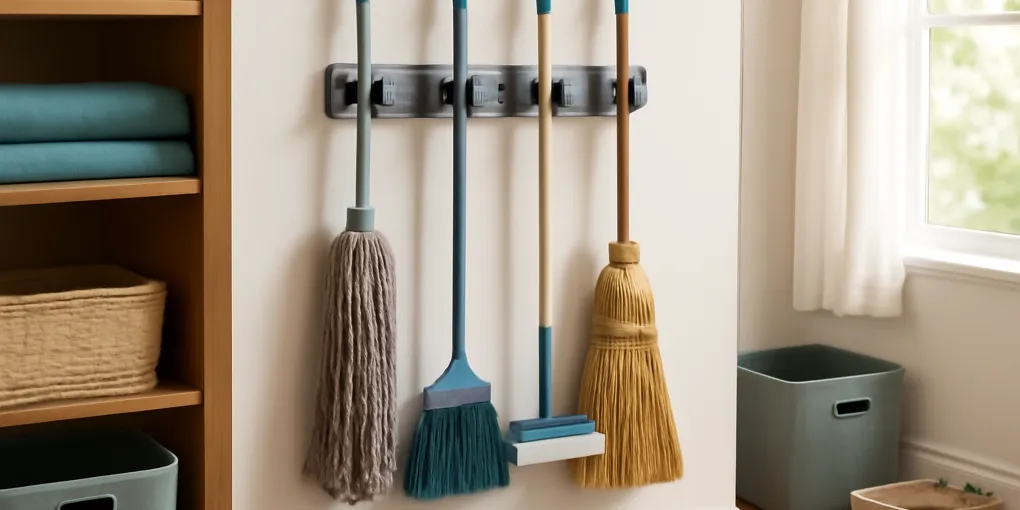
Best Broom and Mop Wall Holders for a Small Utility Closet
Buyer's GuideCommand Broom Gripper Style
Best renter-friendly single holderBest For: One or two lightweight tools on a smooth wall
$8-18
Quick picks
| Product | Key Specs |
|---|---|
| See price on Amazon |
|
| See price on Amazon |
|
| See price on Amazon |
|
Product availability, certifications, and retailer details can change; check the current Amazon page before buying.
A broom-and-mop pile usually starts as a storage problem and turns into a door problem. The broom slides forward, the mop handle catches the vacuum hose, the dustpan disappears behind a bucket, and the utility closet stops closing without a shove. A wall holder fixes that only if it matches the tool weight, wall surface, and door swing.
This guide compares three useful categories: single removable grippers, screw-mounted broom rails, and heavier garage-style racks. Start with the lightest product that can safely hold the tools you actually use.
If your long-handled tools share a narrow utility closet, compare our wall-mounted broom holders guide before drilling. Broom rails, mop hooks, and vacuum docks can fight for the same wall height.
Quick picks for the closet you actually have
- One lightweight broom: Search Amazon for Command broom grippers. Best when you rent, the wall is smooth, and the tool is not wet or heavy.
- Full cleaning closet: Search Amazon for broom and mop holder rails. Choose screw mounting and enough slots for each daily tool.
- Garage or mudroom: Search Amazon for heavy-duty tool racks. Use this for outdoor brooms, shovels, and heavier handles.
- Dustpan problem: Search Amazon for broom holder with hooks. Hooks matter when the dustpan needs to live with the broom.
The safety angle: keep the floor and door path clear
The CDC fall-prevention guidance lists home hazards such as clutter and tripping risks as part of fall prevention (CDC falls prevention). A utility closet is not a staircase, but a broom handle lying across a doorway creates the same practical issue: the item is stored where feet, doors, and hands need clear space.
That does not mean every closet needs an expensive rail. It means the holder should remove long handles from the floor path and keep them from springing out when the door opens.
Start with the tool audit
Before buying, pull every long-handled tool out of the closet and group it by use:
- Daily or weekly tools: broom, dustpan, mop, small duster.
- Occasional tools: extension duster, grout brush, spare mop handle.
- Outdoor tools: push broom, snow brush, rake, garden tool.
- Damaged or duplicated tools: cracked handles, worn mop heads, mystery attachments.
The wall holder should serve the first group. Occasional tools can live higher or farther back. Outdoor tools usually deserve a garage rack, not an indoor closet rail that blocks the mop.
Single adhesive grippers: best for one light tool
A removable broom gripper can be excellent for a single lightweight broom in a rental kitchen, laundry room, or apartment utility closet. It creates a home for the tool without drilling. It also makes the broom easy to grab because there is no rail to thread through.
The limit is load and surface. Adhesive products depend on clean, smooth, dry surfaces and correct installation. Do not use a removable gripper as a shortcut for a heavy wet mop, a textured wall, or a closet that gets humid. Read the product weight rating and removal instructions before committing.
Screw-mounted rail: best for several cleaning tools
A screw-mounted rail is the best choice when the closet holds multiple brooms, mops, dusters, and dustpans. Look for a combination of rubber grippers and side hooks. Grippers hold handles vertically. Hooks hold dustpans, scrub brushes, and lightweight accessories that otherwise fall behind the bucket.
Spacing matters more than slot count. A five-slot rail can fail if the mop head and broom head collide. Measure the widest tool head, then leave a little air between tools. If the closet is narrow, mount the rail on the side wall instead of the back wall so handles do not block the door.
Heavy-duty racks: best outside the closet
Garage tool racks are stronger, but they are not automatically better for an indoor utility closet. They often project farther from the wall and are designed for tools with larger heads. In a small closet, that projection can block shelves, buckets, or the door frame.
Choose a heavy-duty rack when tools are heavier, the wall can be anchored into studs, and the storage zone is a garage, mudroom, or basement wall. Do not use it to cram outdoor tools into a kitchen closet. Separate locations beat one overloaded rack.
Mounting checklist
Use this checklist before drilling or sticking anything to the wall:
| Check | Why it matters |
|---|---|
| Door swing | Handles should not hit the door or hinge side. |
| Wall material | Adhesive, drywall anchors, and studs have different limits. |
| Tool length | The tallest handle needs removal clearance. |
| Head width | Mop heads need side space to dry and avoid bumping. |
| Floor clearance | Tool heads should not wedge under shelves or buckets. |
| Drying needs | Wet mop heads need airflow before tight storage. |
If a mop is stored wet, the holder is only half the solution. Let the mop dry according to its care instructions before sliding it into a crowded closet.
What makes a broom holder worth installing
| Buying factor | What to look for |
|---|---|
| Clear walking path | The holder stops handles from leaning into the door swing, closet floor, or laundry path. |
| Honest safety claims | The product helps remove trip clutter, but it should not promise injury prevention. |
| Practical capacity | The rail fits the tools used monthly instead of turning one wall strip into another overloaded closet. |
| Easy daily reset | Brooms and mops can be removed with one hand and returned when someone is tired. |
| Mounting limits | Weight limits, surface limits, and wet-mop limits are stated plainly before installation. |
Where to mount the rail
The best height is usually shoulder to eye level for the gripper area, with tool heads just above the floor or baseboard. Test this with painter tape before installing. Hold the broom in place, open and close the door, and practice removing it. If the handle hits the closet header, lower the rail.
For small closets, the side wall can be better than the back wall. It keeps handles parallel to the door opening and makes shelves easier to reach. For laundry rooms, mount the rail away from washer vibration and damp splashes.
Buying mistakes to avoid
Do not buy the longest rail just because it has more slots. More slots invite tools the closet should not hold. Do not assume adhesive mounting is renter-safe on every painted surface. Do not hang sharp or heavy tools where children can pull them down. Do not hide the dustpan in a separate bin if the broom is on the wall. The pair should reset together.
The most common failure is installing the holder too low. A low holder leaves tool heads dragging, which makes the closet look neater for one day and then turns the floor into another jam point.
Small-closet layout examples
For a one-door utility closet, place the rail on the side wall if the back wall is blocked by shelves or a vacuum. Put the broom closest to the door, the mop farther back, and the dustpan on a hook below the broom handle. Keep the bucket on the floor under the mop only if it does not push the mop head into the door path.
For a laundry closet, avoid mounting tools where wet clothing or washer vibration will hit them. A short rail beside the machines can work for a broom and duster, but a wet mop may need a bathroom, mudroom, or garage drying spot before it returns to storage.
For a garage wall, mount heavy racks into studs when the manufacturer requires it and group tools by head size. Outdoor push brooms and rakes need more side clearance than indoor brooms. If the rack is overloaded on day one, split outdoor tools from indoor cleaning tools instead of buying a larger rail for the same crowded location.
Broom and Mop Holder FAQ
Is a broom holder better than a freestanding organizer?
For narrow closets, yes. A wall holder clears floor space and stops handles from sliding into the door. A freestanding organizer can work in a mudroom or garage with a wide floor zone.
How many slots should I buy?
Buy for the tools used monthly, not every handle you own. Most small utility closets need three to five grippers plus two hooks.
Can I mount a broom rail inside a cabinet door?
Only if the door is strong enough, the rail does not hit shelves, and the tools are light. Long handles usually work better on a wall than on a swinging door.
What if I cannot drill?
Use one or two removable grippers for lightweight tools and move heavy or wet tools to a freestanding or garage storage system.
Bottom line
For one light broom, a removable gripper can be enough. For a real utility closet, a screw-mounted rail with grippers and hooks is the better long-term fix. Choose a heavy-duty rack only when the wall, tool weight, and storage location justify it. The win is simple: the door opens, the floor path stays clear, and every handle has a visible home.
Frequently Asked Questions
- Use a screw-mounted rail for several tools, a removable gripper for one lightweight broom, and a heavy-duty rack for garage tools.
- Usually not reliably. Wet mop heads add weight and moisture, so use screw mounting or store the mop where it can dry before hanging.
- Mount it high enough that the tool heads clear the floor but low enough that handles can be removed without hitting the closet header.
- They should not lean across the walking path or wedge against the door. Floor contact is less important than stable vertical storage and dry mop heads.