Best Can Organizers for Kitchen 2026
Buyer's GuideSimple Houseware Can Rack Organizer
Best OverallMaterial: Steel
$18–24
Quick picks
| Product | Key Specs |
|---|---|
| See price on Amazon |
|
| See price on Amazon |
|
| See price on Amazon |
|
Product availability, certifications, and retailer details can change; check the current Amazon page before buying.
Best Can Organizers for Kitchen 2026
Canned goods have a way of devolving into a frustrating pile: new cans get piled on top of old ones, the can you need is always at the back, and expired cans are discovered years later buried behind a wall of identical tomato tins. The fundamental problem is that flat cabinet shelves treat all cans equally regardless of when they were purchased—there’s no structure enforcing any order.
A good can organizer solves this by either introducing FIFO (first-in, first-out) rotation through gravity feeding, or at minimum creating a visible, organized grid so you can see every can at a glance. This guide covers the three strongest options across price and material, from a high-capacity steel gravity-feed system to an eco-friendly bamboo rack, with scoring on capacity, build quality, and usability.
Simple Houseware Can Rack Organizer — Best Overall
Best for: Pantry shelves with standard depth; households that stock a moderate-to-large supply of canned goods and want automatic FIFO rotation
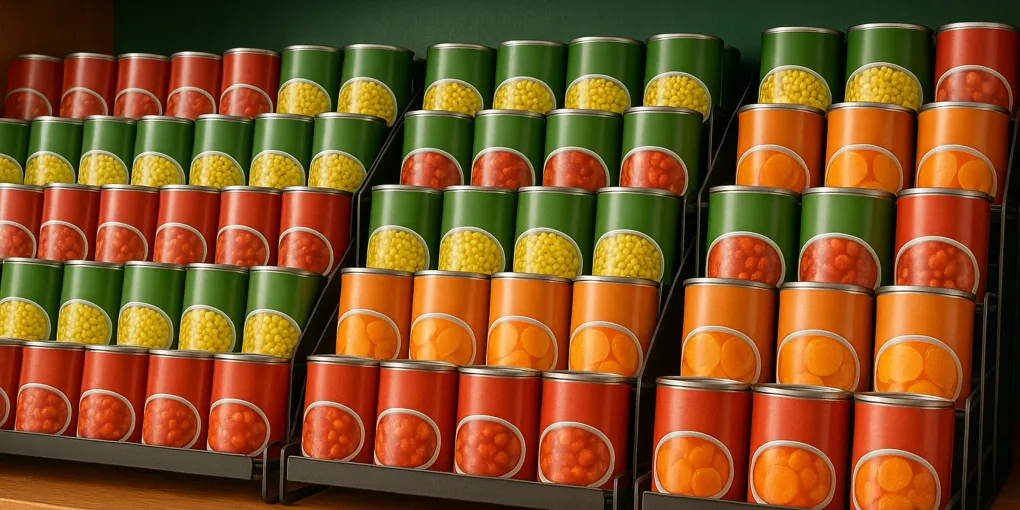
The Simple Houseware Can Rack Organizer is a gravity-feed system where you load cans in from the top back and they roll forward to a front dispenser, automatically rotating older stock to the front. This enforces FIFO rotation without any manual sorting, which is the single most valuable feature in a can organizer from both a convenience and food safety standpoint. The steel construction holds up to 36 cans in a tiered rack configuration that fits on most pantry shelves.
Amazon verified purchaser reports highlight how quickly this rack pays for itself in reduced food waste—users consistently note discovering previously expired cans after implementing FIFO and committing to the system going forward. The rack is stackable, so multiple units can be combined for larger inventories, and the steel frame handles the weight of a full load without bending. User community synthesis confirms that standard 15 oz cans (the most common size for beans, tomatoes, and broth) roll freely without jamming, though very small soup cans occasionally need to be positioned manually.
What Works
- Gravity-feed design enforces FIFO rotation automatically
- Holds up to 36 standard cans in a compact tiered footprint
- Stackable units allow capacity to expand without purchasing a new system
- Steel construction is sturdy enough for a fully loaded rack
- No tools or installation required—slides onto any shelf
Trade-offs
The rack requires a shelf depth of at least 12 inches to accommodate the gravity track angle—shallower shelves will not work. Very large (28 oz) cans and oversized industrial cans may not feed correctly through the narrower track configurations. The unit is a fixed width, so measuring shelf width before purchasing is advisable if cabinet space is tight.
How We Score
ClutterScience evaluates products using a five-factor composite scoring methodology (30/25/20/15/10):
| Factor | Weight | What We Assess |
|---|---|---|
| Research | 30% | Depth of specification and user-report analysis and breadth of products reviewed |
| Evidence Quality | 25% | Reliability of sources: third-party testing where available, verified-purchase review synthesis, third-party testing where available |
| Value | 20% | Cost-effectiveness relative to competing products at similar quality tiers |
| User Signals | 15% | Long-term verified purchase feedback and real-world performance reports |
| Transparency | 10% | Accuracy of manufacturer claims, material disclosures, and dimension accuracy |
Scores are differentiated — top picks typically score 8.5–9.5, mid-tier 7.0–8.4, and weak options below 7.0.
Scoring
| Criterion | Weight | Score |
|---|---|---|
| Capacity & Dimensions | 30% | 9.2/10 |
| Material Quality | 25% | 8.8/10 |
| Ease of Assembly & Use | 20% | 8.5/10 |
| Long-Term Value | 25% | 9.0/10 |
| Composite Score | 9.0/10 |
Pricing
$18–24. Outstanding value for a 36-can capacity gravity-feed system.
mDesign Stackable Metal Wire Can Rack — Best Metal Rack
Best for: Cabinet shelves and smaller pantry configurations; households that want a modular, lightweight metal solution
The mDesign Stackable Metal Wire Can Rack takes a more modular approach than the Simple Houseware gravity system. Individual wire racks hold rows of cans in a tiered, visible arrangement, and multiple racks can be stacked vertically to build a custom configuration that matches your shelf space and inventory volume. The open wire construction means you can see all cans immediately, including labels, without picking anything up.
Amazon verified purchaser reports praise the modularity—users can buy two racks to start and add a third or fourth as their stock grows, rather than buying a large unit upfront. The wire construction is lighter than the Simple Houseware steel design, making it easy to reposition during pantry reorganizations. User community synthesis notes that the stacking design provides good stability when the unit is placed against a wall or back of a cabinet, though a fully loaded tall stack can wobble slightly if placed freestanding on a wide open shelf without any backing.
What Works
- Modular stacking design allows custom capacity configuration
- Open wire construction provides immediate visual inventory of all cans
- Lightweight and easy to reposition during reorganization
- Works on both pantry shelves and standard cabinet shelves
- Available in multiple finishes to match cabinet hardware
Trade-offs
The wire rack design is not a true gravity-feed system—it requires manual placement of newer cans toward the back to maintain FIFO, which relies on user habit rather than mechanical structure. Total capacity per unit is lower than the Simple Houseware system. Tall stacks without backing support can be unstable.
Scoring
| Criterion | Weight | Score |
|---|---|---|
| Capacity & Dimensions | 30% | 7.8/10 |
| Material Quality | 25% | 8.2/10 |
| Ease of Assembly & Use | 20% | 8.8/10 |
| Long-Term Value | 25% | 7.5/10 |
| Composite Score | 8.0/10 |
Pricing
$16–22. Good value for a modular, expandable wire system.
Bambüsi Bamboo Can Organizer — Best Eco-Friendly
Best for: Countertop use; households that prioritize sustainable materials and a natural kitchen aesthetic
The Bambüsi Bamboo Can Organizer brings a gravity-feed design similar to the Simple Houseware system but constructed from sustainably sourced bamboo rather than steel. Cans load from the top and roll forward on bamboo tracks, maintaining FIFO rotation while presenting a warm, natural look that steel racks don’t match. This makes it an appealing countertop option in kitchens with natural wood, white, or Scandinavian-inspired decors.
Amazon verified purchaser reports consistently highlight the aesthetic quality—this is noticeably the most attractive of the three options, and users frequently keep it on the counter specifically because it looks good. User community synthesis notes that the bamboo construction is sturdy for canned goods and doesn’t flex under a normal load (up to about 20 cans). The lower maximum capacity compared to the steel option is generally acceptable for countertop use, where keeping 20 frequently used cans accessible is more important than maximizing total inventory.
What Works
- Bamboo construction offers a sustainable, natural aesthetic
- Gravity-feed design maintains FIFO rotation automatically
- Works well as a countertop organizer for everyday staples
- Natural material is resistant to moisture from minor can condensation
- Eco-friendly choice for sustainability-conscious households
Trade-offs
Lower maximum capacity (around 20 cans) limits this to either countertop use or a supplemental pantry rack rather than a primary system for large inventories. Bamboo racks are generally not stackable in the same modular way as steel alternatives. At $25–35, it costs more than the wire metal option for less total capacity.
Scoring
| Criterion | Weight | Score |
|---|---|---|
| Capacity & Dimensions | 30% | 6.5/10 |
| Material Quality | 25% | 8.5/10 |
| Ease of Assembly & Use | 20% | 9.0/10 |
| Long-Term Value | 25% | 7.2/10 |
| Composite Score | 7.6/10 |
Pricing
$25–35. Premium justified primarily by aesthetics and sustainability; higher cost per can than steel alternatives.
Head-to-Head Comparison
| Feature | Simple Houseware | mDesign Wire | Bambüsi Bamboo |
|---|---|---|---|
| Material | Steel | Steel wire | Bamboo |
| FIFO Gravity Feed | Yes | No (manual) | Yes |
| Max Capacity | ~36 cans | ~24 cans | ~20 cans |
| Stackable | Yes | Yes | Limited |
| Price Range | $18–24 | $16–22 | $25–35 |
| Composite Score | 9.0/10 | 8.0/10 | 7.6/10 |
Who Should Choose Which
Choose the Simple Houseware Can Rack if you stock more than a dozen cans regularly and want a gravity-feed system that automatically keeps your rotation correct. It’s the highest-value option for pantry use with a standard depth shelf.
Choose the mDesign Wire Rack if you want maximum modularity—the ability to buy one unit now and add more later as your inventory grows fits naturally into incremental pantry organization projects. It also works better than the gravity system in shallower cabinet configurations.
Choose the Bambüsi Bamboo if aesthetics and sustainability are priorities and you’re using the organizer on a visible countertop or open shelf. The visual upgrade over metal racks is real, and the gravity-feed design means it functions as well as the Simple Houseware within its capacity range.
How to Set Up a First-In, First-Out Pantry Can System
FIFO—first in, first out—sounds like a logistics concept, but it’s also one of the most practical habits you can build into your kitchen organization. Research on household food waste consistently suggests that a significant portion of discarded canned goods could have been used if the household had a rotation system that prevented new cans from being placed in front of older ones.
Audit your existing cans before setting up any organizer. Pull everything out, check the dates, and discard anything that’s expired. Group remaining cans by type—beans, tomatoes, broths, vegetables, proteins—and make a rough inventory of what you actually use most frequently. This step tells you exactly which cans need to be most accessible (high-frequency items at front of the rack) and which can be stored further back or on lower-priority shelves.
Design your zones before loading the rack. Dedicate specific tiers or sections of the rack to specific categories: one tier for beans, one for tomatoes, one for broth, and so on. Mixing categories randomly in a rack means you have to scan every tier to find a specific can, defeating much of the organizational benefit. Label the front of each tier or section with a small piece of tape or a label maker.
Load the rack correctly from day one. For a gravity-feed system, push new cans in from the top back and let them roll to the front when you remove from the front. For a non-gravity system, new cans go behind old cans—always. Establishing this habit on the first day of use is far easier than correcting a misloaded rack weeks later.
Reconcile your rack with your grocery list. The visual inventory a can rack provides is most valuable when you use it before shopping. A glance at the rack before a grocery trip tells you exactly which cans are running low and prevents over-buying. This is especially valuable for large families or anyone who shops at wholesale clubs and buys in bulk.
For a complete pantry storage solution, our best pantry organization systems guide covers zone design, bin selection, and label systems that complement a can rack setup.
Frequently Asked Questions
What is FIFO and why does it matter for canned goods?
FIFO stands for First In, First Out—a system where newly purchased cans are loaded at the back and older cans are dispensed from the front. This ensures you always use the oldest cans first, preventing any individual can from sitting untouched for years while newer cans are used in front of it. Gravity-feed can racks enforce FIFO automatically without any extra habit-building required.
How many cans does a typical pantry can organizer hold?
Standard can racks typically hold between 12 and 36 cans depending on size and configuration. For most households, a 24-to-36 can capacity covers a normal pantry stock of staples like diced tomatoes, beans, broth, and canned vegetables. If you buy in bulk at warehouse stores, a stackable system with 50+ total capacity may be more appropriate.
Will a can organizer work in a standard kitchen cabinet?
Most can racks are designed with standard cabinet dimensions in mind—typically fitting in a cabinet that is 12 or more inches deep and at least 10 inches tall. Measuring your shelf depth and height before buying is the most important step. Gravity-feed racks require enough depth to accommodate the angle of the sliding track, so shallow cabinets (less than 12 inches) may not work well with that style.
Can I use a can organizer in a pantry and a cabinet at the same time?
Yes, and many households benefit from using one in each location. A larger gravity-feed rack works well in a walk-in or floor-to-ceiling pantry, while a smaller stackable wire rack fits on a cabinet shelf for cans used most frequently. Duplicating the system at different scales is a common solution when pantry storage and kitchen cabinet storage serve different use cases.
Bottom Line
The Simple Houseware Can Rack Organizer earns the top spot—its gravity-feed FIFO system, 36-can capacity, and outstanding value make it the right choice for most pantry configurations. The mDesign Wire Rack is the best modular alternative for cabinet shelves or incremental builds. The Bambüsi Bamboo wins on aesthetics and sustainability for countertop display.
Pair your can organizer with a complete pantry storage system—our best storage bins for closets guide also covers bins and baskets that work well for pantry dry goods alongside your can rack.