Best Tupperware Organizers 2026
Buyer's GuideOXO Good Grips Plastic Lid Organizer
Best Lid-Only OrganizerType: Drawer or cabinet lid rack
$18–25
Quick picks
| Product | Key Specs |
|---|---|
| See price on Amazon |
|
| See price on Amazon |
|
| See price on Amazon |
|
Product availability, certifications, and retailer details can change; check the current Amazon page before buying.
Best Tupperware Organizers 2026
Food container storage is the source of some of the most reliable kitchen frustration: the lid that doesn’t match the container in hand, the avalanche of mismatched containers when the cabinet is opened, the drawer that can’t close because container bodies are stacked haphazardly. Despite being a universal problem, most kitchens allocate one cabinet or drawer to food containers with zero internal organization structure.
The root cause is mixing two distinct storage problems — container bodies and lids — in the same space without systems for either. This guide focuses on the organizational products that solve both sides of the problem, evaluated on fit, lid control, and long-term maintainability in real kitchen configurations.
OXO Good Grips Plastic Lid Organizer — Best Lid-Only Organizer
Best for: Households with mixed container collections needing a dedicated, adjustable lid rack for a drawer or lower cabinet
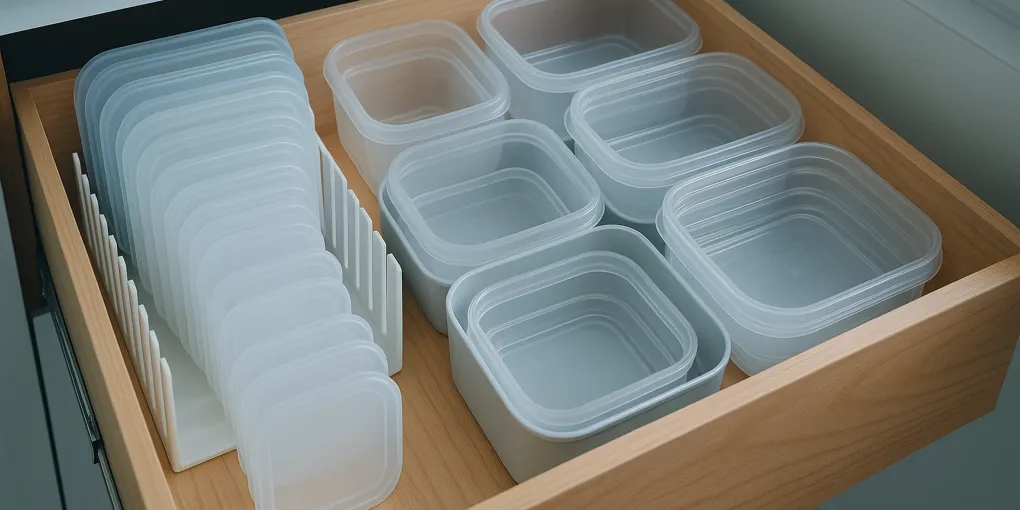
The OXO Lid Organizer applies OXO’s design-first approach to the specific problem of lid chaos. Multiple vertical slots in an adjustable-width chassis allow lids of varying sizes to stand upright and separately, making matching lids visible and retrievable without pulling out the entire collection. The BPA-free plastic construction is dishwasher-safe, which matters given that lid organizers accumulate food residue over time. Amazon verified purchaser reports consistently highlight how dramatically this changes lid retrieval — finding the right lid goes from a two-minute rummage to a five-second scan.
The adjustable-width design is the OXO’s specific differentiator. Slots can be repositioned to accommodate different lid diameters, which is valuable for households with a mix of container brands (Rubbermaid, Tupperware, glass containers, silicone lids) in varying sizes. The organizer fits in most standard kitchen drawers and can also be placed on a cabinet shelf. User community synthesis notes it handles both round and square lids, with round lids standing in the slots and square/rectangular lids sitting stably between wider-spaced dividers.
What Works
- Adjustable slots accommodate mixed lid collections of varying sizes and shapes
- Vertical slot design makes lids visible and individually accessible at a glance
- BPA-free plastic is dishwasher-safe for easy cleaning after food residue accumulates
Trade-offs
Primarily a lid organizer — container bodies still need a separate organization approach. Very large lids (12”+ diameter pot lids) don’t fit in the drawer format. Works best in a dedicated drawer rather than sharing space with other items.
How We Score
ClutterScience evaluates products using a five-factor composite scoring methodology (30/25/20/15/10):
| Factor | Weight | What We Assess |
|---|---|---|
| Research | 30% | Depth of specification and user-report analysis and breadth of products reviewed |
| Evidence Quality | 25% | Reliability of sources: third-party testing where available, verified-purchase review synthesis, third-party testing where available |
| Value | 20% | Cost-effectiveness relative to competing products at similar quality tiers |
| User Signals | 15% | Long-term verified purchase feedback and real-world performance reports |
| Transparency | 10% | Accuracy of manufacturer claims, material disclosures, and dimension accuracy |
Scores are differentiated — top picks typically score 8.5–9.5, mid-tier 7.0–8.4, and weak options below 7.0.
Scoring
| Criterion | Weight | Score |
|---|---|---|
| Capacity & Dimensions | 30% | 9.0/10 |
| Material Quality | 25% | 9.0/10 |
| Ease of Assembly & Use | 20% | 9.2/10 |
| Long-Term Value | 25% | 9.0/10 |
| Composite Score | 9.1/10 |
Pricing
$18–25. Very well-priced for the organizational impact on daily kitchen use.
mDesign Stack and Pull Plastic Bins — Best for Deep Drawers
Best for: Deep drawers or large lower cabinet shelves where container bodies need vertical organization in stackable pull-out bins
The mDesign Stack and Pull Bins approach the container-body side of the food storage organization problem. Rather than trying to organize containers on a flat shelf where items at the back become inaccessible, the stackable-bin system creates lanes of organized containers that pull out like drawers. Each bin holds a category of container bodies (round small, round large, rectangular), and pulling the bin forward brings rear items to the front.
This system works particularly well in deep drawers or in lower cabinets with 18+ inches of depth, where standard flat organization fails. Stacking the bins adds vertical dimension, allowing more container categories without requiring more shelf space. Amazon purchaser reports highlight the “pull-out” functionality as the key feature — no more reaching to the back of a cabinet or drawer for containers. User community synthesis suggests that two to three bins, each holding a category of container sizes, provide a complete organization for most household collections.
What Works
- Pull-out bin access eliminates the deep-drawer rear-access problem
- Stackable design uses vertical space in deep cabinets
- Category-per-bin approach keeps container types sorted without mixing
Trade-offs
Works best for container bodies, not lids — needs to be paired with a lid organizer. Bins need enough depth to accommodate the containers stored inside (measure before purchasing). All-plastic construction is functional but less premium than metal alternatives.
Scoring
| Criterion | Weight | Score |
|---|---|---|
| Capacity & Dimensions | 30% | 8.2/10 |
| Material Quality | 25% | 7.5/10 |
| Ease of Assembly & Use | 20% | 9.0/10 |
| Long-Term Value | 25% | 7.8/10 |
| Composite Score | 8.1/10 |
Pricing
$20–30. Solid mid-range value for the container-body side of food storage organization.
SimpleHouseware Plastic Storage Container Lid Organizer — Best Budget
Best for: Households with relatively standardized container collections who want lid organization at the lowest price point
The SimpleHouseware Lid Organizer occupies the budget tier of lid organization. Like the OXO, it uses vertical slots to stand lids upright in a cabinet or drawer. Unlike the OXO, the slots are fixed rather than adjustable, which means the organizer works best for collections with a consistent lid size range. Amazon purchaser reports note the value for the price and describe it as a significant improvement over unorganized lid storage, even if it’s less flexible than premium alternatives.
The BPA-free plastic construction is functional, though thinner than OXO’s materials. The organizer sits in a standard kitchen drawer or can be placed on a cabinet shelf. For households with a standardized container collection (e.g., all one brand or all similar sizes), the fixed slots are not a meaningful limitation. User community synthesis suggests this is an excellent first step toward lid organization — a low-cost, no-commitment solution that solves the primary lid-chaos problem even if it lacks the configurability of more expensive alternatives.
What Works
- Vertical slots solve the lid-matching problem at a budget price
- Fits in standard kitchen drawers without assembly
- BPA-free plastic handles kitchen humidity without degradation
Trade-offs
Fixed (non-adjustable) slots limit accommodation of mixed-size lid collections. Thinner plastic construction than OXO; more likely to show wear over time. Best for relatively uniform lid collections.
Scoring
| Criterion | Weight | Score |
|---|---|---|
| Capacity & Dimensions | 30% | 7.5/10 |
| Material Quality | 25% | 6.8/10 |
| Ease of Assembly & Use | 20% | 9.5/10 |
| Long-Term Value | 25% | 7.0/10 |
| Composite Score | 7.6/10 |
Pricing
$12–18. Excellent entry-level value for basic lid organization.
Head-to-Head Comparison
| Feature | OXO Lid Organizer | mDesign Stack Bins | SimpleHouseware Lid Organizer |
|---|---|---|---|
| Best for | Mixed lid collections | Container body organization | Budget lid organization |
| Installation | Drawer or cabinet shelf | Deep drawer or cabinet | Drawer or cabinet shelf |
| Solves | Lid chaos in mixed collections | Deep-drawer container access | Basic lid chaos at low cost |
| Price | $18–25 | $20–30 | $12–18 |
| Composite score | 9.1/10 | 8.1/10 | 7.6/10 |
Who Should Choose Which
Choose the OXO Lid Organizer if lid chaos is the primary problem and your collection includes a range of lid sizes and brands. The adjustable slots and dishwasher-safe construction make this the best long-term lid solution for a mixed container collection.
Choose the mDesign Stack and Pull Bins if the container-body side of the problem is as significant as the lid side. Deep drawers and lower cabinets benefit enormously from the pull-out bin approach, which makes rear items accessible without rearranging.
Choose the SimpleHouseware if budget is the top priority and your container collection is relatively standardized. It solves the basic lid-chaos problem without the adjustability premium.
How to Build a Functional Food Container Organization System
A complete food container organization system requires solving two problems independently: where container bodies go, and where lids go. Most organization failures happen because both are mixed together in the same space without distinct systems for each.
Start by emptying the container cabinet or drawer entirely. Lay out every container and every lid. Match lids to containers — any container without a matching lid, or any lid without a matching container, goes to recycling or donation immediately. This audit alone typically reduces most household container collections by 20–30%.
After the audit, sort remaining containers by shape and size: round containers nested together by size (small inside medium inside large), square containers nested separately, rectangular containers nested separately. This nesting arrangement maximizes the container-body storage efficiency. The goal is to give each shape category a designated space — a shelf zone, a bin, or a cabinet section.
For lids, vertical storage is far superior to horizontal storage. Lids stored flat in a pile require removing multiple lids to access one specific lid. Lids stored vertically in slots are individually visible and extractable. Even a simple vertical slot system (like a file folder rack) dramatically improves lid retrieval, which in practice means more frequent use of food containers for meal prep and leftovers storage.
Research on environmental design suggests that the friction involved in accessing frequently used items directly predicts whether those items get used. When matching a container and lid takes more than ten seconds, behavioral research indicates that people often choose a sub-optimal alternative (like covering a bowl with plastic wrap) rather than working through the organizational friction. An organized container system removes this friction and increases actual use of the storage containers — which, in turn, reduces food waste and single-use packaging.
For container collections that have outgrown a single drawer or cabinet, our guide to best kitchen cabinet organizers covers shelf and zone systems for broader kitchen storage reorganization.
Frequently Asked Questions
What is the best way to organize Tupperware and food storage containers?
The most effective system separates lids from container bodies. Containers nest by size inside each other (organized by type — round, square, rectangular), while lids stand vertically in a dedicated lid organizer. This approach eliminates the lid-hunting problem that makes food container cabinets frustrating. A drawer organizer for lids and a separate shelf for stacked container bodies is the standard high-functioning setup.
Should I store containers nested or separately?
Nesting container bodies (smaller inside larger, sorted by shape) is more space-efficient than storing containers individually. The key is consistency — round containers nest together, square containers nest together, and rectangular containers nest separately. Mixing shapes prevents clean nesting. Store lids separately, never under or inside nested containers, as this creates instability and makes matching lids difficult to retrieve.
How do I decide how many food containers to keep?
A useful heuristic is to count meal-prep days per week and multiply by the number of simultaneous portions stored. Most households actively use 8–12 containers at once. If you own 30+ containers, an audit is warranted — check for containers without matching lids, containers with staining or warping that affects sealing, and duplicates beyond what’s actually used. Reducing to an active-use collection before organizing makes the system easier to maintain.
Are adjustable lid organizers worth the extra cost?
Yes, for mixed container collections with lids of varying sizes. Fixed-slot organizers (at lower price points) work best when the container collection is relatively standardized. If you have a mix of Tupperware, glass containers, and various brand lids in different dimensions, an adjustable organizer like the OXO adapts to the actual lid portfolio rather than requiring it to conform to fixed slots.
Bottom Line
For lid organization, the OXO Good Grips Lid Organizer is the strongest choice — adjustable slots, dishwasher-safe construction, and the design quality that OXO consistently delivers make it a multi-year purchase that earns its premium over budget alternatives. If budget is the priority, the SimpleHouseware version delivers the essential lid-chaos fix at a lower cost.
For container-body organization in deep drawers or lower cabinets, mDesign’s Stack and Pull Bins solve the rear-access problem that makes deep drawer container storage frustrating.
See also our guide to best drawer organizers for coordinated drawer solutions that work alongside a container organization system.