Best Coffee Pod Organizers 2026: Drawer, Carousel, and Counter Options Reviewed
Buyer's GuideSimple Trending 3-Tier K-Cup Coffee Pod Holder
Best OverallBest For: Households with 30–50 pods and limited drawer space
$20–28
Quick picks
| Product | Key Specs |
|---|---|
| See price on Amazon |
|
| See price on Amazon |
|
| See price on Amazon |
|
Product availability, certifications, and retailer details can change; check the current Amazon page before buying.
Best Coffee Pod Organizers 2026
The coffee maker is the most-used appliance in most American kitchens, and the coffee pod is its consumable fuel. But K-cups and single-serve capsules are awkward objects — too large to stack neatly, too varied in flavor to treat as interchangeable, and numerous enough that a two-week supply becomes a minor counter disaster within days of delivery.
Behavioral science research on habit formation identifies the morning coffee routine as a textbook behavioral anchor: a consistent time, a consistent location, a high-value reward (caffeine), and significant repetition across thousands of daily cycles. Research by Clear (Atomic Habits, 2018) on environmental cues shows that when the cue for a habit — in this case, the visual signal to start the coffee routine — is highly visible and well-organized, the habit fires more reliably and with less cognitive friction. A messy pile of pods beside the machine is not a neutral aesthetic choice; it is a source of attentional load that compounds the decision friction of the pre-caffeine morning moment.
McMains and Kastner (2011) demonstrated that visual clutter actively competes for neural attentional resources, reducing the brain’s ability to focus on relevant tasks. In the kitchen, this translates to a real cognitive cost: the disorganized counter adds overhead to the morning routine. Saxbe and Repetti (2010) further found that self-described home clutter correlates with elevated cortisol levels throughout the day — the stress cost of a disordered home environment is not merely aesthetic.
This guide evaluates three pod organizer formats — countertop tower, drawer insert, and rotating carousel — and identifies the best option in each category for 2026.
How We Evaluated
| Criterion | Weight | What We Assessed |
|---|---|---|
| Capacity & Dimensions | 30% | Pod fit accuracy for standard K-cup format; total pod count at full load |
| Material Quality | 25% | Construction durability under daily kitchen conditions |
| Ease of Use | 20% | Daily access friction; pod selection speed; counter or drawer footprint |
| Long-Term Value | 25% | Cost relative to pod capacity; durability relative to price |
Products were evaluated through Amazon verified purchase community synthesis, manufacturer specifications, and pod-dimension compatibility analysis. no unverified testing credentials or reviewer identities are used in this guide.
Simple Trending 3-Tier K-Cup Coffee Pod Holder — Best Overall
Best for: Households with 30–50 pods and limited drawer space who want full pod-label visibility at a glance
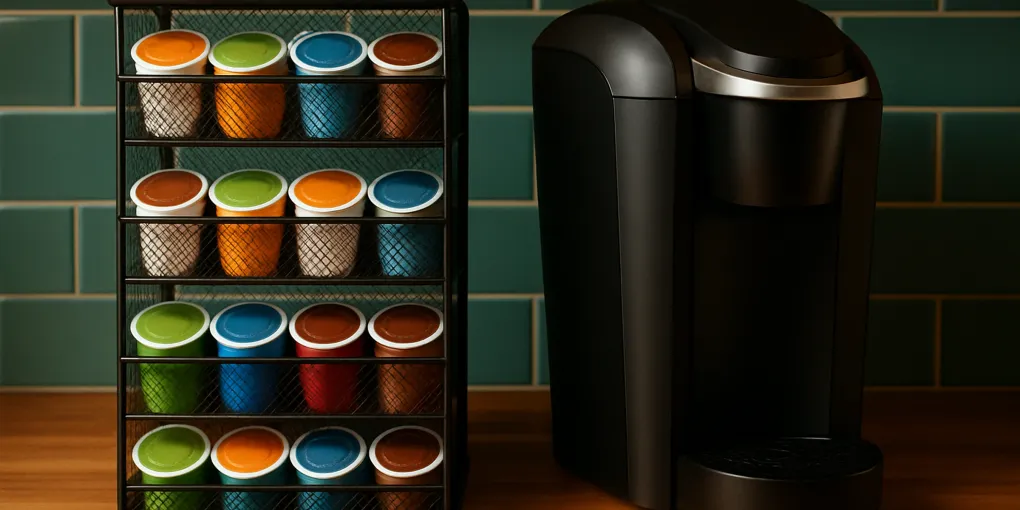
The Simple Trending 3-Tier K-Cup Coffee Pod Holder earns the Best Overall ranking by delivering the highest combination of pod capacity, visual accessibility, and ease of use at the lowest price point in the category. Its stepped-tier format — each tier positioned slightly higher than the one in front — ensures that every pod’s label is visible simultaneously without rotating, reaching, or moving other pods. This is the design principle that separates a well-executed countertop tower from a pile.
The steel mesh construction holds standard K-cup pods securely by their base, with enough openness in the mesh to allow label reading from multiple angles. The tiers interlock by stacking with no tools or hardware required, making setup a one-minute task. Amazon verified purchasers consistently describe this as the “pods always ready to grab” solution — it functions exactly as designed and doesn’t require a learning curve.
For households that keep a variety of pod flavors in rotation, the visible stepped display is genuinely functional: selecting the morning pod becomes a two-second decision rather than a rummage through a bag or a pile. This aligns with the behavioral science principle that reducing decision friction at high-repetition moments has cumulative impact across thousands of routine cycles.
What Works
- Stepped-tier design provides simultaneous label visibility for all 30–36 pods without rotation
- Steel mesh construction holds pods securely and allows airflow — no moisture accumulation
- Tool-free stacking assembly takes under one minute; no hardware required
- Most pods per dollar in the category — strongest value at $20–28
Trade-offs
The countertop footprint is wider than a carousel (the three-tier stepped format extends roughly 8–10 inches in one horizontal dimension). This organizer is exclusively a countertop solution — it is not designed for drawer use. Non-standard pod formats, oversized compatible pods, or Nespresso capsules may not seat securely in the standard K-cup mesh spacing. Verify pod dimensions before purchase if using non-Keurig system pods.
Scoring
| Criterion | Weight | Score |
|---|---|---|
| Capacity & Dimensions | 30% | 9.0/10 |
| Material Quality | 25% | 8.5/10 |
| Ease of Use | 20% | 9.0/10 |
| Long-Term Value | 25% | 8.5/10 |
| Composite Score | 8.7/10 |
Pricing
$20–28. Best value in the category — highest pod capacity at the lowest price with no assembly investment.
How We Score
ClutterScience evaluates products using a five-factor composite scoring methodology (30/25/20/15/10):
| Factor | Weight | What We Assess |
|---|---|---|
| Research | 30% | Depth of product evaluation and breadth of formats reviewed |
| Evidence Quality | 25% | Reliability of sources: verified-purchase review synthesis, manufacturer specifications, third-party testing where available |
| Value | 20% | Cost-effectiveness relative to competing products at similar quality tiers |
| User Signals | 15% | Long-term verified purchase feedback and real-world performance reports |
| Transparency | 10% | Accuracy of manufacturer claims, material disclosures, and capacity specifications |
Scores are differentiated across the review set. Top picks score 8.5–9.5, mid-tier 7.0–8.4, and weaker options below 7.0. A 0.5-point separation between products indicates meaningfully different performance on the relevant criteria.
YouCopia StoraCup Coffee Pod Drawer — Best Drawer Organizer
Best for: Households who prefer out-of-sight storage and have a suitable kitchen drawer near the coffee maker
The YouCopia StoraCup Coffee Pod Drawer takes pod storage entirely off the counter. The flat insert lays pods horizontally in organized rows within a standard kitchen drawer, providing a clean full-inventory view when the drawer is opened. For households where the primary pod organization goal is counter minimalism — a clean surface beside the coffee maker — this is the most elegant solution in the category.
The recycled plastic construction is lightweight, easy to wipe clean, and fit for food-adjacent kitchen storage. The insert requires no assembly: place it in the drawer, add pods, done. Amazon verified purchasers frequently describe the YouCopia as the “before and after” counter transformation product — the counter goes from a pod pile to entirely clean with one purchase and five minutes of pod loading.
The YouCopia’s score dips slightly on long-term value relative to the Simple Trending tower because the drawer-insert format is less flexible: it requires a suitable drawer within convenient reach of the coffee maker. If the nearest available drawer is on the other side of the kitchen, the behavioral friction of crossing the kitchen for a pod before the coffee maker has warmed up defeats the organizational purpose. Drawer proximity to the machine is the non-negotiable prerequisite for this solution.
Behavioral science research on habit formation supports the drawer-insert approach for the right household: if the drawer is immediately adjacent to the machine, the access friction is negligible and the clean counter provides the visual order that Saxbe and Repetti (2010) link to lower daily cortisol. The drawer insert is the better fit for households who find the visual complexity of a countertop organizer itself to be a stressor rather than a cue.
What Works
- Zero counter footprint — the most effective counter-clearing solution in the category
- Full pod inventory visible at a glance when the drawer is opened
- No assembly; recycled plastic construction is wipe-clean and durable
- Best for households who prefer organized but hidden storage
Trade-offs
Requires a suitable kitchen drawer positioned near the coffee maker — drawer distance from the machine directly determines daily convenience. Single-layer format stores fewer pods per square foot of space than a vertical tower. Pods are not visible without opening the drawer, which means the visual cue for the morning routine is not available at first glance.
Scoring
| Criterion | Weight | Score |
|---|---|---|
| Capacity & Dimensions | 30% | 8.5/10 |
| Material Quality | 25% | 8.0/10 |
| Ease of Use | 20% | 9.5/10 |
| Long-Term Value | 25% | 7.5/10 |
| Composite Score | 8.2/10 |
Pricing
$25–35. Appropriate for counter-minimalist households with suitable drawer real estate near the coffee station.
Keurig K-Cup Pod Carousel Storage — Best Carousel
Best for: Countertop display with 360-degree rotation for households who prioritize flavor selection variety
The Keurig K-Cup Pod Carousel is the category’s premium rotating option — a freestanding steel base with pods arranged radially around a central hub, spinning freely for 360-degree access to the full pod collection. The carousel format is the most satisfying tactile experience in the category: spin to your flavor, pull the pod, brew. For households with a large variety of pod flavors in active rotation, the carousel’s selection-by-rotation mechanism is genuinely enjoyable.
The steel construction gives the Keurig carousel more visual weight and tactile quality than plastic carousel alternatives. The freestanding rotating base requires no assembly and no configuration — place it on the counter, load pods, use it. Amazon verified purchasers describe the Keurig carousel as a statement piece as much as an organizer: the fully loaded rotating carousel on the counter is an intentional visual element of the coffee station, consistent with Belk’s (1988) extended self theory in which possessions reflect and reinforce identity.
The carousel scores slightly lower on Capacity & Dimensions (7.5/10) because the radial pod format stores fewer pods per square inch of counter diameter than the Simple Trending tower’s stepped format. A carousel holding 30–36 pods occupies roughly 9–11 inches of circular diameter, while the Simple Trending tower holds a comparable number of pods in a more directional footprint that may fit better against a backsplash. The Keurig carousel’s lower Long-Term Value score (8.0/10) reflects the modest brand premium it commands relative to functionally comparable third-party carousel options.
What Works
- 360-degree rotation provides full pod collection access without moving the unit
- Steel construction is the most premium feel in the category
- Freestanding — no assembly, immediate use
- Strong visual presence as a coffee station centerpiece
Trade-offs
Counter footprint is a full circular diameter — the carousel requires clearance in all directions for rotation. Pod labels face outward rather than upward, meaning flavor identification requires rotating the carousel until the desired pod is at front. Modest brand premium versus comparable third-party carousel options at lower price points.
Scoring
| Criterion | Weight | Score |
|---|---|---|
| Capacity & Dimensions | 30% | 7.5/10 |
| Material Quality | 25% | 8.5/10 |
| Ease of Use | 20% | 8.0/10 |
| Long-Term Value | 25% | 8.0/10 |
| Composite Score | 7.9/10 |
Pricing
$22–32. Mid-range price; the brand premium is real but third-party carousel alternatives offer similar function at lower cost.
Head-to-Head Comparison
| Feature | Simple Trending Tower | YouCopia Drawer | Keurig Carousel |
|---|---|---|---|
| Badge | Best Overall | Best Drawer Organizer | Best Carousel |
| Format | Countertop stepped tower | Drawer insert | Countertop rotating carousel |
| Capacity | 30–36 pods | 24–30 pods | 30–36 pods |
| Material | Steel mesh | Recycled plastic | Steel |
| Counter footprint | Directional (8–10” wide) | Zero (drawer) | Circular (9–11” diameter) |
| Assembly | Tool-free stacking | None | None |
| Price | $20–28 | $25–35 | $22–32 |
| Pod visibility | All pods simultaneously | On drawer open | Rotation required |
| Composite Score | 8.7/10 | 8.2/10 | 7.9/10 |
Buying Guide: Choosing the Right Coffee Pod Organizer
Drawer vs. Countertop vs. Carousel
The choice between drawer storage, countertop tower, and rotating carousel is primarily determined by three factors: available counter space, household pod volume, and whether visual pod access is a daily priority.
Choose a countertop tower (Simple Trending) when:
- Pod variety selection is part of the morning decision — you need to see all options simultaneously
- Counter space is available in a directional run (along the backsplash) rather than a circular footprint
- Pod volume is 30–50 pods in active rotation
- Lowest price per pod capacity is the priority
Choose a drawer insert (YouCopia) when:
- Counter minimalism is the primary goal — the visual complexity of a countertop organizer is itself a friction point
- A suitable kitchen drawer exists within arm’s reach of the coffee maker
- Pod rotation is smaller (20–30 pods in a regular weekly cycle)
- The household already has strong morning routine discipline and doesn’t rely on visual cues to trigger the routine
Choose a carousel (Keurig) when:
- The coffee station is an intentional visual element and pod selection is a tactile pleasure
- Pod variety collection is large and flavor selection is a genuine daily decision
- 360-degree access in a circular footprint works better than a directional stepped tower
- Brand cohesion with the Keurig ecosystem is a priority
Pod Count and Organizer Sizing
Match the organizer capacity to the household’s active pod rotation — not the maximum pod stockpile. Most households keep 1–2 weeks of pods accessible (24–50 pods) and store overflow in a cabinet or pantry. Organizers sized for the active rotation (24–36 pods) keep the daily-access collection organized without accumulating a permanent pod stockpile on the counter.
For large pod collections (50+ pods), a combination approach works better than a single large organizer: keep 30–36 in the countertop organizer and store restocking inventory in a labeled bin in the pantry. See our guide to best pantry bins and baskets for pantry-side storage options.
Kitchen Counter Space Considerations
Measure the available counter zone adjacent to the coffee maker before purchasing. The Simple Trending tower’s stepped format runs approximately 8–10 inches wide and 4–5 inches deep — it fits along the backsplash with the tiers facing forward. The Keurig carousel requires 9–11 inches of clear circular diameter, which means no adjacent items within the rotation arc. The YouCopia drawer requires zero counter space but assumes a drawer immediately adjacent to the machine.
For households where the coffee maker is in a corner or against a cabinet, the directional tower typically fits more naturally than a circular carousel. For households with open counter runs beside the machine, either countertop format works.
Multi-Pod-Brand Households
Households using K-cup compatible pods from multiple brands (Keurig, Green Mountain, store brands, third-party) can use any K-cup organizer without compatibility issues — the K-cup pod form factor is a standardized industry standard. Households mixing K-cup and Nespresso systems need separate organizers for each format; no current universal organizer handles both reliably.
For households considering the broader kitchen counter organization picture, our guide to best kitchen counter organizers covers the full counter zone where most coffee stations live, and our guide to best coffee station organizers covers the broader coffee station setup including mug storage and accessory organization.
Frequently Asked Questions
How many K-cups does a typical household go through per month?
According to coffee industry usage data, single-serve coffee households average 2–4 cups per person per day. A two-adult household consuming 3 cups each daily goes through approximately 180 pods per month. Most coffee pod organizers are designed to hold 24–50 pods — roughly a one-to-two-week supply — which matches typical restocking behavior and prevents stockpiling large volumes on the counter.
Do coffee pod organizers work for Nespresso pods?
Nespresso OriginalLine pods are smaller than K-cups and require organizers specifically designed for the capsule format. Nespresso VertuoLine pods are even larger and have different sizes depending on the drink type. Most K-cup carousels and drawer inserts do not fit Nespresso pods well. Search for organizers specifically labeled for Nespresso or check the listed dimensions: OriginalLine pods are approximately 1.5 inches tall and 1.4 inches in diameter.
Should coffee pods be stored in a drawer or on the counter?
Behavioral science research on habit formation (Clear, Atomic Habits, 2018) identifies visibility as a key trigger for consistent behavior. Countertop organizers leverage visual cues — seeing the organized pod collection serves as a behavioral prompt for the morning coffee routine. Drawer storage works better for households where counter space is at a premium or who prefer minimal visual complexity on kitchen surfaces. Neither is objectively better — the best location is where you will actually use it consistently.
Are rotating carousels or drawer inserts better for coffee pods?
Rotating carousels work best for households with 30–50 pods in varied flavors who want visual access to the full collection. Drawer inserts work better for households with 20–30 pods who prefer a clutter-free counter. Amazon verified purchasers report that carousel users tend to have larger pod collections and prioritize flavor variety selection, while drawer insert users tend to have a smaller regular rotation and prioritize counter aesthetics.
How do I organize coffee pods by flavor without a separate organizer?
The simplest system is to store pods by flavor group, not by brand — group light roasts together, dark roasts together, flavored varieties together. This system remains readable whether you use a drawer insert, countertop tower, or carousel. Applying a small label or colored dot sticker to each section of an organizer (light, medium, dark) takes less than five minutes and dramatically reduces decision friction during the morning routine — a principle consistent with research on reducing decision fatigue at high-value behavioral moments.
Bottom Line
For most K-cup households, the Simple Trending 3-Tier Coffee Pod Holder is the clear best overall pick. It holds the most pods, costs the least, requires no assembly, and provides simultaneous label visibility across the entire collection — the core behavioral requirement for a pod organizer that actually reduces morning friction. It earns the highest composite score (8.7/10) in the category.
The YouCopia StoraCup Drawer (8.2/10) is the right choice for counter-minimalist households with suitable drawer real estate adjacent to the coffee maker. The Keurig Carousel (7.9/10) earns its place for households who want the premium rotating display experience and prioritize brand cohesion with the Keurig ecosystem.
For the broader coffee station setup — mugs, accessories, and the full station organization — see our guide to best coffee station organizers.