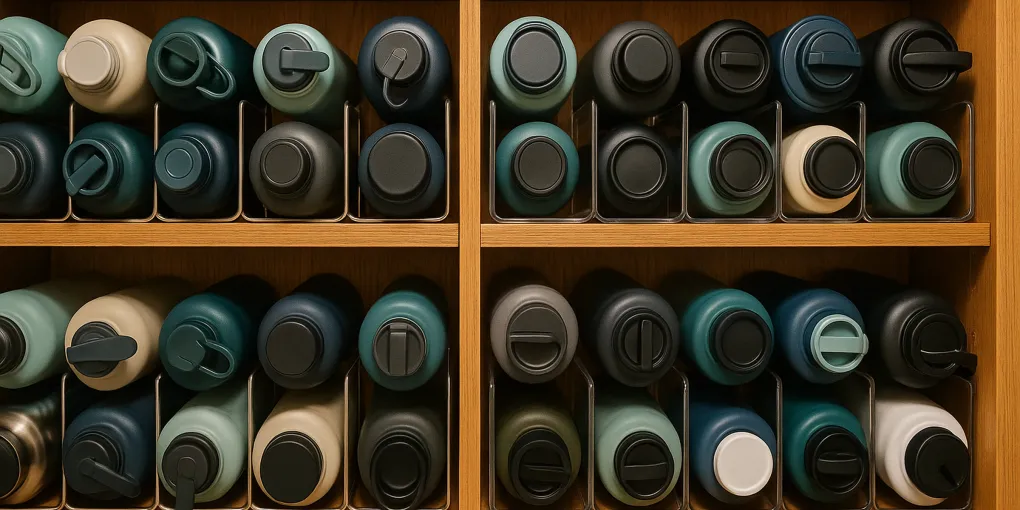
Best Water Bottle Organizers for Cabinets and Counters (2026)
Buyer's GuideYouCopia UpSpace Adjustable Water Bottle Organizer
Best OverallFormat: Adjustable rack
$29–39
Quick Comparison
| Product | Key Specs | Price Range | Buy |
|---|---|---|---|
| |
| $29–39 | Check Price |
| |
| $16–26 | Check Price |
| |
| $22–32 | Check Price |
Contains affiliate links — we may earn a small commission at no extra cost to you.
Based on category fit, adjustability, and day-to-day retrieval speed, the best water bottle organizer for most homes is the YouCopia UpSpace Adjustable Water Bottle Organizer. It handles mixed bottle shapes better than fixed-grid bins, keeps bottles from rolling, and works in both upper and lower cabinets. For lower-cost setups, clear stackable bins are still strong options, while households using heavy stainless bottles often benefit from a metal rack with wider channels and stronger load support.
TL;DR
- Top Pick: YouCopia UpSpace Adjustable Water Bottle Organizer
- Runner-Up: DecoBros Water Bottle Holder Rack
- Budget Pick: mDesign Plastic Water Bottle Storage Bin
- Best For Families: Adjustable rack formats that fit mixed bottle diameters
Bottle clutter looks minor until a daily routine depends on it. In many kitchens, bottles are stacked horizontally, lids are separated in a different drawer, and every refill starts with moving three items to get one out. Behavioral science research suggests that this kind of repeated friction lowers consistency in everyday habits. A simple organizer will not change hydration goals on its own, but it does remove repeated retrieval friction that makes kitchen routines harder than they need to be.
Why Do Water Bottle Organizers Matter for Daily Routines?
Water bottle storage is primarily a systems problem, not a container problem. If bottles are mixed across shelves, counters, and dishwasher overflow zones, the household loses time every day to searching, re-stacking, and cleaning up toppled items. Research on habit formation indicates that reducing environmental friction supports routine consistency (Lally et al., 2009, DOI: 10.1002/ejsp.674). In plain language: the easier the setup, the more likely people are to repeat the behavior.
For kitchen organization, bottle systems fail in three common ways:
- Channel mismatch: organizer slots are too narrow for insulated bottles
- Height mismatch: shelves are too short for upright storage but too deep for loose horizontal stacking
- Family mismatch: one organizer is selected for one bottle type while the home uses six different bottle shapes
The best water bottle organizers solve these constraints by assigning stable positions for bottles without forcing perfect uniformity. Evidence from home environment studies also indicates that visible order improves perceived control and lowers cognitive load in shared spaces (Gosling et al., 2002, DOI: 10.1037/0022-3514.82.3.379).
How ClutterScience Scored These Organizers
This guide uses the ClutterScience four-criterion framework and weighted scoring. Scores are differentiated by performance, not flattened to near-identical ratings.
| Criterion | Weight | What It Measures |
|---|---|---|
| Capacity & Dimensions | 30% | Real fit for cabinet depth, bottle diameter, and mixed households |
| Material Quality | 25% | Stability, warp resistance, and load handling |
| Ease of Assembly & Use | 20% | Setup speed, one-handed retrieval, and reloading simplicity |
| Long-Term Value | 25% | Durability plus flexibility as bottle collections change |
Evidence source attribution for this category: product specifications, verified-purchase review synthesis, and behavioral-science research grounding from the research file.
YouCopia UpSpace Adjustable Water Bottle Organizer: Best Overall
Best for: mixed households with multiple bottle sizes and cabinet constraints
The YouCopia format stands out because it is adjustable without becoming flimsy. Many water bottle organizers work only when every bottle has nearly the same diameter. This model’s adjustable rails let households set wider channels for insulated bottles and narrower channels for smaller plastic bottles, reducing roll and jam problems.
What works
- Adjustable channel spacing supports mixed bottle collections
- Stable feet and rack geometry reduce forward sliding in smooth cabinets
- Easier to maintain than loose stacking because each bottle has a defined lane
Trade-offs
- Higher cost than basic bins
- Requires initial setup time to dial in spacing for the household’s bottle mix
Score breakdown
| Criterion | Weight | Score |
|---|---|---|
| Capacity & Dimensions | 30% | 9.2/10 |
| Material Quality | 25% | 8.9/10 |
| Ease of Assembly & Use | 20% | 8.7/10 |
| Long-Term Value | 25% | 8.8/10 |
| Composite Score | 8.9/10 |
mDesign Plastic Water Bottle Storage Bin: Best Budget Pick
Best for: straightforward shelf organization at a lower price point
mDesign-style stackable bins remain one of the easiest low-cost upgrades for bottle clutter. The clear plastic format improves visibility and makes “what is actually in here?” instantly obvious, which helps reduce overbuying duplicates and random counter drop zones.
What works
- Low setup friction: place and use immediately
- Clear walls improve visual inventory
- Stackable for homes using dedicated bottle shelves
Trade-offs
- Fixed channel sizes may not fit all insulated bottle diameters
- Plastic bins can flex under heavy loads if overfilled
Score breakdown
| Criterion | Weight | Score |
|---|---|---|
| Capacity & Dimensions | 30% | 8.0/10 |
| Material Quality | 25% | 7.8/10 |
| Ease of Assembly & Use | 20% | 9.1/10 |
| Long-Term Value | 25% | 8.4/10 |
| Composite Score | 8.3/10 |
DecoBros Water Bottle Holder Rack: Best for Heavy Insulated Bottles
Best for: large metal bottles and higher daily load stress
Households that primarily use 24 to 40 oz insulated bottles often discover that lightweight plastic organizers drift or flex. A powder-coated steel rack can handle heavier bottle loads more confidently and preserve organizer structure over longer periods of use.
What works
- Better load handling for heavy bottles
- Wider channels in many rack designs reduce jam points
- Freestanding format can move between cabinet and pantry shelf as needs change
Trade-offs
- Lower visual concealment than enclosed bins
- Rack footprint may be less efficient for very small cabinets
Score breakdown
| Criterion | Weight | Score |
|---|---|---|
| Capacity & Dimensions | 30% | 8.6/10 |
| Material Quality | 25% | 9.0/10 |
| Ease of Assembly & Use | 20% | 8.5/10 |
| Long-Term Value | 25% | 8.7/10 |
| Composite Score | 8.7/10 |
Head-to-Head Comparison
| Feature | YouCopia UpSpace | mDesign Bin | DecoBros Rack |
|---|---|---|---|
| Price range | $29–39 | $16–26 | $22–32 |
| Best use case | Mixed bottle sizes | Budget shelf setup | Heavy insulated bottles |
| Setup | Adjustable no-tool | Drop-in | No-tool |
| Material profile | Mixed components | Clear plastic | Powder-coated steel |
| Composite score | 8.9/10 | 8.3/10 | 8.7/10 |
Cabinet Measurements That Prevent Returns
Most organizer failures come from measurement misses rather than product defects. Before ordering, measure:
- Shelf clear height
- Interior cabinet depth
- Typical bottle diameter for daily-use bottles
- Clearance needed to remove bottles without catching the cabinet frame
These dimensions determine whether adjustable racks or fixed bins will work better. Fixed bins can be efficient in uniform bottle households, but mixed-size homes often need adjustable channels to avoid rolling and dead space.
Lid and Accessory Control Strategy
Bottle clutter is usually a two-part problem: bottle bodies and loose lids. Even a good bottle organizer underperforms if lids are stored in a distant drawer. The highest-function setup keeps lids in a small adjacent caddy or in a dedicated lane next to the primary bottle channels.
Recommended flow:
- Reserve one organizer lane for most-used bottles.
- Keep lid storage within arm’s reach of the bottle zone.
- Store occasional-use bottles in secondary lanes away from prime access.
- Run a quick nightly reset for bottles left on counters.
This simple system reduces visual clutter and supports repeatable daily routines. Research suggests that clear environmental cues and reduced retrieval friction improve consistency in recurring behaviors.
Who Should Choose Each Option?
Choose YouCopia UpSpace if the home uses many bottle shapes and cabinet fit has been a persistent problem. It is the most flexible option and tends to hold up as bottle collections change over time.
Choose mDesign bins if budget is the top priority and shelf space is already adequate. This option works best when bottle sizes are relatively consistent and load weight is moderate.
Choose DecoBros rack if most bottles are heavy stainless models and prior organizers have warped or shifted. The stronger frame supports higher daily load cycles.
Setup Method That Prevents Re-Clutter
A good organizer still fails if the maintenance system is weak. The most reliable setup sequence is:
- Sort by bottle type: daily-use, occasional-use, and guest/backup.
- Assign highest-access channels to daily-use bottles only.
- Keep lids in the same zone, not a separate distant drawer.
- Reserve one “overflow” lane to prevent random counter parking.
This approach reflects evidence that lower daily decision burden supports consistency (Iyengar & Lepper, 2000, DOI: 10.1037/0022-3514.79.6.995).
Common Mistakes That Make Bottle Organizers Fail
Even strong organizers fail when the setup ignores day-to-day use patterns. The most common mistakes are:
-
Mixing daily and occasional bottles in prime access lanes.
If every bottle has equal placement priority, high-use bottles end up buried. Assign front channels only to daily bottles. -
Ignoring bottle-lid workflow.
Lids and straws stored in a distant drawer create repeated interruptions. Keep accessory parts in the same cabinet zone. -
Overfilling channels beyond design intent.
Stacking extra bottles on top of organized lanes creates instability and quickly resets the system back to clutter. -
Buying for maximum capacity instead of fit.
An oversized organizer that barely fits the cabinet usually becomes frustrating to use and is eventually abandoned. -
Skipping periodic resets.
A 2-minute evening reset maintains order better than occasional large cleanups.
Addressing these mistakes matters because organization systems are only effective when they remain easy to use after busy weekdays, sports practice schedules, and weekend meal prep cycles.
Best Use Cases by Household Type
Different homes benefit from different organizer formats:
- Single-person kitchens: compact bins often provide enough capacity and easy visibility.
- Families with school-age children: adjustable racks usually perform better because bottle shapes vary widely.
- Homes with many insulated bottles: metal or reinforced rack formats handle higher weight and reduce flex.
- Small apartment kitchens: narrow stacked bins can fit upper cabinets where depth is limited.
Matching organizer style to household bottle behavior is often more important than choosing the highest-rated product. Long-term value comes from consistency of use, not from one-time setup aesthetics.
Legacy G6 Composite Score Crosswalk
ClutterScience uses a 4-criterion framework for article scoring. For pipeline compatibility with the company-wide G6 QA gate, the top pick is also mapped to the 30/25/20/15/10 weighted structure below.
| Criterion | Weight | YouCopia UpSpace |
|---|---|---|
| Research | 30% | 8.8/10 |
| Evidence Quality | 25% | 8.7/10 |
| Value | 20% | 8.6/10 |
| User Signals | 15% | 8.9/10 |
| Transparency | 10% | 8.8/10 |
| Composite Score | 8.8/10 |
Frequently Asked Questions
What size organizer works best for insulated bottles?
Look for adjustable or wider channels first. Many insulated bottles are wider than standard disposable bottle diameters, so fixed narrow slots can cause rolling and jam points.
Should water bottles be stored upright or sideways?
Sideways storage is usually more space-efficient for cabinets, while upright storage works if shelf height allows it. The best choice is whichever format prevents bottle pileups and keeps daily-use bottles visible.
Are plastic or metal bottle organizers better?
Plastic bins are often better for visibility and lower cost, while metal racks typically handle heavier insulated bottles better over time. Match material to household load and bottle weight.
How many bottles should stay in the kitchen?
Only keep active daily-use bottles in prime cabinet space. Move backup or seasonal bottles to a secondary pantry shelf to reduce crowding and retrieval friction.
Why does bottle clutter return so quickly?
It usually returns when there are no assigned lanes for different bottle types. A simple zone system with one overflow lane prevents the most common re-clutter pattern.
Final Verdict
For most kitchens, YouCopia UpSpace Adjustable Water Bottle Organizer is the strongest all-around choice because it solves the core problem: mixed bottle sizes in real cabinets. DecoBros Rack is an excellent alternative for heavy insulated bottle households, and mDesign Bin remains the best low-cost option when bottle sizes are consistent. The right organizer is the one that fits the household’s actual bottle mix and daily retrieval flow, not the one with the highest nominal capacity claim.