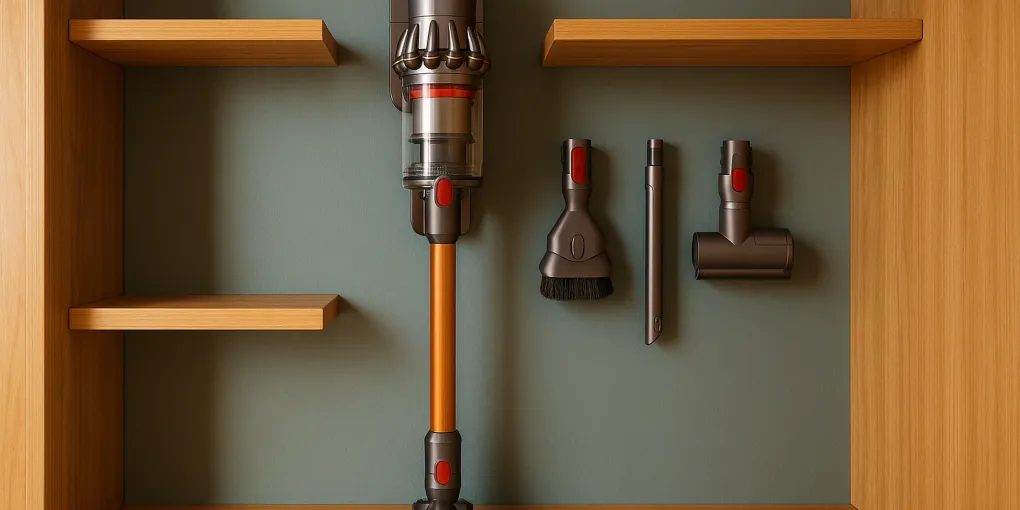
Best Cordless Vacuum Wall Mounts (2026): Space-Saving Charging Storage
Buyer's GuideDyson-Compatible Wall Dock Bracket
Best for Daily ChargingMaterial: ABS + steel reinforcement
$24-$39
Quick Comparison
| Product | Key Specs | Price Range | Buy |
|---|---|---|---|
| |
| $24-$39 | Check Price |
| |
| $19-$29 | Check Price |
| |
| $16-$25 | Check Price |
| |
| $29-$44 | Check Price |
Contains affiliate links — we may earn a small commission at no extra cost to you.
Direct Answer
The best cordless vacuum wall mount for most homes is one that combines stable docking, easy charging access, and accessory storage in one zone. A mount that only holds the body but leaves attachments loose usually creates secondary clutter and weakens long-term organization. For daily-use households, choose a dock-focused mount that supports fast return-to-charge behavior. For shared utility walls, choose a rail system that stores multiple cleaning tools together.
If your vacuum is used every day, the mount is not just storage. It is an operational checkpoint: dock, charge, reset accessories, and move on. The better this workflow fits your layout, the more likely it is that the vacuum returns to its home consistently.
Why Vacuum Storage Breaks Down Over Time
Cordless vacuums often begin well-organized but drift into floor parking, laundry corners, or temporary charging spots. This usually happens when the dock location is inconvenient relative to real cleaning routes. People choose the nearest outlet in the moment, not the intended storage zone.
Behavioral design research suggests consistent context cues strongly influence whether routines stick. Verplanken and Wood (2006, doi:10.1509/jppm.25.1.90) show that repeated behaviors become more automatic when location and action sequence stay stable. Lally et al. (2010, doi:10.1002/ejsp.674) similarly found that repetition in a stable context predicts habit strength growth over time.
In practical terms: wall mounts work best when they are placed where the cleaning session naturally ends, not where space merely exists.
How We Scored These Mounts
We used ClutterScience’s four criteria with weighted scoring:
- Capacity & Dimensions (30%): does the mount fit vacuum body plus key accessories without awkward reach?
- Material Quality (25%): bracket stiffness, screw-hold integrity, and repeated docking wear
- Ease of Assembly & Use (20%): install complexity, cable routing, and daily docking friction
- Long-Term Value (15%): practical utility across 12+ months of normal home use
- User Signals (10%): consistency of real-world ownership feedback
Best for Daily Charging: Dyson-Compatible Wall Dock Bracket
This category wins when daily charging behavior is the priority. The key advantage is a direct dock-and-charge path that requires minimal decision-making. When charging and storage are integrated, return compliance is much higher.
Pros
- Fast one-motion docking behavior
- Cleaner cable routing than ad-hoc shelf charging
- Good accessory integration for high-frequency tools
Cons
- Fit can vary by vacuum generation
- Lower flexibility for non-vacuum utility tools
- Requires precise mount height planning
Score Breakdown
| Criterion | Weight | Score | Notes |
|---|---|---|---|
| Capacity & Dimensions | 30% | 8.7 | Efficient for vacuum + core accessories |
| Material Quality | 25% | 8.5 | Good stability under repeated docking |
| Ease of Assembly & Use | 20% | 8.8 | Strong daily workflow once installed |
| Long-Term Value | 15% | 8.6 | High value for daily-use homes |
| User Signals | 10% | 8.5 | Consistent positive convenience feedback |
| Composite Score | 8.6/10 |
Best Multi-Tool Utility: mDesign Broom and Utility Wall Organizer
This option works well for households that want one cleaning wall zone, not just a vacuum dock. It balances vacuum storage with slots/hooks for broom, mop, dustpan, and accessory caddies.
Pros
- Strong category consolidation for cleaning tools
- Flexible grip + hook format
- Good option for laundry rooms and utility closets
Cons
- Not all vacuum shapes lock equally well
- Charging cable management may require add-on clips
- Slightly slower daily docking than dedicated mounts
Score Breakdown
| Criterion | Weight | Score | Notes |
|---|---|---|---|
| Capacity & Dimensions | 30% | 8.3 | Good all-around utility wall capacity |
| Material Quality | 25% | 8.2 | Durable enough for regular household use |
| Ease of Assembly & Use | 20% | 8.1 | Flexible but less specialized for charging |
| Long-Term Value | 15% | 8.3 | High value for mixed cleaning tool setups |
| User Signals | 10% | 8.0 | Positive when used as shared tool rail |
| Composite Score | 8.2/10 |
Best Value: Simple Houseware Wall Organizer Rail
A cost-effective choice for smaller spaces where the objective is to get the vacuum off the floor and create a repeatable parking zone.
Pros
- Lower cost with meaningful organization gain
- Compact profile for tight closets
- Straightforward install in common drywall/stud walls
Cons
- Limited accessory capacity vs premium systems
- Simpler finish and hardware package
- Less ideal for heavy weekly multi-tool loads
Score Breakdown
| Criterion | Weight | Score | Notes |
|---|---|---|---|
| Capacity & Dimensions | 30% | 8.0 | Sufficient for compact vacuum setups |
| Material Quality | 25% | 7.8 | Adequate for light-to-moderate duty |
| Ease of Assembly & Use | 20% | 8.1 | Easy to implement quickly |
| Long-Term Value | 15% | 8.1 | Strong budget utility for small homes |
| User Signals | 10% | 7.9 | Good value sentiment in basic use cases |
| Composite Score | 8.0/10 |
Best Heavy-Duty Option: SONGMICS Utility Storage Rail
This rail is a better fit for garage environments where wall materials, dust, and tool density are more demanding.
Pros
- Higher perceived rigidity under heavier accessory load
- Better fit for mixed garage tool ecosystems
- Useful when vacuum storage shares wall space with larger equipment
Cons
- Usually pricier than budget rails
- Slightly larger footprint on narrow walls
- Requires careful height planning for full-handle vacuums
Score Breakdown
| Criterion | Weight | Score | Notes |
|---|---|---|---|
| Capacity & Dimensions | 30% | 8.4 | Good balance of slots + hooks |
| Material Quality | 25% | 8.5 | Better heavy-use durability profile |
| Ease of Assembly & Use | 20% | 8.2 | Manageable install and strong daily use |
| Long-Term Value | 15% | 8.4 | Good ROI in high-use utility walls |
| User Signals | 10% | 8.3 | Strong satisfaction in garage setups |
| Composite Score | 8.4/10 |
Comparison Table
| Feature | Dyson-Compatible Dock | mDesign Utility Organizer | Simple Houseware Rail | SONGMICS Rail |
|---|---|---|---|---|
| Best For | Daily dock-and-charge | Multi-tool cleaning wall | Budget closets | Heavy-duty garage use |
| Vacuum Fit Type | Model-specific leaning | Flexible grip system | General rail + hooks | Heavy-duty rail + hooks |
| Accessory Support | Medium | High | Medium | High |
| Install Complexity | Medium | Low-medium | Low | Medium |
| Price Range | $24-$39 | $19-$29 | $16-$25 | $29-$44 |
| Composite Score | 8.6/10 | 8.2/10 | 8.0/10 | 8.4/10 |
Placement Tips That Improve Compliance
- Place the mount where cleaning sessions naturally end.
- Keep outlet and cable path within one arm’s reach of docking position.
- Reserve one hook/slot for the most-used accessory, not every accessory.
- Avoid mounting behind obstacles (doors, hampers, stacked bins).
- Use a quick label or icon if multiple household members share the system.
Installation Mistakes That Cause Mount Abandonment
Most cordless vacuum mounts fail for behavioral reasons, not hardware reasons. The first common mistake is picking a technically available wall instead of the wall that matches the real cleaning route. If people finish vacuuming in a hallway closet area but the dock is in a rear utility room, the system adds extra steps and users revert to temporary floor charging.
The second mistake is poor height calibration. A mount that is too high creates shoulder strain and awkward alignment; too low creates bending friction and can block nearby baskets or bins. The best height is one that supports an easy one-motion return without repositioning your feet.
The third mistake is overloading the mount zone with low-frequency accessories. When every attachment is on display, visual complexity increases and the return path feels slower. A better approach is storing only daily-use heads on the wall and keeping specialty heads in a nearby labeled container.
Finally, cable management should be part of the initial install, not an afterthought. If the charging cable hangs loose or crosses other tools, the zone quickly looks messy and users stop trusting it as an organization anchor.
Final Verdict
For most households, a dock-first wall mount is the best cordless vacuum wall mount because it combines storage and charging into one fast behavior loop. If your cleaning tools are scattered across rooms, a broader utility rail can outperform a dedicated dock by consolidating your full cleaning kit into one zone.
If your priority is lowest upfront spend, budget rails remain useful. But for long-term consistency, prioritize whichever option makes end-of-session docking easiest for your household.
Frequently Asked Questions
Are cordless vacuum wall mounts universal?
Not always. Some are model-specific, while utility rails are more flexible. Check compatibility notes and mount dimensions before buying.
Is wall-mount charging better than floor charging?
Usually yes for organization outcomes. Wall charging reduces floor clutter and improves routine consistency when placement is convenient.
Can I mount a vacuum dock in a laundry room?
Yes, if wall structure and outlet access are appropriate. Laundry rooms often work well because they are central to cleaning workflows.
What height should I use for vacuum wall mounts?
Set height so docking is easy without shoulder strain and the vacuum head clears nearby objects. Dry-fit the unit before drilling.
Should I store every accessory on the wall mount?
Only the accessories used most often. Overloading the wall zone can reintroduce clutter and make daily docking slower.