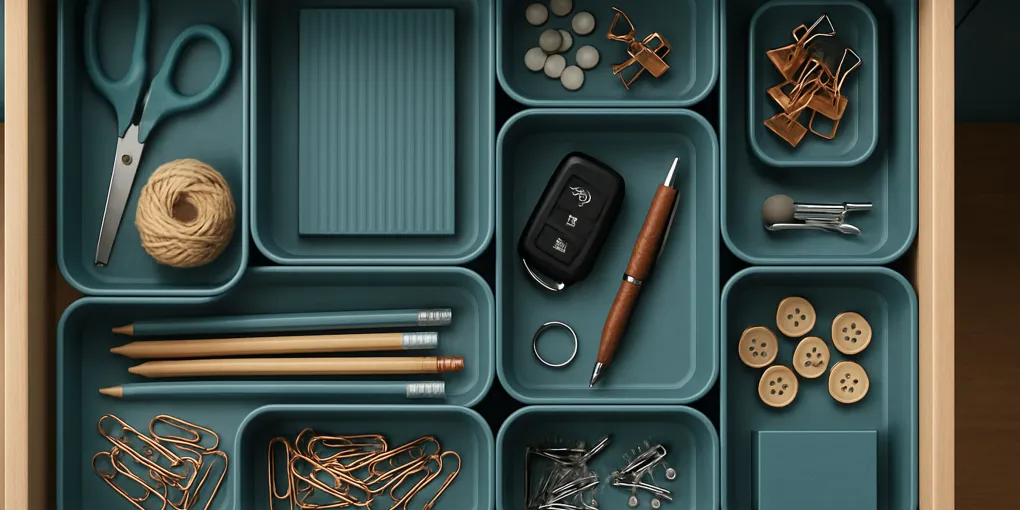
Best Drawer Organizers for Junk Drawers: Dividers, Trays, or Small Bins?
Buyer's GuideThe best drawer organizer for a junk drawer is the one that makes returning items easier than tossing them loose. For most homes, that means shallow trays for small objects, adjustable dividers for long tools, and one overflow rule: if the category no longer fits its compartment, edit the category instead of buying a deeper drawer.
Disclosure: This article contains Amazon affiliate links. If you buy through qualifying links, ClutterScience may earn a commission at no extra cost to you.
Editorial Transparency
ClutterScience uses AI tools during drafting support, outline organization, and source review. Human editors review every article for accuracy, clarity, product-link policy, and source quality. We do not fabricate reviewers, credentials, test results, ASINs, or citations.
Quick Picks by Drawer Type
| Drawer problem | Best organizer type | Why it works |
|---|---|---|
| Pens, tape, scissors, clips | Shallow compartment tray | Keeps small items visible and fast to return |
| Spatulas, peelers, rulers, flashlights | Adjustable dividers | Fits long categories without wasting space |
| Batteries, hooks, hardware | Clear small bins | Easy to lift out and inspect |
| Cosmetics or first-aid overflow | Washable plastic trays | Handles spills better than wood |
| Desk and craft supplies | Modular trays | Lets categories change over time |
Useful search links include adjustable drawer dividers, bamboo drawer organizer tray, clear drawer organizer bins, and modular desk drawer organizer. We are using search links rather than direct ASIN links because exact listings and sellers change.
How to Choose the Right Drawer Organizer
Start by measuring the inside width, depth, and height of the drawer. Height matters more than people expect. A tall organizer can block the drawer from closing, and a deep bin can hide small objects at the bottom.
Then empty the drawer and sort items into real categories. Do not buy an organizer for the current pile. Buy for the categories you actually want to keep there:
- Writing tools.
- Cutting and repair tools.
- Adhesives and tape.
- Batteries and charging accessories.
- Household hardware.
- Coupons, keys, or active papers.
- Miscellaneous items that truly need a quick-access home.
A junk drawer should not be a permanent home for everything without a home. It should be a utility drawer for small items that are used often enough to deserve convenient access.
Option 1: Shallow Compartment Trays
Shallow trays are the easiest choice for classic junk drawers. They work well for pens, scissors, tape, rubber bands, clips, sticky notes, and small tools. Because the compartments are visible, they reduce rummaging.
Best for:
- Kitchen command drawers.
- Office drawers.
- Family utility drawers.
- Small apartments where one drawer serves multiple functions.
Avoid them when the drawer contains many long objects. A fixed tray can waste space if it forces a flashlight, ruler, or long spatula to sit diagonally.
ClutterScience score: 8.5/10. Trays score high because they are simple, visible, and easy to maintain.
Option 2: Adjustable Drawer Dividers
Adjustable dividers are tension-fit or expandable pieces that create custom lanes. They are useful when categories are long or uneven: kitchen tools, rulers, batteries in cases, reusable straws, flashlights, tape rolls, and small notebooks.
Best for:
- Deep kitchen drawers.
- Utility drawers with long tools.
- Shared drawers where categories change.
- Drawers that need broad zones instead of tiny compartments.
Avoid them in very shallow drawers or drawers with lots of tiny items. Small objects can slide under or around dividers if the fit is loose.
ClutterScience score: 8.0/10. Dividers are flexible, but they work best when paired with small cups or trays for tiny items.
Option 3: Small Clear Bins
Small bins are ideal when you need to lift a category out of the drawer. Batteries, picture-hanging hardware, command strips, sewing supplies, first-aid overflow, and charging adapters are easier to manage when the whole category can come out at once.
Best for:
- Batteries and small electronics.
- Hardware and repair supplies.
- Bathroom or cosmetics drawers.
- Craft drawers with changing materials.
Avoid them when every bin becomes a mixed mini-junk drawer. Clear bins improve visibility, but visibility does not replace categories.
ClutterScience score: 7.8/10. Clear bins are practical and washable, but they can look visually busy if overfilled.
Option 4: Bamboo or Wood Organizers
Bamboo organizers look calm and work especially well in kitchens, dining areas, and desks where the drawer is opened often. The warm material can make a utility drawer feel intentional rather than chaotic.
Best for:
- Utensil-adjacent kitchen drawers.
- Entry or console drawers.
- Desk drawers with pens and office tools.
- Homes where visible material quality increases maintenance buy-in.
Avoid wood for wet, sticky, or leaky categories. Markers, glue, cosmetics, and medicine overflow are better in washable plastic.
ClutterScience score: 7.6/10. Bamboo is attractive and durable enough for dry categories, but less forgiving than plastic.
The Junk Drawer Setup Protocol
- Empty the drawer completely.
- Wipe the drawer before measuring.
- Remove trash, duplicates, dried pens, mystery keys, expired coupons, and dead batteries.
- Choose no more than six categories.
- Assign one compartment per category.
- Put the most-used categories closest to the front.
- Add one small “decide” cup only if it gets emptied weekly.
The most important step is editing. No organizer can make a drawer work if the drawer is holding three drawers’ worth of decisions.
Safety Notes for Batteries and Small Items
Batteries deserve more care than most junk drawer categories. Poison Control warns that button batteries can be dangerous if swallowed, especially for children. Keep button batteries and loose batteries away from young children, store them in packaging or a dedicated case, and do not let loose batteries mix with metal objects.
For sharp tools, use a compartment that prevents rummaging. Scissors, utility blades, and small screwdrivers should be visible before someone reaches into the drawer.
What to Avoid Buying
Avoid deep bins for shallow categories. They hide small items and invite overfilling.
Avoid huge expandable trays if the drawer’s main issue is too many categories. A larger tray may simply make the mess look more organized for one week.
Avoid velvet or fabric-lined organizers for utility drawers. They collect dust and are harder to clean.
Avoid organizers with oddly specific compartments unless your drawer contents match them. Flexibility is more valuable than a perfect-looking product photo.
How We Score Drawer Organizers
Composite score breakdown: 30/25/20/15/10. We use this weighted rubric so a product is not rewarded only for looking tidy in a photo. Research quality is 30% and covers whether the organizer solves the actual junk-drawer problem: mixed sizes, quick retrieval, and repeatable returns. Evidence quality is 25% and weighs stated dimensions, material information, brand consistency, and whether the product category has enough real-world use signals to judge durability. Value is 20% and considers whether the organizer gives more usable compartments per dollar without forcing you to buy a larger storage system than the drawer needs. User signals are 15% and include recurring owner comments about fit, sliding, cracking, ease of cleaning, and long-term use. Transparency is 10% and rewards clear limits: exact measurements, search-link use when listings change, and honest trade-offs instead of pretending one tray fits every household.
For this guide, we prioritized flexible systems over decorative trays because junk drawers fail when categories do not have a return path. A beautiful single tray can still become a pile if scissors, batteries, keys, tape, and spare hardware all share the same compartment. The best option is usually the one that creates enough small boundaries without making the drawer annoying to reset. If a tray has too many tiny slots, larger objects sit on top and the system fails. If it has too few compartments, small items migrate together and the system becomes a search exercise again.
Fit Checks Before You Buy
Measure the drawer interior, not the drawer face. Width matters, but depth and height matter too. Many kitchen drawers have enough surface area for a tray but not enough height for stacked bins, especially when the drawer slides under a counter lip. Leave at least half an inch of clearance above the tallest item you expect to store. If you use the drawer for scissors or a flashlight, place those items in the drawer before you buy and measure around them.
The second fit check is category count. Empty the drawer onto a towel and make piles: writing tools, cutting tools, batteries, adhesive items, small repair parts, keys, coupons, and miscellaneous objects that actually belong somewhere else. Count the piles you want to keep in the drawer. That number tells you the minimum number of usable zones. Do not count decorative micro-compartments that cannot hold a real category. One shallow rectangle for paper clips is useful only if paper clips actually live there.
The third fit check is cleaning. Junk drawers collect crumbs, graphite dust, leaking pens, and small hardware debris. Clear plastic and coated bamboo wipe more easily than raw wood or fabric. If the drawer is near food prep, choose materials you can clean quickly. If the drawer is in an office, appearance may matter more than wipeability.
Reset Plan That Keeps the Organizer Useful
A drawer organizer is a boundary, not a magic filter. Give the drawer one five-minute reset each month. Remove expired coupons, duplicate tools, dry pens, mystery keys, and parts that belong with a specific appliance or project. Put non-drawer items where they belong before adding another compartment.
Use the one-in-one-out rule for tiny categories. If the battery slot is full, do not start a second battery pile. If the tape zone is full, decide whether you need all the tape in that drawer. The organizer works because it makes capacity visible. When the visible boundary is ignored, the system stops doing the work.
Finally, label only the categories that other people in the home frequently misplace. A label for batteries, scissors, or tape can help the whole household return things correctly. Labels for every tiny slot usually create clutter of their own. The goal is a drawer that can be reset by anyone in under a minute, not a museum display.
Common Buying Mistakes
The biggest mistake is buying a tray before editing the drawer. If old chargers, expired coupons, and mystery parts stay in the drawer, the new organizer only sorts clutter into smaller piles. Edit first, then buy for the categories that remain. The second mistake is choosing a tray that fills the entire drawer so tightly that nothing can be lifted out easily. Leave finger room around the organizer or choose modular bins that can be removed one at a time. The third mistake is storing dangerous or leaky items beside everyday tools. Button batteries, glue, medications, and sharp blades need safer containment than a general junk drawer tray can provide.
Sources
- Poison Control button battery safety information. https://www.poison.org/battery
- MedlinePlus home safety overview. https://medlineplus.gov/ency/patientinstructions/000600.htm
- University of Minnesota Extension guidance on household organization and storage principles. https://extension.umn.edu/
Bottom Line
For most junk drawers, start with shallow trays or modular clear bins. Add adjustable dividers when you have long tools. Choose bamboo for dry, visible utility drawers and washable plastic for messy categories. The organizer matters, but the category limit matters more.
Frequently Asked Questions
- The best organizer is usually a mix of shallow trays for small categories and adjustable dividers for long tools. Choose low-profile compartments so items are visible and easy to return.
- Bamboo looks warmer and works well for kitchens and desks. Plastic or clear acrylic is easier to wipe and often better for batteries, hardware, cosmetics, and messy utility categories.
- Limit the drawer to active household tools, use compartments sized to categories, and add a monthly five-minute reset. Do not use one drawer for every homeless item in the house.