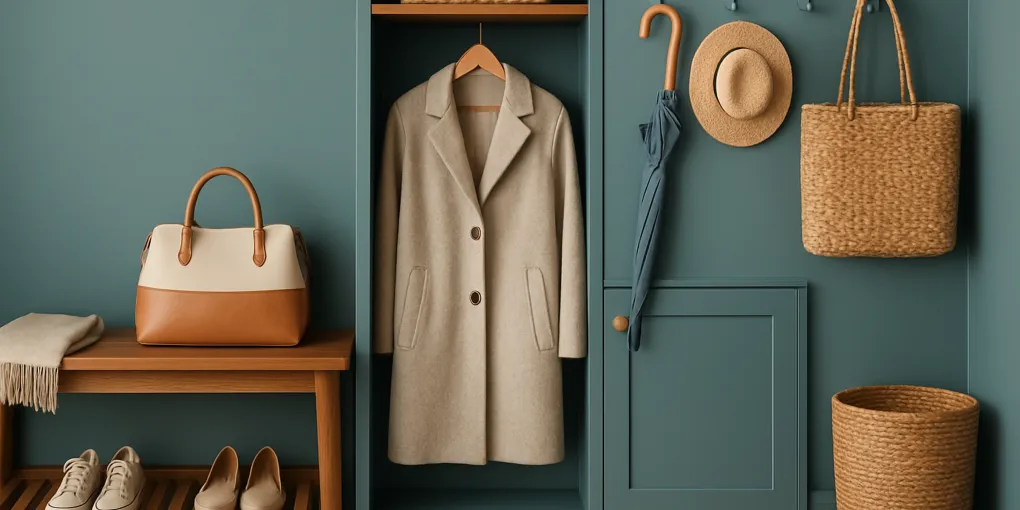
Best Small-Entryway Storage Ideas for Shoes, Keys, Bags, and Mail
Buyer's GuideThe best small-entryway storage creates a landing strip, not a miniature storage room. Shoes, keys, bags, mail, and returns need fast homes near the door, but the entry should hold only active rotation. If every shoe, coat, and receipt lives there, the entry becomes a bottleneck instead of a reset point.
Disclosure: This article contains Amazon affiliate links. If you buy through qualifying links, ClutterScience may earn a commission at no extra cost to you.
Editorial Transparency
ClutterScience uses AI tools during drafting support, outline organization, and source review. Human editors review every article for accuracy, clarity, product-link policy, and source quality. We do not fabricate reviewers, credentials, test results, ASINs, or citations.
Quick Recommendations
| Entryway problem | Best storage type | Why it works |
|---|---|---|
| Keys and wallet vanish | Small catchall tray or key rail | Creates one repeatable landing spot |
| Shoes pile by the door | Two-tier slim shoe rack | Limits active shoes by capacity |
| Bags land on chairs | Wall hooks or peg rail | Uses vertical space and keeps floors clear |
| Mail covers the table | Narrow wall file or mail slot | Separates paper from keys and shoes |
| Returns and errands scatter | One handled basket | Makes outgoing items portable |
Useful search links include small entryway shoe rack, wall hooks for entryway, entryway catchall tray, wall mail organizer, and small woven basket with handles. We use search links rather than direct ASIN links because listing availability changes.
Start With the Entryway Job Description
A small entryway has one job: support the transition between outside and inside. It does not need to store every outdoor item your household owns.
Good entryway categories are active and time-sensitive:
- Current shoes.
- Keys, wallet, sunglasses, and badge.
- Daily bags.
- Outgoing mail and returns.
- Seasonal weather gear in active use.
- Dog leash or pet-walk supplies if relevant.
Poor entryway categories are archival or occasional:
- Off-season shoes.
- Extra coats.
- Old mail.
- Bulk shopping bags.
- Tools that belong in the garage.
- Sentimental items with no daily function.
When the entry has a job description, product choices become easier. You are buying containers for repeat transitions, not for every homeless item.
Best for Shoes: Slim Two-Tier Rack
A two-tier shoe rack works when the entry has floor space but not closet depth. The rack should hold only the shoes currently in rotation. For a household of two, that may mean four to six pairs. For a family, it may mean one active pair per person plus weather footwear.
Look for:
- A narrow footprint.
- Enough height for boots if needed.
- Wipeable surfaces.
- Open sides for airflow.
- A capacity that enforces a limit.
Avoid oversized racks in tiny entries. More shoe slots often produce more shoes by the door. If the rack is always overflowing, move off-season or occasional shoes elsewhere before buying a second rack.
ClutterScience score: 8.2/10.
Best for Bags and Jackets: Wall Hooks or Peg Rail
Wall hooks usually beat freestanding racks in small entries because they use vertical space and keep the floor clearer. A peg rail works well when each person needs one defined hook. Individual hooks work better when you need custom spacing for backpacks, tote bags, hats, or leashes.
Look for hooks that are anchored properly for the wall type and expected weight. Heavy backpacks and loaded work bags need more support than lightweight jackets.
ClutterScience score: 8.5/10. Wall hooks are simple, visible, and easy for household members to use.
Best for Keys and Wallets: One Tray or Rail
Keys need a tiny, frictionless home. The best key system is the one you can use while holding groceries. A tray works for keys, wallet, sunglasses, lip balm, and earbuds. A key rail works better if keys must be visible and separate.
Choose a tray if several small daily-carry items come in together. Choose a hook rail if keys are the only recurring problem.
Do not combine mail and keys in the same container. Paper hides small objects. A key tray should stay shallow and single-purpose.
ClutterScience score: 8.0/10.
Best for Mail: Narrow Wall File
Mail becomes entry clutter when it has no immediate route. A narrow wall file or vertical sorter can hold active mail, but it needs a processing rhythm. Otherwise, it becomes an archive by the door.
Use two labels at most:
- Incoming.
- Outgoing.
If you need more categories, use a separate paperwork command center. The entryway should capture paper, not manage the whole household office.
ClutterScience score: 7.6/10.
Best for Errands and Returns: One Handled Basket
A handled basket is useful for library books, returns, packages, and items that need to leave the house. The handle matters because the whole category can move to the car or work bag at once.
Set a deadline rule. A returns basket with no deadline becomes another clutter bin. Add a weekly errand reset or calendar reminder.
ClutterScience score: 7.8/10.
Safety and Accessibility Notes
Entryways are circulation areas. The National Safety Council highlights falls as a major home safety issue, and cluttered walkways can increase trip risk. Keep shoes, bags, cords, and baskets out of the walking path. A narrow entry does not need a bench if the bench blocks the door swing or hallway.
Also consider reach height. Kids’ hooks should be low enough to use. Adult hooks should not require loaded bags to be lifted above shoulder height. A system that is physically awkward will not be used consistently.
The Capacity Rule That Keeps It Working
Every entryway category needs a visible capacity limit:
- One tray for keys.
- One hook per daily bag.
- One shoe slot per active pair.
- One mail slot for incoming paper.
- One basket for outgoing errands.
When the category exceeds the container, reset the category instead of expanding the entry. This is the difference between a landing strip and a storage spillover zone.
How We Score Small-Entryway Storage
Composite score breakdown: 30/25/20/15/10. Research quality is 30% and focuses on whether the storage idea solves the daily bottleneck of entering and leaving the home. Evidence quality is 25% and weighs product dimensions, mounting constraints, material information, and whether the category has enough user feedback to judge durability. Value is 20% and favors pieces that solve more than one active problem without expanding clutter capacity. User signals are 15% and include owner patterns around wobbling, wall damage, shoe fit, hook strength, basket collapse, and reset friction. Transparency is 10% and covers trade-offs, measurement requirements, and the use of Amazon search links where exact listings change.
This scoring model matters because small-entryway storage often looks successful on day one and fails by week three. The failure is rarely lack of storage. It is usually too much undifferentiated storage in a space that needs fast decisions. A deep bench basket can swallow shoes, returns, pet gear, hats, and mail until nobody knows what is inside. A narrow wall hook rail with clear limits may look smaller but work better because each hook has a job.
Choose by Traffic Pattern, Not by Aesthetic
Start by watching the entry for two ordinary days. Notice what gets dropped first. Shoes may be the obvious category, but keys, sunglasses, dog leashes, backpacks, lunch bags, mail, and return packages often create more friction. Buy for the first dropped category, not for the category that looks nicest in a catalog.
If people arrive carrying bags, hooks beat baskets because a bag can be parked in one motion. If mail is the problem, a vertical sorter near the door beats a decorative bowl because paper needs separation between action, archive, and recycling. If shoes are the problem, a low rack works only when it matches the number of shoes that are truly active that week. If every pair lives by the door, the entry has become a closet and needs a different plan.
Small spaces also need negative space. Leave floor clearance where feet naturally turn. A storage bench that blocks the swing path will be avoided no matter how many compartments it has. Wall-mounted options often outperform floor furniture because they preserve the walking lane.
Capacity Rules for Narrow Entries
Use one container per active category and make the container intentionally small. One tray for keys. One slot for mail. One basket for returns. One hook per daily bag. One shoe zone with a visible maximum. This sounds strict, but it prevents the common entryway pattern where the first organizer becomes a magnet for every homeless item.
For households with children, lower hooks are usually better than more hooks. A child-height hook creates a return path that does not depend on an adult. For renters, freestanding racks avoid wall damage, but they should be weighted or backed against a wall so daily use does not tip them forward. For narrow apartments, a combination of adhesive hooks, a small tray, and one slim shoe rack can outperform a single large entryway unit.
Review the entry every Sunday or on trash day. Remove shoes that were not worn that week, recycle old mail, return tools to rooms where they are used, and move completed returns out of the basket. The entryway is a launch pad, not storage for the whole house. When the launch pad stays limited, mornings get faster and the room looks calmer without needing a full decluttering project.
What Not to Store in a Small Entryway
A small entry should not hold every pair of shoes, every reusable bag, every coat, and every piece of mail. It should hold the items needed for the next departure. Move off-season shoes, special-occasion bags, archive paperwork, and bulk pet supplies elsewhere. If the entry must also serve as storage because the home is small, divide active launch items from true storage. Daily shoes can stay open; backup shoes can go in closed bins. Current mail can stay in a slot; archived papers should not. That split keeps the entry functional instead of turning it into the first overloaded closet in the house.
Maintenance Triggers
Use container fullness as the maintenance trigger. When the shoe rack is full, reset shoes. When the mail slot is full, process mail. When hooks are full, remove bags that are not being used this week. This is easier than scheduling a full declutter because the storage itself tells you when action is needed.
Sources
- MedlinePlus home safety overview. https://medlineplus.gov/ency/patientinstructions/000600.htm
- CDC STEADI fall-prevention resources. https://www.cdc.gov/steadi/
- U.S. Fire Administration home escape and clear-exit safety guidance. https://www.usfa.fema.gov/prevention/home-fires/prepare-for-fire/home-fire-escape-plans/
Bottom Line
For a small entryway, buy less storage than you think. Use wall hooks, a slim shoe rack, one catchall tray, one mail slot, and one outgoing basket. Then enforce active rotation. The entry should make leaving and returning easier, not become the house’s most convenient storage overflow.
Frequently Asked Questions
- A small entryway should store only active daily items: current shoes, keys, bags, outgoing mail, and weather gear in season. Overflow shoes, archives, and rarely used bags should live elsewhere.
- Wall hooks usually give more function per square foot. A bench is helpful if people need a seated shoe spot, but it should include a strict shoe limit or it can become clutter.
- Limit each category by capacity: one tray for keys, one slot for mail, one hook per active bag, and one small shoe zone. When the container is full, reset instead of adding another container.