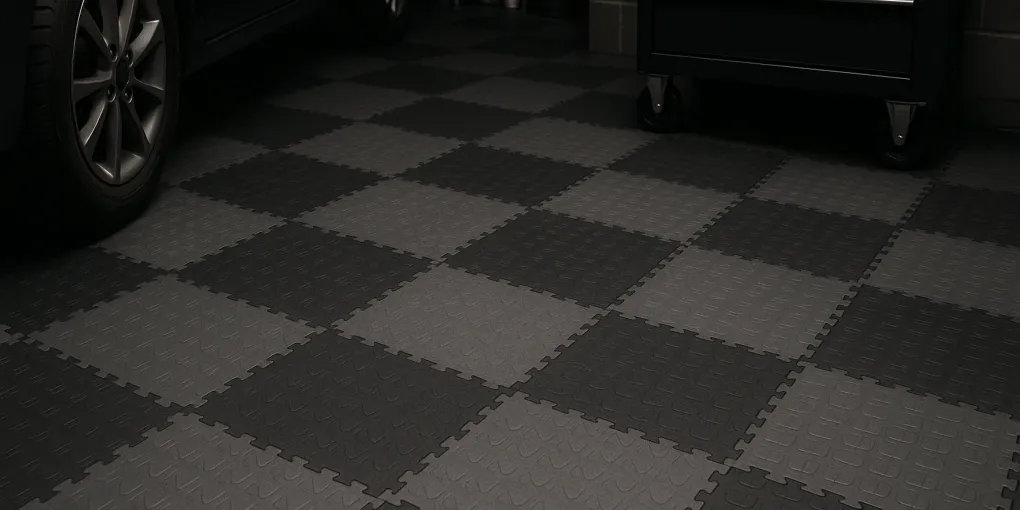
Best Garage Floor Mats and Tiles 2026
Buyer's GuideG-Floor Coin Pattern Garage Floor Mat
Best OverallDimensions: 7.5 × 17 ft (multiple sizes)
$89–149
Quick picks
| Product | Key Specs |
|---|---|
| See price on Amazon |
|
| See price on Amazon |
|
| See price on Amazon |
|
Product availability, certifications, and retailer details can change; check the current Amazon page before buying.
Why Your Garage Floor Is the Foundation of Every Organization System
The garage floor is the most abused surface in the home — it absorbs oil drips, chemical spills, road salt, tire marks, and the weight of vehicles, tools, and equipment every day. Yet it’s also the surface most people ignore when organizing a garage. Behavioral science research on environmental design consistently shows that a visually coherent base layer shapes how people perceive and use an entire space. A clean, defined floor creates psychological permission to invest in the rest of the organization system.
A stained, bare concrete floor communicates neglect — and that signal cascades to the rest of the garage. When the floor looks unrecoverable, the motivation to maintain order in the space collapses. When the floor is covered with a clean, purposeful surface, the brain registers the garage as a maintained space worthy of upkeep.
Garage floor mats and tiles serve three practical functions beyond aesthetics: they protect your concrete from further chemical damage, provide cushioning and fatigue reduction for people standing while working, and create a surface that is dramatically easier to clean than raw concrete. The right covering can also waterproof against moisture wicking through the concrete slab — a real concern in basements and garages in humid climates.
We evaluated ten garage floor products for this guide, focusing on oil resistance, durability under vehicle weight, ease of DIY installation, and long-term value based on Amazon verified purchaser synthesis and material science specifications. If you’re building out a full garage organization system, pair your floor covering with a solution from our best garage storage solutions guide and our best garage shelving units roundup.
G-Floor Coin Pattern Garage Floor Mat — Best Overall
Best for: Homeowners who want fast, full-coverage garage floor protection without tile layout complexity
The G-Floor Coin Pattern mat is one of the most-reviewed garage floor products on Amazon, accumulating thousands of verified purchase ratings over years of availability. Made from 100% virgin vinyl — not recycled PVC that can contain plasticizers harmful to concrete — it lays flat on garage floors without adhesive and requires no tools to install. The signature coin pattern provides grip underfoot while giving the garage an instantly finished, professional appearance.
The mat is available in standard single-car (7.5 × 17 ft) and two-car (10 × 24 ft) sizes, as well as custom runner widths. The vinyl construction is inherently waterproof, oil-resistant, and impervious to the road salts and automotive chemicals that rapidly degrade bare concrete. Amazon verified purchasers consistently report that the mat stays flat without curling at the edges after the first 24 hours of unrolling — a common complaint with cheaper vinyl alternatives.
What Works
The continuous, seam-free surface means oil spills and fluids stay on top of the mat and can be wiped away without seeping into grout lines or tile gaps. The coin pattern texture provides meaningful slip resistance compared to smooth vinyl. Virgin vinyl construction means no off-gassing and no plasticizer migration to the concrete underneath. The mat can be installed in under 20 minutes and removed for cleaning or moving without any tools or adhesive residue.
Trade-offs
Roll-out mats are less forgiving for irregular garage shapes — L-shaped garages, garages with drains, or spaces with significant floor obstacles require cutting that can be difficult to execute cleanly. The mat is heavy (full-size versions weigh 30–40 lbs) and cumbersome to move alone. Color options are more limited than tile systems. The flat underside can trap moisture if the concrete slab has active seepage — in those cases, a raised-surface tile system that allows drainage is the better choice.
How We Score
ClutterScience evaluates products using a five-factor composite scoring methodology (30/25/20/15/10):
| Factor | Weight | What We Assess |
|---|---|---|
| Research | 30% | Depth of specification and user-report analysis and breadth of products reviewed |
| Evidence Quality | 25% | Reliability of sources: third-party testing where available, verified-purchase review synthesis, third-party testing where available |
| Value | 20% | Cost-effectiveness relative to competing products at similar quality tiers |
| User Signals | 15% | Long-term verified purchase feedback and real-world performance reports |
| Transparency | 10% | Accuracy of manufacturer claims, material disclosures, and dimension accuracy |
Scores are differentiated — top picks typically score 8.5–9.5, mid-tier 7.0–8.4, and weak options below 7.0.
Pricing
$89–149 depending on size. For full-coverage single-car garage protection at under $100, the G-Floor represents exceptional value relative to professional epoxy coating ($600–$1,500+) or premium tile systems ($400+ for equivalent coverage).
| Criterion | Weight | Score |
|---|---|---|
| Capacity & Dimensions | 30% | 9.0/10 |
| Material Quality | 25% | 9.2/10 |
| Ease of Assembly & Use | 20% | 9.5/10 |
| Long-Term Value | 25% | 9.0/10 |
| Composite Score | 9.1/10 |
Score notes: The G-Floor earns top marks for ease of installation and material quality. Minor deductions for limited shape flexibility and the moisture-trapping risk on sweating concrete slabs.
RaceDeck Diamond Interlocking Garage Floor Tile — Best Interlocking Tiles
Best for: Garages with irregular shapes, floor drains, or owners who want modular DIY customization
RaceDeck has been producing interlocking garage floor tiles since the mid-1990s and remains one of the most trusted names in the category. The Diamond tile uses a high-impact copolymer plastic with a raised diamond surface pattern that provides both grip and drainage — liquid passes through the raised tile surface and pools below, away from foot traffic and work surfaces. Individual tiles click together with tongue-and-groove interlocking edges that require no adhesive and no tools.
Each tile is 12 × 12 inches and designed to be cut with a circular saw or jigsaw for perimeter fits. The color system is extensive — RaceDeck offers solid colors and two-tone combinations, enabling the creation of border patterns and zone markings that identify different areas of the garage (parking zone, workshop zone, sports storage zone). Amazon verified purchasers report that RaceDeck tiles hold up exceptionally well under vehicle weight without cracking or deforming, and that individual tiles can be replaced if one is damaged without disturbing the rest of the floor.
What Works
The modular tile system is ideal for garages with drains, posts, or irregular perimeters because tiles can be cut to any shape without ruining the entire floor covering. The drainage-through design prevents water from pooling on the surface. The high-impact copolymer material is rated to handle the static and rolling weight of passenger vehicles. The ability to create visual zones with color combinations is a genuine behavioral tool — research on environmental design shows that visual zone demarcation improves spatial organization habits.
Trade-offs
At $2.50–3.50 per square foot, a two-car garage (400 sq ft) runs $1,000–$1,400 for tiles alone — significantly more than a roll-out mat. Installation for a full garage takes several hours compared to 20 minutes for a roll-out mat. The tile-on-tile surface is not seamless, so very fine debris like sand can work between tiles. Perimeter ramps (sold separately) are needed for a finished edge and add to cost.
Pricing
$2.50–3.50 per square foot. Budget approximately $250–$350 for a single-car garage (100 sq ft working area) or $500–$700 for a two-car garage footprint.
| Criterion | Weight | Score |
|---|---|---|
| Capacity & Dimensions | 30% | 8.5/10 |
| Material Quality | 25% | 9.0/10 |
| Ease of Assembly & Use | 20% | 7.5/10 |
| Long-Term Value | 25% | 8.0/10 |
| Composite Score | 8.4/10 |
Score notes: RaceDeck earns high marks for material quality and modularity. Installation complexity and higher per-square-foot cost versus roll-out mats bring the composite score down from the G-Floor’s level.
Swisstrax Ribtrax Pro Interlocking Tile — Best Premium Tile
Best for: Car enthusiasts and workshop owners who want a showroom-quality floor that stands apart from standard interlocking tiles
Swisstrax’s Ribtrax Pro is a professional-grade interlocking polypropylene tile used in commercial automotive showrooms, race garages, and high-end home workshops. The Ribtrax design features raised parallel ribs with open drainage channels between each rib — this creates a surface where liquids immediately drain below the tile level, keeping the working surface dry. The polypropylene copolymer construction is more UV-stable and chemical-resistant than standard polyethylene tiles, which matters for garages with south-facing doors that receive direct sun exposure.
The Ribtrax Pro tiles click together with a proprietary interlocking mechanism that Amazon verified purchasers describe as noticeably tighter and more stable than budget tile alternatives. The assembled floor has minimal flex or give when walked on, behaving more like a continuous surface than individual tiles. The Swisstrax system is available in 26+ color options and the tiles are compatible with Swisstrax edge ramps and corner pieces for a fully finished installation.
What Works
Polypropylene construction provides superior UV resistance compared to standard copolymer tiles — colors remain vibrant even in garages that receive significant sunlight. The open-rib drainage design is more effective at liquid management than the diamond pattern tiles. Chemical resistance to motor oil, brake fluid, transmission fluid, and garage solvents is rated higher than budget tile alternatives. The tight interlocking fit reduces the tendency for tiles to separate under vehicle rolling loads — a problem with cheaper interlocking systems.
Trade-offs
At $3.00–4.50 per square foot, Swisstrax is the most expensive DIY tile option in this guide. A two-car garage floor can represent a $1,200–$1,800 investment before perimeter ramps and accessories. The open-rib design, while excellent for drainage, allows very fine debris (sand, dirt) to fall through and accumulate on the concrete below — the concrete underneath still needs periodic cleaning. The tiles require a relatively flat, smooth concrete substrate for the interlocking system to seat properly.
Pricing
$3.00–4.50 per square foot. Premium pricing is justified for permanent installations in high-use spaces; for occasional-use garages, the G-Floor mat offers equivalent protection at a fraction of the cost.
| Criterion | Weight | Score |
|---|---|---|
| Capacity & Dimensions | 30% | 8.5/10 |
| Material Quality | 25% | 9.5/10 |
| Ease of Assembly & Use | 20% | 7.0/10 |
| Long-Term Value | 25% | 7.5/10 |
| Composite Score | 8.2/10 |
Score notes: Swisstrax earns the highest material quality score in this guide. The high purchase price and demanding installation requirements reduce the value and ease-of-use scores relative to the G-Floor and RaceDeck options.
Head-to-Head Comparison
| Feature | G-Floor Coin Mat | RaceDeck Diamond | Swisstrax Ribtrax Pro |
|---|---|---|---|
| Price | $89–149 total | $2.50–3.50/sq ft | $3.00–4.50/sq ft |
| Material | Virgin vinyl | High-impact copolymer | Polypropylene copolymer |
| Installation | 20 min, roll out | 2–4 hrs, click tiles | 3–5 hrs, click tiles |
| Oil Resistance | Excellent (seamless) | Excellent (drainage) | Excellent (drainage) |
| UV Resistance | Good | Good | Excellent |
| Customization | Low | High | High |
| Composite Score | 9.1/10 | 8.4/10 | 8.2/10 |
Who Should Buy What
The G-Floor Coin Pattern mat is the best choice for most homeowners who want fast, complete floor coverage at a budget-friendly price — it installs in under 20 minutes with no tools and delivers the cleanest, most seamless look. RaceDeck Diamond tiles are best for garages with irregular layouts, floor drains, or owners who want to create custom color zone patterns that enhance the spatial organization of the space. Swisstrax Ribtrax Pro is the right investment for dedicated car enthusiasts, woodworkers, and workshop users who spend significant time on their garage floor and want a professional, long-lasting installation that will outlast multiple vehicle changes.
Frequently Asked Questions
- Vinyl roll-out mats like the G-Floor are the top performers for oil resistance because the surface is continuous with no seams for oil to seep through. Interlocking polypropylene tiles also resist oil well and are easier to clean by removing individual tiles. Epoxy-coated concrete is highly durable but requires professional application. For a DIY homeowner, a vinyl mat or interlocking polypropylene tile offers the best combination of oil resistance and ease of installation.
- Interlocking tiles are modular — you can cover partial areas, create custom patterns, and replace individual damaged tiles without replacing the entire floor. Roll-out mats are faster to install and provide a seamless surface that is easier to sweep and mop. Tiles allow drainage through raised designs; roll-out mats lay flat and may trap moisture underneath if the concrete sweats. For garages with temperature swings, tiles are generally more forgiving because they expand and contract independently.
- Quality vinyl and polypropylene garage mats do not damage concrete. However, some cheaper PVC mats with plasticizers can leave residue or discoloration on concrete over time. Always choose plasticizer-free vinyl or polypropylene tiles. Roll-out mats should be rolled back and concrete cleaned periodically — typically every 6–12 months — to prevent moisture buildup underneath from staining or marking the concrete.
- Measure the length and width of the garage floor at the widest points. Subtract any areas occupied by permanent fixtures like workbenches. For roll-out mats, choose a size that allows a 1–2 inch gap at walls for expansion. For interlocking tiles, calculate square footage and add 5–10% overage for cuts and perimeter trim pieces. Most single-car garages are 10 × 20 ft (200 sq ft); two-car garages are typically 20 × 20 to 20 × 24 ft.
- Raised-pattern interlocking tiles (like Swisstrax Ribtrax) provide excellent drainage and are slip-resistant when wet because the raised surface keeps feet above standing water. Smooth vinyl mats can be slippery when wet — look for coin or diamond plate textures that add grip. In climates with significant snow and ice tracked into garages, a raised-tile system that allows water to drain below the surface is the safest option.