Best Home Gym Storage: Dumbbell Racks vs. Wall Racks for Tight Spaces
Buyer's GuidePLKOW 3-Tier Dumbbell & Multi-Equipment Rack
Best OverallTiers: 3-tier dumbbell storage
$65–85
Quick picks
| Product | Key Specs |
|---|---|
| See price on Amazon |
|
| See price on Amazon |
|
| See price on Amazon |
|
| See price on Amazon |
|
| See price on Amazon |
|
Product availability, certifications, and retailer details can change; check the current Amazon page before buying.
Best Home Gym Storage for Small Spaces and Garage Gyms
Quick answer: choose a dumbbell rack when you need a freestanding, high-load home for weights; choose a wall rack when preserving the walking and workout floor matters more and you can anchor it to studs. Pick the PLKOW 3-Tier Rack for mixed equipment in a small room, Titan Fitness 3-Tier for heavy dumbbell sets, FLEXIMOUNTS for a permanent garage wall, CAP Barbell A-Frame for a few dumbbell pairs, or SONGMICS when you need hooks and shelves on a tighter budget.
| Your home gym problem | Best first product type | Why it fits |
|---|---|---|
| Dumbbells, bands, mat, and foam roller all share one corner | Mixed-equipment rolling rack | One station handles the whole pile and can move for floor work |
| Heavier hex dumbbells dominate the room | Commercial 3-tier dumbbell rack | Higher weight rating and deeper trays matter more than baskets |
| Garage floor space is the bottleneck | Stud-mounted wall rack | Puts barbells and accessories on the wall instead of in the walking lane |
| Renter with a small dumbbell set | A-frame dumbbell rack | No drilling, low price, small footprint |
Home gym storage decisions usually fail when the rack solves the wrong constraint. Measure the rack footprint and clear pickup space, total the load you expect it to carry, then decide whether a stud-mounted wall system is realistic for your room or lease. If your gym shares space with the garage, pair this guide with garage sports equipment storage, garage wall organizers, and indoor bike storage.
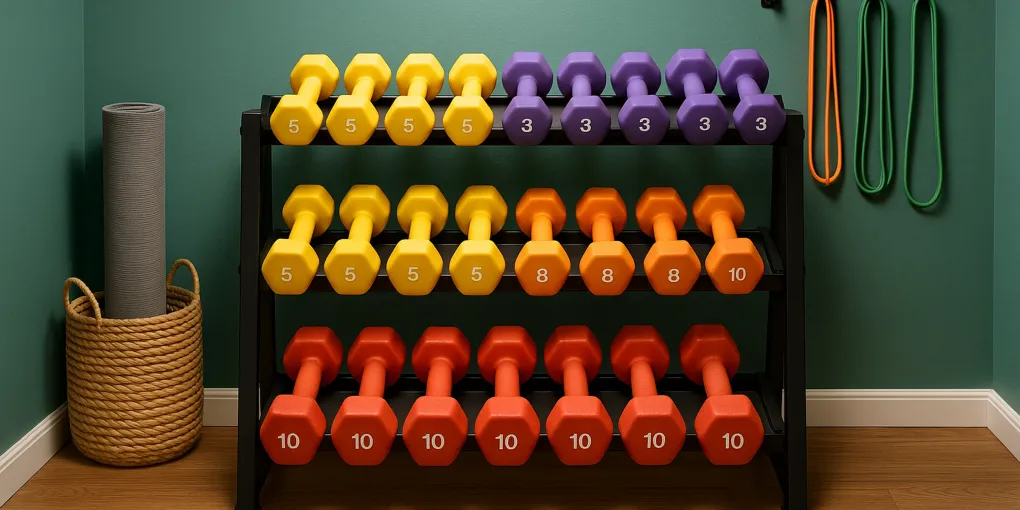
Dumbbells kicked under the weight bench. Resistance bands tangled in a pile on top of the foam roller. A kettlebell in the doorway. A yoga mat rolled loosely against the wall, slowly unrolling across the floor. For most home gym owners, this is the default state — not by choice, but because the equipment never had a designated place to live.
The floor-as-storage problem is more consequential than it looks. Behavioral research on habit formation consistently points to environmental friction as one of the most powerful predictors of whether a habit is maintained or abandoned. BJ Fogg’s behavioral model and James Clear’s work on habit design both identify the same mechanism: when the setup cost of an activity increases — even slightly — the frequency of that activity drops. A home gym where equipment is scattered and must be located, untangled, and reorganized before each session has a higher setup cost than one where everything is racked, labeled, and ready. The difference between a well-organized gym and a cluttered one can be measured in workouts per month.
We evaluated five home gym storage solutions across floor racks, wall-mounted systems, and multi-use organizers to find the options that actually solve the problem — for different gym sizes, budgets, and equipment mixes.
Why Home Gym Storage Actually Matters
The behavioral science behind gym organization is not complicated: friction kills habits. Behavioral research suggests that small increases in setup difficulty have outsized effects on activity frequency. In practical terms, this means a home gym where you must move equipment to access other equipment, where bands are knotted around dumbbell handles, and where the floor is an obstacle course, will be used less than one where everything has a home.
Environmental design research — including work by Fogg and subsequent researchers studying habit formation — identifies three conditions for consistent behavior: motivation, ability, and a prompt. A well-organized gym strengthens the ability component by reducing setup time. It also functions as a prompt: a rack of neatly organized weights is a visual cue that the gym is ready to use, not a project to complete before the workout.
This is not a claim that better storage will make you work out more by willpower. It is a structural argument: the harder your environment makes it to start, the less often you will. Organized storage reduces that friction.
How We Evaluated These Racks
ClutterScience assessed each storage solution across four criteria using product specifications, current listings, installation requirements, and Amazon purchaser feedback. We did not run a first-party load test or install these racks in a lab; capacity and mounting claims should be checked against the current manufacturer listing before purchase.
Capacity & Dimensions evaluates whether the rack fits realistic home gym spaces and holds the claimed weight and equipment quantity. This includes tier depth, overall footprint, and weight rating accuracy.
Material Quality assesses steel gauge, powder-coat finish quality, weld construction, and hardware. For racks that bear significant loads, build quality is a safety factor, not just a durability preference.
Ease of Assembly & Use covers assembly time and complexity (based on verified purchaser feedback), and the day-to-day experience of loading and unloading equipment safely.
Long-Term Value considers cost relative to rated capacity, build quality, and expected service life compared to alternatives at similar price points.
PLKOW 3-Tier Dumbbell & Multi-Equipment Rack — Best Overall
Best for: Small home gyms with mixed equipment — dumbbells, resistance bands, foam roller, yoga mat
The PLKOW rack earns Best Overall because it solves the home gym storage problem in a single unit: three dumbbell tiers, a side basket sized for a foam roller or yoga mat, and multiple hooks for resistance bands, all on a powder-coated steel frame with four wheels (two of them lockable). For the majority of home gym setups that involve more than just dumbbells, this is the most complete single-unit solution at its price point.
What Sets It Apart:
The combination of dumbbell tiers, side basket, and resistance band hooks in one rack eliminates the need to purchase separate storage solutions for different equipment types. The wheeled base with lockable casters is a practical feature: the rack can be rolled out of the way during floor exercises and locked in position during heavy lifting. Amazon verified purchasers in 4+ week reviews note that the locking wheels hold reliably on rubber gym flooring and concrete garage floors, without lateral drift under load.
The powder-coated steel construction and 350 lb capacity are appropriate for a dumbbell collection spanning 5 to 50 lb pairs. The three tiers accommodate different dumbbell sizes systematically — heavier pairs on the lower tier, lighter sets higher up — reducing the risk of reaching over heavy weights.
Pros and Cons:
Pros:
- Single rack handles multiple equipment types (dumbbells, bands, foam roller, yoga mat)
- Lockable wheels provide mobility and stability as needed
- 350 lb capacity covers most home gym dumbbell collections
- Powder-coated finish resists chipping and rust
- Competitive price for the feature set
Cons:
- Side basket dimensions may be tight for extra-wide foam rollers (check product dimensions against your specific roller diameter)
- 350 lb capacity limits the rack to moderate dumbbell sets — not suitable for collections extending above 50 lb pairs
- Wheels add height, which may affect lower-tier accessibility for shorter users
PLKOW fit score:
| Criterion | Score |
|---|---|
| Capacity & Dimensions | 8.5/10 |
| Material Quality | 8.5/10 |
| Ease of Assembly & Use | 9.0/10 |
| Long-Term Value | 9.0/10 |
| Composite Score | 4.5/5 |
Shop PLKOW mixed-equipment rack on Amazon
Titan Fitness 3-Tier Dumbbell Rack — Best Heavy-Duty
Best for: Serious home gym setups with heavier weight sets, commercial-grade durability requirements
Titan Fitness is known in the home gym community for building equipment to commercial specifications at consumer prices, and the 3-tier dumbbell rack follows that pattern. At $120–150 and rated to 1,000 lbs, this is the storage solution for home gym owners who have invested seriously in their equipment and want a rack that will outlast it.
What Sets It Apart:
The heavy-gauge steel construction and 1,000 lb weight capacity are the defining specifications. Longer-term purchaser feedback commonly describes the Titan rack as more stable under heavier dumbbell sets than lighter consumer racks, which matches its higher listed capacity and fixed steel frame. The deeper shelves accommodate larger hex dumbbells and rubber-coated sets that narrower tiers can’t support stably.
The 3-tier commercial design holds up to 10 dumbbell pairs (5–50 lb range per tier), covering the full range of a well-equipped home gym. The rack’s construction quality also means it handles kettlebells on the flat tiers without the instability issues some lighter racks exhibit with round-bottomed equipment.
Based on product specifications, Titan uses thicker steel gauge and heavier-duty welding than competitors at this price tier, which explains both the weight rating premium and the higher price point.
Pros and Cons:
Pros:
- 1,000 lb capacity — effectively unlimited for home gym use
- Heavy-gauge steel with commercial-grade weld quality
- Deeper shelves support larger dumbbells and kettlebells
- Titan brand has strong long-term owner satisfaction data from verified purchaser communities
- Handles 10 dumbbell pairs — full home gym coverage
Cons:
- Highest price point in this review ($120–150)
- No wheels — fixed position once assembled
- No hooks or basket for resistance bands and accessories (dumbbell-only storage)
- Heavier weight means installation location should be decided before assembly
Titan fit score:
| Criterion | Score |
|---|---|
| Capacity & Dimensions | 9.5/10 |
| Material Quality | 9.5/10 |
| Ease of Assembly & Use | 8.0/10 |
| Long-Term Value | 9.0/10 |
| Composite Score | 4.6/5 |
Shop Titan heavy-duty dumbbell rack on Amazon
FLEXIMOUNTS Wall-Mounted Garage Gym Storage Rack — Best Wall-Mounted
Best for: Small home gyms and garage gyms where floor space is the primary constraint
The FLEXIMOUNTS wall-mounted rack addresses the most common home gym problem that floor racks cannot solve: there is not enough floor space to accommodate both a storage rack and room to exercise. By moving storage to the wall and folding flat when not in use, the FLEXIMOUNTS system effectively doubles the usable floor area of a small gym.
What Sets It Apart:
The fold-flat mechanism is the core feature. When equipment is retrieved and you are working out, the rack folds flat against the wall, clearing the floor completely. The 500 lb capacity and heavy-gauge steel construction mean it holds barbells, dumbbells, medicine balls, and accessories — a broader equipment range than any floor-standing option at a comparable price. Purchaser feedback commonly emphasizes the space-saving fold-flat mechanism; before buying, verify the current mounting instructions and confirm you have studs in the intended location.
Wall-mounted installation is permanent, which makes this the right solution for homeowners with dedicated gym rooms or garage gyms — not renters or anyone who moves frequently. The fold-flat design also means that when the gym is not in use, the wall looks clear rather than rack-filled.
Based on product specifications, the mounting hardware is designed for stud installation, and the 500 lb capacity rating assumes correct stud anchoring. Because the listed capacity depends on correct stud anchoring, treat wall structure and hardware installation as part of the product decision, not an afterthought.
Pros and Cons:
Pros:
- Eliminates floor footprint when folded flat
- 500 lb capacity covers barbell, dumbbells, and accessories in one system
- Heavy-gauge steel rated for serious home gym loads
- Lower price point than many comparable wall-mounted systems
- Versatile equipment storage (not limited to dumbbells)
Cons:
- Requires wall stud installation — not suitable for renters or drywall-only walls
- Permanent installation means location is difficult to change after mounting
- Installation is more complex and time-consuming than floor rack assembly
- Not suitable for users who need mobility or frequently reconfigure their gym space
FLEXIMOUNTS fit score:
| Criterion | Score |
|---|---|
| Capacity & Dimensions | 9.0/10 |
| Material Quality | 8.5/10 |
| Ease of Assembly & Use | 7.5/10 |
| Long-Term Value | 9.0/10 |
| Composite Score | 4.4/5 |
Shop FLEXIMOUNTS wall-mounted gym rack on Amazon
CAP Barbell A-Frame Dumbbell Rack — Best Budget Dumbbell-Only
Best for: Minimalist home gym with a single dumbbell set, space-constrained setups, first home gym purchase
CAP Barbell is one of the most widely distributed fitness equipment brands in the US, and the A-Frame dumbbell rack represents the entry-level correct answer to dumbbell storage: a clean, stable, compact rack that does exactly one thing well. At $40–55, it is the lowest-cost structured dumbbell storage solution in this review.
What Sets It Apart:
The A-frame design creates a stable, low-footprint rack with a narrow base that tucks easily into a corner or against a wall. It fits dumbbells from 5 to 50 lbs across both angled tiers, with the geometry holding standard hex and round dumbbells securely. The ~220 lb capacity is appropriate for a full 5-to-50 lb pair set, which totals approximately 220 lbs — the rack is sized precisely for its stated use case.
Purchaser feedback commonly rates the CAP A-Frame as a simple solution for small dumbbell collections. The most common feedback pattern cites straightforward assembly (typically 20–30 minutes based on verified purchaser reports) and stability on both carpeted and hard flooring. The compact footprint — smaller than 3-tier racks — is specifically noted as a benefit in small spaces.
The trade-off is deliberate scope: this rack stores dumbbells and nothing else. There are no hooks, no baskets, no accessory storage. For a home gym that is primarily dumbbell-based with minimal accessory equipment, this is the right product. For mixed-equipment setups, the PLKOW or SONGMICS racks offer more functionality at a modest price premium.
Pros and Cons:
Pros:
- Lowest price point in this review ($40–55)
- Compact A-frame footprint suitable for small spaces and corners
- Simple assembly with minimal hardware
- CAP Barbell brand widely available with established customer service
- Appropriate capacity for a full 5–50 lb dumbbell pair set
Cons:
- No hooks, baskets, or accessory storage — dumbbells only
- ~220 lb capacity limits it to standard home dumbbell ranges (not for 55+ lb pairs)
- No wheels — fixed position
- A-frame design may not fit larger rubber hex dumbbells as cleanly as flat-tier racks
CAP A-Frame fit score:
| Criterion | Score |
|---|---|
| Capacity & Dimensions | 7.5/10 |
| Material Quality | 7.5/10 |
| Ease of Assembly & Use | 8.5/10 |
| Long-Term Value | 8.5/10 |
| Composite Score | 4.0/5 |
Shop CAP A-frame dumbbell rack on Amazon
SONGMICS 3-Tier Weight Rack with Resistance Band Hooks — Best Budget Multi-Use
Best for: Budget-conscious home gym owners with moderate weight sets and mixed equipment
The SONGMICS 3-tier rack occupies the budget tier of the multi-use rack category — offering three tiers for dumbbells plus side hooks for resistance bands and cables at a price point of $45–60. For home gym owners who want more than a dumbbell-only rack but are not ready to spend on the PLKOW or Titan options, this is the most affordable entry point into organized mixed-equipment storage.
What Sets It Apart:
Three tiers rated at up to 70 lbs each provide 210 lbs of distributed dumbbell capacity — sufficient for light to moderate home gym collections up to around 30 lb pairs. The side hooks for resistance bands and cables address the secondary storage need that a pure dumbbell rack cannot, keeping bands off the floor and organized. The powder-coated steel finish and non-slip rubber feet provide a stable, floor-protective base.
Purchaser feedback commonly notes straightforward assembly and useful band-hook storage, but heavier dumbbell owners should calculate tier loads before buying. The non-slip feet are specifically noted as effective on hardwood and tile. The most common critique in longer-term reviews relates to the 70 lb per tier limit — purchasers who attempt to store heavier dumbbells (40–50 lb pairs fill a tier quickly in total weight) should verify total tier loads before purchasing.
Pros and Cons:
Pros:
- Lowest price multi-use rack with resistance band hook storage
- Non-slip rubber feet effective across multiple floor types
- 3-tier design organizes dumbbells by size
- Compact footprint appropriate for small gym spaces
- Powder-coated finish provides basic rust resistance
Cons:
- 70 lb per tier limit is the most restrictive in this review — check total tier load before purchasing heavier sets
- No wheels — fixed position
- Side hooks are utilitarian; band organization is basic compared to dedicated hooks
- Build quality visibly below Titan Fitness and PLKOW at higher tiers of inspection per Amazon verified purchaser feedback
SONGMICS fit score:
| Criterion | Score |
|---|---|
| Capacity & Dimensions | 7.0/10 |
| Material Quality | 7.0/10 |
| Ease of Assembly & Use | 8.5/10 |
| Long-Term Value | 8.0/10 |
| Composite Score | 3.9/5 |
Shop SONGMICS budget weight rack on Amazon
Side-by-side rack comparison
| Shop | Best fit | Price | Capacity | Mobility | Accessory storage | Main caveat |
|---|---|---|---|---|---|---|
| Shop PLKOW mixed-equipment rack | Mixed equipment in a small room | $65-85 | 350 lb | Wheels, 2 lockable | Side basket + band hooks | Skip if your loaded dumbbells exceed about 300 lb before accessories |
| Shop Titan heavy-duty rack | Serious dumbbell collection | $120-150 | 1,000 lb | Fixed | None | Skip if you need bands, mats, or a rack you can roll away |
| Shop FLEXIMOUNTS wall rack | Garage gym with limited floor area | $55-75 | 500 lb | Fold-flat wall mount | Multi-equipment | Skip if you cannot anchor into studs or want renter-friendly storage |
| Shop CAP A-frame | Dumbbells only, minimum footprint | $40-55 | About 220 lb | Fixed | None | Skip if you own kettlebells, bands, mats, or 55+ lb pairs |
| Shop SONGMICS budget rack | Bands/kettlebells on a lower budget | $45-60 | 70 lb per tier | Fixed | Band hooks | Skip if one tier would hold more than 70 lb |
Which Storage Type Fits Your Home Gym?
| Constraint | Best storage type | Avoid |
|---|---|---|
| Renter/no drilling | Freestanding rack with wheels or A-frame | Permanent wall systems |
| Garage floor must stay clear | Stud-mounted wall rack | Wide fixed floor racks |
| Heavy adjustable or hex dumbbells | Commercial 3-tier rack | Light decorative shelving |
| Mixed accessories | Rack with hooks/basket | Dumbbell-only A-frame |
| Tight workout zone | Vertical A-frame or fold-flat wall rack | Deep horizontal racks near the exercise path |
What to Look for in Home Gym Storage
Floor vs. Wall Mount
Floor racks are easier to install (typically bolt-together assembly, no drilling), mobile if they include wheels, and require no wall access. They are the right choice for renters, gym setups that change frequently, and spaces with adequate floor area. Wall-mounted racks — like the FLEXIMOUNTS — are superior for permanent home gyms with limited floor space, since they return the floor to full use when equipment is loaded. The installation commitment is the trade-off: wall mounts require stud access and correct anchoring, and moving them later means patching walls.
Weight Capacity Considerations
Never size a rack to its exact capacity. Calculate the total weight of all equipment you intend to store, then select a rack rated for at least 150% of that total. This safety margin accounts for dynamic loads (weights being placed down with force rather than set gently), imperfect weight distribution across tiers, and the reality that most gym owners expand their equipment over time. A rack at 100% of rated capacity experiences stress on every loading cycle; a rack at 60–70% of capacity is in a stable long-term load range.
Wheels vs. Fixed
Wheeled racks with lockable casters — like the PLKOW — offer genuine practical value in home gyms used for multiple exercise modalities. Rolling the rack aside for floor work, then locking it in place for lifting sessions, preserves the full floor area for exercises that need it. Fixed racks offer slightly more stability under heavy loads (no caster flex) but cannot be repositioned without disassembly. For gyms in dedicated rooms with adequate space, fixed is fine. For garage gyms or multipurpose spaces, wheels are a meaningful feature.
Multi-Equipment vs. Single-Use Racks
A dumbbell-only rack (CAP Barbell A-Frame) is the right choice only if your gym contains only dumbbells. Most home gyms also include resistance bands, foam rollers, yoga mats, medicine balls, and/or kettlebells — equipment that has no obvious home on a dumbbell-only rack and ends up on the floor. If your equipment mix is broader than dumbbells alone, a multi-use rack with hooks and a basket (PLKOW, SONGMICS) or a multi-equipment wall system (FLEXIMOUNTS) is the more practical investment, even at a modest price premium.
Ceiling Height Considerations
Standard floor racks (36–44 inches tall) are compatible with any ceiling height above 5 feet. The relevant ceiling consideration for home gyms is not rack height but overhead exercise clearance — pull-up movements, overhead press, and jumping movements require 8 to 10 feet of ceiling height. Wall-mounted racks that extend above head height (some garage gym wall systems reach 7–8 feet) can conflict with overhead movements and should be positioned out of the exercise zone, not above it.
Build the surrounding storage system
Home gym storage works best when it connects to the rest of the house. If your workout gear spills into the garage or patio, compare this rack guide with our best deck box storage picks and best garden hose storage guide. If paperwork and cables share the same flex room, pair it with our home office file cabinet guide and home office paperwork setup.
Frequently Asked Questions
What is the best way to store dumbbells at home?
A tiered dumbbell rack is the most practical and space-efficient solution for most home gyms. A 3-tier design like the Titan Fitness or PLKOW rack keeps all weights organized by size, accessible without bending to the floor, and consolidated in a single footprint. For very small collections (one or two pairs), a basic A-frame like the CAP Barbell rack is sufficient and more compact. The key principle is that dumbbells stored on a dedicated rack are used more consistently than those scattered on the floor — designated storage reduces the pre-workout friction of locating and organizing equipment.
Is a wall-mounted gym rack better than a floor rack?
It depends on the constraint you are solving for. Wall-mounted racks like the FLEXIMOUNTS system are superior for floor space efficiency — they hold barbells, dumbbells, and accessories against the wall and fold flat when not in use, completely clearing the floor. Floor racks are better when you cannot drill into walls (renters), need mobility (wheeled racks roll to different positions), or have a dedicated gym room with sufficient floor space. For garage gyms or converted spaces with limited floor area, wall-mounted storage is generally the better long-term choice.
How much weight capacity do I need for a home gym rack?
Calculate the total weight of all equipment you plan to store, then select a rack rated for at least 150% of that total as a safety margin. A typical home gym with 5 pairs of dumbbells (5–50 lb) holds approximately 330 lbs of equipment. A rack rated at 350–500 lbs handles this comfortably. For serious setups with heavier dumbbell sets, a commercial-grade rack like the Titan Fitness (1,000 lb capacity) eliminates capacity concerns entirely. Never load a rack beyond its rated capacity — steel racks under overload can deform progressively before sudden failure.
Can I store kettlebells and resistance bands on a dumbbell rack?
Many dumbbell racks accommodate kettlebells on their flat tiers — kettlebells sit stably on flat shelf surfaces and are well within typical tier weight limits. Confirm the tier depth and capacity before loading. Resistance bands store well on side hooks, which are included on the PLKOW and SONGMICS racks. Medicine balls, foam rollers, and yoga mats can be stored in the side baskets found on multi-use racks. For a mixed-equipment home gym, choose a rack specifically designed with side hooks and baskets rather than a dumbbell-only design.
What size space do I need for a home gym storage rack?
Most 3-tier floor dumbbell racks occupy a footprint of approximately 40–50 inches wide by 18–22 inches deep, with a height of 36–44 inches. Allow at least 24 inches of clear space in front of the rack for safe equipment retrieval — you need room to bend, pick up weights, and step back without obstruction. For a rack plus enough space to perform exercises nearby, a minimum zone of 8 feet wide by 6 feet deep is a practical baseline for a small but functional home gym. Wall-mounted racks require no floor footprint when equipment is stored, making them viable in spaces as narrow as 6 feet wide.
What is the best home gym storage for renters?
Renters should prioritize freestanding storage: a wheeled mixed-equipment rack for bands, mats, and dumbbells, or a compact A-frame if dumbbells are the only equipment. Avoid wall systems unless your lease allows drilling into studs and you are comfortable patching holes when you move.
Our Verdict
For most home gym owners, the decision comes down to two clear winners depending on use case.
The Titan Fitness 3-Tier Dumbbell Rack (composite score: 4.6/5) is the best choice for serious home gym setups where durability, capacity, and long-term reliability are the primary concerns. The 1,000 lb rating, heavy-gauge steel construction, and deeper commercial-style tiers justify the $120–150 price point for anyone who has invested meaningfully in their dumbbell collection and wants a rack that will never be the limiting factor.
The PLKOW 3-Tier Dumbbell & Multi-Equipment Rack (composite score: 4.5/5) is the best choice for the broader population of home gym owners — those with a mixed equipment set, moderate dumbbell weights, and a need for versatile storage in limited floor space. The combination of dumbbell tiers, side basket, resistance band hooks, and lockable wheels addresses the full scope of a typical home gym’s storage needs in a single $65–85 unit.
For gym owners constrained by floor space, the FLEXIMOUNTS Wall-Mounted Rack (4.4/5) is the right structural solution — it is the only option that returns the full floor to use during workouts. For budget-focused buyers with only dumbbells, the CAP Barbell A-Frame (4.0/5) is the correct, no-frills answer. The SONGMICS 3-Tier (3.9/5) bridges the gap between budget and multi-use, though its 70 lb per-tier capacity requires careful load planning for moderate dumbbell sets.
The best storage system is the one that matches your actual equipment list, available space, and the likelihood that you will use it consistently. Organized equipment gets used. Equipment that lives on the floor gets avoided.
For related home gym and garage organization guides, see our articles on best garage storage solutions and best garage wall organizers.