Best Extension Cord Organizers 2026: Cable Reels, Cord Boxes & Management Systems
Buyer's GuideIron Forge Cable Extension Cord Storage Reel
Best Overall Cord ReelMaterial: Powder-coated steel
$22–30
Quick picks
| Product | Key Specs |
|---|---|
| See price on Amazon |
|
| See price on Amazon |
|
| See price on Amazon |
|
| See price on Amazon |
|
| See price on Amazon |
|
Product availability, certifications, and retailer details can change; check the current Amazon page before buying.
Best Extension Cord Organizers 2026: Cable Reels, Cord Boxes & Management Systems
Tangled extension cords draped across garage floors, power strips buried in cable piles behind entertainment centers, cords running across living room walkways — these are among the most common and most persistently ignored household clutter problems. They are also genuinely dangerous ones.
An extension cord left loose on a floor is a tripping hazard for every person who walks past it. A power strip buried in a heap of cables in a corner generates heat that has nowhere to go. A cord coiled tightly inside a closed box while energized is, per guidance informed by National Fire Protection Association (NFPA) research on electrical fires, a scenario that can lead to insulation failure. Cord management is not merely about visual tidiness. It is about reducing real physical risk to the people and property in your home.
The good news is that the right organizer for each situation is not expensive or complicated to use. A cord reel for the garage, a ventilated cable box for the desk, a floor cover for doorway thresholds, a raceway channel for TV walls — each of these is a targeted solution that addresses a specific problem. We evaluated five products across these four categories to identify which performs best for safety, capacity, durability, and ease of use.
Why Cord Organization Is a Safety Issue, Not Just Aesthetics
Extension cord misuse is one of the most underappreciated household hazards. According to data cited by the NFPA, extension cords and power strips are involved in an estimated 3,300 residential fires per year in the United States, resulting in dozens of deaths and hundreds of injuries annually. The most common contributing factors are cord damage, overloading, and improper storage.
Coiling an energized extension cord tightly reduces its ability to dissipate heat. Under continuous load, this can raise the cord’s temperature above its rated tolerance, degrading insulation and — in worst-case scenarios — creating ignition risk. This risk is compounded when a coiled, powered cord is stored inside a closed container without ventilation. Purpose-built cord reels and ventilated cable enclosures specifically address this by providing structured, open storage that allows heat to escape.
Tripping hazards are an equally significant concern. The National Safety Council identifies falls as the leading cause of unintentional home injury. Cords running across floors, through doorways, or under rugs in high-traffic areas are a primary contributor. Floor cord covers and wall raceways eliminate this hazard by containing cords in a stable, low-profile channel that is visible, protected, and not a catch point for feet.
Cable damage from foot traffic is a slower-developing but real risk. Repeated compression degrades the insulation around conductors. A cord that looks functional externally may have compromised insulation internally — particularly if it has been run under a rug or carpet for months or years. Managing cords properly extends their functional life and reduces the risk of the kind of slow insulation failure that causes intermittent faults.
How We Evaluated These Solutions
We assessed each product against four criteria directly relevant to safety and functional performance:
Capacity and Dimensions — How many cords does it accommodate, what gauge or length of cord does it support, and does it physically fit the spaces most readers will need to use it in?
Material Quality — What is the build quality of the enclosure or channel? For powered enclosures (cable boxes), does the design include ventilation adequate for heat dissipation? Is the material durable enough for the intended environment?
Ease of Assembly and Use — How difficult is initial setup? Can cords be added, removed, or accessed without fully disassembling the product? Is the daily-use workflow (deploying a cord reel, closing a cable box lid, snapping open a raceway) genuinely convenient?
Long-Term Value — Does the product’s construction quality justify the price relative to alternatives? Does it protect the cords stored in it in ways that extend their useful life?
Iron Forge Cable Extension Cord Storage Reel — Best Overall Cord Reel
Best for: Garage, workshop, and outdoor use where extension cords need to be stored, transported, and deployed repeatedly
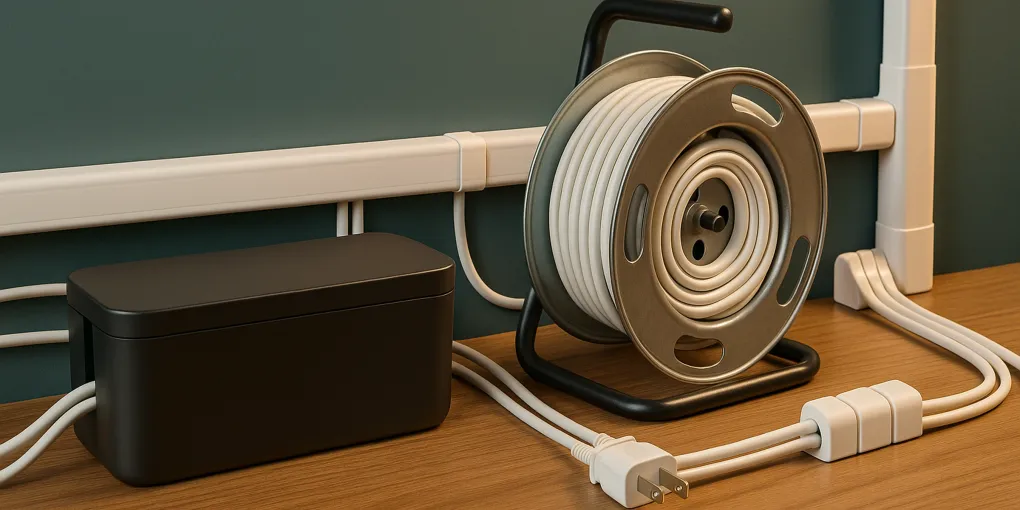
The Iron Forge Cable Extension Cord Storage Reel is a powder-coated steel cord reel with a side carry handle, designed for storing and deploying extension cords in high-use environments. It holds up to 100 feet of 16-gauge extension cord, 75 feet of 14-gauge, or 50 feet of 12-gauge cord — accommodating the full range of residential and light commercial extension cord gauges on a single spool.
What Works
The powder-coated steel construction is built for environments that would destroy a plastic reel: garages with temperature swings, outdoor use in varying weather, workshop floors where tools get dropped. The metal body resists dents, cracks, and UV degradation in a way that comparable plastic reels do not.
The spool design solves the extension cord’s most persistent problem: tangling during storage. Rather than coiling the cord loosely in a bucket or wrapping it around itself (which stresses insulation at the bends), the reel provides a structured winding surface. Cord goes on neatly, stores compactly, and unwinds without knotting. The side handle makes carrying the loaded reel genuinely practical — at up to 11 lbs when fully loaded with 12-gauge cord, the handle placement balances the weight appropriately.
Per manufacturer specifications and verified purchaser feedback on Amazon, the cord reel accommodates the most commonly used residential extension cord lengths with room for the full cord to be stored on the spool. Reviewers with repeated workshop use report the powder-coated finish holding up to typical garage conditions over extended use periods.
Trade-offs
At 11 lbs loaded, this is not a lightweight product. For users who primarily need to store a single small extension cord at a desk or in a closet, the weight and scale are unnecessary. The Iron Forge reel is designed for cords that need to be deployed, used over a distance, and then rewound — not for permanent stationary storage. It also does not include a cord; it stores your existing extension cord.
The open reel design means stored cords are not enclosed or concealed — this is correct from a heat-dissipation standpoint, but it is not a visual hiding solution for environments where aesthetics matter.
Pricing
$22–30.
| Criterion | Score |
|---|---|
| Capacity & Dimensions | 8.5/10 |
| Material Quality | 9.2/10 |
| Ease of Assembly & Use | 8.8/10 |
| Long-Term Value | 9.0/10 |
| Composite Score | 4.5/5 |
Verdict: The best purpose-built cord storage tool for garages and workshops. The metal construction and spool format justify the price for anyone who uses extension cords repeatedly and wants them to last.
Monoprice Large Cable Management Box / Power Strip Hider — Best Power Strip Hider
Best for: Hiding desk or entertainment center power strips and the cable tangle that accumulates around them
The Monoprice Large Cable Management Box is a ventilated enclosure that houses power strips and their associated cable bundles, removing them from view while maintaining safe heat dissipation during use. At its large size variant, it fits power strips up to 15.8 x 5.9 x 5.1 inches — covering most standard 6- to 8-outlet surge protectors found in home and office use.
What Works
The defining specification for a powered cable enclosure is ventilation. Monoprice includes ventilated side panels as a core design element — not afterthought holes, but perforated sides that allow consistent airflow around the enclosed power strip. This is the critical safety feature that separates a purpose-built cable management box from the improvised alternatives (cardboard boxes, plastic bins, closed storage drawers) that create heat-trapping risk.
The cable entry and exit slots on both ends of the box handle real-world cord routing well. Input cables (from the wall outlet) route through one end; output cables (to devices on the desk or entertainment center) exit through the other. The result is that a power strip with multiple cords plugged in effectively disappears, leaving only the organized runs to the devices. The black finish suits most home office and entertainment center environments.
The large size variant’s internal dimensions (accommodating strips up to 15.8 inches long) are generous enough for the wide-body surge protectors that commonly accompany home theater equipment. A medium size is also available for smaller setups.
According to verified purchaser reviews on Amazon, the most consistent praise centers on the transformation effect: the cord cluster that was previously the most visually chaotic element in a room is replaced by a single neutral box.
Trade-offs
The Monoprice box is functional rather than premium in its aesthetic. The ABS construction is practical and durable, but it does not have the deliberate design quality of the Bluelounge CableBox Plus reviewed below. For entertainment centers where the box will be largely hidden, this is a non-issue. For desk surfaces where it will be consistently visible, users who care about aesthetics should weigh the Bluelounge alternative.
The box does not include mounting hardware and sits on surfaces rather than mounting to walls or under desk frames out of the box.
Pricing
$24–32 (large size; medium available at lower price).
| Criterion | Score |
|---|---|
| Capacity & Dimensions | 9.0/10 |
| Material Quality | 8.2/10 |
| Ease of Assembly & Use | 9.0/10 |
| Long-Term Value | 8.5/10 |
| Composite Score | 4.4/5 |
Verdict: The most capable power strip hider in this comparison for sheer cord capacity and internal dimensions. Practical, safe, and effective at eliminating the most common cord-clutter scenario in homes and offices.
D-Line Cable Management Kit (Floor/Desk Raceway) — Best Wall/Floor Cord Raceway
Best for: Routing TV cables, living room cords, or home office wiring along walls and baseboards without drilling
D-Line’s cable management raceways are adhesive-mounted PVC channels that attach to walls, baseboards, or desk surfaces and conceal cord runs inside a flat, covered track. The snap-open design allows cords to be laid into the channel without disconnecting them — open the cover, place cords inside, snap the cover closed. The channels come in white and black, and the manufacturer notes that the surface accepts standard paint, making color-matching to most wall colors achievable.
What Works
The snap-open cover is the key usability feature. Cable raceway systems that require threading cords through closed channels are genuinely tedious to install — you need to disconnect devices, feed cords through the channel, and reconnect. The D-Line’s hinged or clip-open design eliminates this: lay the base strip along the wall, open the channel, place existing cords inside, and close. For a living room TV installation with three to four cords running from components to the outlet, this can be completed in 20–30 minutes without any tools.
The adhesive mounting avoids drilling, which makes D-Line appropriate for renters, for finished walls where drilling creates repair obligations, and for situations where cord paths may change in the future. The peel-and-stick backing is strong enough for firm wall adhesion on clean, dry surfaces, while remaining removable without wall damage when the strips are peeled off at a shallow angle.
Multiple kit configurations and lengths are available to cover cord runs of various lengths. The channels can be cut to exact length with scissors or a utility knife, and corner pieces allow routing around room corners without gaps.
Trade-offs
Adhesive mounting is less permanent than screw-mounted alternatives, and adhesive performance on textured walls (brick, rough plaster, some tile) is reduced. On smooth painted drywall, adhesion is reliable; on textured surfaces, additional mounting tape or mechanical fasteners may be needed.
The channels have a defined cable capacity — a small-profile raceway that fits neatly against a baseboard may not accommodate a bundle of four or five thick power cables. Selecting the correct raceway size for the cord volume you intend to manage is important before purchasing. D-Line offers multiple size profiles to match different cord volumes.
Pricing
$18–28 (varies by kit length and number of pieces).
| Criterion | Score |
|---|---|
| Capacity & Dimensions | 7.8/10 |
| Material Quality | 8.0/10 |
| Ease of Assembly & Use | 8.5/10 |
| Long-Term Value | 8.2/10 |
| Composite Score | 4.3/5 |
Verdict: The right choice for anyone who needs to route cords along walls cleanly without drilling or visible cable runs. The snap-open design and paint compatibility make it the most practical raceway solution for residential use.
Yecaye Flexible Cable Cover / Floor Cord Cover — Best Floor Cord Cover
Best for: Crossing cords across floors, under rugs, or over doorway thresholds without creating a tripping hazard
The Yecaye flexible floor cord cover is a low-profile PVC channel designed to be placed directly on floors to protect cord runs from foot traffic and eliminate tripping hazards. It accommodates up to 6 cords side by side in separate channels, uses a self-adhesive base to stay in position, and can be cut to any length. It is available in brown, black, and white to approximate flooring and rug colors.
What Works
The primary function is tripping hazard elimination, and the design addresses this well. A 6-channel capacity means that a doorway threshold with multiple cords crossing it — common behind entertainment centers or home offices where extension cords run from one room to another — can be managed in a single run without multiple overlapping covers. The flexible PVC conforms to slightly uneven floor surfaces rather than bridging gaps.
The self-adhesive base keeps the cover positioned under foot traffic without shifting. The cut-to-length design means a single product serves both a 12-inch threshold crossing and a 6-foot floor run without needing to purchase a size-specific product. The color variants allow reasonable approximation of wood, carpet, and tile floor colors, reducing visual intrusion.
For floor runs under rugs, the flat, low-profile design sits under most area rugs without creating a visible ridge. This makes it a safer alternative to running bare cords under rugs — the cover distributes compression across its wider surface rather than concentrating it on the cord itself.
Trade-offs
The Yecaye cover is not a visual concealment solution in the way that a cable box or wall raceway is. On bare floors where the cover is clearly visible, it reduces the tripping hazard but does not make cords invisible. Color matching to light-colored floors is imperfect; the brown variant is well suited to hardwood floors but may read as noticeably different on lighter or patterned flooring.
The adhesive base, while functional for floor positioning, may leave residue on certain floor finishes if the cover is frequently repositioned. For permanent installations, this is not a concern; for temporary or frequently moved setups, the adhesive should be tested on a small area first.
Pricing
$16–24.
| Criterion | Score |
|---|---|
| Capacity & Dimensions | 8.5/10 |
| Material Quality | 7.5/10 |
| Ease of Assembly & Use | 8.8/10 |
| Long-Term Value | 7.8/10 |
| Composite Score | 4.1/5 |
Verdict: The most practical solution for the specific hazard of floor cord crossings. At $16–24, it is an inexpensive correction for one of the most common and underaddressed cord safety issues in homes.
Bluelounge CableBox Plus Cable Organizer — Best Desk/Home Office Cable Box
Best for: Home office desks and workspaces where the cable management solution is regularly visible and aesthetic quality matters
The Bluelounge CableBox Plus is a molded ABS enclosure with a ventilated design, built to house a 6-outlet power strip and its associated cable tangle in a package that looks like a deliberate desk accessory rather than a utility product. It fits power strips up to 11.7 inches long, routes cables through entry/exit ports at both ends, and is available in white and black.
What Works
The CableBox Plus is differentiated by design quality. The proportions are clean, the finish is consistent, and the visual result — a single compact box on or under a desk, with only organized cable runs emerging from its ends — is substantially more polished than what a generic cable management box produces. For home office environments where the desk is visible on video calls, visible to clients or family, or simply visible to the user who spends hours at it daily, this visual quality translates into real workspace satisfaction.
The ventilated construction addresses the heat management requirement for enclosed power strips without compromising the aesthetic — the ventilation is integrated into the design rather than appearing as an afterthought. The stackable design means two CableBox units can be combined for setups with more cords than a single box accommodates, without the stacked units looking visually disorganized.
Cable entry and exit ports at both ends allow clean routing regardless of which direction the wall outlet and desk cables exit the box. The lid design allows access to the power strip’s on/off switch if needed.
Trade-offs
The CableBox Plus fits power strips up to 11.7 inches long — verify dimensions before purchasing, as some 8-outlet surge protectors and power strips with wider form factors will not fit. Large power adapter bricks (laptop chargers, monitor adapters) reduce the effective capacity by occupying more outlet space.
At $28–36, it is the most expensive product in this comparison. For users who need a functional enclosure without premium design requirements, the Monoprice box delivers equivalent organizational performance at a lower price.
Pricing
$28–36.
| Criterion | Score |
|---|---|
| Capacity & Dimensions | 7.5/10 |
| Material Quality | 8.8/10 |
| Ease of Assembly & Use | 8.5/10 |
| Long-Term Value | 8.2/10 |
| Composite Score | 4.0/5 |
Verdict: The best cable management box for home offices where the solution will be regularly visible. The design quality justifies the premium over functional alternatives for users who care about workspace aesthetics.
Comparison Table
| Product | Price | Best For | Capacity | Material | Composite Score |
|---|---|---|---|---|---|
| Iron Forge Cord Reel | $22–30 | Garage/workshop cord storage | 100 ft (16-ga) | Powder-coated steel | 4.5/5 |
| Monoprice Cable Box (Large) | $24–32 | Hiding power strips, entertainment center | Strips up to 15.8” | ABS plastic, ventilated | 4.4/5 |
| D-Line Raceway Kit | $18–28 | Wall/baseboard cord routing | Multiple cord runs | PVC, adhesive | 4.3/5 |
| Yecaye Floor Cord Cover | $16–24 | Floor threshold crossings | 6 cords side by side | Flexible PVC | 4.1/5 |
| Bluelounge CableBox Plus | $28–36 | Home office desk, aesthetic focus | Strips up to 11.7” | Molded ABS, ventilated | 4.0/5 |
Which Type of Cord Organizer Do You Need?
The extension cord and power strip organization market includes several distinct product categories, each suited to a different physical situation. Matching the product type to your actual problem is more important than choosing the highest-rated product in the wrong category.
Garage, workshop, or outdoor use: cord reel. If you use extension cords frequently for power tools, outdoor equipment, or workshop tasks, the problem is deployment and re-storage. A cord reel like the Iron Forge allows the cord to be wound and unwound quickly, protects the cord from the physical abuse of a garage environment, and keeps a long cord compact when not in use. The metal construction is appropriate for environments where plastic would crack or warp.
Desk or home office: cable management box. If the problem is the pile of cables and power strips at or under your desk, a cable box — either the Monoprice for capacity or the Bluelounge for aesthetics — eliminates it. The power strip goes inside, cord runs route through the end slots, and the visible chaos is replaced by a single box.
Living room or TV area: wall cable raceway. If you have TV cables or media component cords running visibly along your wall or baseboards, a D-Line raceway provides the cleanest solution without drilling. The snap-open design makes installation fast, and the paint-matchable surface makes the channel nearly invisible against a matching wall.
Doorway threshold or floor crossing: floor cord cover. If cords cross foot-traffic areas — doorways, open floor stretches, under area rugs — a floor cord cover like the Yecaye protects the cords from compression damage and eliminates the tripping hazard. This is the lowest-cost intervention for one of the most common cord safety issues.
Many homes need more than one solution type. A well-organized home might use a cord reel in the garage for the workshop extension cord, a Monoprice box in the living room for the entertainment center power strip, a D-Line raceway along the wall behind the TV, and a Yecaye floor cover at the doorway threshold where a cord crosses the hallway.
Important Safety Notes for Extension Cord Storage
Do not coil energized cords in enclosed spaces. A tightly coiled, powered extension cord inside a closed box, drawer, or container can generate heat faster than it dissipates. According to safety guidance informed by NFPA electrical fire data, this is one of the contributing conditions in residential cord-related fires. If you need to enclose cords, use a purpose-built ventilated enclosure, not a sealed container — and do not coil the cord inside while it carries load.
Do not daisy-chain power strips. Connecting one power strip or surge protector into another is not a substitute for running an extension cord to an additional outlet. Daisy-chaining power strips is prohibited by most electrical codes and is a documented cause of overloading and fire. Each power strip should connect directly to a wall outlet or to a single rated extension cord.
Use only ventilated enclosures for active power strips. Both the Monoprice box and the Bluelounge CableBox Plus reviewed here include ventilation openings designed for this purpose. Improvised alternatives — cardboard boxes, sealed plastic bins, wooden drawers, closed cabinet compartments — do not. Use only products specifically designed and ventilated for enclosing powered equipment.
Match extension cord gauge to load. Underrated extension cords used at high current loads generate heat and degrade faster. A 16-gauge cord is appropriate for light-duty use (lamps, small electronics); 14-gauge for most home appliances; 12-gauge for high-draw tools and outdoor use. Using a cord too light for its load is a heat and safety risk regardless of how well it is stored.
Inspect stored cords periodically. Extension cords that have been walked on, bent sharply, or used in physical environments should be inspected at intervals for cracking, discoloration, or deformation of the insulation. Damaged cords should be replaced rather than taped or continued in use.
Frequently Asked Questions
Is it safe to store an extension cord in a box while plugged in?
Storing an active extension cord fully coiled inside an enclosed box is not recommended. When a cord is coiled tightly and energized, it can generate heat that — in a confined space without adequate ventilation — may exceed the cord’s rated temperature tolerance. According to the National Fire Protection Association (NFPA), misuse of extension cords is a contributing factor in thousands of residential electrical fires annually. If you need to enclose an extension cord or power strip while in use, choose a ventilated enclosure specifically designed for that purpose, and leave any coiled excess cord outside the box or loosely gathered with adequate airflow.
How do you store extension cords to prevent tangling?
The most reliable method is the over-under coiling technique: alternate the direction of each loop as you coil (one loop clockwise, the next counterclockwise). This prevents the cord from forming a natural twist that leads to tangles. Once coiled, secure the bundle with a Velcro cable tie rather than wrapping the cord around itself — wrapping damages insulation over time. A cord reel like the Iron Forge model handles this automatically by providing a structured spool to wind the cord onto, eliminating the manual coiling process entirely.
What is the best way to hide power strips under a desk?
A dedicated cable management box — such as the Monoprice Power Strip Hider or Bluelounge CableBox Plus — is the most effective and safest method. Drop the power strip inside, route input cables (from the wall outlet) and output cables (to desk devices) through the designated entry/exit slots, and close the lid. The cord cluster disappears; only the necessary cable runs remain visible. Avoid enclosing power strips in non-ventilated containers such as cardboard boxes or sealed plastic bins, which can trap heat. Under-desk cable trays or adhesive cable clips can also help route the remaining cable runs cleanly along the desk frame.
Can you run extension cords under rugs or carpets?
Running standard extension cords under rugs or carpets is generally not recommended by electrical safety guidelines. Foot traffic compresses the cord repeatedly, which can damage the insulation and internal conductors over time, creating a potential shock or fire hazard. The NFPA and Consumer Product Safety Commission advise against it. If you need to cross a floor threshold with cords, a purpose-built floor cord cover — such as the Yecaye flexible cover — is the safer alternative: it provides a protective channel that distributes foot traffic pressure and keeps cords from being pinched, while keeping them visible and identifiable.
How do you route TV cables along a wall without drilling?
Adhesive-mounted cable raceways are the most practical no-drill solution. Products like the D-Line Cable Management Kit use a snap-open channel that mounts to walls or baseboards with peel-and-stick adhesive. You press the base strip to the wall along the desired cable path, lay the cables inside the channel, and snap the cover closed. The result is a flat, paint-matchable channel that is nearly invisible against a matching wall color. D-Line channels come in white and black and can be painted to match most wall colors. For a fully invisible result on finished walls, in-wall cable management kits (which do require cutting small openings) are the only option, but those involve electrical work best handled by a qualified installer.
Our Verdict
For most households, the single highest-impact extension cord organizer purchase is the Iron Forge Cable Extension Cord Storage Reel if the primary problem is a garage or workshop extension cord — it solves the tangle, the storage, and the deployment problem in one durable product. For anyone whose primary problem is a visible, chaotic power strip under a desk or behind an entertainment center, the Monoprice Large Cable Management Box offers the best combination of capacity and safety at a reasonable price. For aesthetics-focused home offices, the Bluelounge CableBox Plus is worth the premium.
For living room TV cable routing, start with the D-Line Raceway Kit — the snap-open installation makes it the fastest cord organization project in this entire comparison. For floor safety at cord crossing points, the Yecaye Floor Cord Cover is a $16–24 fix for one of the most genuinely hazardous cord situations in any home.
The best cord organization is the kind that addresses the specific hazard in front of you. Choose the solution that matches your situation, install it once, and eliminate the problem permanently.
Product specifications, pricing, and review data cited in this article reflect information available at time of publication and are subject to change. Safety guidance referenced above is based on NFPA and CPSC publicly available resources; consult a qualified electrician for specific electrical questions in your home.