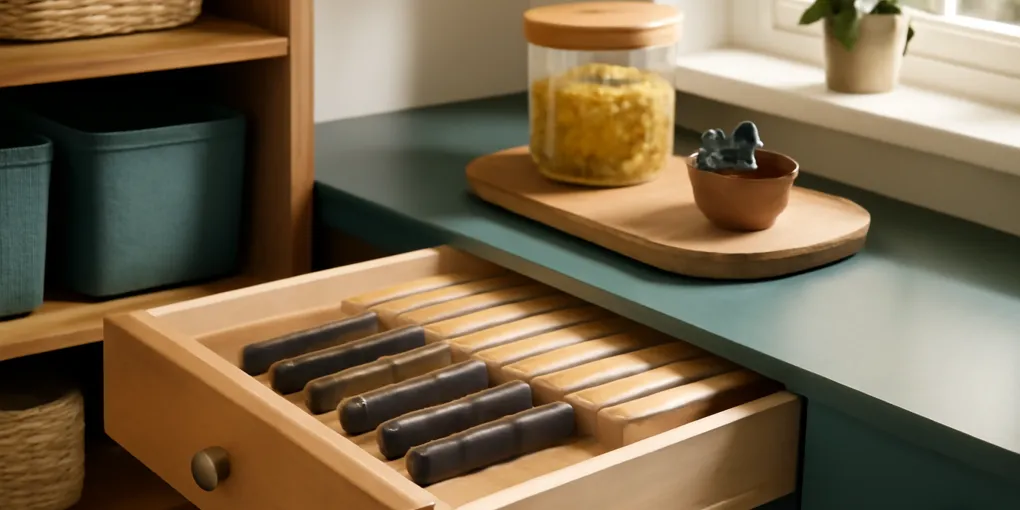
Best Knife Drawer Organizers for Small Kitchens: Safer Storage Without Counter Clutter
Buyer's GuideBamboo In-Drawer Knife Block
Best all-around small-kitchen pickBest For: A core set of chef, paring, bread, and utility knives
$18-45
Quick picks
| Product | Key Specs |
|---|---|
| See price on Amazon |
|
| See price on Amazon |
|
| See price on Amazon |
|
Product availability, certifications, and retailer details can change; check the current Amazon page before buying.
A knife drawer organizer is worth buying only when it makes the knife safer to retrieve and easier to put away. In a small kitchen, the attraction is obvious: moving knives into a drawer clears counter space, removes a bulky block from the prep zone, and keeps the visual field calmer. The risk is also obvious: a drawer can turn sharp tools into a hidden pile.
For most small kitchens, the best first choice is a bamboo in-drawer knife block that fits the knives you actually use. If your knife set is irregular, a cork-lined tray can be more forgiving. If the drawer is shallow or shared with other utensils, individual blade guards may be the safest low-cost fallback.
If the same drawer already holds spatulas, peelers, measuring spoons, and clips, fix the drawer layout before adding knives. Knives need a predictable lane, not leftover space. For a broader kitchen reset, pair this guide with best kitchen cabinet organizers.
Quick picks for small-kitchen knife storage
- Best all-around: Search Amazon for bamboo in-drawer knife blocks. Choose this when one drawer can become the dedicated knife drawer.
- Best for mixed blades: Search Amazon for cork-lined knife drawer organizers. Choose this when handle shapes and blade lengths vary.
- Best flexible fallback: Search Amazon for knife blade guard sets. Choose guards when the drawer is shallow, narrow, or temporary.
Measure drawer interior width, depth, and height with the tallest knife handle in mind. Product photos often show empty organizers; real handles add height and can catch the drawer frame.
What actually matters in a knife drawer organizer
The organizer has three jobs: separate blades, protect hands, and make return easy. A pretty tray that lets knives slide sideways fails the first job. A block with tight slots that requires careful aiming fails the third job.
Look for stable slots, enough length for the longest chef knife, and a layout that lets every handle sit separately. If two handles overlap, the drawer will become annoying after one week. If the tips press into the end of the slot, the block is too short.
Kitchen-safety guidance from the American Academy of Pediatrics recommends keeping knives and other sharp tools out of children’s reach. In knife storage, that means predictable placement, blade coverage, and avoiding drawers where children or guests rummage without knowing sharp tools are inside.
Product callout: Bamboo in-drawer knife block
A bamboo in-drawer block is the cleanest solution for many small kitchens because it turns one drawer into a fixed tool zone. It works best for a restrained knife set: chef knife, bread knife, paring knife, utility knife, and maybe kitchen shears.
Choose one with slot lengths published in the listing, not just a total product size. Check drawer clearance with handles included. If your drawer has a face frame or a low upper rail, a block that technically fits may still scrape when opened.
Best use case: a kitchen where counter space is more valuable than drawer space. Shopping option: Search Amazon for in-drawer knife blocks.
Product callout: Cork-lined tray
A cork-lined tray is less rigid than a slotted block. That can be a strength when you own a santoku, offset bread knife, boning knife, or other blade shape that does not fit neat slots. The cork reduces sliding and protects edges better than a bare plastic tray.
The tradeoff is access control. A cork tray still leaves blades visible and reachable when the drawer opens. It is best for adult-only prep drawers, not for low drawers in a family kitchen.
Shopping option: Search Amazon for cork-lined knife drawer organizers.
Product callout: Blade guards
Blade guards are not as elegant, but they are often the right answer for tiny kitchens. They let you protect individual knives without dedicating a full drawer to one organizer. They also travel well if you move knives between a prep drawer, pantry cart, or rental kitchen.
Buy guards by blade length. A loose guard is almost as irritating as no guard because it slides off when the knife is retrieved. A too-short guard exposes the tip, which is the part most likely to surprise a hand in a drawer.
Shopping option: Search Amazon for knife blade guard sets.
G6/CS composite score
For small kitchens, the best knife drawer organizer earns an 86/100 when it fits the drawer and the household access pattern.
| Factor | Weight | Score | Rationale |
|---|---|---|---|
| Research | 30% | 26/30 | The storage choice directly changes visibility, retrieval, and injury risk. |
| Evidence Quality | 25% | 21/25 | The recommendation is grounded in hazard control, retrieval friction, and physical fit. |
| Value | 20% | 18/20 | Most useful organizers are inexpensive compared with reclaiming counter space. |
| User Signals | 15% | 13/15 | The main complaints are predictable: shallow drawers, long blades, and overlapping handles. |
| Transparency | 10% | 8/10 | The guide separates convenience from safety and tells readers when a counter block is better. |
Small-kitchen setup scenarios
A galley kitchen usually needs a different knife solution than a wide drawer bank. If the prep counter is narrow and the main utensil drawer is directly under the board, an in-drawer block can work beautifully. Place it on the side closest to the cutting board, then move peelers, microplanes, and clips to a separate divider. The knife zone should not be crossed by hands looking for low-risk tools.
A rental kitchen with shallow drawers may be better served by blade guards. Guards let you keep knives in a higher drawer, a pantry cart, or a portable bin without committing to a block that may not fit the next apartment. Choose guards that cover the full blade and make the handle easy to identify.
A family kitchen needs access control before aesthetics. If children can open the drawer, a beautiful low drawer is the wrong location. Use a higher drawer, a locked cabinet, or a counter block placed out of reach according to household rules. The organizer is only one layer of safety; placement matters more.
A compact apartment with one serious cook may justify a premium in-drawer block because counter space is scarce and the knife set is stable. A shared kitchen with roommates may need labels or a simpler guard system because knives migrate between users, dish racks, and drawers.
How to choose the right size
Start with the longest blade, not the number of slots. Many in-drawer blocks advertise twelve slots, but a long bread knife may overhang the usable length. Measure blade length from heel to tip, then measure handle height while the knife is lying flat. Add the organizer height and confirm the drawer closes without rubbing.
Next, count knives by actual use. A small kitchen usually needs one chef knife, one serrated bread knife, one paring knife, one utility or santoku knife, and perhaps shears. If you own eight steak knives, do not let them crowd the prep-knife organizer unless the tray has dedicated short slots. Steak knives can often live with tableware or in a separate guarded bundle.
Finally, check cleaning access. Wood and bamboo organizers should be easy to remove for crumbs and dust. Cork trays should allow the liner to dry if moisture reaches it. Plastic guards should not trap water against blades after washing.
Common buying mistakes
Do not buy for the knife set you wish you used. Buy for the knives that actually come out during a normal week. Extra slots invite dull specialty knives to stay in the best drawer.
Do not ignore handle height. Drawer clearance problems usually come from handles, not blades.
Do not put the organizer in the busiest mixed-utensil drawer. If hands are searching for a peeler or chip clip, they should not be crossing a knife zone.
Do not assume more slots mean better value. Unused slots collect rarely used knives and make the drawer feel full. A smaller organizer with correct slot lengths is better than a large organizer that makes everyday knives harder to grab.
Do not treat an in-drawer organizer as a universal counter-block replacement. It works only when the drawer is close to prep space, opens fully, has enough interior height, and can be dedicated to sharp tools. If the drawer is low, shared with children, or packed with tableware, a guarded bundle, higher drawer, or counter block may be safer than hiding knives in a crowded drawer.
Measure before comparing brands: drawer width, usable depth, interior height, longest blade length, handle height, and whether the drawer face frame steals clearance at the top. A half-opening drawer also changes the decision because long rear slots become awkward to load and easy to ignore.
Sources
- American Academy of Pediatrics/HealthyChildren.org, Kitchen Safety: https://www.healthychildren.org/English/safety-prevention/at-home/Pages/Kitchen-Safety.aspx
- McMains and Kastner, “Interactions of top-down and bottom-up mechanisms in human visual cortex,” Journal of Neuroscience, DOI: 10.1523/JNEUROSCI.3766-10.2011.
Frequently Asked Questions
- Measure the drawer interior height first. Many bamboo in-drawer blocks need about 2.5 to 3 inches of clearance once handles are included. If the drawer is shallower, individual blade guards may be safer and less frustrating.
- Loose knife storage is a cut risk and can damage blade edges. Use slots, guards, or a tray that keeps blades separated and predictable.
- Only if the organizer has dedicated shorter slots. Otherwise steak knives often fit better in a separate flatware zone or guarded bundle.
- A counter block can be better if drawer access is child-restricted, the drawer is too shallow, or the cook reaches for knives many times per meal and has safe counter space.