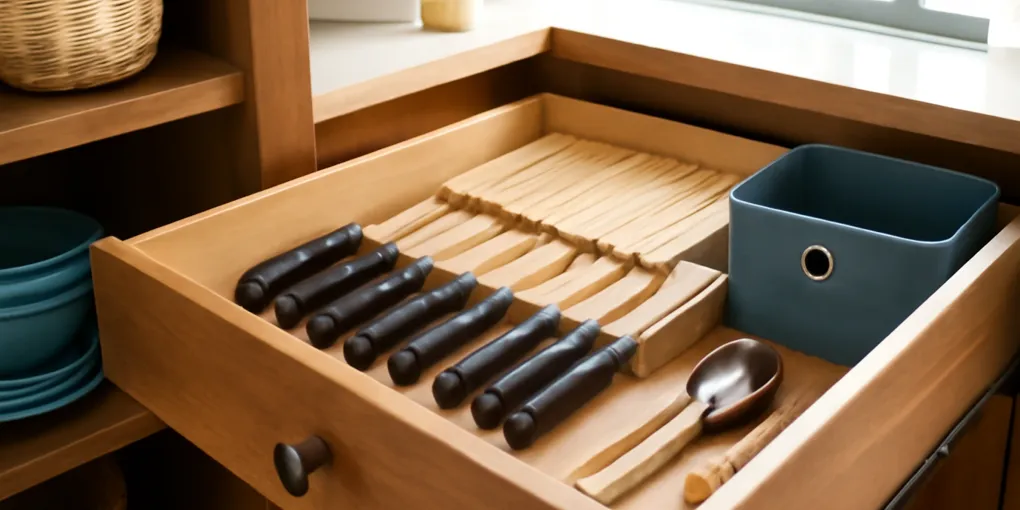
Joseph Joseph DrawerStore Knife Organizer
Best two-tier organizerBest for: Narrow drawers where knives need covered channels
Quick picks
| Product | Key Specs | Pros / Cons |
|---|---|---|
| See price on Amazon |
|
|
| See price on Amazon |
|
|
| See price on Amazon |
|
|
Product availability, certifications, and retailer details can change; check the current Amazon page before buying.
Quick product shortlist
Use this shortlist to choose a product style before you measure. The links are named product or brand searches so you can compare current dimensions, finishes, prices, and return terms before buying.
- Best two-tier organizer: Joseph Joseph DrawerStore Knife Organizer (Search Amazon for Joseph Joseph DrawerStore knife organizer) for narrow drawers where knives need covered channels. Watch-out: long bread knives may not fit.
- Best bamboo block: Bamboo In-Drawer Knife Block by Noble Home & Chef (Search Amazon for Noble Home Chef bamboo in drawer knife block) for standard chef, paring, bread, and utility knives. Watch-out: measure drawer height with handles included.
- Best premium tray: Wüsthof In-Drawer Knife Tray (Search Amazon for Wusthof in drawer knife tray) for higher-end knives where fit and finish matter. Watch-out: confirm slot count and knife lengths before buying.
A knife drawer organizer is not just a neatness upgrade. It changes a drawer from a hidden sharp-object pile into a set of visible, separated tools. The best choice depends on drawer depth, knife length, handle shape, and whether children can reach the drawer.
For most kitchens, start with a bamboo in-drawer knife block (Check current in-drawer knife block options) if the drawer is wide enough. Choose a two-tier knife organizer (Search Amazon for compare two-tier options on Amazon) for narrow drawers. Choose a cork-lined insert (Search Amazon for browse cork knife inserts on Amazon) when your knives come from different brands and do not fit standard slots.
Quick Picks for Real Kitchen Drawers
- Best standard drawer choice: bamboo in-drawer knife block, because it gives each blade a visible slot and keeps counters clear.
- Best narrow-drawer choice: two-tier in-drawer knife organizer, because it stores short and long knives without leaving blade edges loose.
- Best mixed-set choice: cork-lined insert, because the flexible channels handle unusual handles and steak-knife groups better than fixed slots.
- Skip if: the drawer is reachable by young children and cannot be latched or locked. In that case, the storage location is the bigger problem than the organizer style.
If your current setup is a utensil drawer with knives under spatulas, fix the separation first. A general drawer divider is not enough unless the blade edge is covered, isolated, or held in a dedicated knife channel.
What a Knife Drawer Organizer Actually Solves
Loose knives create three problems. First, the sharp edge is hidden until someone reaches into the drawer. Second, knives rub against other utensils, dulling edges and nicking handles. Third, the drawer becomes hard to clean because crumbs and wrappers collect under tools people are nervous to move.
An in-drawer knife block solves those problems by assigning each knife a slot. A good insert makes the blade location obvious, keeps handles facing the same direction, and prevents a bread knife from sliding diagonally across the drawer.
This is different from general utensil organizing. If you are also fighting spoons, spatulas, and measuring cups, pair the knife organizer with a separate utensil tray or an adjustable bamboo divider. See our guide to why food container lids disappear for the same principle in another kitchen category: mixed shapes need assigned lanes, not one big bin.
Measure Before You Buy
Measure four things before ordering:
- Drawer depth from front to back.
- Drawer height from base to the underside of the frame.
- The longest blade plus handle.
- The widest handle in the set.
Drawer height is the detail people miss. Some inserts fit the blade but lift thick handles high enough to scrape the cabinet frame. If the drawer has a center stile or a shallow front, a slim two-tier organizer may fit better than a wide block.
Also count only the knives you use. If the organizer has twelve slots but you use five knives, do not keep seven dull duplicates just because the slots exist.
Bamboo In-Drawer Knife Blocks
A bamboo block is the simplest upgrade for a standard kitchen drawer. It keeps each blade separate, looks calm when the drawer opens, and usually costs less than a premium countertop block. It works best for a core set: chef knife, paring knife, bread knife, utility knife, and a few steak knives.
Search for bamboo in-drawer knife block (check current listings on Amazon) and compare slot length, drawer dimensions, and cleaning instructions. Bamboo should stay dry. If your knife drawer sits beside a sink where wet tools get tossed in, fix that habit before adding a wood insert.
Choose bamboo when the drawer is adult-controlled, dry, and wide enough for a one-layer layout. Skip it if the fixed slots do not match your handle shapes.
Two-Tier Knife Organizers
Two-tier organizers are stronger for small kitchens. They usually place handles on one level and blades in guarded channels below. That can fit more knives into less width while still keeping the blade edges contained.
Search for two tier in drawer knife organizer (compare current options on Amazon). Look closely at the longest-knife limit. Many compact organizers fit chef knives but not long bread knives or carving knives.
The tradeoff is readability. A flat bamboo block often shows every slot clearly. A two-tier design can hide some blades under handle rows, so label or arrange by length if more than one person uses the kitchen.
Cork-Lined Inserts
Cork inserts are useful when the knife set is irregular. Instead of forcing each blade into a fixed slot, the cork channels hold blades more flexibly. This can work well for mixed brands, steak knives, and specialty knives with unusual handles.
Search for cork knife drawer insert (Search Amazon for browse current options on Amazon) if your drawer has enough width and you want a softer contact surface. The maintenance tradeoff is crumbs. Cork and open channels need occasional vacuuming or wiping so the organizer does not become a debris trap.
Cork is not a child-safety solution. It can organize sharp tools, but it does not stop a child from opening the drawer.
Safety Notes for Families
The American Academy of Pediatrics advises keeping knives and other sharp kitchen tools out of children’s reach or secured. That guidance matters more than the material of the organizer. If a child can open the drawer, use a lock, move knives higher, or store them in a secured cabinet. A neat knife drawer can still be unsafe if access is wrong.
For adult-only kitchens, the safety win is retrieval. You should be able to open the drawer, see the handle you need, and lift it without crossing another blade edge. If you still have to dig, the organizer is not doing its job.
Which Organizer Fits Your Knife Set?
A short everyday set can use almost any dedicated insert. If you own one chef knife, one serrated bread knife, one paring knife, and a pair of kitchen shears, choose the organizer that leaves the most empty drawer space for a separate utensil tray. Do not buy a wide block just because it looks professional in a product photo.
A steak-knife-heavy set needs tighter spacing. Many standard blocks have a few long slots and a row for small knives, but the small row may not hold eight steak knives cleanly. Check the slot count before buying, and make sure the handles do not stack so high that the drawer scrapes.
A mixed specialty set needs flexibility. Boning knives, santoku knives, cleavers, and offset serrated knives often do not match fixed slot shapes. A cork insert, knife sheaths inside a dedicated drawer lane, or a custom adjustable divider may work better than a traditional block.
When a Drawer Is the Wrong Place
A drawer is not always the safest or most useful location. If the drawer is below counter height and young children can reach it, move knives to a secured cabinet, high shelf, or locked storage. If the drawer is damp because it sits beside a dishwasher or sink, choose a different drawer or a dry countertop block. If the drawer is shallow and handles scrape, do not force the fit.
Countertop magnetic strips and wall bars can work for some adult kitchens, but they need careful placement away from child reach, shoulder bumps, and busy traffic. This guide focuses on drawer storage because it reduces counter clutter, but the correct answer is the location that keeps blades dry, separated, and controlled.
Cleaning and Maintenance
Empty the organizer monthly during normal kitchen cleaning. Vacuum crumbs, wipe the drawer, and check that slots are dry. Never put wet knives into a wood or cork insert. Dry the blade first, then store it.
If a knife no longer fits its slot because the household added a new set, do not let the overflow become a loose side pile. Replace the organizer, move specialty knives to a sheath, or reduce duplicates.
FAQ
Is a countertop knife block better than a drawer organizer?
A countertop block is easier to reach, but it uses counter space and leaves knives visible. A drawer organizer is better when counter clutter is the bigger problem and the drawer can be kept adult-controlled.
Should steak knives go in the same organizer as chef knives?
They can if the insert has slots sized for them. If steak knives rattle around loose beside larger blades, use a smaller dedicated steak-knife tray or a cork insert with tighter spacing.
What should I avoid in a knife drawer?
Avoid loose blades, wet wood inserts, overfilled slots, and general bins where knives mix with peelers or measuring spoons. Sharp tools need predictable orientation.
Sources
- American Academy of Pediatrics, Childproofing Your Home — supports keeping knives and other sharp tools inaccessible to young children.
- FDA, Safe Food Handling — supports keeping kitchen surfaces and tools clean and dry rather than letting food debris collect in organizers.
Bottom Line
Buy the knife drawer organizer that fits your actual drawer and knife set, not the one with the most slots. A bamboo in-drawer block works for standard adult-controlled drawers. A two-tier organizer fits narrow kitchens. A cork insert handles mixed knife sets. If children can reach the drawer, secure the location first and treat the organizer as secondary.