Why Food Container Lids Disappear: The Storage Science Behind the Kitchen Avalanche
Evidence ExplainerQuick picks
| Product | Key Specs |
|---|---|
| See price on Amazon |
|
| See price on Amazon |
|
| See price on Amazon |
|
Product availability, certifications, and retailer details can change; check the current Amazon page before buying.
Food container lids rarely disappear in a dramatic way. They disappear because the cabinet is a poor retrieval system. A flat lid slides behind a stack of bases. A round lid hides under a square one. A takeout container enters the cabinet without a matching long-term role. After a few weeks, the household owns many containers but trusts none of them.
The storage science is simple: lids are thin, similar, and easy to misfile. Containers are bulky, nested, and often returned in a hurry. When the return action is harder than the retrieval action, the system decays.
If your lower cabinets are already difficult to reach, read best food storage lid organizers for deep kitchen drawers before buying a lid organizer. If the problem is the whole kitchen, start with best kitchen cabinet organizers.
Quick picks for lid control
- Best lid-control tool: Search Amazon for adjustable food container lid organizers. Use one when lids are mostly usable but impossible to file.
- Best replacement path: Search Amazon for clear matching food storage sets. Consider this when orphaned pieces outnumber working pairs.
- Best deep-cabinet fix: Search Amazon for pull-out cabinet bins. Use a pull-out when the back of the cabinet is where containers go missing.
Do the matching audit before buying. A lid organizer cannot fix warped containers, cracked lids, or twelve shapes that serve the same job.
The lid-disappearance mechanism
There are three linked problems.
First, lids are low-visibility objects. They are flat, often translucent, and visually similar. In a crowded cabinet, attention goes to the bulky bases first. Research on visual attention shows that competing objects make selection harder; in a lid pile, every object competes with the correct one.
Second, most households own too many container formats. Round deli tubs, square meal-prep boxes, glass leftovers containers, tiny sauce cups, and old takeout lids create a matching problem. Each new shape increases the search cost.
Third, the return step happens at the worst time. Containers are usually put away after dishwashing, when the person is trying to clear the counter quickly. If the lid system requires precise nesting or a perfect stack, it will not survive normal cleanup.
The four-pile reset
Empty the whole container zone. Make four piles: working pairs, orphan lids, orphan bases, and damaged or questionable pieces. Match every lid to a base. If a piece has no match, it does not go back into the prime cabinet.
Check food-storage condition while you sort. The U.S. Food and Drug Administration advises storing food safely and using appropriate containers and time frames. Organization cannot make a cracked, melted, stained, or poorly sealing container a good storage choice.
After matching, reduce duplicates. Most households need fewer container sizes than they think: one small snack or sauce size, one medium leftovers size, and one larger meal-prep or batch-cooking size. Too many sizes create the illusion of choice while making matching slower.
Product callout: Adjustable lid organizer
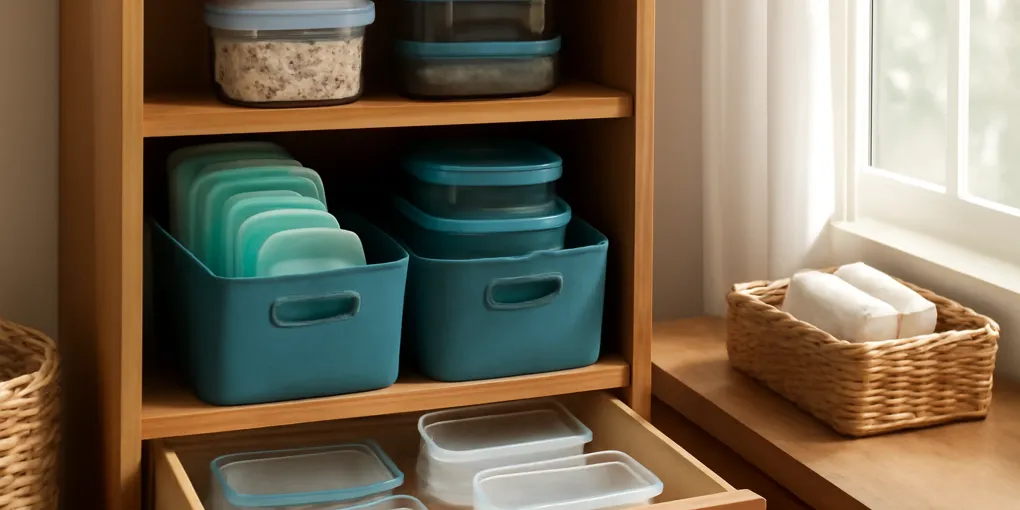
An adjustable lid organizer is best when the containers are still good but the lids need filing. The dividers should move so round, square, and rectangular lids can stand upright without slumping.
Measure cabinet depth and the height of your tallest lid. If the organizer sits on a high shelf, the front divider matters because lids should not slide out when pulled forward. In a lower cabinet, consider a handled organizer that can come fully out for sorting.
Shopping option: Search Amazon for adjustable food container lid organizers.
Product callout: Matching container set
A matching set is useful only when it reduces the number of lid formats. Do not buy a 40-piece set if half the pieces are novelty sizes you will never use. A smaller clear set with two or three repeated sizes is easier to maintain.
Clear walls help because leftovers are more visible in the refrigerator. That matters for food waste as well as cabinet order; see why fridge clutter causes food waste for the visibility side of the problem.
Shopping option: Search Amazon for clear matching food storage container sets.
G6/CS composite score
A lid-control reset scores 88/100 because it fixes a common kitchen failure with a narrow, measurable intervention.
| Factor | Weight | Score | Rationale |
|---|---|---|---|
| Research | 30% | 27/30 | The mechanism is clear: visibility, matching cost, and return friction. |
| Evidence Quality | 25% | 21/25 | The advice aligns with attention research and food-storage safety boundaries. |
| Value | 20% | 18/20 | The reset is free; organizers help only after the matching audit. |
| User Signals | 15% | 13/15 | Upright filing matches how people retrieve lids under time pressure. |
| Transparency | 10% | 9/10 | The article states when buying new containers is unnecessary. |
What not to do
Do not keep orphan lids because the matching base might appear. Put them in a temporary holding bag for one week if needed, then remove them from the active cabinet.
Do not store every container with the lid snapped on unless you have very few containers. It protects matches but wastes space fast.
Do not save takeout containers in the same zone as durable food-storage containers. If you reuse a few, give them a separate limit: one small stack, not a cabinet takeover.
Sources
- U.S. Environmental Protection Agency, Reducing Waste: What You Can Do: https://www.epa.gov/recycle/reducing-waste-what-you-can-do
- McMains and Kastner, Journal of Neuroscience, DOI: 10.1523/JNEUROSCI.3766-10.2011.
Frequently Asked Questions
- They are usually not lost; they are visually buried. Flat lids slide behind bases, mixed shapes stack poorly, and the correct match takes too much searching.
- Only for a small active set if space allows. For most cabinets, lids stored upright beside nested bases use space better and make matches easier.
- It can be worth it when the current mix has warped bases, missing lids, and too many sizes. Do not replace a functional set just to make the cabinet look uniform.
- Match every lid to a base, recycle or discard unusable pieces according to local rules, then store lids upright by shape with the most-used sizes in front.