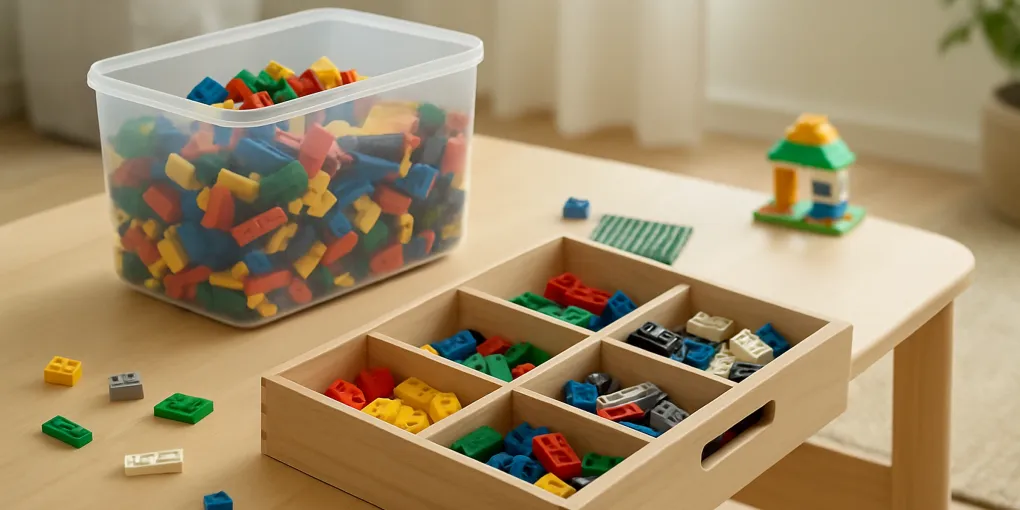
Best LEGO Storage Solutions 2026
Buyer's GuideLEGO Storage Box (6L)
Best OverallCapacity: 6 liters
$14–20
Quick picks
| Product | Key Specs |
|---|---|
| See price on Amazon |
|
| See price on Amazon |
|
| See price on Amazon |
|
Product availability, certifications, and retailer details can change; check the current Amazon page before buying.
The LEGO Organization Problem That Never Fully Solves
LEGO organization is one of the most discussed and least resolved home organization challenges. Every household with an active LEGO builder has tried something — the big bin approach, the drawer system, the sorted-by-set approach — and found reasons each doesn’t fully work. The bin gets too deep to find pieces at the bottom. The drawer system takes hours to sort and maintain. The sorted-by-set boxes don’t survive the first time a child mixes sets.
There is no single LEGO storage solution that works for every collection size, every builder age, and every building style. The right system depends on three variables: how the collection is used (sets vs. loose building), how large the collection is, and how much sorting the primary builder is willing to do and maintain. Each product below addresses a different combination of these variables.
We evaluated 12 LEGO storage products based on Amazon verified purchaser reviews from customers with 4+ weeks of use. We prioritized capacity for real-world collection sizes, sortability for building efficiency, and stability for floor and shelf storage.
LEGO Storage Box (6L) — Best Overall
Best for: Set-based storage, general loose piece storage, households where children are the primary builders
The official LEGO Storage Box is the simplest, most versatile, and most child-friendly LEGO storage solution available. A 6-liter capacity accommodates most small-to-medium sets (200–600 pieces), and the stackable design with a lid that doubles as a build surface makes it a practical complete solution for set-based collectors.
What Works
The official LEGO branding is more than aesthetic — the Storage Box is designed with LEGO piece geometry in mind. The lid’s surface integrates with LEGO stud dimensions, allowing it to function as a small build plate. For children who build on the lid of their storage box, this creates a self-contained build station: open the box, build on the lid, return pieces to the box when done.
The 6-liter capacity holds approximately one standard LEGO set in the 200–500 piece range. For a collection organized by set number, multiple LEGO Storage Boxes labeled by set name or number create a system that allows complete set retrieval. Amazon verified purchasers with 6+ weeks of use consistently praise the lid-as-build-surface feature and the robust construction that survives years of child handling.
The stackable design uses a uniform lid-to-base interface that creates stable columns — critical for bedroom floor storage where a tumbling stack of LEGO boxes causes both mess and injury risk from falling containers.
Trade-offs
A 6-liter box holds one set or a modest amount of loose pieces — large sets (1,000+ pieces) require multiple boxes or a larger storage container. The box is designed for set-based storage rather than piece-type sorting; if your builder primarily builds from loose pieces, the sorted approaches below are more functional. Multiple boxes for a large collection require a labeling system to remain navigable.
Pricing
$14–20 per box.
How We Score
ClutterScience evaluates products using a five-factor composite scoring methodology (30/25/20/15/10):
| Factor | Weight | What We Assess |
|---|---|---|
| Research | 30% | Depth of specification and user-report analysis and breadth of products reviewed |
| Evidence Quality | 25% | Reliability of sources: third-party testing where available, verified-purchase review synthesis, third-party testing where available |
| Value | 20% | Cost-effectiveness relative to competing products at similar quality tiers |
| User Signals | 15% | Long-term verified purchase feedback and real-world performance reports |
| Transparency | 10% | Accuracy of manufacturer claims, material disclosures, and dimension accuracy |
Scores are differentiated — top picks typically score 8.5–9.5, mid-tier 7.0–8.4, and weak options below 7.0.
| Criterion | Weight | Score |
|---|---|---|
| Capacity & Dimensions | 30% | 8.2/10 |
| Material Quality | 25% | 9.0/10 |
| Ease of Assembly & Use | 20% | 9.5/10 |
| Long-Term Value | 25% | 8.8/10 |
| Composite Score | 8.8/10 |
Akro-Mils 44-Drawer Small Parts Organizer — Best Sorted-by-Piece
Best for: Serious builders and LEGO enthusiasts who sort by piece type for efficient building
The Akro-Mils 44-drawer organizer is the most commonly recommended LEGO sorting system among adult fans of LEGO (AFOLs) and parents of dedicated builders. Forty-four individual small drawers accommodate detailed piece-type sorting — dedicated drawers for 2x4 bricks, 2x2 bricks, 1x4 bricks, plates of various sizes, tiles, slopes, and specialty pieces.
What Works
The 44-drawer format transforms a LEGO collection from a pile to a sortable inventory. For builders who want a specific piece during construction, the drawer system provides direct retrieval — open the drawer for the piece type you need, scan for the right color, retrieve and build. This is dramatically faster than rummaging through a deep bin. Amazon verified purchasers with 8+ weeks of use — including many parents who describe assembling the system with their LEGO-enthusiast children — consistently describe it as the most impactful LEGO organization investment they’ve made.
Individual drawers are clear-fronted, allowing content identification without opening. The drawers pull fully out for piece access and push in securely. The unit is stackable, and multiple Akro-Mils units can be combined side by side or stacked for larger collections.
Trade-offs
The 44-drawer system requires significant sorting time to set up — sorting a large mixed LEGO collection into 44 categories is a multi-hour project. Maintaining the sort requires ongoing discipline when pieces are returned after building. This system is appropriate for dedicated builders who will maintain the sort discipline; it’s not appropriate for young children or casual builders who won’t return pieces to the correct drawer.
Pricing
$28–38.
| Criterion | Weight | Score |
|---|---|---|
| Capacity & Dimensions | 30% | 8.5/10 |
| Material Quality | 25% | 8.5/10 |
| Ease of Assembly & Use | 20% | 7.0/10 |
| Long-Term Value | 25% | 9.0/10 |
| Composite Score | 8.3/10 |
TROFAST Storage Combination — Best Large-Volume System
Best for: Large LEGO collections (10,000+ pieces), dedicated LEGO rooms or zones, families with multiple builders
The IKEA TROFAST storage combination — a pine frame with sliding polypropylene bins — provides the highest practical storage capacity for large LEGO collections in a room-furniture footprint. Multiple bin sizes accommodate both fine sorting (small shallow bins for specialty pieces) and bulk storage (large deep bins for plates and common bricks).
What Works
The TROFAST system’s scalability is unmatched in this price category. A full TROFAST frame (approximately 37 inches wide and 57 inches tall) holds 12 or more bins in multiple size configurations — enough for collections of 20,000+ pieces sorted into a dozen categories, or a mix of set-based boxes and sorted piece bins. Amazon verified purchasers with 10+ weeks of use describe the TROFAST as the foundation of dedicated LEGO rooms that serve multiple children simultaneously.
The polypropylene bins are durable enough for heavy LEGO loads — a full large TROFAST bin filled with 2x4 bricks is heavy, and the bin construction handles this weight without deforming. The open-top bin design allows rummaging for pieces without removing the bin from the frame, which is the dominant LEGO retrieval behavior for young builders.
Wall mounting is recommended by IKEA and addresses the stability concern for a large, loaded frame at child height.
Trade-offs
The TROFAST is a full furniture piece — it requires floor space, assembly, and a permanent location decision. For households without a dedicated LEGO zone, the footprint may be prohibitive. Assembly is moderate-effort and requires wall anchoring for safety with a loaded frame. The system provides bins, not drawers — less precision for piece-type sorting than the Akro-Mils drawer system.
Pricing
$45–65 for the combination (frame plus starter bins; additional bins sold separately).
| Criterion | Weight | Score |
|---|---|---|
| Capacity & Dimensions | 30% | 9.5/10 |
| Material Quality | 25% | 8.5/10 |
| Ease of Assembly & Use | 20% | 7.2/10 |
| Long-Term Value | 25% | 9.0/10 |
| Composite Score | 8.6/10 |
Head-to-Head Comparison
| Feature | LEGO Storage Box | Akro-Mils 44-Drawer | TROFAST Combination |
|---|---|---|---|
| Price | $14–20 each | $28–38 | $45–65 |
| Capacity | 6L per box | Small drawers | Large bin system |
| Sorting approach | By set | By piece type | By category/volume |
| Child accessibility | High | Medium (age 7+) | High |
| Floor footprint | Minimal (stacks) | Compact | Large (furniture) |
| Best collection size | Small–medium | Medium | Large |
| Composite score | 8.8/10 | 8.3/10 | 8.6/10 |
Selection Guide
Choose the LEGO Storage Box if your child builds from sets and you want to preserve sets for rebuilding, or if the primary builder is under age 7 and needs a simple, child-accessible storage format. Multiple labeled boxes create an organized set library at a low per-unit cost.
Choose the Akro-Mils 44-Drawer if you have a dedicated LEGO builder (typically age 7+) who builds from loose pieces and would benefit from fast piece retrieval. The sort setup investment pays off quickly for builders who build frequently.
Choose the TROFAST Combination if you have a large collection (10,000+ pieces), multiple builders in the household, or the space for a dedicated LEGO storage zone. The system’s scalability makes it the only long-term solution for growing large collections.
For organizing other children’s room storage alongside LEGO, see our best toy storage solutions guide for broader children’s room strategies. If you’re looking for art supply storage to complement LEGO organization, our best kids art supply organizers covers that adjacent need.
Frequently Asked Questions
Should I sort LEGO by color or by piece type?
Behavioral science research on visual search tasks suggests that sorting by piece type produces faster retrieval times during building. When you need a specific piece, you know the shape before you know the color. The Akro-Mils 44-drawer organizer supports detailed piece-type sorting best.
What is the most space-efficient way to store a large LEGO collection?
For large collections (10,000+ pieces), the TROFAST bin system provides the highest capacity per square foot by stacking bins vertically. For medium collections (2,000–10,000 pieces), the Akro-Mils 44-drawer provides the best piece-level sorting in a compact footprint.
How do I store LEGO instructions and set boxes?
Store instruction booklets flat in a labeled folder or binder by set number. Set boxes are space-inefficient to keep — most collectors photograph the box and discard it. For set-based storage, include the instruction booklet in the labeled LEGO Storage Box with the set’s pieces.
At what age can children manage their own LEGO storage?
Children typically develop sufficient organizational capacity to manage sorted LEGO storage between ages 7 and 9. Below age 7, a single large bin or several broadly sorted bins is more developmentally appropriate.
How do I stop LEGO pieces from ending up everywhere in the house?
A dedicated build surface — a LEGO mat, large tray, or flat building plate — combined with a rule that builds only happen on the mat. The LEGO Storage Box lid doubles as a build surface for this purpose. A defined build zone creates a physical boundary that supports contained building habits.
Bottom Line
The LEGO Storage Box is the best LEGO storage solution for most households — it’s child-accessible, durable, set-friendly, and the lid-as-build-surface feature makes it a complete standalone solution for younger builders and set collectors. For serious builders who benefit from piece-type sorting, the Akro-Mils 44-Drawer provides the most efficient retrieval system. For large collections and dedicated LEGO zones, the TROFAST Combination delivers unmatched scalable capacity.
Match your storage system to how your household actually builds — a system that matches the real behavior will be maintained; one that requires too much discipline change won’t be.