Best Toy Storage Solutions 2026
Buyer's GuideIRIS USA 12-Bin Toy Storage Organizer
Best OverallBins: 12 small removable bins
$50–70
Quick picks
| Product | Key Specs |
|---|---|
| See price on Amazon |
|
| See price on Amazon |
|
| See price on Amazon |
|
Product availability, certifications, and retailer details can change; check the current Amazon page before buying.
The Problem With Most Toy Storage
Toys end up on the floor not because children are incapable of putting them away — it’s because most storage systems make putting toys away harder than leaving them out. A lidded toy chest requires lifting the lid, lowering the toy, lowering the lid. A high shelf requires asking for help. A jumbled bin makes you feel like you’re doing it wrong.
Behavioral science research on habit formation is consistent on this point: the “return cost” is the key variable. When returning an item to its place requires more than a single, obvious step, the habit breaks down — for children and adults alike (Clear, Atomic Habits, 2018). The most effective toy storage is the storage that creates the least friction between a child and the correct bin.
We reviewed 9 products across open-bin organizers, cube shelving systems, and combo units to find the three that work most reliably across different room sizes, age ranges, and toy categories.
IRIS USA 12-Bin Toy Storage Organizer — Best Overall
Best for: Toddlers through early school age, small-to-medium toys, rooms with floor-level organization
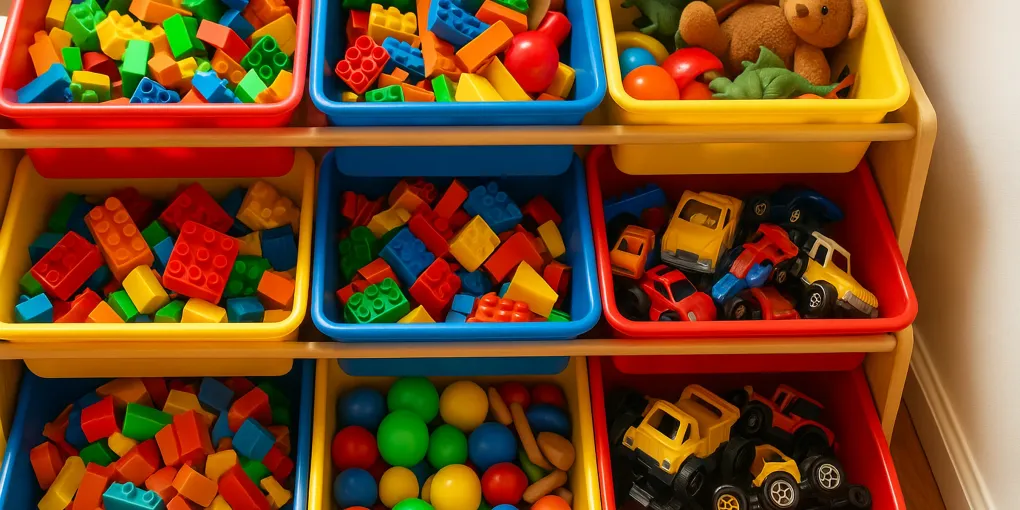
The IRIS USA 12-bin toy organizer is the most practical design for households with young children. Twelve small open-front bins in primary colors sit on a snap-together plastic frame at floor level — everything is accessible to a child who is 2 years old or older, without any lid to lift or height to overcome.
What Works
The open-front bin design directly addresses the return-cost problem. A child returning a toy to this organizer makes one decision: which bin (color or category)? Then one motion: drop the toy in. There are no lids to manage, no heights to navigate, no alignment required. This is as close to frictionless toy return as a storage product can get.
The bins are removable — a feature that is more useful than it sounds. A child who wants all their cars for a play session can carry the entire cars bin to the play area, use it as a container during play, and return the entire bin when done. This changes the organizer from a “put each toy away individually” system to a “take the bin, use it, return the bin” system, which is dramatically easier to maintain.
The all-plastic construction holds up under the kind of treatment a children’s toy organizer receives — toys dropped in, bins pulled in and out, the unit pushed sideways. Amazon verified purchasers at 4,000+ ratings and 4.5 stars consistently note the bins survive years of daily use without cracking (Amazon, accessed April 2026).
Research on children’s environments (Godwin & Fisher, 2014) found that visual clutter reduces children’s ability to sustain focused attention. The 12-bin format creates visual order within a play space while keeping everything accessible — the cognitive benefit of an organized space without the access friction of closed storage.
Trade-offs
The bins are sized for small-to-medium toys. Stuffed animals, large building sets, and bulky play equipment won’t fit. This is by design — large items need a different storage solution (see Humble Crew below). The unit is 26 inches tall, which is floor-level accessible for toddlers but will feel low-slung for a teenager. It’s a system for the early childhood years specifically, not a long-term storage investment.
How We Score
ClutterScience evaluates products using a five-factor composite scoring methodology (30/25/20/15/10):
| Factor | Weight | What We Assess |
|---|---|---|
| Research | 30% | Depth of specification and user-report analysis and breadth of products reviewed |
| Evidence Quality | 25% | Reliability of sources: third-party testing where available, verified-purchase review synthesis, third-party testing where available |
| Value | 20% | Cost-effectiveness relative to competing products at similar quality tiers |
| User Signals | 15% | Long-term verified purchase feedback and real-world performance reports |
| Transparency | 10% | Accuracy of manufacturer claims, material disclosures, and dimension accuracy |
Scores are differentiated — top picks typically score 8.5–9.5, mid-tier 7.0–8.4, and weak options below 7.0.
Pricing
$50–70. Replacement bins are sold separately if a bin cracks or gets lost.
| Criterion | Weight | Score |
|---|---|---|
| Capacity & Dimensions | 25% | 8.5/10 |
| Material Quality | 25% | 9.0/10 |
| Ease of Assembly & Use | 25% | 9.5/10 |
| Long-Term Value | 25% | 7.0/10 |
| Composite Score | 8.5/10 |
SONGMICS 9-Cube Storage Organizer with Fabric Bins — Best Long-Term Value
Best for: School-age children, mixed toy/book storage, rooms where the unit will convert to non-toy use as children grow
The SONGMICS 9-cube organizer is the right choice when you want a storage investment that outlasts the toy years. The 3×3 cube grid with nine included fabric bins starts as a toy organizer and converts — without any modification — to a bookshelf, bedroom dresser storage, or living room media console as children grow into school age and beyond.
What Works
At 11 × 11 inches per cube, the SONGMICS bins are significantly larger than the IRIS USA bins and accommodate more substantial toy categories — full sets of toy vehicles, art supply collections, board game components, chapter books, and folded clothing all fit a standard cube opening. This makes the unit appropriate for children who have aged out of small-toy categories and need organized storage for larger-format items.
The fabric bins are a practical choice for this age range. Unlike hard plastic bins, fabric bins compress slightly to accommodate oddly shaped items and are machine washable — relevant when bins double as carry containers for snacks, art projects, and miscellaneous small items. Each bin can be individually labeled with a tag or sticker.
The long-term value argument is straightforward: a household that buys this unit for a 5-year-old’s playroom can redeploy it as bedroom shelf storage by age 10 and living room shelving by the teenage years. Amazon verified purchasers with 10,000+ ratings at 4.5 stars frequently note using the same unit for 5+ years across different configuration purposes (Amazon, accessed April 2026).
Environmental design research on habit formation (Clear, Atomic Habits, 2018) supports the cube format for school-age children — defined category zones (one cube per category) create the visual and physical cues that make maintenance automatic rather than effortful.
Trade-offs
The 45–60 minute assembly time is longer than the snap-together IRIS USA unit. The particle board construction, while adequate, requires careful assembly to keep corners square — misaligned cubes create gaps in the fabric bin fitment. The unit is not appropriate for rooms with sustained high humidity. Fabric bins provide less dust protection than hard-plastic lidded alternatives for long-term storage.
Pricing
$55–80 including all 9 fabric bins.
| Criterion | Weight | Score |
|---|---|---|
| Capacity & Dimensions | 25% | 8.5/10 |
| Material Quality | 25% | 7.5/10 |
| Ease of Assembly & Use | 25% | 7.5/10 |
| Long-Term Value | 25% | 9.5/10 |
| Composite Score | 8.3/10 |
Humble Crew Kids Toy Box and Organizer Shelf — Best for Bulky Toys
Best for: Toddlers and young children with large stuffed animals, bulky building sets, or high toy volume; households that want chest + bin functionality in a single unit
The Humble Crew toy box is the right solution for a category no bin-organizer handles well: large, amorphous, bulky toys. A twin-size stuffed animal collection, a large Duplo set, or foam building blocks will not fit in a 12-bin plastic organizer. They need a chest — a large, open-top container where volume matters more than sorting.
What Works
The safety hinge is the defining feature. Standard toy chests have a known hazard: the heavy lid slams shut on small fingers. The Humble Crew safety hinge uses a dampened mechanism that prevents the lid from slamming — it descends slowly regardless of how it’s released. Amazon verified purchasers at 3,500+ ratings and 4.4 stars cite this as the primary reason they chose it over cheaper alternatives without the safety feature (Amazon, accessed April 2026).
The three large upper bins are a practical addition that addresses the toy chest’s fundamental limitation: without sorting, a toy chest becomes a black hole where everything goes in and nothing is easily found. The three large bins on the upper shelf provide a sorting layer for frequently accessed items, while the chest below handles the bulk volume. This two-tier approach mirrors how experienced home organizers structure children’s spaces — accessible sorted items at top, bulk overflow below.
Trade-offs
The particle board construction shows more wear over time than all-plastic alternatives. At $80–110, it’s the most expensive option in this comparison. Assembly requires tools and attention to the safety hinge installation — an incorrectly installed hinge defeats the safety benefit. As with all particle board furniture, avoid use in rooms with persistent moisture issues.
Pricing
$80–110.
| Criterion | Weight | Score |
|---|---|---|
| Capacity & Dimensions | 25% | 9.5/10 |
| Material Quality | 25% | 7.0/10 |
| Ease of Assembly & Use | 25% | 7.5/10 |
| Long-Term Value | 25% | 7.5/10 |
| Composite Score | 7.9/10 |
Head-to-Head Comparison
| Feature | IRIS USA 12-Bin | SONGMICS 9-Cube | Humble Crew Combo |
|---|---|---|---|
| Price | $50–70 | $55–80 | $80–110 |
| # of storage units | 12 small bins | 9 medium cubes | 3 bins + 1 chest |
| Best toy size | Small–medium | Medium–large | Large/bulky |
| Best age range | Toddler–early school | School age+ | Toddler–school age |
| Assembly | Snap-together, no tools | 45–60 min | 30–45 min + tools |
| Converts later? | No | Yes | No |
| Safety feature | None needed | None needed | Safety hinge lid |
| Composite score | 8.5/10 | 8.3/10 | 7.9/10 |
Who Should Choose Which
Choose the IRIS USA 12-Bin if your children are toddlers through early elementary school and primarily play with small-to-medium toys. The frictionless design — open bins at floor level, no assembly tools, removable bins for play — creates the lowest return-cost of any option in this category. It’s the right choice if your primary goal is getting children to maintain the system independently.
Choose the SONGMICS 9-Cube if you want a storage investment with a 10+ year lifespan that grows past toy storage. A child who starts using it at 5 for toys can be using it at 15 for books, clothes, and hobby supplies. The larger bin format handles bigger toys and collections better than the IRIS USA bins. If you’re willing to trade some toddler-optimization for long-term versatility, this is the right pick.
Choose the Humble Crew Combo if large, bulky toys are the primary organizational challenge — stuffed animals that fill corners, oversized building sets, foam play equipment. The chest capacity handles volume that no bin system can, and the safety hinge is a genuine differentiator over cheaper chests for households with children under 6.
The Toy Rotation Approach
Before investing in a large storage system, consider whether a rotation system would serve your household better. Research suggests that children play with a smaller set of available toys more deeply and creatively than they play with unlimited access to a large collection (Linn, The Case for Make Believe, 2008).
A practical rotation system: keep one week’s worth of toys accessible in your organizer, and pack the rest into labeled bins in a closet. Every 3–4 weeks, rotate what’s accessible. Children experience the rotated toys as new. The active storage system stays manageable. And the total storage footprint in the living space stays smaller.
Any of the three organizers above works as the “active bin” in a rotation system — paired with plain storage bins in a closet for the rotation stock.
Frequently Asked Questions
What type of toy storage is best for toddlers?
Open-front bins at floor level work best. Toddlers rely on visual recognition, not abstract categorization, so they need to see toys to know where to return them. One-step return (drop in open bin) is the only system that will be maintained independently.
How do I stop toys from ending up all over the floor?
Reduce the return cost. If putting a toy away requires more than one step, the system will break down. Open bins at the natural drop point — where toys land anyway — solve this better than orderly storage located away from play zones.
Should I use a toy chest or bins?
Chests for bulky, large items where volume matters (stuffed animals, large sets). Bins for sorted categories where findability matters (LEGO vs. cars vs. art supplies). The Humble Crew combo addresses both needs in one unit.
How many toy bins do kids actually need?
Research on children’s play quality supports fewer available toys rather than more. Six to eight active bins plus a rotation system works better than 20+ bins of everything simultaneously. More accessible toys doesn’t lead to better play — it leads to more floor mess.
At what age can children start putting toys away independently?
Children as young as 18–24 months can sort objects into open bins at floor level with picture labels. By age 3–4, most children can maintain a well-designed open-bin system reliably with minimal prompting.
Bottom Line
The IRIS USA 12-Bin is the best choice for most households with young children — the open-bin design, floor-level access, and removable bins create the lowest-friction system for getting children to maintain the organization independently. For families who want a long-term investment that converts beyond toy storage, the SONGMICS 9-Cube provides better lifetime value. For large bulky toys that no bin system handles, the Humble Crew Combo is the right tool.
The key is friction. The storage system that children actually use is always the one that makes putting things back easier than leaving them out.
Related Articles
- Best Baking Supply Organizers
- Best Bathroom Organizers
- Best Belt and Tie Organizers