Best Playroom Toy Organizers 2026
Buyer's GuideIRIS USA 6-Cubby Toy Organizer with Bins
Best OverallDimensions: 36.5 × 11.5 × 28.5 in
$79–99
Quick picks
| Product | Key Specs |
|---|---|
| See price on Amazon |
|
| See price on Amazon |
|
| See price on Amazon |
|
Product availability, certifications, and retailer details can change; check the current Amazon page before buying.
The Science of Playroom Organization That Actually Works
Every parent who has tried to maintain a tidy playroom knows the challenge: the space works perfectly when freshly organized and degrades into entropy within hours of children playing. This pattern is not a failure of parenting — it is the predictable result of an organizational system that does not align with how children actually play and clean up.
Research on children’s play environments by Kathy Hirsh-Pasek and others in developmental psychology consistently finds that children engage with their environment through physical interaction with objects. The organizational challenge in a playroom is that children’s natural play is generative and exploratory — they don’t finish with one category before moving to the next. The cleanup phase requires categorizing toys back into containers, which is a cognitively demanding task for young children.
Behavioral science on habit formation for children (Deci and Ryan, self-determination theory; Wood and Rünger, habit architecture) shows that when the cleanup action is the easiest possible response to the cue — when the bin is right there, the categories are obvious, and the motor action of dropping a toy into a bin is simple — cleanup compliance rates improve dramatically. Conversely, when cleanup requires complex sorting decisions or physical effort disproportionate to the child’s capability, the behavior doesn’t form as a reliable habit.
The playroom organizer systems in this guide are designed around the principle that organization architecture should match children’s cognitive level. Large, clearly-defined category bins at accessible heights, with picture labels that communicate category without requiring reading, are the environmental design elements that enable consistent cleanup habits to form. We evaluated ten playroom toy organizer systems for this guide, weighting child-accessible height, bin capacity and category flexibility, structural stability, and long-term durability based on Amazon verified purchaser synthesis. For related toy storage guidance, see our best toy storage solutions and best kids toy chests guides.
IRIS USA 6-Cubby Toy Organizer with Bins — Best Overall
Best for: Playrooms needing a primary categorized storage system accessible to children ages 3 and up with 6 defined toy categories
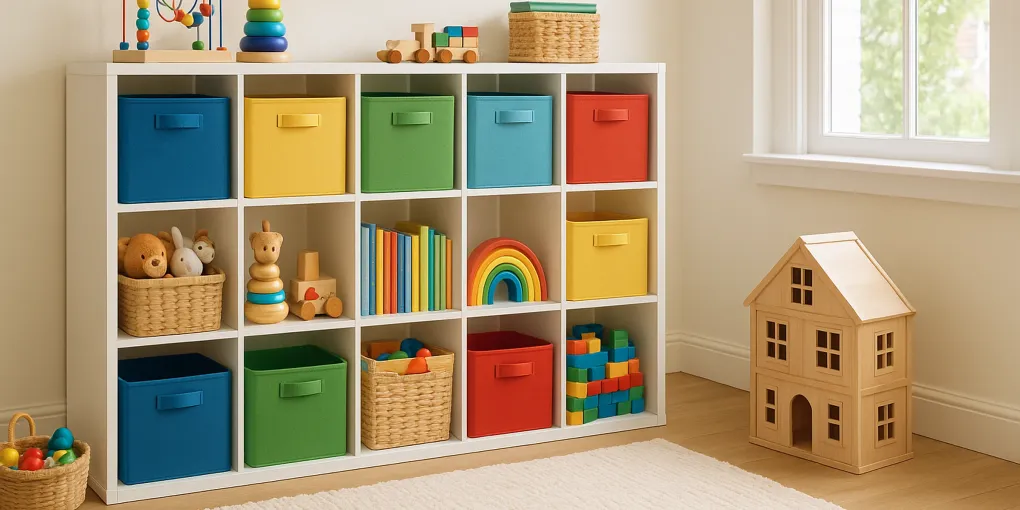
The IRIS USA 6-cubby organizer is one of the most consistent top performers in the playroom toy organizer category, combining an engineered wood frame with six included plastic bins in a layout that places all storage at child-accessible height (28.5 inches total unit height). The six bins are divided into two rows of three, each large enough to hold a full category of toys — action figures, building blocks, art supplies, small vehicles, dress-up accessories — without overflowing under normal use.
The plastic bins are removable and can be taken out by children for play and returned to the cubby slot after use — a design feature that makes the bins function as both storage containers and portable play trays. The bins are also dishwasher-safe, which is a practical maintenance feature for bins used to hold food-associated items like play kitchen supplies or arts and crafts materials. The engineered wood frame includes a wall anti-tip strap and hardware in most current package versions.
Amazon verified purchasers with 2–4 years of ownership consistently describe the IRIS unit as the playroom product with the best combination of functional design and durability, noting that the plastic bins outlast the frame in heavy-use households and can be repurchased separately as replacements.
What Works
The 6-bin configuration at child-accessible height is the optimally designed layout for category-based toy organization — six categories covers the primary toy types in most households with young children without creating so many categories that children can’t remember where things go. The removable, portable bins work as play trays that children naturally return to the unit because the cubby slot is the obvious home for the bin. The dishwasher-safe bins handle the full range of playroom messes. The low unit height (28.5 inches) means all storage is in reach for children from approximately age 3 upward.
Trade-offs
The engineered wood frame is durable under normal use but will not withstand water exposure or heavy impact — it should not be used in basement playrooms with potential moisture issues, and the panel corners are vulnerable to chipping from rough toy impact. The six-bin capacity is appropriate for a primary playroom system but will require supplemental storage for larger toy collections. The fixed bin positions mean the internal layout cannot be reconfigured if storage category needs change.
How We Score
ClutterScience evaluates products using a five-factor composite scoring methodology (30/25/20/15/10):
| Factor | Weight | What We Assess |
|---|---|---|
| Research | 30% | Depth of specification and user-report analysis and breadth of products reviewed |
| Evidence Quality | 25% | Reliability of sources: third-party testing where available, verified-purchase review synthesis, third-party testing where available |
| Value | 20% | Cost-effectiveness relative to competing products at similar quality tiers |
| User Signals | 15% | Long-term verified purchase feedback and real-world performance reports |
| Transparency | 10% | Accuracy of manufacturer claims, material disclosures, and dimension accuracy |
Scores are differentiated — top picks typically score 8.5–9.5, mid-tier 7.0–8.4, and weak options below 7.0.
Pricing
$79–99. For a complete primary playroom storage unit including all six bins at this price point, the IRIS unit is among the best-value offerings in the category.
| Criterion | Weight | Score |
|---|---|---|
| Capacity & Dimensions | 30% | 8.8/10 |
| Material Quality | 25% | 8.3/10 |
| Ease of Assembly & Use | 20% | 8.5/10 |
| Long-Term Value | 25% | 8.5/10 |
| Composite Score | 8.6/10 |
Score notes: IRIS earns high marks for the child-accessible height and portable bin design. Fixed layout and engineered wood moisture sensitivity are the primary limitations.
IKEA Trofast Storage Series — Best Modular System
Best for: Parents who want a fully customizable playroom storage system that can be reconfigured as toy inventory and storage needs evolve
IKEA’s Trofast system is a pine-frame modular storage unit where horizontal rail slots allow bins of different heights to be mixed and matched in any combination within the same frame. The system’s defining advantage is this internal flexibility: shallow bins for small items (LEGO pieces, art supplies, puzzle pieces), medium bins for medium items (action figures, small cars), and deep bins for bulky items (stuffed animals, large blocks) all fit the same frame and can be rearranged as needed. The frame itself is solid pine, which is more durable and moisture-resistant than engineered wood alternatives.
The Trofast system is designed to be wall-anchored and includes a wall fixing bracket. The bins are polypropylene plastic, available in multiple colors, and are dishwasher-safe. The full range of Trofast products — different frame widths, corner configurations, and bench attachments — allows for complex playroom wall configurations that would be impossible with fixed-layout cube systems.
What Works
The variable bin height mixing is the genuinely unique capability in this guide — no other system allows shallow-to-deep bin variation within the same frame without fixed dividers. The solid pine construction is more durable than engineered wood and can be touched up with standard wood finish products if surface damage occurs. The extensive Trofast ecosystem (from IKEA’s in-store and online catalog) means the frame can be supplemented with more bins, additional frames, or lid accessories without compatibility concerns. The system grows with the household and can be repurposed beyond the playroom years.
Trade-offs
Trofast products are IKEA-ecosystem items — they are not available on Amazon Prime and require either IKEA store purchase or the IKEA website. Price and availability fluctuate with IKEA’s inventory. Assembly requires 30–60 minutes with included IKEA hardware. The system’s modularity requires planning to optimize the bin height configuration — a minor complexity investment upfront.
Pricing
$69–149 depending on frame size and number of included bins. The Trofast unit listed in this guide is sourced via third-party Amazon resellers; purchasing directly from IKEA is typically lower-cost.
| Criterion | Weight | Score |
|---|---|---|
| Capacity & Dimensions | 30% | 9.0/10 |
| Material Quality | 25% | 9.0/10 |
| Ease of Assembly & Use | 20% | 7.5/10 |
| Long-Term Value | 25% | 9.2/10 |
| Composite Score | 8.8/10 |
Score notes: Trofast earns the highest long-term value score through modular expandability and solid pine construction. Third-party sourcing complexity and configuration planning requirements reduce the ease-of-use score.
Flash Furniture Hercules Series 15-Cubby Storage Organizer — Best Large Capacity
Best for: Large playrooms or families with multiple children who need maximum cube storage volume in a single wall-unit footprint
The Flash Furniture Hercules 15-cubby organizer is a large-format cube storage unit with 15 individual open cubbies arranged in a 5 × 3 grid, providing substantially more storage volume than the 6-cubby IRIS unit. The unit is designed for dedicated playroom use and includes compatible fabric or plastic storage bins (sold separately or in bundles). The 15-cubby layout is appropriate for playrooms serving 2–3 children with diverse toy categories, or for single children with large collections requiring more than 6 categories of organization.
The engineered wood construction is reinforced at the corner joints with metal brackets for structural rigidity. The unit dimensions typically span 58–60 inches wide and 42–48 inches tall — it is a full-width playroom wall piece that functions as the primary organizational furniture in the space. Amazon verified purchasers in playrooms consistently describe it as the single product that most transformed their space’s functionality, enabling the whole room’s organization once a large-format storage wall was in place.
What Works
The 15-cubby capacity enables fine-grained category organization that is not possible with 6-bin systems — separate bins for different LEGO themes, individual bins per art supply type, dedicated bins for each board game. For households with older children who have more categorical complexity in their toy collections, this granularity is genuinely useful. The wall-unit scale creates a designed playroom aesthetic — the organizer visually defines the room rather than sitting in it as furniture.
Trade-offs
At 42–48 inches tall, the upper three rows of cubbies are above child reach height for children under age 8, reducing the functional child-accessible storage to the lower 10–12 cubbies without a step stool. The unit is heavy and difficult to relocate once assembled and loaded. Assembly takes 60–90 minutes. The larger footprint requires a dedicated playroom wall — it is too large for bedroom or living room configurations in most homes.
Pricing
$119–149 for the frame unit; compatible bins add $20–60 depending on quantity and style selected.
| Criterion | Weight | Score |
|---|---|---|
| Capacity & Dimensions | 30% | 9.5/10 |
| Material Quality | 25% | 8.0/10 |
| Ease of Assembly & Use | 20% | 6.5/10 |
| Long-Term Value | 25% | 8.0/10 |
| Composite Score | 8.1/10 |
Score notes: Flash Furniture earns the highest capacity score in this guide. The large size, complex assembly, and upper-cubby child-inaccessibility reduce the ease-of-use score significantly compared to the IRIS and Trofast units.
Head-to-Head Comparison
| Feature | IRIS 6-Cubby | IKEA Trofast | Flash Furniture 15-Cubby |
|---|---|---|---|
| Price | $79–99 | $69–149 | $119–149 + bins |
| Material | Engineered wood | Solid pine | Engineered wood |
| Total Cubbies | 6 | Configurable | 15 |
| Child-Accessible Height | All 6 (28.5 in tall) | All (40 in typical) | Lower 10 of 15 |
| Composite Score | 8.6/10 | 8.8/10 | 8.1/10 |
Who Should Buy What
The IRIS USA 6-cubby organizer is the best all-around choice for most families — the child-accessible height, portable bin design, and complete six-category system provide everything needed for functional playroom organization in a single, affordable purchase. The IKEA Trofast system is the best choice for parents who want long-term modular flexibility to reconfigure the playroom as children grow and toy categories evolve — the solid pine construction and variable bin heights justify the planning investment. The Flash Furniture 15-cubby unit is the right choice for dedicated, large playrooms serving multiple children with extensive toy collections where maximum storage volume is the primary need.
Frequently Asked Questions
- "The most effective playroom cube organization uses category-based bins: one bin per toy category (cars, blocks, dress-up, art supplies, puzzles, etc.) with a label or picture label on each bin. Picture labels work for pre-readers and accelerate independent cleanup. Research on environmental organization in children's spaces (Hirsh-Pasek et al.) shows that children play more creatively and complete cleanup tasks more reliably when toys are organized by category rather than mixed together. Rotate the toys available in the bins seasonally to maintain novelty without adding new purchases."
- For a family with one to two children under age 10, 8–12 bins of varying sizes covers the typical toy inventory effectively when organized by category. Fewer, larger categories (not one bin per individual toy set) is the more effective approach — children can sort by "vehicles" rather than "red cars" and "blue cars." The IRIS 6-bin system and IKEA Trofast with 9–12 bins are sized appropriately for most family playroom inventories.
- The target height for child-accessible playroom storage is 24–36 inches maximum from floor to the top of the uppermost accessible bin. This range is accessible for children from approximately age 2.5–3 upward without requiring step stools. Storage units taller than 36 inches can hold items in higher bins that are adult-accessed or used for less-frequently-needed items, while keeping the primary toy inventory in the lower accessible zone. The IRIS 6-cubby unit at 28.5 inches tall places all bins within child reach for ages 3 and up.
- All freestanding playroom storage units should be wall-anchored with the anti-tip strap and hardware included with most units (IRIS, Flash Furniture) or purchased separately. This is particularly critical in playrooms where children will climb, pull on bins, or lean against the unit. Wall anchoring attaches the unit to a stud with a strap and bracket, preventing the unit from tipping forward even under significant forward load. Never place a non-anchored storage unit in a space where children will be unsupervised.
- IKEA Trofast bins are designed to fit only IKEA Trofast frame units — they are not dimensionally compatible with other cube organizer systems. However, the Trofast system's own flexibility is significant: bins come in three heights (shallow, medium, deep) and all fit the same horizontal frame rail, allowing mixing and matching within a single Trofast unit. This internal compatibility is the system's organizational advantage — one unit can hold different bin depths in different positions based on the size of items being stored.