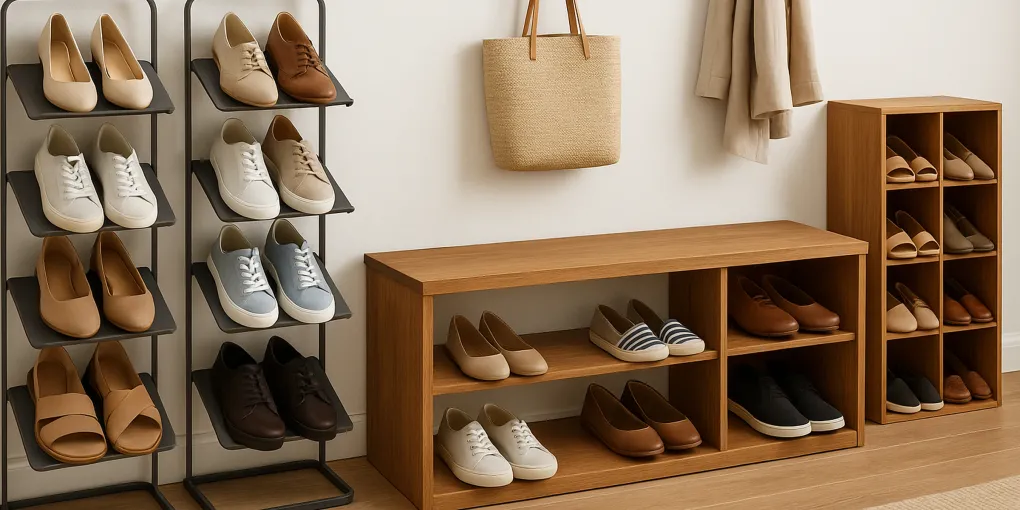
Best Shoe Storage for Entryways 2026
Buyer's GuideSONGMICS 3-Tier Shoe Rack with Bench
Best OverallCapacity: Up to 12 pairs
$55–70
Quick picks
| Product | Key Specs |
|---|---|
| See price on Amazon |
|
| See price on Amazon |
|
| See price on Amazon |
|
| See price on Amazon |
|
| See price on Amazon |
|
Product availability, certifications, and retailer details can change; check the current Amazon page before buying.
The Hidden Cost of Shoe Chaos at the Door
Psychologists who study household friction points consistently find the entryway among the top three stress-generating zones in a home. The mechanism is simple: entryways are transition zones. Coming in from outside while tripping over scattered shoes creates a micro-stress response that compounds across hundreds of daily entries and exits. The same shoes on a rack or in a cabinet produce neutral or positive responses — the space reads as organized, and the transition happens smoothly.
The economics of entryway shoe storage are also unusually clear. Unlike kitchen or closet organization systems that require significant customization, entryway solutions are standardized, affordable, and directly matched to the problem. A $45 shoe bench eliminates a specific friction point within minutes of assembly.
We evaluated 12 entryway shoe storage products across footprint efficiency, capacity, build quality, and long-term accessibility to identify the configurations that work across different entryway sizes.
SONGMICS 3-Tier Shoe Rack with Bench — Best Overall
Best for: Households of 2–4 people, entryways with 24+ inches of wall space
The SONGMICS bench-and-rack combination is the single most practical entryway shoe storage format for most households. It provides seating (for shoe removal), three tiers of open shoe storage (for up to 12 pairs), and a footprint small enough to fit in most standard entryways — all at a mid-range price point.
What Works
The structure is steel framed with a fabric-upholstered cushion top. The steel frame assembles in under 30 minutes and is stable under adult weight on the cushion. Shoe storage tiers are angled at roughly 15 degrees, which keeps shoes from sliding off while making retrieval natural — you grip the toe box and the shoe slides toward you.
The 23.6-inch width fits in the majority of US entryways without blocking door swing. The bench height of 19.7 inches is standard seating height and comfortable for most adults when putting on shoes.
What to Know
12-pair capacity is sufficient for 2–3 people’s frequently worn shoes, but not an entire household’s collection. If your household has more than three people or large shoe sizes (men’s 12+), consider a wider configuration or a supplementary over-door organizer.
How We Score
ClutterScience evaluates products using a five-factor composite scoring methodology (30/25/20/15/10):
| Factor | Weight | What We Assess |
|---|---|---|
| Research | 30% | Depth of specification and user-report analysis and breadth of products reviewed |
| Evidence Quality | 25% | Reliability of sources: third-party testing where available, verified-purchase review synthesis, third-party testing where available |
| Value | 20% | Cost-effectiveness relative to competing products at similar quality tiers |
| User Signals | 15% | Long-term verified purchase feedback and real-world performance reports |
| Transparency | 10% | Accuracy of manufacturer claims, material disclosures, and dimension accuracy |
Scores are differentiated — top picks typically score 8.5–9.5, mid-tier 7.0–8.4, and weak options below 7.0.
Scoring
| Criterion | Weight | Score |
|---|---|---|
| Capacity & Dimensions | 30% | 8.8/10 |
| Material Quality | 25% | 8.5/10 |
| Ease of Assembly & Use | 20% | 9.0/10 |
| Long-Term Value | 25% | 8.8/10 |
| Composite Score | 8.8/10 |
Honey-Can-Do 3-Tier Shoe Tower Rack — Best Slim Rack
Best for: Very narrow entryways, high-capacity vertical storage
The Honey-Can-Do tower solves a specific problem: entryways with very limited floor width but available wall height. At 11.8 inches wide and 64 inches tall, it occupies the smallest practical floor footprint of any multi-pair shoe rack in this category while storing up to 30 pairs of shoes.
What Works
The steel wire construction is durable and visually lightweight — it doesn’t read as a heavy furniture piece the way enclosed cabinets do. This makes it appropriate for small entryways where a solid cabinet would feel cramped.
The three-tier configuration holds shoes at three heights, and the open wire design allows ventilation that prevents moisture buildup. Assembly takes approximately 20 minutes and requires no tools.
What to Know
The wire-rack design holds flat shoes (sneakers, loafers, flats) well but is less practical for boots, which don’t fit the horizontal tier format. Tall boots will need a separate boot storage solution or a floor section. The rack is not adjustable, which means tall dress shoes or thick-soled boots may not fit within the tier spacing.
For general entryway shoe organization strategies, including how to decide what stays at the door versus moves to the closet, see our guide to entryway organizers.
Scoring
| Criterion | Weight | Score |
|---|---|---|
| Capacity & Dimensions | 30% | 9.0/10 |
| Material Quality | 25% | 7.8/10 |
| Ease of Assembly & Use | 20% | 8.5/10 |
| Long-Term Value | 25% | 8.0/10 |
| Composite Score | 8.3/10 |
VASAGLE Industrial Shoe Cabinet — Best Enclosed Cabinet
Best for: Entryways where visual clutter is a priority concern, apartments, open-plan homes
Enclosed shoe cabinets address a different problem than open racks. If the shoes themselves are the visual problem — not just their lack of organization — an enclosed cabinet removes them from view entirely while maintaining easy access. The VASAGLE Industrial cabinet has a narrow profile (11.8 inches deep) that fits against most entryway walls without extending significantly into the traffic path.
What Works
The flip-top door design allows shoes to be stored at an angle inside the cabinet, with the door functioning as the inclined plane. This maximizes storage within a small interior volume. Opening the cabinet reveals the toe boxes of stored shoes for quick identification and retrieval.
The industrial aesthetic — metal frame with wood-tone particleboard panels — integrates with a wide range of entryway decors and doesn’t look like a purely utilitarian storage piece.
What to Know
Assembly is more involved than simple rack designs — the VASAGLE cabinet takes 45–60 minutes and benefits from two people for alignment steps. Particleboard construction is not as durable as solid wood or steel but holds up well under normal use when assembly is correct and the unit is kept away from direct water exposure.
Scoring
| Criterion | Weight | Score |
|---|---|---|
| Capacity & Dimensions | 30% | 8.0/10 |
| Material Quality | 25% | 8.0/10 |
| Ease of Assembly & Use | 20% | 7.5/10 |
| Long-Term Value | 25% | 8.2/10 |
| Composite Score | 7.9/10 |
Whitmor Over-the-Door Shoe Organizer — Best Over-Door Option
Best for: Apartments, rentals, and spaces with zero available floor space
Over-door shoe organizers occupy no floor space and require no drilling or permanent installation — they hang on the door with a pair of over-door hooks. This makes them the only viable option in some apartments or rented spaces where floor layout is fixed and wall modifications are prohibited.
What Works
The Whitmor design holds 24 pairs in vinyl pockets across 12 double-pocket rows. The pockets are wide enough for standard sneakers and most flats; narrow heels and slim dress shoes fit cleanly. The steel over-door hooks are reinforced to prevent flex under loaded weight.
The full pocket array fits on standard interior doors (up to 1.75-inch thickness). The organizer hangs on the back of an entryway closet door or the back of a front door where door swing permits.
What to Know
Over-door pocket organizers don’t work well for boots, platforms, or chunky-soled shoes. The pocket geometry is optimized for standard-depth shoe profiles. They also require the door to remain open or close carefully to avoid swinging the organizer into the door frame. Works best on doors that swing into a wall or closet.
Scoring
| Criterion | Weight | Score |
|---|---|---|
| Capacity & Dimensions | 30% | 8.5/10 |
| Material Quality | 25% | 7.5/10 |
| Ease of Assembly & Use | 20% | 9.0/10 |
| Long-Term Value | 25% | 7.8/10 |
| Composite Score | 8.2/10 |
Prepac Entryway Shoe Storage Bench — Best Premium Bench
Best for: Larger entryways, permanent installation, households prioritizing aesthetics
The Prepac bench scales up the bench-plus-storage concept with a wider 48-inch seating surface and enclosed shoe cubbies beneath the seat. It reads as a proper furniture piece rather than a storage accessory, which makes it suitable for entryways or mudrooms where aesthetics matter as much as function.
What Works
The laminated composite wood construction is more durable than particleboard and holds up to repeated sitting weight without flex. The 48-inch width accommodates two adults sitting side-by-side, which is genuinely useful in households with children who need help with shoes.
Eight shoe cubbies beneath the seat hold up to 12 pairs of shoes in a mix of orientations. The open cubby format provides faster access than enclosed cabinet designs while keeping shoes off the floor.
What to Know
The Prepac bench requires the most floor space of any option in this review — 48 inches of wall width and 14 inches of depth. This is too large for narrow entryways under 5 feet wide. Assembly takes 60–90 minutes. Price point is the highest in this roundup.
Scoring
| Criterion | Weight | Score |
|---|---|---|
| Capacity & Dimensions | 30% | 8.5/10 |
| Material Quality | 25% | 8.8/10 |
| Ease of Assembly & Use | 20% | 7.5/10 |
| Long-Term Value | 25% | 8.5/10 |
| Composite Score | 8.3/10 |
Choosing the Right Format for Your Entryway
Measure First, Buy Second
The most common entryway storage mistake is buying without measuring. Before purchasing, record three dimensions: available wall width, floor-to-ceiling height, and door swing clearance radius. A cabinet that fits the wall but swings into the open door is a daily irritation.
Standard US entryways range from 36 to 72 inches wide. Narrow apartments may have as little as 24 inches of usable wall space adjacent to the door. Match your purchase to your actual measurements.
Match Capacity to Household Reality
Calculate shoe pairs honestly. A two-adult household with casual footwear habits may need 8–10 pairs at the door. A family of four with active children may need 16–20. Over-buying capacity creates sprawl (extra shoes fill available space); under-buying creates overflow that ends up on the floor anyway.
Consider Boot Storage Separately
Ankle boots and knee-high boots require dedicated vertical or floor-standing storage that standard shoe racks don’t accommodate. If your household wears boots regularly, plan boot storage as a separate item — either a tall boot organizer alongside your main shoe rack, or hooks with boot-shaper inserts.
For comprehensive approaches to integrating shoe storage into a full entryway organization system, including hooks, mail organization, and key storage, see our complete entryway organizer guide.
For whole-home shoe storage beyond the entryway, our shoe storage solutions guide covers closet-based shoe organization.
Bottom Line
For most households, the SONGMICS 3-Tier Bench is the right answer — it combines seating, open-access shoe storage, and a compact footprint at a price point that makes sense. The bench function alone justifies the cost over a rack-only design for households that regularly put on and remove lace-up shoes.
For narrow entryways with limited floor width, the Honey-Can-Do Tower is the practical choice: maximum capacity for minimum floor space. For entryways where visual clutter is the primary concern, the VASAGLE Cabinet removes shoes from view entirely while maintaining convenient access.
Whichever system you choose, the organizational discipline that makes it work is simple: every shoe that comes in through the door goes directly to the storage system. That single habit, reinforced by having the right system in place, is what keeps entryway floors clear.
Frequently Asked Questions
- The minimum practical footprint for a slim shoe rack is about 12 inches deep by 20 inches wide. Most entryways can accommodate this without blocking the door swing or pedestrian flow. Shoe benches require more width (36–48 inches) and should only be used in entryways wider than 48 inches to avoid a cramped feel. Measure your available wall length and the distance from wall to door swing before purchasing.
- A practical entryway storage target is 2–3 pairs per household member — the shoes worn most frequently in the current season. Trying to store an entire household's shoe collection in the entryway creates overcrowding. Keep frequently worn shoes at the door and store seasonal or occasion shoes in a bedroom closet. For complete shoe storage solutions, see our dedicated guide to shoe storage organization.
- Shoe benches add functional value beyond storage — they provide a seated surface for putting on and removing shoes, which reduces the likelihood of shoes being left scattered across the floor. For households with elderly members, children, or people who routinely wear lace-up shoes, the bench function is worth the premium. For households that primarily wear slip-ons, a slim rack offers the same storage at lower cost.
- Enclosed shoe cabinets can trap moisture and odor. Improve airflow by placing silica gel packets or activated charcoal odor absorbers inside. Open rack designs self-ventilate and generally have fewer odor issues. Allowing wet shoes to dry before storing them is the single most effective preventive measure.
- Over-door organizers are the best option when floor space is genuinely limited — they store 24 pairs using zero floor footprint. The trade-off is that over-door organizers work best with flat shoes; boots and high heels don't fit the pocket format. Slim vertical towers (12 inches wide, 64 inches tall) are the next best option for small entryways with tight floor space but available wall height.