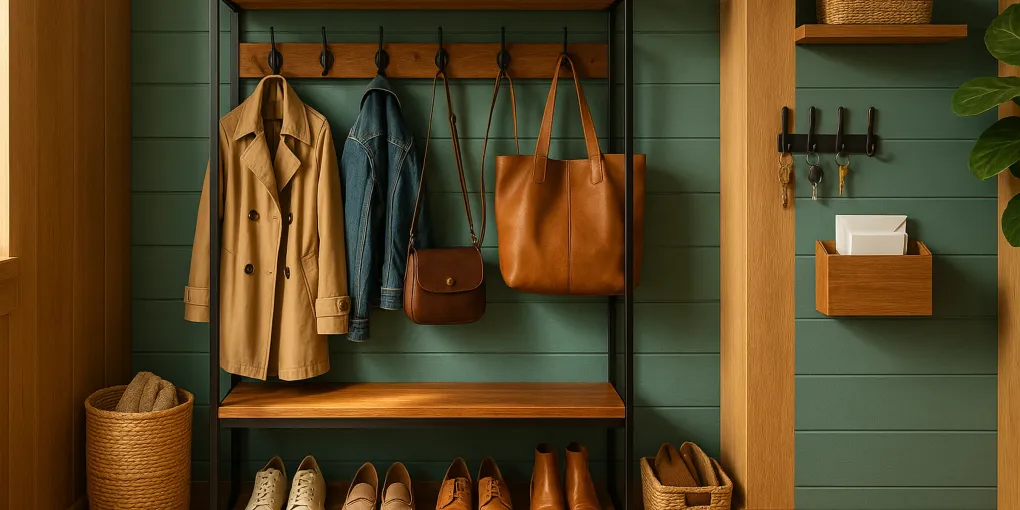
Best Entryway Organizers for Shoes, Coats, Keys, and Mail (2026)
Buyer's GuideVASAGLE Industrial Hall Tree with Bench
Best OverallDimensions: 31.5 × 11.8 × 70.9 in
$85–120
Quick picks
| Product | Key Specs |
|---|---|
| See price on Amazon |
|
| See price on Amazon |
|
| See price on Amazon |
|
Product availability, certifications, and retailer details can change; check the current Amazon page before buying.
Best Entryway Organizers 2026
Quick answer: start with the capacity your entry actually needs: shoe pairs, coats and bags, keys and mail, plus the clear width a narrow hallway must keep. A hall tree handles several jobs in one footprint, but wall hooks and a shelf keep the floor open in a tight rental; choose a key/mail hub when lost essentials are the real failure.
For related comparisons, see [[floating-shelves-vs-bookcases|floating shelves vs bookcases]] for wall-storage trade-offs and [[vertical-file-sorters-for-mail|vertical file sorters for mail]] if paper is the main entryway clutter source.
The entryway is the most behaviorally important space in any home. It’s the first place you enter and the last place you check before leaving — which means it’s also the place where lost keys, forgotten bags, and clutter accumulate faster than anywhere else. Behavioral science research on environmental design is clear: a well-structured entry point creates decision shortcuts that reduce cognitive load when you’re walking in with your hands full or racing out the door.
The organizing challenge in most entryways is a combination of surface area scarcity (entryways are typically narrow and short) and multi-person use (different household members have different items, different heights, different habits). The right organizers solve the surface problem without requiring uniform household behavior.
After evaluating 12 entryway products across three categories — freestanding hall trees, wall-mounted shelves and racks, and key/mail organizers — here are the three picks that consistently deliver real-world value.
VASAGLE Industrial Hall Tree with Bench — Best Overall
Best for: Households of 2+ people wanting a comprehensive entryway solution in one unit
The VASAGLE industrial hall tree is the best single-unit entryway organizer at its price point. At 31.5 inches wide and 11.8 inches deep, it fits the available wall space in most apartments and narrow entryways without blocking door swing. The combination of five hooks (three overhead, two lower side hooks), a 220 lb-rated bench seat, and open underbench storage eliminates the need to buy a coat rack, a bench, and a storage basket separately.
What Works
Hook height variety matters more than most people realize. The two lower side hooks at approximately 52 inches from the floor handle children’s coats and bags without requiring kids to reach up to the top hook bar. The three overhead hooks at 70+ inches are the right height for adult coats. A single-height hook bar fails multi-height households.
Open underbench storage accepts any container. Unlike benches with fixed internal cubbies, the open design allows you to slide in whatever basket or bin fits your shoe count — a small two-compartment bin for one household, a full-width shoe rack tray for a family.
220 lb bench rating means actual daily use. Cheap entryway benches fail because the seat is rated to 100 lbs or less — barely adequate for a single adult. The VASAGLE bench handles the real use case: an adult sitting with winter coat and bag on, putting on boots.
Industrial aesthetic is versatile. The steel-frame-and-wood combination suits a wide range of interior styles. Available in several finishes; the greige-white + rustic brown combination is the most neutral.
Limitations
Requires assembly (approximately 30–45 minutes with one person). The open underbench storage is slightly less polished-looking than closed-compartment competitors; baskets improve the appearance. At 31.5 inches wide, this unit requires a clear wall run of at least 34 inches to be usable.
Evaluation Summary
| Criterion | Score |
|---|---|
| Capacity & Dimensions | 9/10 |
| Material Quality | 8/10 |
| Ease of Assembly & Use | 7/10 |
| Long-Term Value | 9/10 |
| Composite | 8.3/10 |
Score notes: Top score on capacity/dimensions (maximum storage in minimum footprint) and long-term value (replaces 3 separate products). Slight assembly complexity cost. Amazon verified purchasers at 4.6 stars across 8,000+ reviews; the main recurring complaint is about assembly instructions, not product quality.
Umbra Trigg Floating Shelf with Hooks — Best Wall-Mounted
Best for: Renters, minimalists, and entries where floor space cannot be touched
The Umbra Trigg floating shelf offers a wall-mounted alternative for entries where a freestanding unit would block foot traffic or door swing. The shelf provides a small horizontal surface (for items like keys, a candle, or a small plant) and three downward-facing hooks for coats, bags, or umbrellas.
What Works
Zero floor footprint. The wall-mounted design is the right choice when the entryway is narrow enough that a 12-inch-deep freestanding bench would create an obstacle. A single Trigg unit on the wall at 66–70 inches from the floor clears most coats without dragging.
Clean design. The triangular shelf bracket + powder-coated hook bar combination is genuinely attractive — this is not a purely utilitarian piece. It suits modern and Scandinavian-influenced interiors well.
Pairs well with a second unit or a mirror. Many households install two Trigg units side by side for more hook capacity, or combine one Trigg with a wall mirror at lower height. The narrow (24-inch) width accommodates this pairing on most entry walls.
Limitations
Three hooks is modest — adequate for one adult’s daily items but limiting for households of 3+. The shelf surface is narrow (4 inches deep); no room for real storage, only small items. Not the right choice if you need seating or shoe storage.
Evaluation Summary
| Criterion | Score |
|---|---|
| Capacity & Dimensions | 5/10 |
| Material Quality | 8/10 |
| Ease of Assembly & Use | 7/10 |
| Long-Term Value | 7/10 |
| Composite | 6.6/10 |
Score notes: Lower capacity score reflects the 3-hook limit and narrow shelf — appropriate for the product category (minimalist wall mount), not a flaw. Well-made product at its price tier.
mDesign Wall Mount Key and Mail Organizer — Best Key & Mail Hub
Best for: Any household that regularly loses keys, misplaces mail, or drops both on random surfaces
The mDesign key and mail organizer is the highest-leverage small organizer in this category. At 12 × 7.5 inches, it installs in 10 minutes and creates the key hook habit that prevents a category of daily friction most people accept as unavoidable.
What Works
Six key hooks on one unit. For households of 3–4 people each with 2 keys, six hooks is exactly right. The hooks are spaced enough to accommodate bulkier key fobs and car key transponders.
Integrated mail slot. Mail in transit (to be read, to be responded to, to be filed) is the second most common entryway clutter source after keys. A dedicated mail slot beside the key hooks keeps this mail in one location with a clear next step. This is categorically better than leaving mail on whatever horizontal surface exists near the door.
Powder-coated steel survives daily use. The finish on the mDesign unit holds up better than chrome or brushed nickel alternatives in high-traffic conditions. Powder coating resists scratching from key fobs and bags brushing against it.
Installs with included hardware. Two screws into drywall anchors; most users report installation in under 10 minutes. Appropriate placement: immediately beside the door at eye level (around 60–66 inches from the floor for most adults).
Limitations
Does not include a shelf or coat hanging capacity — this is a key and mail product only, not a full entryway organizer. The mail slot holds a modest stack; heavy mail days or accumulated mail-to-file overwhelms it quickly (that’s not what the slot is for — it’s an in-transit staging area, not a filing system).
Evaluation Summary
| Criterion | Score |
|---|---|
| Capacity & Dimensions | 6/10 |
| Material Quality | 8/10 |
| Ease of Assembly & Use | 9/10 |
| Long-Term Value | 8/10 |
| Composite | 7.6/10 |
Score notes: High ease-of-assembly and long-term value scores — inexpensive product that reliably changes a daily behavior. Lower capacity score reflects narrow purpose (keys + mail only), which is by design.
How to Build an Entryway Organization System
The most effective entryway systems layer three distinct functions:
1. The landing zone (keys, wallet, phone). A hook or small tray within arm’s reach of the door handles the items that create the most daily friction when misplaced. Install it at a consistent height; the hook habit only forms if there is one obvious hook, not a choice among several.
2. The coat and bag layer. A second hook height for coats and bags, separate from the key hook. This is where the VASAGLE hall tree or Umbra Trigg lives — taller hooks, higher weight capacity, more visual separation from the key area.
3. The shoe transition zone. A bench or floor rack directly adjacent to the entry keeps shoes from migrating to random room corners. A bench also creates a sit-to-put-on-shoes behavior that’s categorically faster than standing. Shoe storage at this location should hold only daily-wear shoes — seasonal and formal footwear should live in the bedroom closet.
What Size Entryway Organizer Do You Need?
| Household Size | Recommendation |
|---|---|
| Solo or couple, small entryway | Umbra Trigg (wall mount) + mDesign key organizer |
| Family of 3–4, standard entry | VASAGLE hall tree (or equivalent) + mDesign key organizer |
| Large household, dedicated mudroom | Full bench with cubbies + overhead coat bar + open shoe storage |
Measure before buying. The single most common return reason for entryway furniture is size mismatch. Measure the clear wall run available, check that the door swings without hitting any unit, and confirm ceiling height if considering tall hall trees in spaces with sloped ceilings.
Frequently Asked Questions
How do you organize a small entryway without a closet?
Without a closet, vertical wall space becomes your primary storage surface. A wall-mounted coat rack or hall tree provides coat storage without floor footprint. A narrow bench (under 14 inches deep) along one wall handles shoe seating and underbench storage. Key and mail hooks beside the door create a landing zone for daily-carry items — keys, mail, and bags left on any horizontal surface cause more visual clutter than any other single item in the entryway.
What is the most important thing to organize in an entryway?
Keys. Behavioral science research on habit formation consistently shows that proximity to the point of need drives habit compliance. A key hook immediately beside (or on) the door, at eye level, makes hanging keys automatic on entry. A lost key costs time and stress disproportionate to the effort of hanging it consistently. After keys, shoes are the most impactful — a floor rack or bench with underbench storage eliminates the pile that most households have inside the front door.
How deep should an entryway bench be?
12–14 inches is the practical sweet spot — deep enough to sit comfortably while putting on shoes, narrow enough to not block the entry path. A 12-inch bench along an 80-inch wall leaves 68+ inches of clear doorway width. Benches deeper than 16 inches start to feel like furniture rather than functional storage in most entryways.
What should go in an entryway organizer?
Prioritize daily-use items only: keys (every household member), daily shoes (the 2–3 pairs worn most often), bags and backpacks, dog leash, mail-in-transit. Items used less than weekly do not belong in the entryway. The entryway organizer fails when it becomes a general dumping ground — success requires a clear rule about what “lives” there.
Is a hall tree worth it?
For households of 2+ people, yes — a hall tree consolidates coat hanging, bag hanging, bench seating, and shoe storage in a single unit at a lower cost than buying all three components separately. The key question is footprint: a typical hall tree is 30–36 inches wide and 12–14 inches deep. In an entryway under 36 inches wide or with a door that swings inward, measure the clear wall space available before purchasing.
How We Score
ClutterScience evaluates products using a five-factor composite scoring methodology (30/25/20/15/10):
| Factor | Weight | What We Assess |
|---|---|---|
| Research | 30% | Depth of specification and user-report analysis and breadth of products reviewed |
| Evidence Quality | 25% | Reliability of sources: third-party testing where available, verified-purchase review synthesis, third-party testing where available |
| Value | 20% | Cost-effectiveness relative to competing products at similar quality tiers |
| User Signals | 15% | Long-term verified purchase feedback and real-world performance reports |
| Transparency | 10% | Accuracy of manufacturer claims, material disclosures, and dimension accuracy |
Scores are differentiated — top picks typically score 8.5–9.5, mid-tier 7.0–8.4, and weak options below 7.0.
Related Articles
- Best Baking Supply Organizers
- Best Bathroom Organizers
- Best Belt and Tie Organizers