Best Under-Bed Shoe Storage for Small Closets: Low Bins, Dividers, and Dust Control
Buyer's GuideUnder-bed shoe organizer with clear lid
Best for dust controlBest for: Seasonal shoes, dress shoes, and pairs that should not collect dust
Quick picks
| Product | Key Specs | Pros / Cons |
|---|---|---|
| See price on Amazon |
|
|
| See price on Amazon |
|
|
| See price on Amazon |
|
|
Product availability, certifications, and retailer details can change; check the current Amazon page before buying.
The best under-bed shoe storage for small closets is the organizer that matches your bed clearance and shoe routine, not the one that claims the highest pair count. A soft 24-pair bag can be worse than a smaller rigid box if it jams under the frame, hides black shoes in dark corners, or forces you to kneel every morning.
Under-bed storage works best for shoes that are real but not constantly needed: seasonal sandals, dress shoes, backup sneakers, special-event heels, or kids’ sizes waiting for a sibling. Daily shoes still need a faster drop zone. If every pair goes under the bed, the system usually turns into a dusty search drawer.
Quick picks
- Best first choice for most small closets: under-bed shoe organizer with a clear lid (Search Amazon for clear-lid under-bed shoe organizers).
- Best for shoes you grab several times a week: rigid low-profile under-bed shoe box (Search Amazon for rigid low-profile shoe storage boxes).
- Best for mixed shoe sizes: fabric organizer with adjustable dividers (Search Amazon for adjustable under-bed shoe dividers).
Before buying, measure the true under-bed opening at the lowest support rail. Then measure your tallest shoes while they are naturally paired, not compressed.
Why under-bed shoe storage succeeds or fails
A small closet usually fails because every shoe category competes for one floor strip. Boots, gym shoes, sandals, dress shoes, and returns-in-progress all land near the closet door. Under-bed storage helps only when it removes a specific category from that floor strip.
Think of the bed space as a secondary shelf. It is useful for low, clean, paired items. It is poor for muddy shoes, damp footwear, loose socks, or anything that must air out. The same access principle appears in our small closet laundry sorter guide: the storage tool has to respect the path your body already takes.
Clear-lid fabric organizers: best for seasonal pairs
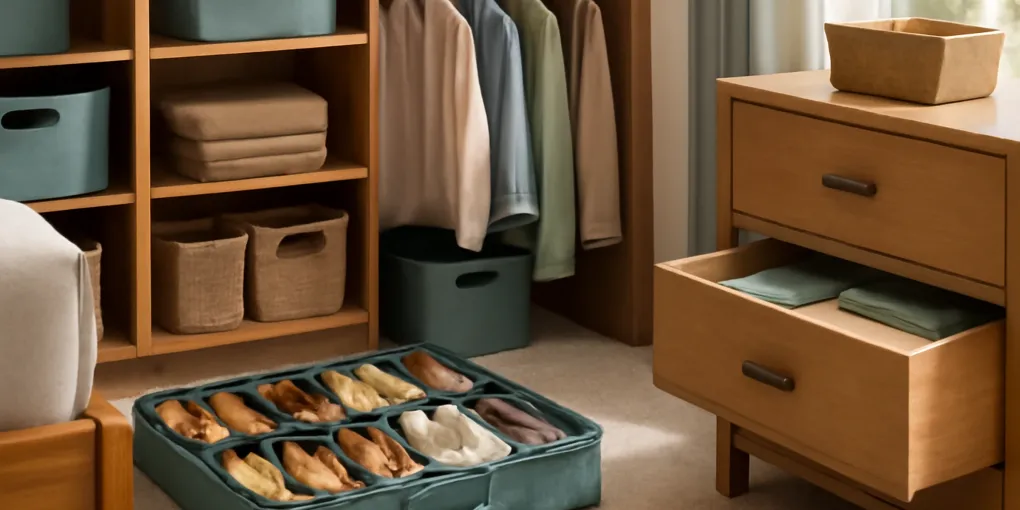
A clear-lid under-bed organizer is the safest default when shoes will sit for more than a few days. The lid reduces dust, the transparent top prevents blind digging, and the fabric sides keep the unit light enough to pull out from one side of the bed.
Best use: sandals in winter, dress shoes, formal flats, backup sneakers, and pairs that stay clean. Choose reinforced handles and a zipper that runs smoothly around corners.
Caveat: soft organizers exaggerate capacity. Product photos often show flat shoes, not bulky running shoes or high-top sneakers. If the organizer advertises 12 pairs, assume fewer if your shoes are tall, wide, or stored with shape inserts.
Current options: Compare clear-lid under-bed shoe organizers on Amazon.
Rigid low-profile boxes: best for frequent access
Rigid boxes cost more, but they solve the two biggest under-bed annoyances: sagging and crooked pulls. A plastic or structured box keeps dividers upright, slides more predictably, and can be easier to clean if dust collects under the bed.
Best use: sneakers, flats, sandals, and school shoes that move in and out weekly. Wheels can help on hard floors, but check whether they add too much height for your bed frame.
Caveat: rigid dimensions are unforgiving. If a box is too tall by half an inch, it will not work. If fixed dividers are too narrow, adult sneakers may need to be stored sideways, reducing capacity.
Current options: Search rigid low-profile shoe storage boxes on Amazon.
Adjustable dividers: best for mixed shoe sizes
Adjustable dividers are useful when one household stores ballet flats, kids’ shoes, slippers, and a few taller pairs in the same organizer. Instead of forcing every compartment to be the same size, you can make wider lanes for sneakers and narrow lanes for sandals.
Best use: children sharing a room, guest-room overflow, or a small closet where shoe sizes vary widely.
Caveat: flexible dividers need discipline. If pairs are tossed in without being reset, the organizer becomes a soft bag with seams. Keep the most fragile or least-used pairs toward the center and heavier sneakers near the sides.
Current options: Search adjustable under-bed shoe organizers on Amazon.
Shoe-storage buying checks
Use the comparison cards above as a shortlist, then verify the measurements that decide whether an under-bed organizer will survive daily use:
- Clearance: measure the lowest rail, rug height, and handle path before trusting a listed product height.
- Capacity honesty: product photos usually show flats; adult sneakers, high tops, and wedges reduce the pair count fast.
- Dust and access: choose a clear lid for seasonal pairs, a rigid box for weekly access, and adjustable dividers only when mixed shoe sizes are the real problem.
Measurement checklist
Measure bed clearance in three places: near the side rail, at the center support, and near the foot. Many beds have a low center bar that product photos ignore. If you have a rug, measure from the rug surface, not the hard floor.
Next, measure the shoe category you actually plan to store. Low sandals and flats can fit in shallow fabric bags. Running shoes, high tops, and wedges need taller boxes or adjustable compartments. Boots usually belong somewhere else unless the bed frame is unusually high.
Finally, check the pull path. The organizer needs room to come out without hitting a nightstand, dresser, hamper, or bedside rug curl. A bin that technically fits under the bed but cannot be pulled out straight will be abandoned.
What not to store under the bed
Do not store damp, muddy, or odor-heavy shoes under a bed. Let shoes dry and air out first. Do not store loose shoe-care sprays, batteries, or heat-sensitive items in the same bin. If shoes need frequent cleaning supplies, keep those supplies in a separate caddy or closet basket.
For families with young children, avoid small loose accessories under beds where they can become choking or tripping hazards. Keep the floor path around the bed clear enough for nighttime movement.
Setup plan for a small closet
Start with the closet floor, not the bed. Pull out every pair that currently blocks the closet door and sort into four groups: daily shoes, weekly shoes, seasonal shoes, and shoes that need a decision. Daily shoes should stay near the door or front of the closet because under-bed access is too slow for rushed mornings. Weekly shoes can go in the easiest under-bed lane. Seasonal pairs should go toward the back or in the lidded organizer you open least often.
Clean the shoes before loading them. Under-bed storage magnifies dust because the bin slides through the lowest part of the room. Wipe soles, let damp shoes dry fully, and remove receipts or tags from shoe boxes. If the organizer will hold dress shoes, add soft shoe bags or tissue around delicate materials instead of letting buckles scrape neighboring pairs.
Load by retrieval order. The pair most likely to be needed first should sit closest to the handle. If two people share the organizer, divide it left and right rather than mixing sizes by color. A mixed-size rainbow may look tidy on day one, but a spouse or child will disturb every compartment when searching for one black flat.
When to skip under-bed storage
Skip under-bed shoe storage if the bed sits directly on the floor, if the only pull path crosses a narrow walkway, or if pets regularly hide under the frame. Also skip it when the closet is not the true problem. If most shoes are unworn, uncomfortable, wrong size, or waiting for repair, an organizer only preserves decisions that should be made.
A door rack, front-entry shoe bench, or narrow closet shelf can be better for daily footwear. Under-bed bins are best for overflow that deserves to stay but does not need first-position access. If you cannot describe exactly which shoe group will move under the bed, wait before buying; the organizer should answer a real closet-pressure problem, not hide a delayed edit.
FAQ
Which shoes should stay visible?
Daily shoes, wet-weather shoes, and anything needed for a child’s morning routine should stay visible near the closet or door. Individual boxes protect delicate shoes well, but they waste vertical space under low beds and make comparison harder. Use boxes for delicate shoes; use an organizer for ordinary overflow pairs.
How do I stop under-bed shoe storage from getting dusty?
Choose a lidded organizer, vacuum under the bed before loading it, and keep the unit closed. If the bedroom has pets, a rigid box or zippered lid is usually better than an open tray.
Where should daily shoes go if not under the bed?
Keep the two or three most-used pairs near the closet front, entryway, or bedroom door. Under-bed storage should reduce crowding, not make every morning start on the floor.
Source notes
For safer bedroom pathways, CDC fall-prevention guidance emphasizes reducing home hazards that can contribute to falls: https://www.cdc.gov/falls/prevention/index.html. For households with young children, HealthyChildren childproofing guidance reinforces keeping small objects and household hazards out of reach: https://www.healthychildren.org/English/safety-prevention/at-home/Pages/Childproofing-Your-Home.aspx.