Best Under-Bed Storage for Seasonal Clothes: Bags, Boxes, or Rolling Bins?
Buyer's GuideLifewit Under Bed Storage Bag
Best soft bagBest for: Sweaters, off-season clothes, and soft textiles under a low bed
Quick picks
| Product | Key Specs | Pros / Cons |
|---|---|---|
| See price on Amazon |
|
|
| See price on Amazon |
|
|
| See price on Amazon |
|
|
Product availability, certifications, and retailer details can change; check the current Amazon page before buying.
Quick product shortlist
Use this shortlist to choose a product style before you measure. The links are named product or brand searches so you can compare current dimensions, finishes, prices, and return terms before buying.
- Best soft bag: Lifewit Under Bed Storage Bag (Search Amazon for Lifewit under bed storage bag seasonal clothes) for sweaters, off-season clothes, and soft textiles under a low bed. Watch-out: soft sides sag if dragged when overloaded.
- Best rigid box: Sterilite Underbed Storage Box (Search Amazon for Sterilite underbed storage box clear) for shoes, folded clothes, and items that need crush protection. Watch-out: plastic height must clear bed frame and center supports.
- Best rolling bin: Onlyeasy Under Bed Rolling Storage (Search Amazon for Onlyeasy under bed rolling storage) for higher beds and frequent seasonal rotations. Watch-out: wheels need smooth floor and enough pull-out room.
Under-bed storage can be a smart way to store seasonal clothing, but it can also become a low, dark archive of things you forgot you owned. The difference comes down to container type, humidity, visibility, and whether you review the contents when seasons change.
This guide compares fabric bags, clear boxes, rolling bins, and vacuum bags for off-season clothing. The goal is not to fill every inch under the bed. The goal is to store a limited seasonal rotation in a way that stays clean, findable, and easy to reset. Compare current labels, prices, sellers, and return policies before buying.
Quick Picks
- Best overall: rolling under bed storage bins (See current price on Amazon) for easy access and less dragging.
- Best budget: fabric under bed storage bags (See current price on Amazon) for lightweight seasonal textiles in dry rooms.
- Best visibility: clear under bed storage boxes (See current price on Amazon) for seeing categories quickly.
- Best space saving: vacuum storage bags for clothes (See current price on Amazon) for bulky short-term storage with caveats.
G6 Composite Score
| Option | Research 30% | Evidence Quality 25% | Value 20% | User Signals 15% | Transparency 10% | Composite |
|---|---|---|---|---|---|---|
| Rolling under-bed bins | 8.5 | 7.5 | 8.0 | 8.5 | 9.0 | 8.2 |
| Clear lidded boxes | 8.0 | 7.5 | 8.0 | 8.0 | 9.0 | 7.9 |
| Fabric storage bags | 7.5 | 7.0 | 8.5 | 7.5 | 9.0 | 7.8 |
| Vacuum bags | 6.5 | 6.5 | 7.5 | 7.0 | 9.0 | 7.0 |
For seasonal clothes under a bed, prioritize dust protection, fabric compression, handle strength, height clearance, and whether the container makes the next season swap easier.
The Clutter Science of Under-Bed Storage
Under-bed space is tempting because it is large and hidden. Hidden storage can reduce visual clutter, but it also reduces feedback. If you cannot see what is stored, you may buy duplicates, forget categories, or avoid seasonal reviews.
Research on visual clutter and search efficiency suggests that crowded environments make finding targets harder; Rosenholtz and colleagues review this problem in vision science: https://doi.org/10.1167/7.2.17. Under-bed storage creates the opposite risk: low visibility rather than too much visibility. The solution is not to leave everything out. It is to make hidden categories easy to identify.
For related tradeoffs, see [[under-bed-storage-bags-vs-rolling-bins|under-bed storage bags vs rolling bins]]. This article updates the buyer decision specifically for seasonal clothing.
Option 1: Rolling Under-Bed Bins
Rolling bins are the best choice for most households because they reduce friction. You can pull the bin out without scraping the floor or dragging a soft bag. That matters when a system must be used twice a year or more.
Choose rolling bins when:
- You have hard flooring or low carpet.
- You rotate clothing seasonally.
- You want easy access without lifting the mattress.
- You store sweaters, jeans, scarves, or kids’ clothes.
Look for low-profile wheels, a lid or zip cover, and a height that clears the bed frame. Measure from the floor to the lowest frame support, not just the outer rail. Many bins fail because they fit at the edge but catch in the middle.
The main drawback is cost and rigidity. Rolling bins take their full footprint even when empty. They may also be too tall for platform beds.
Option 2: Clear Lidded Boxes
Clear boxes are useful when visibility is the priority. They protect from dust better than many soft bags, stack neatly when not under the bed, and make it easy to identify “winter sweaters” or “summer linen” without opening every container.
Choose clear boxes when:
- You forget what is stored under the bed.
- Dust is a concern.
- You want categories visible at a glance.
- You have enough bed clearance for rigid containers.
The downside is that clear boxes are less flexible around bed supports. They can crack if overfilled or forced. They also show visual clutter through the plastic, which may bother some people if the boxes are visible from the side.
Option 3: Fabric Storage Bags
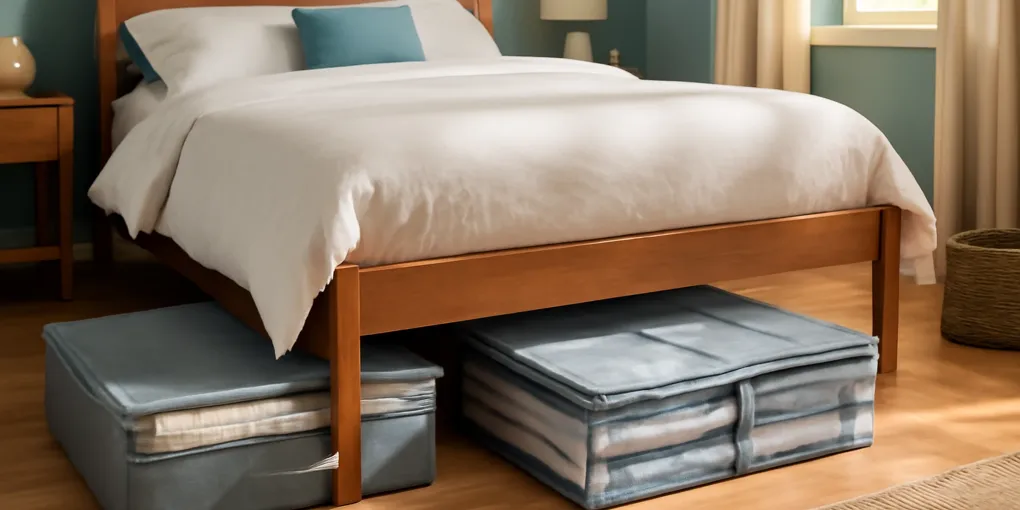
Fabric bags are lightweight, inexpensive, and flexible. They are good for soft textiles in dry rooms, especially when the bed clearance is limited. Many have handles and clear top windows.
Choose fabric bags when:
- You store lightweight clothing.
- You need a low-profile option.
- You want a budget-friendly container.
- You have a dry, clean bedroom environment.
Avoid fabric bags for damp rooms, pest-prone storage, or heavy items. Handles can tear if bags are overloaded. Soft sides also encourage overstuffing, which makes the bag harder to pull out and harder to reset.
Option 4: Vacuum Bags
Vacuum bags are best for short-term space saving, not everyday seasonal browsing. They compress bulky items dramatically, which can help in apartments or shared closets.
The tradeoff is fabric care and access. Compression can crease clothing and may not be ideal for delicate fibers, structured garments, or items that need loft. The Smithsonian’s textile care guidance warns against storing textiles in conditions that create stress, moisture problems, or poor air circulation: https://www.si.edu/mci/english/learn_more/taking_care/textiles.html.
Use vacuum bags for bulky synthetic blankets or short-term moves, not as the default for all seasonal clothing.
What Not to Store Under the Bed
Avoid storing:
- Damp or not-quite-clean clothing.
- Leather or delicate heirloom textiles.
- Important documents.
- Food, candles, or scented products.
- Items you use weekly.
- Anything you are avoiding deciding about.
Under-bed storage should hold intentional seasonal categories. If the category is “things I do not know what to do with,” the bed becomes a clutter delay machine.
Humidity and Pest Considerations
Clothing should be clean and completely dry before storage. Body oils, food residue, and moisture can attract pests or create odors. The University of Minnesota Extension notes that clothes moth management includes cleaning garments and reducing favorable conditions: https://extension.umn.edu/yard-and-garden-insects/clothes-moths.
If you live in a humid climate, use breathable storage carefully and consider a room dehumidifier or desiccant packets where appropriate. Do not trap damp textiles in plastic.
How to Label Seasonal Storage
Labels should answer three questions:
- What season?
- What category?
- When should it be reviewed?
Examples:
- “Winter sweaters — review October 2026.”
- “Kids 6T summer clothes — review April 2027.”
- “Guest bedding — wash before use.”
A label maker, painter’s tape, or luggage tag can work. Search options include storage bin labels (See current price on Amazon) and label maker for bins (See current price on Amazon).
Seasonal Reset Protocol
Use this reset twice per year:
- Pull out every under-bed container.
- Empty one container at a time.
- Remove damaged, ill-fitting, or unwanted clothing.
- Wash or air items before storing if needed.
- Repack by category, not by random leftover space.
- Update the label with the next review date.
- Leave one container partly empty if possible.
Leaving a little slack prevents zipper strain and makes the next reset easier. If every bag is packed tight, the system has no margin.
Comparison Table
| Storage type | Best for | Avoid if | Main risk |
|---|---|---|---|
| Rolling bin | Frequent seasonal access | Bed clearance is very low | Wheels catch on carpet |
| Clear box | Visibility and dust control | You dislike visible contents | Cracking or poor fit |
| Fabric bag | Low-cost soft clothing storage | Room is damp or pest-prone | Overstuffing |
| Vacuum bag | Short-term space saving | Delicate or structured clothes | Compression damage and hard access |
FAQ
What is the best under-bed storage for seasonal clothes?
Rolling bins are the best overall for most people because they are easy to pull out and reset. Clear boxes are best for visibility, while fabric bags are a good budget option in dry rooms.
Should seasonal clothes be stored in vacuum bags under the bed?
Vacuum bags can help for bulky short-term storage, but they are not ideal for delicate garments or items you need to access often. Avoid compressing structured or fragile textiles.
How do I keep under-bed storage from becoming clutter?
Limit it to intentional seasonal categories, label every container, and schedule a seasonal review. Do not store undecided items under the bed.
Buyer Checklist Before You Measure
Before ordering under-bed containers, decide what category deserves the space. Good categories include winter sweaters, summer linen, guest bedding, holiday pajamas, or the next size of children’s clothing. Weak categories include “maybe clothes,” unfinished laundry, sentimental textiles you never review, or random overflow from the closet.
Then measure three points: the visible edge clearance, the lowest support under the bed, and the distance you can pull a container out without hitting another piece of furniture. Many buyers measure only the edge and discover that center supports block the bin. If the bed has a skirt, lift it and measure the real opening.
Also check the floor. Wheels work well on hard floors and low carpet, but they can catch on thick rugs. Fabric bags slide more easily in some rooms, but they can sag when overloaded. Clear boxes protect from dust, but they need enough height and a straight pull path.
For a broader bedroom storage comparison, see under-bed storage bags vs rolling bins. Use that guide if your main question is container mechanics rather than seasonal clothing rotation.
What To Do If Everything Does Not Fit
If all seasonal clothes do not fit under the bed, do not buy more containers immediately. First remove items that did not get worn during the last appropriate season. Then separate sentimental clothing from functional clothing. Sentimental clothing should have its own memory-storage decision, not occupy active seasonal space. Finally, move true deep storage to a closet shelf or sealed tote. Under-bed storage is best for categories you intentionally rotate, not the entire clothing archive.
Product Fit Notes
For rolling bins, check whether the wheels are replaceable or molded into the base. Molded wheels are common and inexpensive, but if one cracks the whole container may become annoying to use. For fabric bags, inspect the zipper path and handle stitching. A low-cost bag can still work well if it is not overloaded, but weak handles are a common failure point. For clear boxes, choose lids that latch securely without requiring excessive force.
Color also matters. Fully opaque containers can look calmer from the side of the bed, but they require better labels. Clear containers reveal contents but may look messy if the bed frame exposes them. If the containers will be visible, choose one consistent style rather than mixing random bags and boxes. Consistency reduces visual clutter even when the storage is not completely hidden.
Finally, buy fewer containers than the maximum space allows. Leaving some empty under-bed space improves air circulation, makes cleaning easier, and prevents the area from becoming a permanent overflow zone.
Bottom Line
Under-bed storage works best when it is visible enough to manage, protected enough for clothing, and limited enough to force seasonal review. Rolling bins are the best default. Clear boxes are best for visibility. Fabric bags are budget-friendly in dry rooms. Vacuum bags are a space-saving tool with fabric-care tradeoffs.
The best container is the one you will actually pull out, review, and reset when the season changes.