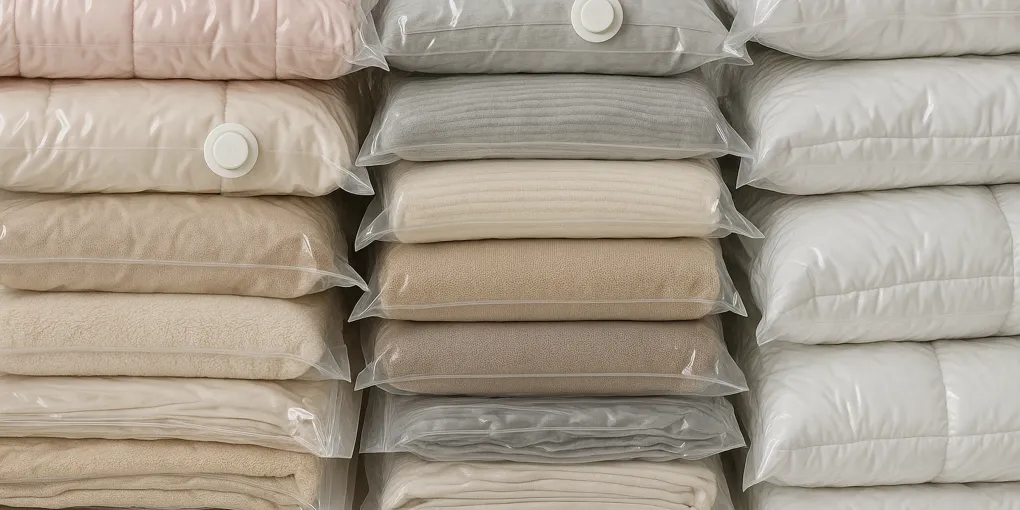
Spacesaver Premium Vacuum Storage Bags (6-pack)
Best OverallSizes: Small, Medium, Large, Jumbo
$28–36
Quick picks
| Product | Key Specs |
|---|---|
| See price on Amazon |
|
| See price on Amazon |
|
| See price on Amazon |
|
| See price on Amazon |
|
| See price on Amazon |
|
Product availability, certifications, and retailer details can change; check the current Amazon page before buying.
Why We Over-Fill Our Closets (And What To Do About It)
Behavioral scientists call it the “endowment effect” — the psychological tendency to overvalue things simply because we own them. Applied to seasonal clothing storage, this means most of us hold onto far more than we need, and our closets pay the price. A queen comforter compressed into a vacuum bag takes up one-sixth the space of the same item folded on a shelf. Multiply that across a household’s worth of seasonal sweaters, extra bedding, and travel gear, and you’re looking at a genuinely transformative amount of reclaimed space.
Vacuum storage bags are one of the highest-return investments in home organization: the cost per square foot of space recovered is lower than almost any shelving, cabinet, or storage system. But not all bags perform equally. Cheap bags fail at the valve, lose their seal within one season, and end up in landfill. Quality bags last for years and compress reliably every time.
We compared 11 vacuum storage bag products using manufacturer specifications, material disclosures, verified-purchase review patterns, and third-party/user reports on compression, seal durability, material quality, and reuse.
Spacesaver Premium Vacuum Storage Bags — Best Overall
Best for: Seasonal wardrobe rotation, comforters, and bulky knitwear
Spacesaver is the most consistently recommended vacuum bag brand across verified Amazon reviews, and the product specifications explain why. The three-layer PA/PE laminate construction is presented as more puncture-resistant than single-layer budget alternatives. The double-zip closure with integrated seal indicator (a color strip that shows when the zipper is fully engaged) addresses the most common failure mode — partial zipping.
What Works
The turbo valve design is a strong fit for bulky seasonal storage. Its wider opening should support faster vacuum suction with less effort than narrow valves, and verified-purchase review patterns repeatedly credit the one-way mechanism with holding compression during multi-month closet storage when bags are sealed carefully and kept in stable conditions.
The six-pack includes multiple sizes — typically two smalls, two mediums, one large, and one jumbo — which makes it practical for mixed seasonal storage needs in a single purchase. The size variety is useful; seasonal sweaters compress best in medium bags while a king comforter needs the jumbo.
What to Know
Spacesaver bags are priced at a slight premium over budget multi-packs. For households storing large volumes, the 12-pack alternatives may be more economical per bag while offering similar compression.
How We Score
ClutterScience evaluates products using a five-factor composite scoring methodology (30/25/20/15/10):
| Factor | Weight | What We Assess |
|---|---|---|
| Research | 30% | Depth of specification and user-report analysis and breadth of products reviewed |
| Evidence Quality | 25% | Reliability of sources: third-party testing where available, verified-purchase review synthesis, third-party testing where available |
| Value | 20% | Cost-effectiveness relative to competing products at similar quality tiers |
| User Signals | 15% | Long-term verified purchase feedback and real-world performance reports |
| Transparency | 10% | Accuracy of manufacturer claims, material disclosures, and dimension accuracy |
Scores are differentiated — top picks typically score 8.5–9.5, mid-tier 7.0–8.4, and weak options below 7.0.
Scoring
| Criterion | Weight | Score |
|---|---|---|
| Capacity & Dimensions | 30% | 9.0/10 |
| Material Quality | 25% | 9.2/10 |
| Ease of Assembly & Use | 20% | 8.8/10 |
| Long-Term Value | 25% | 9.0/10 |
| Composite Score | 9.0/10 |
Hibag Vacuum Storage Bags 12-Pack — Best Value Multi-Pack
Best for: Households with large seasonal storage needs, mixed clothing and bedding
The Hibag 12-pack provides the best cost-per-bag ratio in this category. At roughly $2 per bag versus $5 for Spacesaver, the per-unit savings are real — and the compression performance is competitive. The PA/PE laminate is slightly thinner than Spacesaver’s three-layer construction, but adequately durable for annual seasonal use.
What Works
Four size variants in a single pack (three of each size) give genuine flexibility. For a typical household managing seasonal clothing rotation plus extra bedding, the mix of small, medium, large, and jumbo covers all the common use cases without requiring multiple separate purchases.
The universal turbo valve is compatible with the hose attachment of virtually any canister or upright vacuum cleaner. Evacuation takes approximately 30–60 seconds per bag for a fully loaded medium bag, which is practical for processing an entire seasonal wardrobe in an afternoon.
What to Know
Hibag bags show higher variance in valve quality compared to Spacesaver. Some users report occasional valve that allows slow air re-entry over 3–4 months. For items being stored longer than one season, the Spacesaver construction is more reliable.
Scoring
| Criterion | Weight | Score |
|---|---|---|
| Capacity & Dimensions | 30% | 8.5/10 |
| Material Quality | 25% | 7.8/10 |
| Ease of Assembly & Use | 20% | 8.5/10 |
| Long-Term Value | 25% | 8.0/10 |
| Composite Score | 8.2/10 |
LEVOIT Vacuum Storage Bags Travel Size — Best for Travel
Best for: Carry-on packing, trip gear compression, travel wardrobe
The travel vacuum bag category operates differently from household seasonal bags. Without access to a vacuum cleaner, compression comes from manual rolling — you seal the bag, then roll it from the bottom to force air out through a one-way pressure valve. LEVOIT’s travel bags achieve 50–60% compression this way, which is meaningfully less than vacuum-assisted bags but genuinely useful for reducing suitcase bulk.
What Works
The roll-seal mechanism is reliable and fast. Fill the bag, zip it shut, and roll tightly from the bottom toward the valve. The one-way pressure valve releases air without requiring suction, and the seal holds through normal luggage handling. For a week-long trip, rolling four T-shirts and two pairs of jeans into a travel bag can reduce that clothing stack to a palm-sized brick.
The bags lay flat in suitcase compartments and conform to available space rather than maintaining a rigid shape, which is genuinely practical for fitting multiple items around shoes and toiletries.
What to Know
Travel bags are not resealed mid-trip for rearranging — opening the bag releases compression, and re-rolling without a flat surface is cumbersome. Plan what goes in each bag before sealing. These are not suitable for home seasonal storage; use dedicated vacuum bags for closet applications.
Scoring
| Criterion | Weight | Score |
|---|---|---|
| Capacity & Dimensions | 30% | 7.8/10 |
| Material Quality | 25% | 8.0/10 |
| Ease of Assembly & Use | 20% | 8.5/10 |
| Long-Term Value | 25% | 7.5/10 |
| Composite Score | 7.9/10 |
Ziploc Space Bag — Most Recognizable Brand
Best for: Occasional users who want familiar brand reliability
Ziploc Space Bags have been on store shelves for over two decades, and the brand recognition reflects genuine baseline quality. The large and jumbo sizes handle bulky sweaters, extra blankets, and off-season comforters reliably. The one-way valve design is simple and works with standard vacuum cleaner attachments.
What Works
The Ziploc double-zipper seal is one of the most reliable in this category. Ziploc’s brand foundation in food storage sealing technology translates to stronger, more consistent zipper construction than many third-party alternatives. The bags also have a textured grip strip that signals when the seal is fully engaged — useful for users who are new to vacuum bag storage.
What to Know
The Ziploc Space Bag line is typically priced higher per bag than comparable third-party options. The size variety is more limited than multi-packs like Hibag. For users who want the assurance of an established brand and are storing a modest number of items, the higher per-bag cost is justified. For high-volume seasonal storage, the value proposition of multi-packs is better.
Scoring
| Criterion | Weight | Score |
|---|---|---|
| Capacity & Dimensions | 30% | 8.2/10 |
| Material Quality | 25% | 8.5/10 |
| Ease of Assembly & Use | 20% | 8.8/10 |
| Long-Term Value | 25% | 7.8/10 |
| Composite Score | 8.3/10 |
Gohome Vacuum Compression Bags Jumbo 5-Pack — Best for Bulky Comforters
Best for: King and queen comforters, duvets, and oversized bedding
Standard-size vacuum bags cannot accommodate a king-size comforter in a single bag — attempting to force one in stresses the zipper seal and usually results in partial failure. The Gohome jumbo bags solve this with a 31x39 inch opening that can take a king comforter in one pass. The five-pack format is practical for households with multiple beds and bedding sets to rotate.
What Works
The wide-mouth turbo valve design is notably faster to evacuate than narrow valves. A loaded king-comforter bag takes approximately 45 seconds of vacuum time to fully compress. The thick three-layer laminate construction holds up to the additional stress of compressing dense, bulky fills that put more strain on the material than folded clothing.
The bags also stack efficiently when compressed — a flat, uniform profile that organizes cleanly on a closet shelf or under a bed.
What to Know
Jumbo bags are only practical for genuinely bulky items. Using them for clothing results in inefficient fill ratios — you spend the same compression time for less density than you’d get from a medium bag properly loaded with folded sweaters. Use jumbo bags for their intended purpose: bedding, sleeping bags, and heavy winter outerwear.
Scoring
| Criterion | Weight | Score |
|---|---|---|
| Capacity & Dimensions | 30% | 9.2/10 |
| Material Quality | 25% | 8.5/10 |
| Ease of Assembly & Use | 20% | 8.0/10 |
| Long-Term Value | 25% | 8.5/10 |
| Composite Score | 8.6/10 |
How to Use Vacuum Storage Bags Effectively
Step 1: Fold Before You Fill
Vacuum bags don’t organize — they compress. Clothes that go in unfolded come out as a compressed tangle that resists neat retrieval. Fold everything flat before placing in the bag, and consider organization by category: all sweaters in one bag, all bedding in another. When you retrieve the bag next season, you’ll find what you need without unpacking everything.
Step 2: Don’t Overfill the Zipper Zone
The top 2–3 inches of a vacuum bag are the zipper area. Overfilling pushes fabric into the zipper track, which prevents a full seal and causes slow air re-entry. Fill to 75–80% of capacity maximum.
Step 3: Double-Check the Seal
After zipping, run your finger along the entire seal twice — once in each direction. On indicator-stripe bags, confirm the color has changed fully across the width. A partial zip is the most common cause of bags losing compression overnight.
Step 4: Store in Stable Conditions
Store compressed bags in a cool, dry location away from direct sunlight. Temperature cycling (like in a garage or attic) accelerates valve degradation. Under-bed storage or a climate-controlled closet shelf is ideal.
Vacuum Bags and Your Seasonal Clothing Strategy
Vacuum storage bags integrate most effectively with a systematic seasonal wardrobe rotation. If you’re already transitioning seasonal clothes between active use and storage, see our guide to bedroom closet organization systems for a framework that pairs well with vacuum bag storage.
For storage beyond seasonal clothing — bedding sets, extra towels, and linen supplies — vacuum bags pair with the organizational approach covered in our linen closet organizer guide.
What to Look for When Buying Vacuum Storage Bags
Valve design: Double-check valve compatibility with your vacuum cleaner model. Most standard turbo valves work with any canister or upright, but some narrow-profile vacuum attachments won’t seal properly against certain valve designs. Look for bags that specify “universal valve” compatibility.
Layer count: Single-layer bags feel noticeably flimsier and puncture more easily during loading. Two-layer and three-layer PA/PE laminates are worth the small price premium for anything you plan to reuse over multiple seasons.
Size variety: A single-size pack (all jumbos, for example) is rarely practical. Most households need a mix of medium bags for clothing and jumbo bags for bedding. Multi-packs with mixed sizes provide more flexible storage configurations.
Seal indicator: Visual zipper indicators are a worthwhile feature — they eliminate the guesswork about whether the seal is fully engaged and reduce failure rates from partial zipping.
Bottom Line
For most households, Spacesaver Premium Vacuum Storage Bags represent the best investment: reliable three-layer construction, a proven double-zip seal, and size variety in a single purchase. The slightly higher per-bag cost is offset by multi-season reusability that budget bags often don’t deliver.
For high-volume seasonal storage on a tighter budget, Hibag 12-pack provides solid compression performance at the lowest cost per bag. For households managing king-size bedding specifically, Gohome Jumbo 5-pack is the right tool for the application.
One final note: vacuum bags solve a space problem, but they work best in combination with a genuine wardrobe edit. Items you haven’t worn in two years won’t be worn next season either. Compress what you’ll actually use; donate the rest. The space savings from vacuum bags plus a purposeful clothing edit can transform a cramped bedroom closet into a genuinely functional storage system.
Related Resources
Frequently Asked Questions
- Quality vacuum bags compress soft goods by 75–80% of their original volume. A standard queen comforter that fills a 31x39 inch jumbo bag compresses down to roughly 4–6 inches of thickness when fully evacuated. Clothing items like sweaters compress similarly — a stack of 10 bulky knits that fills a large suitcase will fit into a medium vacuum bag with room to spare. Real-world compression varies based on fill density and fabric type; tightly woven synthetics compress more than fluffy down fills.
- Yes, premium bags with double-zip seals and quality PA/PE laminates can be reused for 20–30 seasonal cycles. Single-season failure is usually caused by zipper seal damage (from over-filling) or valve degradation. Spacesaver and Hibag bags are specifically designed for multi-year reuse. Avoid using bags that have developed creases at the seal — crease damage compromises the zip integrity and allows slow air re-entry.
- Travel-style roll-seal bags work without a vacuum — you fold the bag to push air out through a one-way valve. These reduce volume by 50–60% rather than the 75–80% achieved with vacuum suction, but they're genuinely useful for travel packing. Standard turbo-valve bags require a vacuum; most work with any household vacuum using the hose attachment or a canister nozzle.
- Short-term storage (one season) is generally safe for down items. Extended storage (over 6 months) in compressed form can affect down loft — the down clusters may not fully re-expand. For down items stored longer than one season, slightly under-fill the bag rather than fully compressing. Synthetic fills are more resilient to extended compression.
- Double-zip seals are more reliable than single-zip designs. After zipping, run your finger firmly across the seal twice in opposite directions to ensure full engagement. Store bags in a cool, dry location — temperature cycling and humidity fluctuation accelerate valve degradation. Avoid stacking heavy items directly on bags, which can stress valve seals over time.