Does the One-Touch Rule Reduce Clutter? Evidence and Limits
Evidence ExplainerThe one-touch rule sounds perfect: touch each item once, make a decision immediately, and clutter disappears before it becomes a pile. The idea is useful, but only if it is treated as a friction rule, not a moral rule. Real homes contain mail that needs a spouse’s input, school forms that need a calendar check, returns that need packaging, and objects that belong in another room while your hands are full.
Quick picks
Use this as a shortcut to the products mentioned below; verify dimensions and mounting limits against your space before buying.
- entryway key tray: See current price on Amazon
- wall mounted key hooks: See current price on Amazon
- mail sorter for countertop: See current price on Amazon
- charging drawer organizer: See current price on Amazon
The practical question is not whether the one-touch rule is good or bad. The question is where it reduces cognitive load and where it quietly creates avoidance.
The Science Behind Why It Feels Appealing
Clutter often grows because small decisions are deferred. Research on decision fatigue and self-control suggests that repeated choices can become draining, especially when they are ambiguous or emotionally loaded. Baumeister and colleagues described self-control as a limited resource in their influential work on ego depletion, while later replication debates remind us not to overstate the effect. The safer takeaway for home organization is modest: if a system requires too many tiny decisions, people are less likely to maintain it.
The one-touch rule reduces the number of open loops. Instead of asking “where should I put this later?” every time you pass a pile, you make a return decision now. That is similar to the logic behind implementation intentions: Gollwitzer’s research showed that “if-then” plans can make behavior more automatic by linking a cue to a specific action.
For clutter, the cue might be: if I bring in the mail, then envelopes go in recycling, bills go in the pay tray, and magazines go in the reading basket.
Where the One-Touch Rule Works Best
The one-touch rule works well for low-ambiguity objects with stable homes:
- Keys go on the hook or tray.
- Shoes go on the rack.
- Receipts go in a tax envelope or recycling.
- Junk mail goes straight to recycling.
- Clean towels go to the linen shelf.
- Chargers go to the charging drawer.
These items do not need analysis. They need a visible home and a short path. If the item is used daily, the storage location should be close to the point of use. If it is shared, the label should use household language, not a private category name.
Useful searches for this kind of setup include entryway key tray (See current price on Amazon), wall mounted key hooks (See current price on Amazon), mail sorter for countertop (See current price on Amazon), and charging drawer organizer (See current price on Amazon). These are shopping links so readers can compare current labels, prices, sellers, and return policies before buying.
Where It Fails
The rule fails when “touch it once” becomes “finish every task immediately.” That creates an impossible standard. Some items genuinely require a second step.
A medical bill may need an insurance login. A child’s permission slip may need a calendar check. A return may need tape, a label, and a trip outside. A sentimental object may need a family conversation. If the rule says you must finish all of that now, the likely result is avoidance.
The hidden failure mode is the emergency pile. A person tries to follow the rule, gets interrupted, and creates a temporary pile that has no label, no boundary, and no scheduled reset. The pile then becomes furniture.
A Better Version: The Two-Touch Rule
For most homes, the better version is a two-touch rule:
- First touch: sort the item into a defined action zone.
- Second touch: finish the action during a scheduled reset.
This preserves the benefit of not moving clutter randomly while admitting that some tasks require time. The key is that every action zone must be specific.
Weak zones:
- Later.
- Stuff to deal with.
- Miscellaneous.
- Important.
Better zones:
- Pay this week.
- Sign and return.
- Receipts to scan.
- Package for returns.
- Upstairs tonight.
- Donate this month.
A zone is not a pile if it has a category, a container, and a reset schedule.
Set Up a One-Touch Entry System
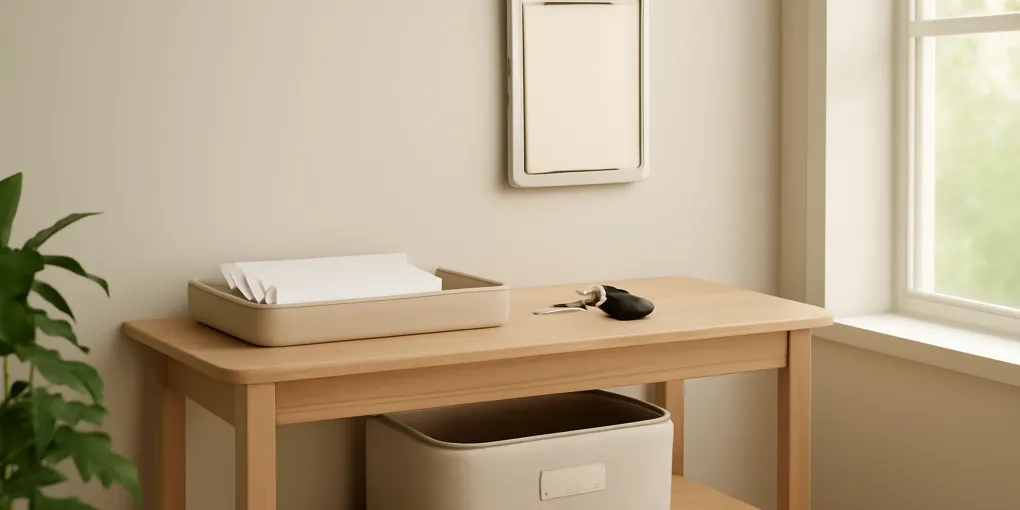
Start at the door, because entries create daily clutter. You need only five destinations:
| Item type | Destination | Reset rule |
|---|---|---|
| Keys and wallet | Tray or hook | Every arrival |
| Sorter with 2-3 slots | Same day for junk, weekly for action | |
| Shoes | Rack or boot tray | Same day |
| Returns | Labeled bin near exit | Weekly errand |
| Bags | One hook or basket | Nightly reset |
Keep the system physically small. If the mail sorter holds three months of paper, it is not an action system. It is storage for postponed decisions.
How to Use the Rule Without Over-Organizing
Do not create a labeled container for every object in the house. The one-touch rule works because the next action is obvious. Too many micro-categories increase search time and maintenance.
Use the rule for high-frequency clutter first:
- Entryway items.
- Mail and receipts.
- Laundry transitions.
- Dishes and cups.
- Bathroom products left on counters.
- Cables and chargers.
- Children’s school papers.
Then stop. A home does not need perfect compliance to improve. It needs fewer repeat decisions in the places where clutter returns every day.
Evidence-Informed Rules of Thumb
The research base does not prove that one specific decluttering rule works for everyone. It does support broader design principles: reduce friction, make cues visible, keep action steps specific, and avoid systems that overload working memory.
A good one-touch system has four traits:
- The item category is obvious.
- The storage location is close to the point of use.
- The container has a capacity limit.
- Exceptions have a named action zone.
If any of those are missing, the rule will feel like pressure instead of support.
How We Score Decluttering Rules
We use a G6-style composite score for decluttering advice so the article does not promote a rule just because it sounds simple. The weighting is 30/25/20/15/10: research fit 30%, evidence quality 25%, value 20%, user signals 15%, and transparency 10%.
Research fit asks whether the rule matches what is known about cues, habits, implementation intentions, and cognitive load. The one-touch rule scores well for repeatable actions with obvious homes: keys on a hook, dishes in the dishwasher, shoes on a rack, junk mail in recycling. It scores lower for ambiguous items because ambiguity creates a real decision cost.
Evidence quality looks at the strength of the underlying behavioral principles, not at whether a specific organizing phrase has been tested in a randomized home study. The strongest support is indirect: simple plans, visible cues, reduced friction, and specific next actions make habits easier to repeat. That evidence supports the one-touch rule as a design principle, not as a universal command.
Value considers time, money, and emotional cost. A rule that needs no product and can reduce repeat handling has high value. But value drops when the rule causes guilt, rushed decisions, hidden dumping, or conflict with other household members. A two-touch system can be more valuable if it preserves momentum without pretending every item can be finished immediately.
User signals come from common failure patterns: overflowing mail piles, mystery bins, rooms that look cleaner only because clutter moved behind a door, and systems that one person understands but the rest of the household ignores. Transparency means we state the limits clearly. This is not therapy, a treatment for executive dysfunction, or proof that everyone should handle possessions the same way.
When the Rule Backfires
The one-touch rule backfires when it is used for items with missing information. Insurance papers, tax letters, school forms, medical bills, and repair parts often need another step before they can be completed. Forcing an immediate decision can lead to bad filing, accidental disposal, or a new pile in a less visible place.
It also backfires when it ignores energy. A tired person may not have the capacity to finish a multi-step item at 9 p.m. A good home system should have a safe landing place for that reality. The goal is not to turn every moment into a productivity test. The goal is to prevent temporary items from becoming permanent clutter.
Finally, it backfires when there is no shared agreement. If one household member moves everything immediately and another needs visible reminders, the rule can feel like disappearance. In shared homes, label the destination and define the reset time so the system supports trust as well as tidiness.
A Better Test: One Easy Next Action
Instead of asking whether you can touch an item once, ask whether the next action is easy and visible. If the answer is yes, finish it now. If the answer is no, place it in a labeled action zone that has a scheduled reset.
This test keeps the useful part of the one-touch rule while removing the unrealistic part. It still reduces repeated handling, but it gives complicated items a controlled waiting place. That is often the difference between a system that works for one motivated afternoon and a system that survives a normal week.
A Seven-Day Test
Test the rule for one week in only one zone. Choose the entryway, kitchen counter, laundry handoff, or bathroom counter. Pick a small category that appears every day and give it one obvious destination. Then watch what happens without redesigning the whole house.
At the end of the week, ask three questions. Did the item land in the right place most days? Did anyone avoid the system because it was annoying? Did clutter move to a hidden backup pile? If the answer is yes to the first question and no to the second and third, the rule fits that category.
If the test fails, change the path before blaming the person. Move the hook closer, use an open tray instead of a lid, reduce the number of categories, or add a temporary action bin. The best rule is the one your household can repeat without negotiation.
Bottom Line
The one-touch rule is useful for simple items and daily resets. It is not realistic for every object, every day, or every household member. Use it as a design test: can this item be returned with one easy action? If yes, create that path. If not, create a small, labeled, scheduled action zone.
The best clutter systems are not the strictest. They are the ones that still work when you are tired.
Sources
- Gollwitzer, P. M. “Implementation intentions: Strong effects of simple plans.” American Psychologist, 1999. https://doi.org/10.1037/0003-066X.54.7.493
- Baumeister, R. F., Bratslavsky, E., Muraven, M., and Tice, D. M. “Ego depletion: Is the active self a limited resource?” Journal of Personality and Social Psychology, 1998. https://doi.org/10.1037/0022-3514.74.5.1252
- National Association of Professional Organizers / NAPO consumer organizing principles. https://www.napo.net/
Frequently Asked Questions
- The one-touch rule means handling an item once when possible: decide whether to put it away, act on it, file it, recycle it, or place it in a defined next-action spot instead of moving it from pile to pile.
- It can work for simple, low-risk items with obvious homes, but it fails when an item requires information, another person, or more time than the moment allows.
- Use a two-touch system: one touch to sort into a clearly labeled action zone, then one scheduled reset to finish the decision.