Garage Extension Cord Storage Safety Protocol
ProtocolQuick picks
Tornado 00525 Large Wall-Mount Utility Hooks
★ Top pickBayco KW-110 Cord Storage Reel
Wrap-It Storage Heavy-Duty Straps
A garage extension cord pile creates three different problems at once: you cannot find the right length, the cord gets damaged under tools or tires, and loose loops become a trip hazard near the door. The fix is not to wind every cord as tightly as possible. It is to store unplugged cords loosely, visibly, and away from the path where people carry groceries, bikes, or trash cans.
This protocol is for ordinary household extension cords used with yard tools, holiday lights, shop vacs, battery chargers, and occasional garage tasks. It does not replace manufacturer instructions or electrical codes. If a cord, outlet, or tool looks damaged, stop using it.
For related utility-zone decisions, see best garage utility carts and utility drawer battery storage protocol.
Quick picks for cord storage
- Several loose coils: Search Amazon for Tornado wall utility hooks. Use broad hooks when cords need to hang visibly without tight bends.
- One frequently used long cord: Search Amazon for Bayco KW-110 cord reels. Choose a reel only after checking the cord rating and instructions.
- Portable cords by job: Search Amazon for Wrap-It Storage heavy-duty cord straps. Straps work when cords move between the garage, driveway, and yard.
Fast setup summary
- Keep cords unplugged before storing them.
- Remove damaged cords instead of organizing them.
- Store daily-use cords on wall hooks or rated reels, not in a floor pile.
- Keep loops loose enough to prevent hard kinks.
- Label by length and use: indoor, outdoor, heavy-duty, holiday, or shop.
- Leave walking paths and vehicle paths clear.
Step 1: Separate cords by rating and job
Lay every cord out where you can see the plug, jacket, and length. Sort into groups before buying organizers.
Outdoor-rated cords should not be mixed blindly with indoor cords. Heavy-duty cords used for garage tools should not be treated like thin holiday-light cords. If a cord has a three-prong plug, do not store it with damaged ground pins or adapters that invite misuse later.
The Electrical Safety Foundation International advises replacing damaged cords, avoiding overloaded outlets, and using extension cords only as temporary wiring. That safety framing matters because a tidy cord wall is still a bad system if it makes the wrong cord easy to grab.
Step 2: Remove damaged cords before organizing
Inspect the full length of each cord under bright light before it goes on a hook. Look for cracked insulation, crushed sections from garage doors or tires, exposed conductors, burn marks, melted spots, loose plugs, missing ground pins, and tape repairs. Flex the first few inches near each plug because that is where garage cords often fail after being yanked around mowers, vacuums, or holiday lights.
Do not keep a questionable cord “just for something small.” Put damaged cords in a discard pile immediately so they do not return to the station. If you are not sure whether a cord is safe, replace it or ask a qualified electrician. A hook cannot turn a damaged cord into a safe cord.
Step 3: Choose the right storage method
Wall hooks
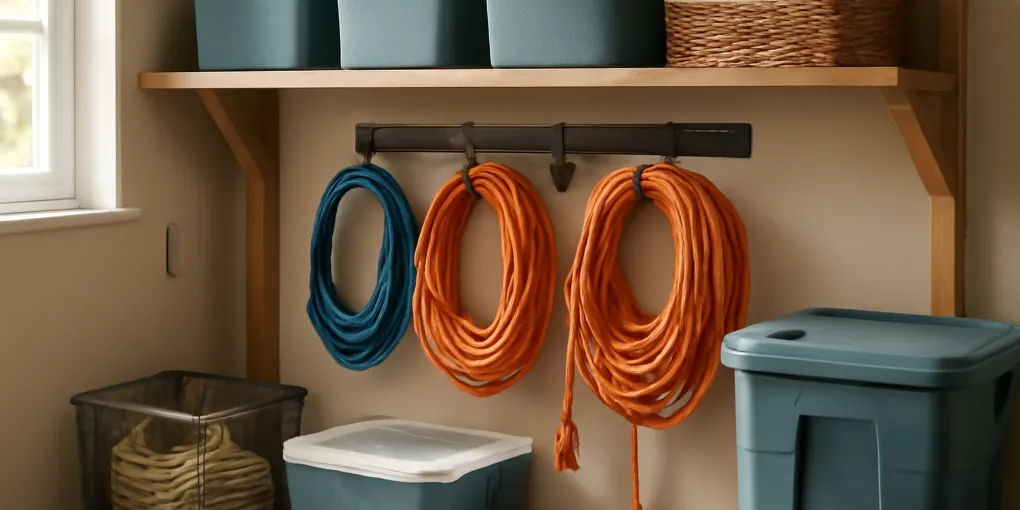
Wall hooks are the safest default for several cords because they keep loops visible and off the floor. Choose hooks with a broad curve rather than a sharp peg. A sharp peg concentrates stress in one small bend.
Shopping path: Search Amazon for Tornado wall utility hooks.
Cord reels
A reel works when one long cord is used often and the reel is rated for the environment and cord load. Read the instructions carefully. Some reels need the cord fully unwound during use for high-load equipment because heat can build up in tight coils.
Shopping path: Search Amazon for Bayco KW-110 cord reels.
Heavy-duty straps
Straps are good for individual cords that move between the garage, driveway, and yard. Choose wide reusable straps that hold a loose loop and leave room for a label.
Shopping path: Search Amazon for Wrap-It Storage heavy-duty extension cord straps.
Step 4: Pick a safe wall zone
The best wall zone is close to where cords are used, but not in the path of the car door, lawn mower, bikes, or trash bins. Keep cords away from water heaters, sharp garden tools, oily rags, and damp floor corners. Leave enough clearance that the lowest loop does not brush the floor or catch a handlebar; in many garages that means mounting the hook rail roughly shoulder-to-eye height for the adults who use it.
Mount hooks into studs or appropriate anchors, and use a broad hook that supports the coil instead of a nail-like peg. A 50-foot outdoor cord is heavy enough that several cords on one weak hook can pull out of drywall. If the hook flexes, the cord drags near a tire path, or a child can pull loops down into the walkway, move the station before adding labels.
Step 5: Coil without creating tight kinks
Use a loose over-under coil or broad loop. The goal is not a perfect circle; it is a cord that comes down without knots. Avoid tying knots in the cord itself. Use a strap around the coil, not the cord jacket as the tie.
Put the plug end where it can be seen. A hidden plug encourages pulling on the cable instead of lifting the coil down.
Step 6: Label the decision, not just the length
Labels should answer the question someone asks in a hurry. Better labels are “Outdoor 50 ft leaf blower,” “Indoor light-duty,” “Holiday lights only,” or “Shop vac 25 ft.” A plain “cord” label does not prevent misuse.
Color-coded tags can help, but they should not be the only system if multiple people use the garage. Write the actual rating or use case when it matters.
Step 7: Build a five-minute reset
A cord station fails when cords come back wet, dirty, tangled, or half-wrapped. Put a small towel, brush, or empty hook near the station so a damp outdoor cord can dry before final storage. Keep one open spot for the cord in use.
Once a month, glance at the hooks. If one hook is carrying every cord and another is empty, your categories are too fussy. Merge them into fewer, more obvious zones.
FAQ
Can extension cords be stored outside?
Outdoor-rated cords can be used outdoors as directed, but storage is usually better in a dry garage or shed away from sunlight, water, and sharp edges. Follow the cord label and manufacturer instructions.
Is a cord reel safer than a loose coil?
Not automatically. A reel can reduce floor clutter, but it must match the cord and use. For some loads, instructions require unwinding the cord during use to reduce heat buildup.
What should not go in the extension cord zone?
Do not store damaged cords, permanent wiring substitutes, adapters that defeat grounding, oily rags, sharp cutting tools, or children toys in the same station.
How high should garage cord hooks be?
Set hooks high enough to clear the floor and walking path, but low enough that the cord can be lifted down without pulling. Shoulder to eye height often works for adults; adjust for the household.
Sources
- Electrical Safety Foundation International, Extension Cord Safety Tips: https://www.esfi.org/extension-cord-safety-tips/
- Electrical Safety Foundation International, Home Electrical Safety: https://www.esfi.org/home-electrical-safety/