Garage Paint Can Storage Protocol: Keep Leftover Paint Findable Without Turning Shelves Into a Hazard
ProtocolQuick picks
| Product | Key Specs |
|---|---|
| See price on Amazon |
|
| See price on Amazon |
|
| See price on Amazon |
|
Product availability, certifications, and retailer details can change; check the current Amazon page before buying.
Leftover paint becomes garage clutter because every can feels potentially useful. The shelf fills with half-gallons from old rooms, dried sample pots, exterior stain, spray products, and cans with labels facing the wall. When a wall needs a touch-up, nobody knows which can still matches.
This protocol creates a small, inspectable paint zone. It is not a full garage makeover. If your bigger problem is shelf capacity, compare it with our best paint organizers and best garage shelving units. Here the goal is safer leftover-paint storage: fewer cans, better labels, and no mystery chemicals mixed into general clutter.
Product starting point
- Spill control: Search Amazon for shallow utility trays
- Small touch-ups: Search Amazon for paint touch-up jars and labels
- Shelf grouping: Search Amazon for heavy-duty garage shelf bins
Choose shallow and visible over deep and hidden. A paint bin that hides labels will recreate the same problem in a nicer container.
Step 1: Pull every can into one audit zone
Start by gathering interior paint, exterior paint, primer, stain, sample pots, and touch-up containers from shelves, laundry rooms, basements, and utility closets. Put them on a protected floor surface. Do not open questionable cans indoors for curiosity; deal with damaged, bulging, leaking, or badly rusted containers according to local household-hazard guidance.
Group the remaining cans by current surfaces: kitchen walls, bedrooms, trim, exterior, furniture, and unknown. The unknown group is the key. If nobody can name the room, color, date, or surface, the can is not a storage asset. It is deferred disposal.
Step 2: Check storage conditions before organizing
Paint manufacturers commonly advise keeping paint sealed and protected from freezing, extreme heat, and moisture. A detached garage may violate those conditions in winter or summer. If your garage freezes, bakes, or leaks, storing paint there may shorten shelf life and make future touch-ups unreliable.
Use the garage only if it stays reasonably dry and temperature-stable for the paint you are keeping. Otherwise, move a small number of current touch-up containers to a safer utility area that children and pets cannot access. Store cans upright, off the floor, and away from ignition sources or high-traffic zones where they can be kicked.
Step 3: Label for the future repair, not the original project
The label that matters is not just the color name. Record:
- Room or surface.
- Brand and color name.
- Sheen.
- Date opened.
- Where the paint was bought or matched.
- Whether the surface has since been repainted.
Write this on the lid and side because shelves hide one or the other. If you decant a small amount into a touch-up jar, copy the same information onto the jar. A beautiful touch-up bottle without sheen and room information is just a smaller mystery container.
Step 4: Keep only useful quantities
Most homes do not need to store a full gallon for every historical color. Keep enough for plausible touch-ups on surfaces that still exist. If a room was repainted, if the can is from a previous home, or if the paint no longer matches faded walls, remove it from the active zone.
A small touch-up jar can replace a bulky can when the wall color is still active but only a few nail holes are likely. Keep the original formula information if you decant. Do not mix different products into an unlabeled jar.
Step 5: Build the shelf zone
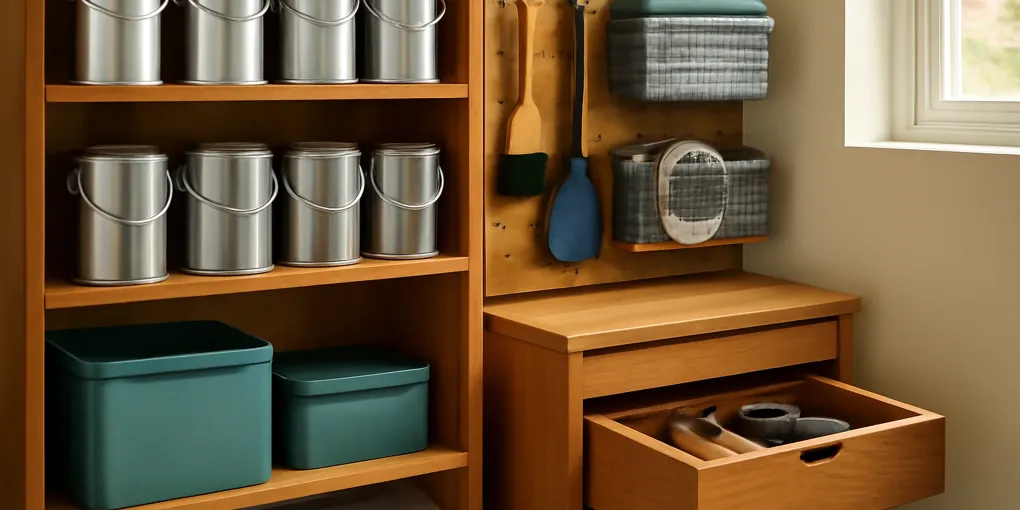
Use one sturdy shelf section, not scattered pockets around the garage. Put cans in a single layer inside a shallow tray or heavy-duty bin. The tray catches small drips, rust flakes, and lid residue while keeping every label visible.
Keep heavy gallons low enough to lift safely. Do not store them above shoulder height. Avoid stacking cans because stacked metal can dent lids, hide corrosion, and make the rear cans invisible.
Step 6: Set the twice-a-year exit check
Paint clutter grows when there is no exit rule. Use the start of spring and fall as the audit cue. Check for rust, swelling, odor, dried lids, missing labels, or rooms that were repainted. Move unwanted cans to your local paint recycling or household hazardous waste path.
PaintCare and local waste agencies often give state-specific instructions for leftover paint recycling. The organizing answer is not to keep questionable cans because disposal is annoying. It is to schedule the disposal errand when the shelf still has only a few decisions.
Paint storage fit matrix
| Setup choice | Best use | Avoid |
|---|---|---|
| Shallow tray | A few active cans with visible labels | Deep bins that hide old paint |
| Touch-up jars | Current wall colors with small repair needs | Unlabeled decanted paint |
| Low garage shelf | Heavy gallons that must be lifted safely | High shelves above shoulder level |
| Twice-yearly disposal box | Old colors waiting for local drop-off | Permanent “maybe later” piles |
How to evaluate the setup
| Factor | Weight | What matters |
|---|---|---|
| Label clarity | 30% | Room, color, sheen, and date are visible without opening cans. |
| Storage conditions | 25% | Paint is protected from extreme temperature, moisture, and impact. |
| Spill containment | 20% | Small leaks or lid residue stay in a washable tray. |
| Lift safety | 15% | Heavy cans are not stored high or stacked. |
| Exit path | 10% | Unwanted paint has a local disposal or recycling plan. |
Paint storage FAQ
What if I do not know whether paint is still good?
Do not keep it in the active zone as a mystery can. Check the manufacturer’s guidance and local disposal rules. If the can is rusted, leaking, unlabeled, frozen, or unrelated to a current surface, it should usually leave the shelf.
Can I store spray paint with wall paint?
Keep aerosol products in their own category and follow the label directions for temperature and storage. Do not bury aerosols behind gallons of wall paint where they cannot be inspected.
Is a clear bin better than a garage cabinet?
A clear tray or bin is better for active paint because labels stay visible. A cabinet can work if it is ventilated as appropriate, child-resistant, and not so deep that old cans disappear.
Sources and safety notes
- PaintCare, leftover paint storage, drop-off, and recycling information: https://www.paintcare.org/
- U.S. Environmental Protection Agency, household hazardous waste basics: https://www.epa.gov/hw/household-hazardous-waste-hhw
Frequently Asked Questions
- Only if the garage stays within the paint manufacturer's storage-temperature guidance and the cans remain sealed, labeled, upright, and away from ignition or child-access risks.
- Keep only colors that still match current rooms or exterior surfaces, plus a small touch-up amount. Old mystery cans should be evaluated for local disposal or recycling.
- Avoid stacking heavy cans. A single layer in a shallow tray or sturdy bin is easier to inspect and less likely to dent lids or hide leaks.