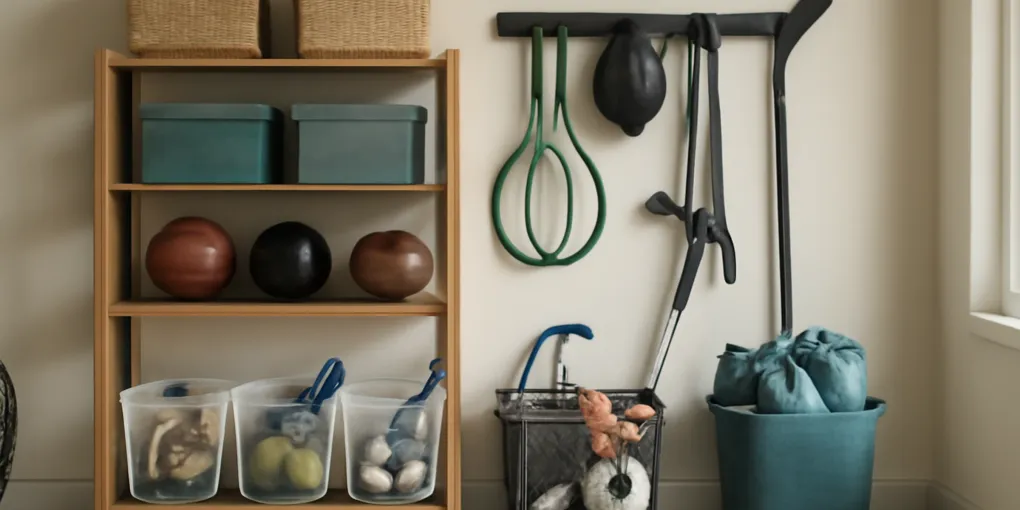
Garage Sports Equipment Storage System: Balls, Bats, Helmets, and Wet Gear
ProtocolA good garage sports equipment storage system is less about buying a matching set of containers and more about removing friction from the moment when clutter usually appears. If the same garage also holds weights, mats, and bands, use the home gym equipment storage guide to separate workout gear from balls, bats, and wet outdoor equipment. The most common failure pattern is predictable: an item is used, the return path is unclear, the container is too full, or the correct storage spot is inconvenient. Once that happens a few times, the home starts teaching everyone that the pile is the real storage location.
Quick picks
Use this as a shortcut to the products mentioned below; verify dimensions and mounting limits against your space before buying.
- clear storage bins: See current price on Amazon
- label maker tape: See current price on Amazon
- wall mounted organizer: See current price on Amazon
- heavy duty storage baskets: See current price on Amazon
This guide uses a practical evidence lens. Environmental psychology research links visual disorder with higher cognitive load and harder self-regulation for some people. A frequently cited study in Personality and Social Psychology Bulletin found that women who described their homes as cluttered or unfinished had flatter diurnal cortisol slopes than women who described restorative homes (Saxbe and Repetti, 2010). That does not mean a bin can fix stress. It does mean that visible unfinished decisions can matter, especially in high-traffic spaces.
The product links below point to current Amazon search results so readers can compare dimensions, reviews, sellers, prices, and return policies. Start with clear storage bins (See current price on Amazon), label maker tape (See current price on Amazon), wall mounted organizer (See current price on Amazon), and heavy duty storage baskets (See current price on Amazon) only after you know what problem you are solving.
Quick Recommendation
For most households, the best garage sports equipment storage system setup has four parts: a visible landing zone, a constrained container, one label per action, and a scheduled reset. If a product does not make one of those parts easier, it is decoration, not infrastructure.
Do not start by shopping for the largest organizer. Large storage often hides delayed decisions. A smaller system that overflows visibly is usually better because it tells you when the routine needs attention.
G6 Organization Score
| Factor | Weight | What earns a high score | Score |
|---|---|---|---|
| Research | 30% | Matches behavior, access frequency, and measured item volume | 8.4 |
| Evidence Quality | 25% | Uses safety guidance, ergonomic reach zones, and real dimensions | 8.1 |
| Value | 20% | Solves the failure point without excess product cost | 8.6 |
| User Signals | 15% | Easy for guests, children, or tired adults to use correctly | 8.0 |
| Transparency | 10% | Clear tradeoffs, no magic-product claims, visible maintenance needs | 9.0 |
| Composite | 100% | Weighted practical score | 8.4 |
The score favors systems that remain usable when the house is busy. A beautiful solution that requires perfect folding, careful stacking, or daily motivation should score lower than a plain container that gets used.
Step 1: Map the Clutter Path
Before buying anything, watch the path the items already take. Where do they enter? Where are they used? Where do they land when people are rushed? The landing spot is data, not failure.
Write down three things:
- The item categories that actually appear.
- The people who need to put them away.
- The moment when the current system breaks.
For garage sports equipment storage system, the answer is rarely “we need more storage.” More often it is “the return path competes with another task.” If a lid has to be opened, a stack has to be lifted, or a door has to be cleared, the item will usually stop at the nearest flat surface.
Step 2: Choose Containers by Job, Not Aesthetic
A storage product should be chosen for the job it performs. Clear bins help when people need to identify contents quickly. Opaque bins help when visual noise is the main problem. Open baskets help with daily items. Lidded bins help with dust, pests, and seasonal storage but add friction.
Use this decision table:
| Situation | Better choice | Why |
|---|---|---|
| Daily use | Open bin or shelf | Fast return path beats perfect concealment |
| Weekly use | Clear labeled bin | Visible contents reduce search time |
| Seasonal use | Lidded labeled tote | Protection matters more than instant access |
| Mixed users | Picture or action labels | Reduces interpretation errors |
| Tight space | Vertical or wall storage | Keeps floors and counters clear |
Measure before buying. Product photos often show empty containers from flattering angles. Real household items are bulky, irregular, dusty, wet, or handled by people who are in a hurry.
Step 3: Build in Capacity Limits
Capacity limits are the science part of a clutter system. Without limits, every container slowly becomes an archive. A useful limit answers the question: “How much can this category hold before we must decide?”
Set a limit that is smaller than the maximum physical space. Leave hand clearance, label visibility, and retrieval space. If you have to unpack half the container to reach one item, the container is too full even if the lid closes.
A simple rule is 80 percent full for frequently used categories and 90 percent full for seasonal categories. The remaining space is not wasted. It is the working room that makes the system maintainable.
Step 4: Put the Reset on the Calendar
No organizer eliminates maintenance. The realistic promise is a faster reset. Attach a five- to fifteen-minute reset to an existing cue: trash night, laundry folding, grocery restocking, Sunday planning, or the first school night of the week.
The reset script is simple:
- Remove items that do not belong.
- Return stray items to their labeled categories.
- Check whether any category is over capacity.
- Donate, recycle, relocate, or repair the overflow.
- Put the most-used items back at the front.
Implementation-intention research shows that specific cue-action plans can improve follow-through (Gollwitzer, 1999). In home terms, “reset this when I feel overwhelmed” is weak. “Reset this every Sunday after taking out recycling” is stronger.
Product Criteria That Matter
When comparing products for garage sports equipment storage system, prioritize:
- Exact exterior and interior dimensions.
- Weight capacity with a safety margin.
- Smooth edges and stable bases.
- Cleanability for dusty, wet, or greasy items.
- Visibility of labels from the normal viewing angle.
- Return-policy clarity, especially for oversized items.
Be skeptical of product sets that look efficient only when every item is identical. Homes contain odd sizes. A flexible system usually beats a tightly fitted system unless the category is highly standardized.
Safety and Ergonomics Notes
Use heavy items between knee and chest height when possible. The National Institute for Occupational Safety and Health discusses lifting risk factors such as load weight, reach distance, and frequency (NIOSH lifting equation resources). Home storage is not industrial work, but the same basic logic applies: heavy, awkward items should not require long reaches or overhead lifting.
Keep walkways clear. For garage, entry, and kitchen areas, floor clutter can become a trip hazard. The CDC notes that home fall risks include obstacles and poor lighting (CDC falls prevention). A storage system that creates a narrow pathway is not a win.
Common Mistakes
The first mistake is buying before sorting. You need to know the categories and the volume before the container can be right.
The second mistake is using labels that describe objects rather than actions. “Miscellaneous” is a warning sign. “Return,” “wash,” “donate,” “charge,” or “sports tonight” tells people what happens next.
The third mistake is hiding daily items behind too many steps. If the system requires opening a closet, sliding a bin, removing a lid, and restacking contents, the floor will win.
The fourth mistake is ignoring the person with the lowest tolerance for friction. Design for the tired adult, the distracted teenager, or the guest who has never seen the system before.
FAQ
What is the best first step for garage sports equipment storage system?
Start with a one-week audit. Do not reorganize immediately. Photograph the current pile, list what is actually in it, and note when it appears. Then build the system around that evidence.
Are clear bins always better for Garage Sports Equipment Storage System?
No. Clear bins are useful when identification is the problem. If visual noise is the problem, opaque bins with clear labels may work better. The best choice depends on whether you need visibility or calm.
How many labels should I use for Garage Sports Equipment Storage System?
Use as few as possible. Four to seven labels is usually enough for a small household zone. More labels can become a filing project that people avoid.
When should I replace the system for Garage Sports Equipment Storage System?
Replace it only after you can name the failure. If the issue is overflow, edit the category. If the issue is access, move the location. If the issue is visual noise, change the container style. Buying a bigger version of the same failed system usually delays the decision.
Internal Links
If this problem is mostly paper-related, compare the workflow in How to Build a Weekly Home Reset Station. If the problem is visual overstimulation, read Open Shelving vs Closed Cabinets before choosing open shelving.
Bottom Line
The best garage sports equipment storage system system is the one that makes the correct action the easiest action. Choose products after you understand the clutter path, keep capacity intentionally limited, and schedule the reset before the system looks broken. That combination is less glamorous than a makeover, but it is much more likely to survive normal household life.
Seven-Day Test Plan
Use a short test before making the system permanent. On day one, install only the minimum containers and labels. On days two through six, do not correct the system immediately when something lands outside it. Instead, write down why the item missed the target. Was the container full? Was the label vague? Was the opening too small? Was the storage spot too far from the real path? On day seven, adjust one variable at a time.
This testing period prevents a common organizing trap: blaming people for a design problem. If several people make the same mistake, the system is probably asking for too much precision. Move the container closer, make the label more action-oriented, or reduce the number of categories.
Budget Tiers
A low-cost version can use repurposed boxes, painter’s tape labels, and one existing shelf. This is often the best starting point because it proves the categories before money is spent. A midrange version can add clear bins, clip labels, and one wall-mounted or stackable component. A premium version may use matching modular pieces, but only after the layout has survived at least two weekly resets.
Do not judge value by how coordinated the products look on day one. Judge value by how little time the reset takes on day thirty. A plain bin that saves five minutes every week is better than a beautiful system that has to be rebuilt whenever life gets busy.
Maintenance Triggers
Review the system when any of these signals appears: the same item lands outside the zone three times, a container stays full after a reset, a label no longer matches the contents, or people avoid the area because retrieval feels annoying. These signals do not mean the project failed. They are feedback for the next small adjustment.
Garage-Sports-Specific Design Notes
Sports gear is chaotic because every category behaves differently. Balls roll under vehicles. Bats, sticks, and racquets tip when leaned in a corner. Helmets take up awkward volume and should not be crushed. Pads and gloves trap sweat. Cleats drop dirt. Water bottles leak. A single giant sports bin hides all of those problems and usually creates a bigger mess.
Use zones. Balls belong in a low mesh bin with front access so children can see and return them without climbing. Bats, hockey sticks, lacrosse sticks, and racquets need vertical slots or rubber-coated hooks parallel to the wall. Helmets belong on shelves or cubbies where they cannot fall from height or be buried under bags. Wet gear needs open airflow: mesh bags, boot trays, drying racks, and hooks. Small accessories need labeled bins for pumps, tape, mouthguard cases, goggles, wristbands, and spare laces.
Car clearance is the garage test. Park the vehicle where it actually sits, open doors and hatch, and mark the swing zone before mounting racks. Avoid freestanding racks where mirrors, doors, stroller paths, or grocery unloading will hit them. Deep storage near a parked car is often worse than wall rails and shallow hooks. Keep daily kid gear low enough to reach from the floor; store seasonal, heavy, sharp, or parent-only equipment higher.
Wet gear needs a protocol, not a tub. After practice, balls go to mesh, sticks to vertical storage, helmets to shelves, washable clothes to laundry, and pads or gloves to the drying zone. If it touched rain, mud, sweat, ice, or grass, it dries before enclosed storage. This rule prevents odor and makes missing equipment visible before game day.
A good garage sports system is specific, modular, and slightly rugged. It should survive a tired Tuesday night when kids are hungry, cleats are muddy, and the car still needs to fit.