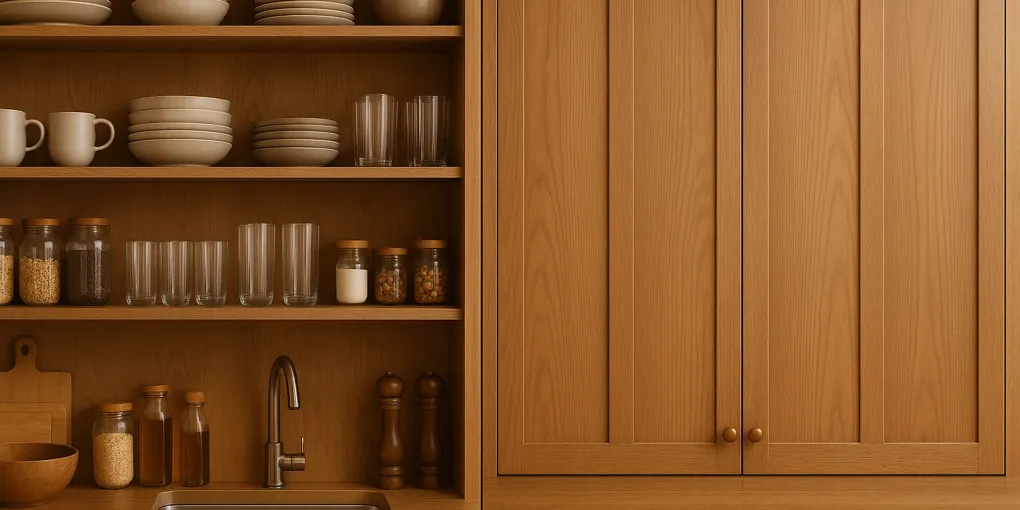
Open Shelving vs Closed Cabinets: Which Is Better for Kitchens? 2026
Buyer's GuideQuick picks
Product option
Quick picks
These are the products referenced in the guide; check dimensions, material, and installation limits before ordering.
- Recommended product: See current price on Amazon
- Recommended product: See current price on Amazon
- Recommended product: See current price on Amazon
- Recommended product: See current price on Amazon
Open Shelving vs Closed Cabinets: The Core Trade-Off
Few kitchen design decisions generate more passionate disagreement than the choice between open shelving and closed cabinets. Interior designers promote open shelves for their visual lightness and personality; practical homeowners defend closed cabinets for their order, cleanliness, and forgiveness. Both are right—but for different kitchens, different households, and different styles of cooking.
The behavioral science lens here focuses on what researchers call decision fatigue and visual complexity. Studies in cognitive load theory show that environments with higher visual complexity require more mental energy to process and navigate. Open kitchen shelves create ongoing visual decisions: What looks organized enough? What needs to be straightened? Is that out of place? These micro-decisions accumulate over the course of a day spent in the kitchen, contributing to a subtle but real increase in cognitive fatigue.
Closed cabinets, by contrast, create what psychologists call bounded storage—the visual complexity is contained and resolved. The kitchen looks organized regardless of what’s actually inside the cabinets. This cognitive relief is a meaningful benefit, particularly for families with children, heavy cooks who create significant kitchen chaos during meal prep, and anyone whose home doubles as a workspace.
On the other side, research on environmental aesthetics and motivation shows that beautiful, personally meaningful spaces increase time spent and enjoyment of activities within them. For food enthusiasts who genuinely love their kitchen, open shelving that displays beautiful dishes, plants, and cookbooks can transform the kitchen from a utilitarian workspace into a space that feels alive and inspiring—which has documented effects on cooking frequency and experimentation.
Open Shelving: What It Is and When It Wins
Open kitchen shelving removes cabinet doors entirely, presenting stored items to full view. It can be implemented through floating shelf installations, open-back cabinet frames, or simply removing existing cabinet doors. In new kitchen construction, open shelves are typically custom-built into the design.
The most compelling advantage of open shelving is accessibility. Reaching for a glass or plate requires no door opening, no searching for a handle, and no conscious decision about whether to open the right or left door. In a kitchen where you cook daily, this friction-free access is genuinely time-saving and pleasant. Research on kitchen workflow consistently identifies cabinet accessibility as a primary frustration point—open shelves eliminate the door as a friction layer.
Open shelves also create a sense of personalization that closed cabinets can’t match. A display of artisan ceramics, colorful mixing bowls, copper pots, and cookbooks communicates personality and aesthetic intention. For people who have invested in beautiful kitchen tools and serving pieces, open shelving makes those investments visible and meaningful rather than hidden behind doors.
The cost advantage of open shelving is significant in kitchen renovations. Removing upper cabinet doors or installing floating shelves instead of cabinet boxes costs substantially less than full upper cabinet installation. For budget-conscious kitchen updates, open shelving can dramatically refresh a kitchen’s look at a fraction of new cabinet costs.
The primary limitations are well-documented: open shelves collect grease, dust, and steam more aggressively than closed cabinets; they require that stored items are attractive and consistently organized; and they’re dramatically less forgiving of the ordinary mess of daily kitchen use.
Closed Cabinets: What They Are and When They Win
Standard kitchen cabinets with doors—whether shaker style, flat panel, or raised panel—provide enclosed storage that protects contents from kitchen environment while concealing the organizational state of what’s inside.
The defining advantage of closed cabinets is maintenance forgiveness. Real kitchens are messy. The dishes get washed and put away without artistic arrangement. The glasses get stored in imperfect stacks. The mixing bowls accumulate in a stack that’s functional but not photogenic. Closed cabinet doors contain all of this visual reality and present a clean, organized face to the kitchen regardless. This maintenance-free aesthetics is enormously valuable in households with children, multiple cooks, or simply less organizational energy.
Closed cabinets also provide better protection for stored items. Cabinet doors block grease vapor, cooking steam, and airborne particles that accumulate on open-shelf items during cooking. Dishes in closed cabinets stay cleaner between uses; open-shelf dishes require rinsing before use in active cooking kitchens, which adds steps that most cooks skip and most guests don’t know about.
For families with young children, closed cabinets near floor level are a safety feature as much as an organizational one. Cabinet locks on lower cabinets protect cleaning supplies and sharp tools. Closed cabinets above the counter also keep visual stimulation lower—a kitchen with many items on open display is more visually complex and potentially more distracting for children trying to focus in adjacent spaces.
Closed cabinets are also the default choice in rental kitchens and homes being prepared for sale. Buyers and renters expect closed upper cabinets; departing from this expectation requires that the execution be exceptional enough to overcome the difference from baseline expectations.
Head-to-Head Comparison
| Feature | Open Shelving | Closed Cabinets |
|---|---|---|
| Cost | Lower (no doors) | Higher (full cabinet) |
| Accessibility | Excellent | Good (requires door opening) |
| Visual complexity | Higher (items visible) | Lower (contents concealed) |
| Maintenance | High (dusting, grease) | Low (wipe doors) |
| Forgiveness of disorder | None | Complete |
| Best for | Design-forward kitchens, light cooking | Family kitchens, heavy cooking |
| Resale appeal | Variable | Broad appeal |
| Item protection | Minimal | Good |
When to Choose Open Shelving
Choose open shelving when aesthetics are a primary kitchen priority and you maintain organized, visually attractive storage. If your everyday dishes are beautiful, if you have cookbooks you display proudly, and if you’re the kind of cook who keeps their kitchen consistently tidy, open shelving rewards that discipline with a kitchen that looks genuinely designed.
Open shelving works best in small kitchens where the visual weight of upper cabinet doors makes the space feel enclosed and heavy. Removing upper cabinet doors or replacing them with floating shelves can make a small kitchen feel dramatically larger—one of the highest-impact low-cost kitchen changes available.
Consider open shelving when you’re doing a budget kitchen refresh. Removing existing upper cabinet doors costs nothing; installing floating shelves in their place costs $50–$200 in materials and a few hours of work. The visual impact is often comparable to a full kitchen renovation at a fraction of the cost.
Open shelving pairs best with frequent cooking schedules. When you cook daily and use the same dishes repeatedly, items never sit long enough to accumulate significant grease or dust. The accessibility benefit compounds when items cycle through the kitchen frequently.
Our best kitchen cabinet organizers guide includes organizer options for both open and closed cabinet configurations—useful for maximizing the usable space in either approach. For a comprehensive kitchen organization strategy, see our how to organize kitchen cabinets article.
When to Choose Closed Cabinets
Choose closed cabinets when your kitchen sees heavy, frequent use and organizational perfection isn’t realistic. If you cook multiple large meals weekly, have children contributing kitchen chaos, or simply don’t have the organizational energy to keep displayed items consistently attractive, closed cabinets are the sustainable choice.
Closed cabinets are essential when you store items that aren’t visually attractive. Cleaning supplies, economy-size pantry staples, plastic food storage containers, specialty appliances you use monthly rather than daily, and the general assortment of miscellaneous kitchen tools that accumulate over time all belong behind doors.
If you’re preparing to sell your home, closed cabinets in the kitchen are the safer choice. While open shelving appeals to some buyers, closed cabinets read as conventional kitchen design and avoid polarizing strong opinions. A kitchen with beautiful closed cabinetry appeals broadly; a kitchen with open shelving appeals specifically.
Choose closed cabinets when moisture and steam are significant factors. Kitchens that produce heavy steam—frequent pasta cooking, pressure cooker use, large batch canning—will damage items on open shelves over time and cause finish degradation on floating shelves. Closed cabinets protect both contents and cabinet interiors.
Households in climates with high ambient dust levels should strongly prefer closed cabinets. In high-dust regions or older homes with HVAC systems that circulate dust heavily, open-shelf items require constant wiping to remain ready to use—an ongoing maintenance burden that quickly outweighs aesthetic benefits.
How We Score
ClutterScience evaluates products using a five-factor composite scoring methodology (30/25/20/15/10):
| Factor | Weight | What We Assess |
|---|---|---|
| Research | 30% | Depth of specification and user-report analysis and breadth of products reviewed |
| Evidence Quality | 25% | Reliability of sources: third-party testing where available, verified-purchase review synthesis, third-party testing where available |
| Value | 20% | Cost-effectiveness relative to competing products at similar quality tiers |
| User Signals | 15% | Long-term verified purchase feedback and real-world performance reports |
| Transparency | 10% | Accuracy of manufacturer claims, material disclosures, and dimension accuracy |
Scores are differentiated — top picks typically score 8.5–9.5, mid-tier 7.0–8.4, and weak options below 7.0.
Product Recommendations
Best Open Shelving for Kitchens
Floating Shelves by Wallniture (Set of 2) $55–$80. These 24-inch solid pine floating shelves are ideal for kitchen installation. The hidden mounting system supports up to 50 lbs per shelf with stud mounting, and the natural wood grain adds warmth to any kitchen aesthetic. The set includes all mounting hardware and a level guide for precision installation.
| Criterion | Weight | Score |
|---|---|---|
| Capacity & Dimensions | 30% | 8.2/10 |
| Material Quality | 25% | 8.8/10 |
| Ease of Assembly & Use | 20% | 8.0/10 |
| Long-Term Value | 25% | 8.5/10 |
| Composite Score | 8.4/10 |
Ekby IKEA Kitchen Shelf System $25–$45 per shelf. IKEA’s Ekby range offers clean, minimal kitchen shelving that pairs well with modern and Scandinavian kitchen aesthetics. Laminate finish in white or birch wipes clean easily—critical in kitchen environments. Available in lengths from 19 to 47 inches. Pair with Ekby bracket hardware for the desired look.
| Criterion | Weight | Score |
|---|---|---|
| Capacity & Dimensions | 30% | 7.8/10 |
| Material Quality | 25% | 7.5/10 |
| Ease of Assembly & Use | 20% | 8.5/10 |
| Long-Term Value | 25% | 7.8/10 |
| Composite Score | 7.9/10 |
Best Closed Cabinet Organizers
Rev-A-Shelf 5WB-1527-CR Pull-Out Cabinet Organizer $75–$100. One of the most effective closed-cabinet upgrades available: a chrome pull-out basket organizer that mounts to the base of a standard lower cabinet. Transforms the back half of a base cabinet from dead storage into fully accessible organized space. The two-tier design doubles usable cabinet depth, which is the primary wasted space in most kitchens.
| Criterion | Weight | Score |
|---|---|---|
| Capacity & Dimensions | 30% | 9.5/10 |
| Material Quality | 25% | 9.0/10 |
| Ease of Assembly & Use | 20% | 7.5/10 |
| Long-Term Value | 25% | 9.2/10 |
| Composite Score | 9.0/10 |
Stackable Cabinet Shelf Organizer by Simple Houseware $16–$22. A simple wire shelf riser that doubles the vertical storage in any upper or lower cabinet. No installation required—place it on an existing shelf to add a second tier. Available in several widths to fit different cabinet dimensions. Chrome finish looks intentional rather than improvised. One of the highest ROI cabinet upgrades available.
| Criterion | Weight | Score |
|---|---|---|
| Capacity & Dimensions | 30% | 7.8/10 |
| Material Quality | 25% | 7.5/10 |
| Ease of Assembly & Use | 20% | 9.5/10 |
| Long-Term Value | 25% | 8.0/10 |
| Composite Score | 8.1/10 |
The Verdict
The open shelving vs closed cabinets debate doesn’t have a universal answer, and any guide claiming otherwise is ignoring the diversity of kitchens, households, and organizational styles.
Choose open shelving if your kitchen is small and visually heavy, if you have beautiful everyday dishes you want to display, if you cook frequently enough that items cycle through regularly, and if you have the organizational discipline to keep displayed items consistently presentable. The aesthetic payoff can be genuinely transformative.
Choose closed cabinets if you have children, cook frequently and messily, have a mix of attractive and unattractive items that need storage, or simply want a kitchen that looks organized without requiring ongoing visual maintenance. The maintenance forgiveness of closed cabinets is an underrated quality-of-life advantage.
For most kitchens, the optimal solution is a deliberate mix: open shelving for the items you’re proud of and use constantly, closed cabinets for everything else. This hybrid approach captures the aesthetic energy of open shelving without its practical vulnerabilities—and it’s the configuration professional kitchen designers consistently recommend when given the choice.
Frequently Asked Questions
- Yes. Open shelves remove the visual mass of cabinet doors and allow the eye to travel deeper into the space, making kitchens appear larger. This effect is most pronounced in small or narrow kitchens where closed cabinets create a visually heavy, enclosed feel.
- Yes. Open shelves collect grease, dust, and kitchen steam on both items and shelf surfaces. In a kitchen where daily cooking is heavy, open shelves require significantly more regular cleaning than closed cabinets where contents are protected.
- Absolutely, and this is the approach most kitchen designers recommend. Using open shelves for attractive, frequently used items while keeping closed cabinets for less photogenic everyday storage offers the aesthetic benefits of open shelving without its practical limitations.
- Open shelves can help or hurt resale depending on execution and buyer preferences. Well-organized open shelving in a styled kitchen photographs beautifully and appeals to design-conscious buyers. Disorganized open shelves or open shelving that replaces upper cabinets in an otherwise standard kitchen can concern practical buyers.
- Open kitchen shelves work best for items that are visually attractive and frequently used: everyday dishes, glasses, mugs, cookbooks, small appliances you use daily, and decorative items like plants and ceramics. Keep cleaning supplies, pantry staples, and unattractive but necessary items behind closed doors.