How to Organize Your Car Interior: A Step-by-Step System
ProtocolWhy Cars Get Disorganized (and How to Fix It Permanently)
Cars are hard to keep organized because they’re shared spaces with no designated homes for most items that enter them. Sunglasses, receipts, charging cables, snacks, sports gear, grocery bags — all of it lands in the nearest available surface and stays there. Unlike a kitchen or closet, there’s no obvious structural motivation to return things to a specific place.
The solution is a zone-based system: divide the car into functional areas, give every zone a defined purpose, and give every regularly used item a specific home within that zone. When the system is designed correctly, maintaining it requires 5 minutes per week — not a Sunday afternoon of clearing out bags and receipts.
This guide walks through the zones, the organizational tools that work in each, and the maintenance habits that prevent accumulation from returning.
How We Evaluate Products in This Guide
ClutterScience uses a five-factor composite scoring methodology (30/25/20/15/10) when recommending organizational tools and products:
| Factor | Weight | What We Assess |
|---|---|---|
| Research | 30% | Depth of product evaluation and real-world functional testing |
| Evidence Quality | 25% | Reliability of sources: specification data, verified reviews, expert consensus |
| Value | 20% | Cost-effectiveness relative to competing products at similar quality tiers |
| User Signals | 15% | Long-term verified purchase feedback and real-world performance reports |
| Transparency | 10% | Accuracy of manufacturer claims, material disclosures, compatibility accuracy |
Step 1 — Start With a Full Clear-Out
Before establishing any system, remove everything from the car. Everything — not just the obvious clutter. Check under seats, in all storage pockets, in the glove compartment, and in every cup holder.
Sort what you remove into three categories:
Permanently in the car: Items that belong in the car and will return — emergency kit, registration and insurance documents, car-specific tools (ice scraper, tire gauge), reusable grocery bags.
Regularly travels with you: Items that move between car and home regularly — charging cable, sunglasses, gym bag, work bag.
Accumulated clutter: Everything else — receipts, water bottles, forgotten items, single-use bags, trash.
The permanently-in-the-car category is your inventory for this system. Every item in that category needs a designated zone. Everything else needs a process (specific pocket for charging cable) or removal (trash, recycling, or return to where it belongs).
Step 2 — Set Up the Front Cab Zone
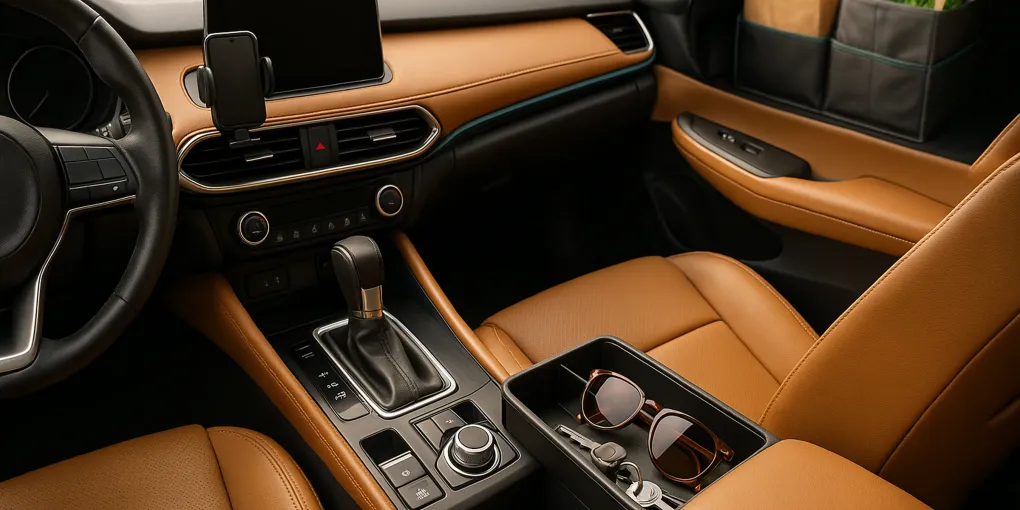
The front cab includes the driver and passenger areas: cup holders, the center console, the glove compartment, door pockets, and the space behind the front seats.
Cup holders should hold exclusively what they’re designed for — drinks and phone holders. A silicone cup holder insert ($8–$12) keeps cup holders clean and makes them easier to wipe down. A phone mount attached to the dash vent or windshield gives the phone a permanent home that’s both accessible and safe.
Center console is the highest-turnover zone in the car. Designate it by function:
- Front tray or organizer insert: Keys, sunglasses, lip balm, hand sanitizer, and anything touched every day. A center console organizer insert ($15–$25) that fits the specific console dimensions creates compartments within the existing space.
- Rear section or armrest bin: Backup charging cables, car-specific documents, and items accessed weekly but not daily.
Glove compartment is for vehicle documents only: registration, insurance card, owner’s manual. Adding anything else increases the retrieval friction for the documents you actually need in emergencies.
Door pockets are best for item-specific uses: driver’s door for a window scraper or umbrella, passenger door for a small reusable bag with kids’ items or a car first-aid kit.
Recommended products for front cab:
- Console organizer insert: a model specific to your car make and model is ideal; universal console organizers ($15–$25) fit most vehicles → Shop center console organizers on Amazon
- Vent phone mount ($10–$20 for a quality magnetic or clamp mount) → Shop car phone mounts on Amazon
Step 3 — Set Up the Back Seat Zone
If you regularly carry passengers (especially children), the back seat needs its own organization structure. If the back seat is primarily cargo space, this zone is simpler — a back seat protector and a collapsible bin are sufficient.
For cars with children:
A back seat organizer that attaches to the front seat headrests is the most practical solution. These kickmat-style organizers ($25–$45) include storage pockets for tablets, snacks, and small toys, plus a scuff-protecting panel for the front seat back. The Lusso Gear and Lebogner models are consistently highest-rated by verified purchasers for pocket organization and durability.
Key features to look for in a back seat organizer:
- Clear tablet pocket (9–12” size covers most tablets)
- Multiple small pockets (snacks, crayons, wipes)
- Kickmat panel to protect front seat upholstery
- Attachment straps that don’t loosen with use
For back seat cargo use:
A back seat cargo net or a collapsible bin on the floor behind the passenger seat prevents items from sliding under seats. A back seat cover protects upholstery from wet gear, sports equipment, or pets.
Recommended products for back seat:
- Kickmat back seat organizer: Shop back seat organizers on Amazon
Step 4 — Set Up the Trunk Zone
The trunk is the highest-capacity zone in the car and the most prone to accumulation. A zone-based trunk system divides the space by use frequency:
Permanent zone (always in the trunk):
- Emergency kit in a dedicated bag or compartment (see car emergency kit list in the FAQ below)
- Jumper cables or lithium jump starter
- Reusable grocery bags in a designated corner or hook
- Collapsible cargo carrier for oversized loads
Variable zone (loaded and unloaded with each trip):
- Groceries and shopping
- Sports gear, gym bags, outdoor equipment
A collapsible trunk organizer ($20–$45) is the most practical tool for creating defined zones within the trunk space. Look for:
- Three or more distinct compartments of different heights
- Nonslip base that stays put in corners
- Collapsible sides for trips where the full trunk is needed
- Rigid walls that don’t collapse when a compartment is partially filled
The trunk organizer holds the permanent zone contents in consistent positions so you always know where the emergency kit is and where groceries belong when you return from the store.
Recommended products for trunk:
- Collapsible trunk organizer with dividers: Shop trunk organizers on Amazon
- Cargo net (for preventing lateral movement in a non-compartmentalized trunk): Shop cargo nets on Amazon
Step 5 — Address the Trash Problem
A car trash can is the single item most consistently associated with maintained car cleanliness in verified purchaser reviews. Without a designated trash location, every receipt, wrapper, and tissue becomes a surface-clutter event.
The best car trash solutions:
- Clip-on headrest trash bins ($8–$15): Small bins that clip to the headrest in the back seat — best for cars with children generating back seat trash
- Console-mounted soft bags ($8–$12): Velcro or hang-mounted small bags that sit between the front seats — less visible but easily accessed by the driver
Replace the liner (a small plastic bag) during every weekly reset. The bin needs to be small enough that it fills quickly and gets emptied at every fill — a large bin just becomes a larger clutter accumulation point.
Recommended products:
- Car trash can: Shop car trash cans on Amazon
Step 6 — Create a Maintenance Routine
The system will only persist with a minimal maintenance routine. Two habits maintain a car organization system indefinitely:
Exit trigger (every trip): Take out everything you brought in. Phone, bags, coffee cup, groceries — nothing stays in the car unless it permanently lives there. This single habit eliminates 80% of car accumulation. Behavioral science research on habit formation (Wood W and Neal DT, 2007, Psychological Review, DOI: 10.1037/0033-295X.114.4.843) confirms that exit-triggered behaviors — tied to the physical act of leaving a space — have higher completion rates than intention-based schedules.
Weekly 5-minute reset: Once per week, take everything out that migrated in, empty the trash bin, and restore everything to its zone. This takes under 5 minutes when the underlying system is in place. Without it, the weekly accumulation compounds into the monthly car-clearing project everyone dreads.
Monthly deep check: Once per month, verify emergency kit contents (replace expired items, recharge the jump starter bank), check tire pressure gauge function, and wipe interior surfaces. Schedule it with a calendar trigger rather than relying on memory.
Car Organization by Use Type
If you commute solo: Minimize the front cab. A phone mount, a console insert for daily items, and a car trash bag are sufficient. The back seat and trunk need minimal organization if they’re not regularly used.
If you carpool or carry passengers: Prioritize back seat organization — everyone’s things need designated space to prevent constant reshuffling.
If you have children: Back seat organizer and rear kick mat are non-negotiable. Add a small snack bag with sealed containers in the back seat organizer to prevent loose food from accumulating.
If you do weekly grocery runs: A collapsible trunk organizer with a designated grocery zone and a reusable bag hook or organizer eliminates the grocery bag chaos that typifies most unorganized trunks.
If you use your car for outdoor activities: A waterproof trunk liner ($20–$40) protects the cargo area from wet gear, mud, and equipment. Pair with a vehicle-specific fitted liner for the cleanest fit.
What Not to Do
Don’t use bags as organizers. Bags can hold things, but they don’t create zones — everything ends up in one bag, and the bag becomes the clutter unit. Use compartmentalized organizers with defined spaces for defined categories.
Don’t store non-car items in the glove compartment. Sunglasses, gum, and hand lotion in the glove compartment push the registration and insurance to the back — exactly when you need them most, they’re buried. The glove compartment is a legal document storage area, not a general overflow bin.
Don’t skip the trash solution. Every car without a designated trash location accumulates trash on surfaces. A $10 clip-on trash bin eliminates this problem permanently.
Don’t create a system more complex than daily life. If returning an item to its home requires more steps than just leaving it on the seat, it won’t happen. Every home you assign to an item should be closer than the nearest flat surface.
Frequently Asked Questions
What is the best way to organize a car trunk?
A collapsible trunk organizer with upright dividers is the most effective car trunk organization system for most vehicles. Look for a model with at least 3 compartments (tall compartment for reusable bags and bottles, medium compartment for emergency kit, wide flat base compartment for groceries and gear). Nonslip base is essential — organizers without it migrate to one side in turns. The AmazonBasics and Lifewit collapsible trunk organizers are consistently top-rated by verified purchasers for stability and compartment utility.
How do I stop stuff from accumulating in my car?
Car clutter accumulates when there’s no designated home for incoming items and no regular removal trigger. Two behavioral changes prevent accumulation more reliably than any organizer: (1) a ‘nothing leaves the car unless it belongs in the car’ policy enforced at every trip exit — take out everything you brought in; (2) a weekly 5-minute reset where you remove all items that migrated in during the week. Behavioral science research on habit formation (Wood W and Neal DT, 2007) confirms that exit-triggered habits are more durable than intention-based cleanup schedules.
What should always be in a car emergency kit?
A complete car emergency kit includes: jumper cables or a jump starter bank, a reflective triangle or road flares, a basic first aid kit, a tire pressure gauge, a flashlight, an emergency blanket, water (two 16 oz bottles minimum), and a USB charging cable. Store the emergency kit in a dedicated bag in the trunk so it’s always accessible and never displaced by groceries.
What are the best car back seat organizers for kids?
Kickmat back seat organizers that attach to the front seat headrests and include storage pockets are the most practical solution for cars with children. Look for a model with a clear tablet pocket, smaller pockets for snacks and small toys, and a kickmat panel that protects the back of the front seat from shoe scuffs. The Lusso Gear and Lebogner models are consistently top-rated by verified purchasers for build quality and storage organization.
How often should you clean out and reorganize your car?
A full car reset is realistically a monthly task for most households. The more practical cadence is a weekly 5-minute exit check (remove anything that doesn’t belong permanently in the car) and a seasonal deep clean (spring/fall) that includes clearing the trunk, wiping all surfaces, and replacing expired emergency kit items. Keeping a small trash liner eliminates the primary driver of interior clutter between resets.
Bottom Line
A car organization system works when it’s designed around actual use — not around what looks organized on Instagram. Zone the space (front cab, back seat, trunk), give every permanently-in-the-car item a specific home, solve the trash problem with a dedicated bin, and establish a weekly exit-trigger habit.
The result isn’t a car that never gets used — it’s a car where everyday use doesn’t accumulate into a monthly clearing project.
Frequently Asked Questions
- A collapsible trunk organizer with upright dividers is the most effective car trunk organization system for most vehicles. Look for a model with at least 3 compartments (tall compartment for reusable bags and bottles, medium compartment for emergency kit, wide flat base compartment for groceries and gear). Nonslip base is essential — organizers without it migrate to one side in turns. The AmazonBasics and Lifewit collapsible trunk organizers are consistently top-rated by verified purchasers for stability and compartment utility.
- Car clutter accumulates when there's no designated home for incoming items and no regular removal trigger. Two behavioral changes prevent accumulation more reliably than any organizer: (1) a 'nothing leaves the car unless it belongs in the car' policy enforced at every trip exit — take out everything you brought in; (2) a weekly 5-minute reset where you remove all items that migrated in during the week. Behavioral science research on habit formation (Wood W and Neal DT, 2007) confirms that exit-triggered habits are more durable than intention-based cleanup schedules.
- A complete car emergency kit includes: jumper cables or a jump starter bank (lithium jump starters like the NOCO Boost Plus work without another car), a reflective triangle or road flares, a basic first aid kit (bandages, antiseptic wipes, gauze, pain reliever), a tire pressure gauge, a flashlight with fresh batteries or a hand-crank flashlight, an emergency blanket, water (two 16 oz bottles minimum), and a USB charging cable for your phone. Store the emergency kit in a dedicated bag or compartment in the trunk so it's always accessible and never displaced by groceries.
- Kickmat back seat organizers (models that attach to the front seat headrests and include storage pockets) are the most practical solution for cars with children. Look for a model with a clear tablet pocket (for screen entertainment), smaller pockets for snacks and small toys, and a kickmat panel that protects the back of the front seat from shoe scuffs. The Lusso Gear and Lebogner models are consistently top-rated by verified purchasers in this category for build quality and storage organization. Pair with a small collapsible bin on the floor behind the front passenger seat for loose items.
- A full car reset — removing everything, wiping surfaces, and restoring storage zones — is realistically a monthly task for most households. The more practical cadence is a weekly 5-minute exit check (remove anything that doesn't belong permanently in the car) and a seasonal deep clean (spring/fall) that includes clearing the trunk, wiping all surfaces, and replacing expired emergency kit items. Keeping a small trash liner (specifically designed car trash cans with a clip attachment) eliminates the primary driver of interior clutter between resets.