How to Organize a Coat Closet 2026
Buyer's GuideSimple Houseware Over Door Organizer
Best door storageBest for: Gloves, hats, umbrellas, and small entry extras
Quick picks
| Product | Key Specs | Pros / Cons |
|---|---|---|
| See price on Amazon |
|
|
| See price on Amazon |
|
|
| See price on Amazon |
|
|
Product availability, certifications, and retailer details can change; check the current Amazon page before buying.
Quick product shortlist
Use this shortlist to choose a product style before you measure. The links are named product or brand searches so you can compare current dimensions, finishes, prices, and return terms before buying.
- Best door storage: Simple Houseware Over Door Organizer (Search Amazon for Simple Houseware over door organizer closet) for gloves, hats, umbrellas, and small entry extras. Watch-out: door must still close freely.
- Best floor reset: SONGMICS Shoe Bench With Rack (Search Amazon for SONGMICS shoe bench with rack) for closets that also handle daily shoes and bags. Watch-out: measure door swing and walking clearance.
- Best soft shelf upgrade: Whitmor Hanging Closet Shelves (Search Amazon for Whitmor hanging closet shelves) for hats, folded scarves, and light seasonal accessories. Watch-out: needs enough rod width and height.
Quick picks
These are the products referenced in the guide; check dimensions, material, and installation limits before ordering.
- Recommended product: See current price on Amazon
- Recommended product: See current price on Amazon
- Recommended product: See current price on Amazon
The Coat Closet as a Household Chokepoint
The coat closet sits at one of the most psychologically significant locations in any home: the threshold. It is where every person in the household transitions between the outside world and the domestic environment, usually under time pressure. The morning rush to get out the door, the after-school avalanche of backpacks and jackets, the visitor who needs somewhere to hang their coat — these all converge on this one small space.
When a coat closet is disorganized, the consequences ripple outward. People are late because they cannot find their keys, which ended up in a coat pocket buried under five other coats. Jackets pile on chairs and doorknobs instead of being hung up because opening the closet reveals a tangle of items too dense to navigate quickly. Children default to dropping their coats on the floor because the closet is too complicated to engage with under the cognitive load of after-school exhaustion.
Environmental design research shows that people choose behaviors based on the path of least resistance. A coat closet that is easy to use — one where hanging up a coat requires a single effortless motion, where any household member can find any item in under ten seconds, where daily-use items are front and center and seasonal items are stowed away — directly produces better household habits without requiring additional willpower.
This guide covers the complete process of coat closet organization: the initial declutter, the zone design that accommodates all household members, the products that make the system work, and the seasonal rotation habits that prevent the closet from accumulating clutter over time. For broader entryway organization, see our guides on best entryway organizers and best closet organization systems.
Step 1: Empty and Declutter Completely
Begin by removing every item from the coat closet. This includes not just coats and jackets but the shoes on the floor, the hats and gloves on the shelf, the mystery bag that has been in the back corner for two years, the umbrellas, the sports equipment that migrated in, and anything else that has been stored there.
Coat closets are notorious for accumulating items that have no logical claim to the space. Because the closet is near the front door, items brought into the house land there first and often never move. A thorough declutter begins with this question: does this item belong in an entryway closet, or was it just convenient?
Sort every item into four groups: keep in the coat closet, relocate to another location in the home, donate or sell, and discard. For the keep pile, apply a seasonal lens: coats and accessories that are actively in rotation belong in the main accessible area. Seasonal items that are not in active rotation — heavy winter coats in July, for example — should be relocated to longer-term seasonal storage.
For coats specifically, assess each one: Does it still fit the person it belongs to? Is it in wearable condition? Has it been worn in the past two years? Coats that fail this assessment should be donated. A functional coat closet cannot be built in a space that is overwhelmed with coats no one wears.
Wipe down all interior surfaces while the closet is empty. Vacuum the floor, dust the shelves, and wipe the rod. A clean starting point reinforces the psychological reset that a thorough reorganization represents.
Step 2: Design the Zone System
An effective coat closet zone system accounts for three variables simultaneously: who uses what (household member sections), what is used when (current-season versus seasonal storage), and what is used how often (daily access versus occasional retrieval).
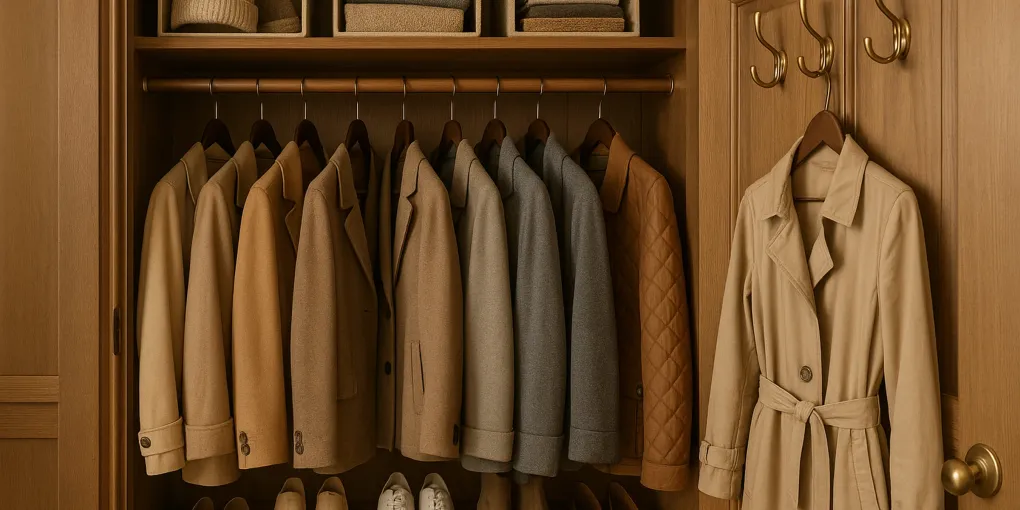
Main hanging rod: This is the highest-priority space and should be reserved for outerwear in active rotation. Divide the rod into sections — one per household member, or by frequency of use if the household is large. Adults’ sections typically need more linear rod space (wider coats); children’s sections need less width but may benefit from a lowered secondary rod at their reach height.
Upper shelves: Hats, scarves, gloves, and other accessories live on the upper shelf. Bins or baskets with category labels (one per household member, or one per category type) keep accessories from becoming a jumbled pile. The upper shelf is also a good location for less-frequently accessed items: spare umbrellas, sports accessories used seasonally, travel bags.
Floor space: A shoe rack on the floor of a coat closet dramatically improves household organization at the front door. At minimum, store the shoes that are worn daily — one or two pairs per household member. Bulky sports shoes, boots not in current season, and spare footwear should live in a dedicated shoe storage location rather than the coat closet floor.
Door: The inside of the coat closet door is consistently underutilized. An over-door organizer with hooks, pockets, or shelves can add meaningful storage for small items: keys, sunglasses, mail, daily-carry items, and accessories. This is particularly valuable in smaller coat closets where every inch counts.
Write out the zone plan before restocking. Knowing where each category goes before you start loading prevents items from being placed by default in the first available space rather than the logical space.
Step 3: Optimize the Rod and Shelf Configuration
Standard closet configurations — a single rod at the top and a single shelf above it — are rarely optimal for how coat closets actually function. Most coat closets have room for a more efficient configuration that meaningfully increases usable capacity.
Double-hang sections: For a household with multiple family members, a double-hang section (upper rod and lower rod) maximizes the number of items that can be hung. Shorter items — children’s coats, jackets, vests — only use half the vertical height under a full-length rod, wasting the space below. Adding a lower rod below for these items doubles hanging capacity in that section.
Shelf dividers: The upper shelf of a coat closet typically stretches the full width of the space. Without dividers, items from one household member’s section spill into another’s, and folded items collapse into each other. Shelf dividers create visual and physical category boundaries that significantly improve daily usability.
Adjustable shelving: If your coat closet has fixed shelving, consider whether the current configuration truly matches your needs. Adding an extra shelf between the existing shelf and the ceiling, for example, can create space for bins holding seasonal items, bags, and accessories.
Door hooks: The most accessible door upgrade is a set of over-door hooks. These are instantly useful for daily coats that would otherwise end up on chairs, doorknobs, and banisters — the informal coat storage that most households default to when the closet feels too full or too difficult to use.
Measure the closet before purchasing any organizers. A systematic measurement — width, depth, height, rod position, shelf position — takes five minutes and prevents purchasing products that do not fit.
Step 4: Implement Seasonal Rotation
A coat closet that tries to hold the entire household’s outerwear year-round will always feel crowded and disorganized. The solution is seasonal rotation: storing out-of-season items elsewhere and maintaining a lean, manageable in-season collection in the main closet.
Twice per year — as seasons change — spend about 30 minutes rotating the coat closet. In spring: move heavy winter coats, thick scarves, gloves, and winter boots to seasonal storage (vacuum storage bags, garment bags in a bedroom closet, or bins in a basement or attic). Bring forward lighter spring and fall coats, rain gear, and transitional accessories.
In autumn: reverse the process. Retrieve winter gear from storage and assess it before loading it into the coat closet: does it still fit? Is it in good condition? This is the moment to donate items before they reenter the active closet.
The behavioral science rationale for seasonal rotation is simple: a coat closet that contains only items in current rotation requires less cognitive processing to navigate. Fewer items means less decision fatigue, faster retrieval, and higher compliance with the hang-it-up habit that keeps the closet functional day to day.
Keep seasonal storage organized and labeled. A vacuum storage bag labeled “Winter Coats — Adults” and another labeled “Winter Accessories — Kids” takes five minutes to create and saves significant time when the seasonal swap comes around.
Step 5: Assign Responsibilities and Build the Habit
An organized coat closet only stays organized if every household member participates in maintaining it. The most effective way to achieve this is to make the system so intuitive and low-friction that the default behavior — returning an item to its correct location — requires less effort than the alternative.
For children specifically, the coat closet hook height matters enormously. If the hook or rod section assigned to a child is too high to reach, they will not use it. A low-level hook on the door or wall at child height, or a lower rod section, dramatically improves compliance with the hang-it-up habit. Behavioral research on children’s household routines consistently shows that physical accessibility is the primary driver of whether habits form or fail.
Create a simple rule for the coat closet: at the end of each day, anything that has migrated to a doorknob, chair, or banister goes back to the coat closet. Enforce this gently and consistently, especially in the first few weeks after the reorganization. It typically takes three to four weeks for the new system to feel like the default, at which point maintenance becomes largely automatic.
A weekly two-minute check — pulling anything that has ended up on the floor back to its spot, returning accessories to their bins — is sufficient to keep the system functional between seasonal rotations.
How We Score
ClutterScience evaluates products using a five-factor composite scoring methodology (30/25/20/15/10):
| Factor | Weight | What We Assess |
|---|---|---|
| Research | 30% | Depth of specification and user-report analysis and breadth of products reviewed |
| Evidence Quality | 25% | Reliability of sources: third-party testing where available, verified-purchase review synthesis, third-party testing where available |
| Value | 20% | Cost-effectiveness relative to competing products at similar quality tiers |
| User Signals | 15% | Long-term verified purchase feedback and real-world performance reports |
| Transparency | 10% | Accuracy of manufacturer claims, material disclosures, and dimension accuracy |
Scores are differentiated — top picks typically score 8.5–9.5, mid-tier 7.0–8.4, and weak options below 7.0.
Product Recommendations
For coat closet organization, these products deliver the best results:
Utopia Home Velvet Hangers (50 Pack)
Best for: Maximizing hanging rod capacity for coats and jackets $16–22. Amazon verified purchasers consistently note that switching from bulky plastic hangers doubles the number of items that fit on the rod, and the non-slip surface prevents coats from falling without requiring additional clips.
| Criterion | Weight | Score |
|---|---|---|
| Capacity & Dimensions | 30% | 9.3/10 |
| Material Quality | 25% | 8.8/10 |
| Ease of Assembly & Use | 20% | 9.5/10 |
| Long-Term Value | 25% | 8.9/10 |
| Composite Score | 9.1/10 |
Simple Houseware Over-Door Hook Organizer
Best for: Adding accessible hooks to the coat closet door without drilling $18–24. Purchasers highlight that the steel construction holds heavy coats, bags, and backpacks without bending, and the over-door mount installs and removes in under a minute with no tools.
| Criterion | Weight | Score |
|---|---|---|
| Capacity & Dimensions | 30% | 8.8/10 |
| Material Quality | 25% | 9.0/10 |
| Ease of Assembly & Use | 20% | 9.4/10 |
| Long-Term Value | 25% | 8.8/10 |
| Composite Score | 9.0/10 |
SpaceAid Bamboo Shelf Dividers for Closets
Best for: Dividing upper shelf space into per-member zones for hats and accessories $22–28. Verified buyers report that the spring-tension mounting requires no hardware and holds firmly through years of daily use, while the bamboo construction provides a more premium aesthetic than plastic alternatives.
| Criterion | Weight | Score |
|---|---|---|
| Capacity & Dimensions | 30% | 8.4/10 |
| Material Quality | 25% | 9.1/10 |
| Ease of Assembly & Use | 20% | 8.8/10 |
| Long-Term Value | 25% | 8.9/10 |
| Composite Score | 8.8/10 |
Maintenance: Keeping Your Coat Closet Functional All Year
The coat closet is one of the highest-traffic organizational spaces in any home, which means it requires both robust daily habits and a reliable seasonal maintenance system. Daily habits center on the one-motion return: every coat, jacket, bag, and accessory has a designated spot, and returning an item to that spot should require no more thought or effort than dropping it on a chair.
Seasonal rotation — twice per year, at the change of seasons — is the structural maintenance event that prevents the coat closet from gradually filling beyond its functional capacity. Mark the seasonal rotation dates in your calendar now. Thirty minutes twice a year is all it takes to keep the system appropriately lean.
Involve children in both the initial setup and the ongoing maintenance. When children help decide where their section is and which bin holds their gloves, they develop ownership over the system that translates into more consistent compliance. A child who helped create the system is a child who uses it — this is a well-documented principle from research on intrinsic motivation and ownership psychology.
Periodically reassess the coat closet configuration as household needs change. A young family’s closet needs shift significantly as children grow, as household size changes, and as seasonal gear accumulates or is donated. A coat closet that worked perfectly three years ago may need a reconfiguration as needs evolve. The best organizational systems are maintained not just through daily habits but through periodic strategic reassessment.
Frequently Asked Questions
- Assign each household member a designated section of the hanging rod — either by shelf space above or by position on the rod. Color-coded hangers or labeled sections make assignments visible and clear, which improves compliance significantly, especially with children.
- Seasonal coats not in active rotation should be stored in breathable garment bags on a secondary closet rod or in a cedar chest or vacuum storage bag. Avoid non-breathable plastic bags for long-term storage, which can trap moisture and promote mildew.
- Small coat closets benefit most from vertical maximization — adding a second hanging rod for shorter items below the main rod, installing shelf organizers above the rod for hats and accessories, and using the door for additional hooks or an over-door organizer.
- Yes, if space permits. A floor-level shoe rack in a coat closet is one of the most practical uses of that space. Keeping shoes near the exit point of the home reduces the time spent searching for shoes before leaving.
- Velvet slim-line hangers are the best choice for coats and jackets. They are non-slip (preventing coats from falling), take up less horizontal rod space than plastic or wood hangers, and provide a uniform look that makes the closet feel more organized visually.