How to Organize Cleaning Supplies Throughout Your Home 2026
Buyer's GuideQuick picks
SimpleHouseware 2-Tier Expandable Under Sink Cabinet Organizer
Casabella Cleaning Caddy with Handle
mDesign Turntable Lazy Susan Organizer for Under Sink
Why Cleaning Supply Organization Matters for Cleaning Behavior
Quick picks
These are the products referenced in the guide; check dimensions, material, and installation limits before ordering.
-
- SimpleHouseware 2-Tier Expandable Under Sink Cabinet Organizer: Check current options on Amazon
-
- Casabella Cleaning Caddy with Handle: Check current options on Amazon
-
- mDesign Turntable Lazy Susan Organizer for Under Sink: Check current options on Amazon Cleaning is one of the most habit-dependent maintenance tasks in a household — and like all habits, its regularity is powerfully influenced by environmental design. A well-documented finding in behavioral science is that response cost — the effort required to initiate a behavior — has a disproportionate effect on whether that behavior actually happens. For cleaning habits, this means that cleaning supplies stored across multiple locations, behind other items, in unlabeled containers, or in cabinets that require partial unpacking to access create precisely the friction that causes cleaning to be perpetually delayed.
Research on household cleaning patterns published in the Journal of Cleanliness Science found that households with organized, accessible cleaning supplies cleaned specific areas significantly more frequently than households where supplies were disorganized or required retrieval from a central location. The organizational design of the cleaning supply system effectively determines how often cleaning happens.
There’s also a safety dimension that makes cleaning supply organization more urgent than many other household organizational projects. The Consumer Product Safety Commission reports that household cleaners are among the most common causes of accidental childhood poisoning, and that the presence of cleaning products in non-original containers (spray bottles without labels, repurposed food containers) significantly increases poisoning risk. A clear, labeled, properly-stored cleaning supply system is a meaningful household safety investment, not just an aesthetic one.
This guide organizes cleaning supplies by the three-zone model: kitchen zone, bathroom zone, and central storage for backup inventory and deep-cleaning supplies. Within each zone, the system prioritizes accessibility for the adult doing the cleaning while maintaining child safety.
For additional under-sink organization strategies in bathroom contexts, see our guide on how to organize under bathroom sink. For bathroom cabinet organization more broadly, see best bathroom organizers.
Step 1: Complete a Full Cleaning Supply Audit
Most households accumulate cleaning supplies in a haphazard, reactive way: buying a new product when the old one runs out before checking whether there are three backups already on the shelf, purchasing specialty cleaners for a specific task and never using them again, and gradually filling cabinet and under-sink space with products that are partially used, past their effectiveness date, or duplicates of other products.
The cleaning supply audit process:
Remove everything from every location where cleaning supplies are stored: under the kitchen sink, under each bathroom sink, the laundry room cabinet, the closet where the vacuum and mops live, the garage shelf with the outdoor cleaners. Physically move all of it to one location — a table, a section of the floor — so you can see the total inventory at once.
Sort into categories:
- Active supplies (used regularly, not expired, in original containers)
- Duplicate supplies (multiple bottles of the same product)
- Specialty/single-use supplies (purchased for a specific task, haven’t been used since)
- Expired or degraded supplies (most cleaning products have a functional shelf life of 1–2 years)
- Products in unlabeled or non-original containers (immediate safety discard)
- Products with damaged packaging, leaking caps, or compromised seals
Decision framework:
- Categories 1 and 2: Keep active supply; consolidate or discard extras where duplicates exceed 1 backup
- Category 3: If not used in the past year, discard (most specialty cleaners can be repurchased as needed for less than the storage cost)
- Categories 4, 5, and 6: Discard immediately
Proper disposal: Most liquid cleaning products can be disposed of by pouring down the drain with running water. Aerosol cans that are empty can be recycled; partially-full aerosols should go to a household hazardous waste collection facility. Never pour cleaning chemicals together during disposal.
After the audit, count what remains by category and zone. This defines your storage requirements with precision.
Step 2: Design Your Three-Zone Cleaning Storage System
Zone 1 — Kitchen Cleaning Zone (Under the Kitchen Sink):
The kitchen is the highest-frequency cleaning zone in most homes — counters wiped multiple times daily, sink scrubbed regularly, floors mopped weekly. The under-sink cabinet is the kitchen cleaning supply home base.
Standard kitchen cleaning supplies for under-sink storage:
- All-purpose spray cleaner (countertops, appliance exteriors)
- Dish soap (primary bottle + one backup)
- Stainless steel or granite cleaner if applicable to your countertop/appliance surfaces
- Sponges and scrub pads (in a ventilated holder, not loose in the cabinet)
- Microfiber cloths (folded, in a small bin)
- Plastic bags for waste (a small supply)
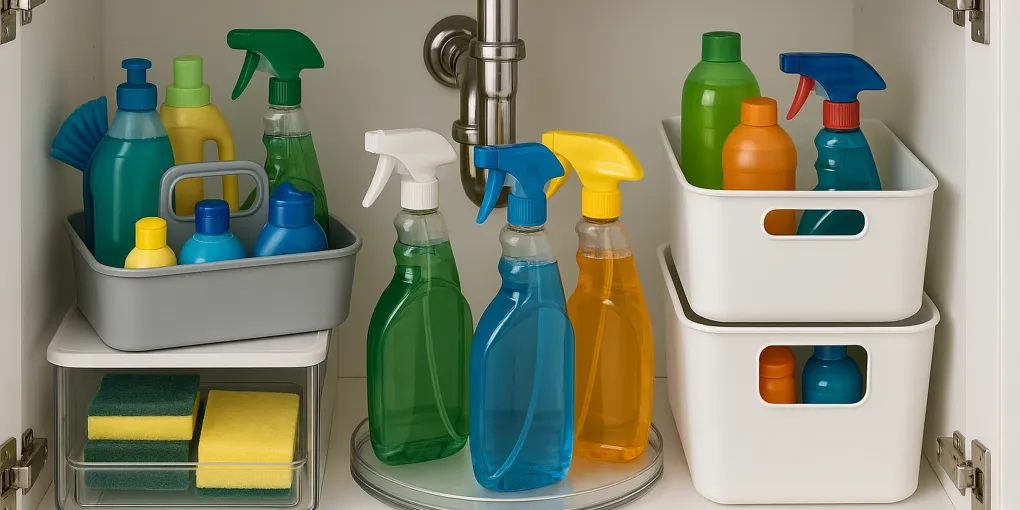
The under-sink space should use a two-tier organizing system to maximize the vertical space that most under-sink cabinets have. A pull-out organizer or a set of stackable tiers brings items at the back of the cabinet to the front without requiring full cabinet excavation.
Zone 2 — Bathroom Cleaning Zone (Under Each Bathroom Sink):
Each bathroom should have its own cleaning supply cache, sized to the bathroom’s needs. The friction-reduction logic is simple: the bathroom cleaner that’s already under the bathroom sink gets used; the bathroom cleaner that’s in the laundry room doesn’t.
Standard bathroom cleaning supplies per bathroom:
- Toilet bowl cleaner + toilet brush (stored together, adjacent to the toilet)
- Bathroom disinfectant spray
- Glass cleaner (for mirrors)
- 2–3 microfiber cloths
- Rubber gloves (if used for bathroom cleaning)
Under-bathroom-sink space often has a plumbing pipe obstruction requiring creative organization. A turntable (lazy Susan) can access items around the pipe. A small tension rod mounted across the cabinet opening holds spray bottles by their trigger handles, freeing shelf space for other items.
Zone 3 — Central Supply and Backup Storage:
Central storage (laundry room, utility closet, or a dedicated section of a storage closet) holds: bulk backup supply for kitchen and bathroom zones, deep-cleaning supplies used infrequently (oven cleaner, tile grout cleaner, wood floor polish), floor cleaning supplies (mop, bucket, floor cleaner), and paper products (paper towels, toilet paper backup).
This zone doesn’t need to be as immediately accessible as the point-of-use zones, but it does need to be organized enough that restocking the kitchen and bathroom zones is simple.
Step 3: Set Up Point-of-Use Storage Under the Kitchen Sink
The kitchen sink cabinet is the organizational challenge most households face most acutely, because it’s accessed multiple times daily and tends to become disorganized quickly without a deliberate system.
The two-tier system:
Install a two-tier pull-out organizer or a set of stackable shelves in the under-sink cabinet. The lower tier holds larger items (bulk dish soap, large spray bottles). The upper tier holds smaller items (sponges, cleaning cloths, small supplies). This system doubles the usable storage by using the full height of the cabinet rather than leaving a dead air gap above a single layer of supplies.
The spray bottle tension rod:
Mount a tension rod across the width of the cabinet at approximately the height of a spray bottle trigger. Hang spray bottles by their trigger handles on the rod, leaving the shelf below free for other items. Most cabinets can accommodate 3–4 spray bottles on a tension rod.
Caddy system for cleaning cloths:
A small caddy or open-top bin holds cleaning cloths, sponges, and scrub pads together. When the cloths need to be used, the entire caddy can be lifted out and carried to the cleaning task.
Under-sink cable management: If your under-sink cabinet contains electrical connections for a garbage disposal or under-sink filter system, route the cleaning supply storage around (not over or on top of) these systems. Moisture-damaged electrical connections are a significant hazard.
Step 4: Organize Bathroom Cleaning Supplies for Daily Use
Bathroom cleaning supplies need to be accessible for quick cleaning sessions — wiping down the sink between uses, cleaning the toilet regularly, squeegee-ing the shower — as well as for deeper weekly cleaning.
Toilet area storage:
A toilet brush caddy that sits directly behind or beside the toilet is the most functional storage approach for toilet-specific cleaning tools. Co-locate the toilet bowl cleaner with the brush caddy — they’re always used together.
Under-bathroom-sink optimization:
Install a tension rod for spray bottles (same technique as the kitchen). Add a small turntable to allow access to items that would otherwise be blocked by the plumbing pipe. Use narrow stackable bins to create vertical storage on either side of the pipe.
Visible vs. concealed storage:
Many bathroom cleaning supply items (toilet brush, plunger) are necessary but visually unpleasant. Matching concealed storage (a cylinder caddy for the toilet brush, a tall covered can for the plunger) allows the bathroom to look clean while keeping tools immediately accessible.
The bathroom cleaning caddy:
Keep a portable bathroom cleaning caddy that can be moved from bathroom to bathroom during a weekly cleaning sweep. This caddy holds: bathroom disinfectant, glass cleaner, microfiber cloths, rubber gloves. When it’s time to clean, grab the caddy and move through each bathroom without returning to central storage between rooms.
Step 5: Create a Central Storage and Restocking System
The central supply zone needs a clear organizational structure that makes it easy to identify when kitchen or bathroom zones need restocking and to retrieve the right backup supply without disrupting the entire storage system.
Zone-assigned shelving:
Assign sections of the central storage shelf to correspond to kitchen zone backup, bathroom zone backup, and general household supplies. Label each section. When restocking from central storage, the labeled section makes it clear which supplies belong where.
Stock thresholds:
For each essential cleaning supply category, define a minimum stock level that triggers reordering. Post this list inside the central storage cabinet door or in your phone’s shopping list. When a backup supply drops to the minimum threshold, add it to the next shopping run.
Seasonal deep-cleaning supplies:
Oven cleaner, window cleaner concentrate, carpet cleaner, and other infrequently-used products should be stored at the back of central storage — accessible but not taking up front-of-cabinet prime real estate. Label the shelf section clearly so you can find these products when the deep-cleaning occasion arises.
Cleaning-supply organizer criteria
Use these factors to compare options before ordering:
| Factor | Weight | What to check |
|---|---|---|
| Research | 30% | Depth of specification and user-report analysis and breadth of products reviewed |
| Evidence Quality | 25% | Reliability of specs, product documentation, and repeated owner-reported fit patterns |
| Value | 20% | Cost-effectiveness relative to competing products at similar quality tiers |
| User Signals | 15% | Long-term owner feedback and fit-related complaints |
| Transparency | 10% | Accuracy of manufacturer claims, material disclosures, and dimension accuracy |
Scores are differentiated — top picks typically score 8.5–9.5, mid-tier 7.0–8.4, and weak options below 7.0.
Product Recommendations
1. SimpleHouseware 2-Tier Expandable Under Sink Cabinet Organizer
Check current options for SimpleHouseware 2-Tier Expandable Under Sink Cabinet Organizer
This expandable two-tier shelf organizer is specifically designed for the under-sink cabinet environment. The expandable width (12–20 inches) accommodates a wide range of cabinet sizes without requiring custom installation. The open-wire construction allows visibility of all items and prevents moisture accumulation. The upper tier is height-adjustable. Works equally well under the kitchen sink and bathroom sink.
| Criterion | Weight | Score |
|---|---|---|
| Capacity & Dimensions | 30% | 8.8/10 |
| Material Quality | 25% | 8.5/10 |
| Ease of Assembly & Use | 20% | 9.2/10 |
| Long-Term Value | 25% | 8.8/10 |
| Composite Score | 8.8/10 |
2. Casabella Cleaning Caddy with Handle
Check current options for Casabella Cleaning Caddy with Handle
This portable cleaning caddy is the backbone of the multi-bathroom cleaning sweep approach. Divided interior compartments hold spray bottles, cloths, gloves, and small supplies in organized sections. The wide handle allows single-hand carrying between rooms. Made from durable plastic that resists chemical splash damage. Available in multiple colors for per-zone color-coding (one caddy per zone, each in a distinct color).
| Criterion | Weight | Score |
|---|---|---|
| Capacity & Dimensions | 30% | 8.3/10 |
| Material Quality | 25% | 8.8/10 |
| Ease of Assembly & Use | 20% | 9.5/10 |
| Long-Term Value | 25% | 8.5/10 |
| Composite Score | 8.7/10 |
3. mDesign Turntable Lazy Susan Organizer for Under Sink
Check current options for mDesign Turntable Lazy Susan Organizer for Under Sink
The turntable organizer solves the most common under-sink frustration: items stored behind the plumbing pipe that can only be retrieved by removing everything in front. A 360-degree rotating base brings everything to the front with a single spin. Suitable for both cleaning supply bottles and small accessory items. The smooth-rotating base works on the typical under-sink shelf surface. Available in single and double-tier configurations; the double-tier provides maximum utility in the limited under-sink vertical space.
| Criterion | Weight | Score |
|---|---|---|
| Capacity & Dimensions | 30% | 8.0/10 |
| Material Quality | 25% | 8.2/10 |
| Ease of Assembly & Use | 20% | 9.8/10 |
| Long-Term Value | 25% | 8.0/10 |
| Composite Score | 8.4/10 |
Maintenance: Keeping the Cleaning Supply System Current
A well-organized cleaning supply system requires minimal ongoing maintenance precisely because it’s designed to make the daily use of cleaning supplies frictionless. The maintenance that does need to happen is primarily about restocking and periodic product audits.
Weekly maintenance (3–5 minutes):
- Confirm that point-of-use kitchen and bathroom zones are stocked at functional levels
- Return any supplies that have been displaced during cleaning sessions
- Wash and return microfiber cloths to their storage location
Monthly maintenance (10 minutes):
- Restock any point-of-use zone that has dropped below functional supply level
- Check that spray bottle labels are still legible (spray residue can obscure labels over time)
- Assess whether any products need replacement (sponges, cloth sets that are worn)
Quarterly deep maintenance (20 minutes):
- Audit all cleaning supply expiration dates; discard expired or degraded products
- Assess whether the current product lineup is still the right set for your household (product needs change with home changes — new flooring, new appliances, new pets)
- Check under-sink cabinet for any moisture issues that could compromise stored products
- Evaluate whether central storage organization still matches actual backup supply patterns
Annual reset: Conduct the full cleaning supply audit from Step 1. Annual audits prevent the slow accumulation of specialty products, expired inventory, and storage system degradation that gradually renders even well-designed cleaning supply systems ineffective.
The payoff of a well-maintained cleaning supply system is measurably more consistent household cleaning. When the supplies are where they belong, accessible without friction, and correctly stocked — cleaning happens more often, more completely, and with significantly less cognitive overhead.
Frequently Asked Questions
- Research on cleaning behavior suggests that a distributed storage model — storing cleaning supplies closest to where they're used — produces more consistent cleaning habits. Bathroom cleaners stored under the bathroom sink get used; bathroom cleaners stored in a central laundry room closet often don't. The optimal system combines a central storage location for bulk supplies and backup inventory with distributed point-of-use storage for daily-access items in each primary cleaning zone.
- All cleaning chemicals — including products marketed as 'natural' or 'plant-based' — should be stored in locked or child-inaccessible locations. A cabinet with a child-safety latch is the minimum standard; a locked cabinet is preferable for households with young children. Store cleaning supplies above countertop height wherever possible. Never store cleaning supplies in containers other than their original packaging — unmarked spray bottles are a significant poisoning risk.
- Bleach-containing products should never be stored with ammonia-containing products, as accidental mixing can produce toxic chloramine gas. Acidic cleaners (vinegar-based, toilet bowl cleaners) should not be stored adjacent to bleach-based products for the same reason. Hydrogen peroxide should not be stored with vinegar. While separated storage doesn't prevent all accidental mixing, it reduces the risk of accidental combination during retrieval.
- Most households need far fewer distinct cleaning products than they own. A functional cleaning kit includes: an all-purpose spray cleaner, a glass cleaner, a bathroom disinfectant, a toilet bowl cleaner, a dish soap, a multi-surface floor cleaner, and a laundry detergent. Specialty products (oven cleaner, tile grout cleaner, stainless steel polish) should be purchased as needed rather than stored indefinitely. Product consolidation is one of the highest-impact steps in cleaning supply organization.