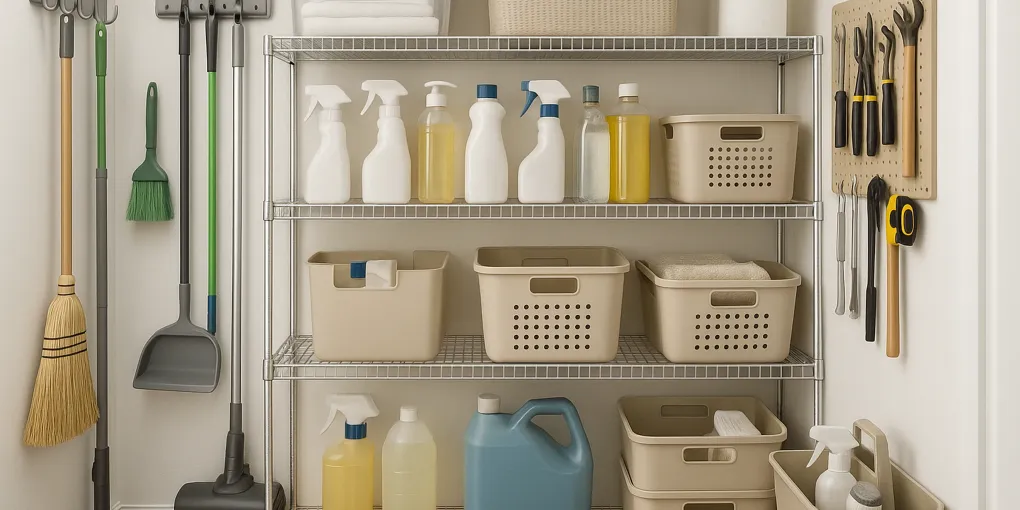
How to Organize a Utility Closet 2026
Buyer's GuideQuick picks
Spectrum Diversified Wall-Mounted Broom Holder
SimpleHouseware Over-Door Organizer with 6 Baskets
Seville Classics 5-Tier Steel Wire Shelving Cart
Quick picks
These are the products referenced in the guide; check dimensions, material, and installation limits before ordering.
- Recommended product: See current price on Amazon
- Recommended product: See current price on Amazon
- Recommended product: See current price on Amazon
The Utility Closet: Functional Infrastructure for a Well-Run Home
The utility closet is the operational heart of home maintenance. It holds the tools and supplies that keep the rest of the home clean, functional, and repaired. When it is disorganized, the downstream effects are felt throughout the house: cleaning tasks are skipped because finding the right supplies feels like too much effort; minor repairs go undone because locating the right tool requires a 20-minute search; household members give up on contributing to home maintenance because the supplies are inaccessible or incomprehensible.
Behavioral research on household task completion shows a clear pattern: the more friction associated with initiating a cleaning or maintenance task, the less frequently it happens. A cluttered utility closet that requires five minutes of searching before any task can begin represents enough friction to prevent habitual cleaning behaviors from forming. The most effective cleaning routine is the one that starts in under 60 seconds — supplies in hand, ready to act.
Environmental design in the utility closet directly supports household functioning. A well-organized utility closet with accessible tools, a clear zone system, and logical product groupings makes every household member more capable and more likely to act on cleaning and maintenance tasks. The organizational investment pays returns every day in the form of faster task initiation and higher compliance.
This guide covers the complete process: the initial audit, the zone system, the hardware and product recommendations that maximize a small space, and the maintenance habits that keep it functional. For related organization guides, see our roundup of the best laundry room organizers and our guide on how to organize a home office.
Step 1: Complete Inventory and Safety Audit
The starting point for utility closet organization is a complete audit — not just of what is stored there, but of the safety and regulatory compliance of the current storage arrangement.
Remove everything from the utility closet and place it on a surface where the complete inventory is visible. For a typical utility closet, this should reveal: long-handled cleaning tools, a mop and bucket, cleaning sprays and chemicals, paper towels and replacement supplies in bulk, small household tools, light bulbs and batteries, and typically a collection of miscellaneous items that migrated in over time.
As you audit, apply three checks to each category:
Expiration and condition: Cleaning products have shelf lives. Aerosols may have lost pressure. Paper products stored in a humid closet may be damaged. Anything past its useful life goes.
Safety compliance: Check that all chemicals are in their original labeled containers. Unlabeled bottles of cleaning solutions are a safety hazard. Check that anything that should be locked away from children (drain cleaners, paint strippers, strong solvents) is either locked or will be after reorganization.
Relevance: Does this item belong in the utility closet specifically? Small hand tools that belong in a tool kit, excess pantry stock that belongs in a pantry, and cleaning supplies for a bathroom that should live in that bathroom are all relocation candidates. The utility closet should hold only the items it makes genuine sense to centralize.
Check whether the closet shares space with a water heater, furnace, electrical panel, or other mechanical equipment. If so, document the required clearances and plan the storage system around them. Never store anything against mechanical equipment or in a way that blocks emergency access to shut-offs.
Step 2: Design the Zone System
A utility closet zone system is more three-dimensional than most organizational systems because the space typically uses vertical height aggressively. The zone design should account for the floor, the walls, the door, and the ceiling as distinct storage surfaces.
Floor zone: Reserve the floor for the largest, heaviest items — mop buckets, vacuum cleaners, and large containers of bulk supplies. Keeping heavy items at floor level prevents the top-heavy instability that makes utility closets dangerous. The floor zone should be organized with the most frequently accessed items nearest the door and the least frequently used items in the back.
Low shelving zone (18 inches to 48 inches): This is the primary product storage zone — cleaning chemicals, spray bottles, paper towels, and replacement supplies. Shelves in this range are accessible without reaching or bending significantly, making them the highest-value storage position. Group by function: all-purpose cleaners together, bathroom cleaners together, floor and surface care together.
High shelving zone (48 inches and above): Infrequently accessed supplies, bulk stock, and seasonal cleaning items. These are items that are accessed less than once per month and can tolerate the slight inconvenience of reaching up.
Wall-mounted zone: The walls of a utility closet are often completely underutilized. Wall-mounted broom holders, hooks, and magnetic strips can hold long-handled tools, extension cords, small tools, and accessories that would otherwise take up shelf or floor space.
Door zone: An over-door organizer on the utility closet door can hold spray bottles, small accessories, paper goods, and personal protective equipment (gloves, dust masks). This is especially valuable in compact utility closets where every square inch of floor and shelf space is at a premium.
Step 3: Install the Right Hardware
The utility closet’s effectiveness is determined largely by its hardware: the physical systems that hold items in their designated positions and prevent the gradual migration that causes organization to break down.
Shelving: Adjustable wire shelving or heavy-duty freestanding shelving units work best. Wire shelving allows visibility from multiple angles and permits airflow around stored chemicals, which matters for both safety and product integrity. Adjustable shelving is worth the modest additional cost because utility closet contents change more frequently than most storage categories — new products replace old ones, and storage needs shift as household maintenance patterns evolve.
Broom and mop holder: A wall-mounted multi-tool holder with rubber grips is the single most transformative piece of hardware in a utility closet. Long-handled tools stored on the floor fall over, block access to other items, and make the closet feel chaotic. Mounted on the wall, those same tools take up zero floor space and are retrievable in a single motion.
Over-door organizer: An adjustable over-door organizer with pockets or wire bins can hold 10 to 15 additional items without using any shelf or floor space. For spray bottles specifically, a door-mounted spray bottle holder keeps them upright, prevents leaks, and allows quick visual inventory.
Turntable (lazy Susan): On a deep shelf, a turntable allows items stored at the back to be rotated forward without reaching over front items. Particularly useful for cleaning product collections where you need to access any item quickly.
Label maker or printed labels: Every shelf section, bin, and zone needs a label. The utility closet is used by everyone in the household, and in reactive situations (someone spills something, something needs fixing), people do not have time to think carefully about where to find what they need. Labels make the system accessible to everyone instantly.
Step 4: Load the System with Maximum Density in Mind
With hardware installed, load the system by category, beginning with the highest-traffic items in the most accessible positions.
Apply the frequency-of-use principle: items reached for daily (paper towels, all-purpose spray, trash bags) belong in the most accessible positions — eye-level shelves nearest the door. Items used weekly (floor cleaner, bathroom cleaners, window cleaner) go on middle shelves, slightly further back. Items used monthly (oven cleaner, drain cleaner, specialty products) go on high shelves or deep storage.
For spray bottles, consider standardizing your cleaning solutions where possible. Having three spray bottles of all-purpose cleaner in different formulations from three different brands is less efficient than choosing one and buying in bulk. Fewer product types means fewer storage units and a simpler mental inventory.
Keep only one of each consumable product active, with backup stock limited to one spare. More than two of any cleaning product is unnecessary stock that takes up space and tracks expiration dates. A running shopping list on the utility closet door or in a household notes app handles resupply without requiring buffer stock.
Safety check as you load: ensure all chemical containers are sealed and upright. Maintain a clear path to any mechanical equipment in the closet. Ensure that any products requiring child safety are stored above the reach of children or in a lockable bin.
Step 5: Build Daily and Monthly Maintenance Habits
The utility closet is a working space, not a showroom. It will be accessed multiple times per day and items will frequently be removed, used, and returned. The maintenance system needs to be designed around this reality rather than pretending the closet can be kept in perfect order without active habits.
The daily habit is the one-motion return: every item that is removed from the utility closet goes back to its designated position before the task is finished. This takes under 30 seconds and prevents the gradual accumulation of out-of-place items that degrades organization over days and weeks.
The monthly habit is a 10-minute check: scan all zones for items out of place, dispose of any empty containers, verify that backup supplies are adequately stocked, and check for any spills or residue from cleaning product containers. This check keeps the system functioning and prevents the monthly version of entropy from building up.
Every three to four months, a more thorough reset: empty the shelves, wipe them down, check expiration dates, reassess which products are actually being used versus sitting unused, and reconfigure the zone assignments if household cleaning patterns have shifted. This seasonal reset takes about 30 minutes and keeps the utility closet genuinely functional rather than merely appearing organized.
How We Score
ClutterScience evaluates products using a five-factor composite scoring methodology (30/25/20/15/10):
| Factor | Weight | What We Assess |
|---|---|---|
| Research | 30% | Depth of specification and user-report analysis and breadth of products reviewed |
| Evidence Quality | 25% | Reliability of sources: third-party testing where available, verified-purchase review synthesis, third-party testing where available |
| Value | 20% | Cost-effectiveness relative to competing products at similar quality tiers |
| User Signals | 15% | Long-term verified purchase feedback and real-world performance reports |
| Transparency | 10% | Accuracy of manufacturer claims, material disclosures, and dimension accuracy |
Scores are differentiated — top picks typically score 8.5–9.5, mid-tier 7.0–8.4, and weak options below 7.0.
Product Recommendations
For utility closet organization, these products deliver the best results:
Spectrum Diversified Wall-Mounted Broom Holder
Best for: Clearing the utility closet floor by wall-mounting long-handled tools $18–24. Amazon verified purchasers highlight that the rubber grips accommodate brooms, mops, brushes, and shovels of different handle diameters without slipping, and the compact footprint fits even in narrow utility closets.
| Criterion | Weight | Score |
|---|---|---|
| Capacity & Dimensions | 30% | 9.0/10 |
| Material Quality | 25% | 8.8/10 |
| Ease of Assembly & Use | 20% | 9.2/10 |
| Long-Term Value | 25% | 9.0/10 |
| Composite Score | 9.0/10 |
SimpleHouseware Over-Door Organizer with 6 Baskets
Best for: Adding spray bottle and small supply storage to the utility closet door $22–28. Purchasers note that the adjustable wire baskets hold different sizes of spray bottles, paper goods, and accessories without swinging or shifting when the door is opened and closed.
| Criterion | Weight | Score |
|---|---|---|
| Capacity & Dimensions | 30% | 8.8/10 |
| Material Quality | 25% | 8.9/10 |
| Ease of Assembly & Use | 20% | 9.0/10 |
| Long-Term Value | 25% | 8.7/10 |
| Composite Score | 8.8/10 |
Seville Classics 5-Tier Steel Wire Shelving Cart
Best for: Compact utility closets needing mobile shelving that can be repositioned $60–80. Verified buyers appreciate the locking casters that allow the entire unit to be rolled out for access to items at the back, then locked in position during use — a significant advantage in narrow utility closets.
| Criterion | Weight | Score |
|---|---|---|
| Capacity & Dimensions | 30% | 8.9/10 |
| Material Quality | 25% | 9.0/10 |
| Ease of Assembly & Use | 20% | 8.7/10 |
| Long-Term Value | 25% | 8.8/10 |
| Composite Score | 8.9/10 |
Maintenance: Keeping Your Utility Closet Operational
The utility closet’s maintenance challenge is fundamentally different from storage closets and pantries. Those spaces have infrequent, deliberate access patterns. The utility closet is accessed reactively — when something spills, when something breaks, when the trash needs taking out — under time pressure and often by multiple household members with different levels of organizational attention.
Building maintenance into the closet design itself is more effective than relying on behavioral habits alone. The one-motion return principle, supported by clear labels and logical zone placement, means that returning an item to its correct position requires no more effort than leaving it somewhere random. When the right behavior is the easy behavior, compliance is not a matter of willpower.
The monthly check should be treated as a household maintenance task rather than an organizational one — like checking smoke detector batteries or changing HVAC filters. Scheduling it on a recurring calendar reminder removes the need to remember to do it, and treating it as routine (rather than exceptional) prevents the gradual decay that turns organized closets back into chaos.
The biggest long-term threat to utility closet organization is product proliferation — the gradual accumulation of specialty cleaning products, each purchased for a specific task and then retained indefinitely. Every additional product takes up space and complicates the inventory. A quarterly review with the question “have I used this in the past three months?” keeps the supply set lean, relevant, and manageable within the available space.
Frequently Asked Questions
- Accessibility. A utility closet is only as useful as the speed with which you can access what you need. If finding the mop requires moving six other items, the closet is functionally disorganized regardless of how tidy it looks. Every item should be reachable in under 10 seconds.
- Wall-mounted broom holders with rubber grips are the most space-efficient solution. They keep long-handled tools off the floor, prevent them from falling, and allow multiple items to be stored in a compact space. Door-mounted versions work well in very tight utility closets.
- Store cleaning chemicals in a well-ventilated area and never mix chemicals — even by storing bleach-based and ammonia-based products in close proximity without proper sealing. Keep chemicals in their original containers and off the floor. Lock the utility closet if young children are in the household.
- Maintain the clearances required by code around mechanical equipment — typically 18 to 30 inches depending on equipment type. Never block access to shut-offs or service panels. Use the remaining space for storage, but ensure emergency access to mechanical components is never compromised.
- Monthly is ideal — a 10-minute check to return items to their zones, dispose of empty containers, and ensure safety compliance. A seasonal deep clean every three to four months handles the more thorough reset.