The Home Edit Clear Bin
Best visible categoriesBest for: Washcloths, guest toiletries, and small linen categories
Quick picks
| Product | Key Specs | Pros / Cons |
|---|---|---|
| See price on Amazon |
|
|
| See price on Amazon |
|
|
| See price on Amazon |
|
|
Product availability, certifications, and retailer details can change; check the current Amazon page before buying.
Quick product shortlist
Use this shortlist to choose a product style before you measure. The links are named product or brand searches so you can compare current dimensions, finishes, prices, and return terms before buying.
- Best visible categories: The Home Edit Clear Bin (Search Amazon for The Home Edit clear bin linen closet) for washcloths, guest toiletries, and small linen categories. Watch-out: clear bins need neat category limits.
- Best seasonal bedding box: IRIS USA Latching Storage Box (Search Amazon for IRIS USA latching storage box bedding) for off-season sheets, blankets, or extra pillows. Watch-out: large bedding boxes get heavy fast.
- Best towel stack control: Shelf Dividers for Wire Shelving (Search Amazon for shelf dividers for linen closet towels) for towel stacks that tip into neighboring categories. Watch-out: confirm shelf type before buying.
Quick picks
These are the products referenced in the guide; check dimensions, material, and installation limits before ordering.
- Recommended product: See current price on Amazon
- Recommended product: See current price on Amazon
- Recommended product: See current price on Amazon
The Linen Closet Problem That Nobody Talks About
The linen closet is one of the most frequently opened and most chronically disorganized spaces in the home. Towels come out of the dryer and get stacked wherever there is room. Sheets get pushed in hastily between the towels, which means the next time someone needs a specific set, half the closet has to be excavated to find it. The extra blanket for guests falls off the top shelf every time someone reaches for a washcloth. Eventually, people stop trying to maintain any system at all and the closet becomes a textile landfill.
The underlying cause is not laziness — it is an organizational system that requires too much effort to maintain. When returning clean laundry to the closet is difficult, the path of least resistance is to stuff it in wherever it fits. The solution is environmental design: a system where the default behavior (tossing a towel into the closet) results in an organized outcome rather than chaos.
Behavioral research on household routines shows that the most durable organization systems are those that make the correct behavior identical to the easy behavior. A linen closet where every category has a clearly defined zone, every set of sheets has its own labeled bin, and every towel has a designated shelf position reduces the cognitive work of daily use to near zero.
This guide walks through the complete process of organizing a linen closet from scratch — the initial audit, the zone design, the folding and storage methods that actually hold up over time, and the product recommendations that make the system stick. For related organization, see our roundup of the best linen closet organizers and our guide to best storage bins for closets.
Step 1: Full Inventory and Declutter
Remove everything from the linen closet. This is the necessary foundation for every successful organizational project, and the linen closet is no exception. It is also frequently the most surprising step — most people discover significantly more textiles than they realized they had stored.
As you remove items, sort them into categories: bath towels, hand towels, washcloths, bed sheets by bed size, pillowcases, extra blankets and quilts, and miscellaneous (heating pads, first aid supplies that migrated in, cleaning cloths, seasonal decorative items).
For each item, apply three questions: Is it in good condition? Does it fit the household’s current needs? Has it been used in the past year? Towels that are worn thin, frayed, or permanently stained should be donated or repurposed as cleaning rags. Sheets for a bed size you no longer own, or for a guest room you no longer have, should go. A blanket that has been in the closet for five years and never come out is a blanket you do not need.
Count what you have. Most households discover they own far more linens than necessary. The standard of two to three sets of sheets per bed and four to six towels per household member is a practical guide. More than this means the closet is carrying inventory that creates work without providing value.
The declutter alone reduces closet volume by 30 to 40 percent in most households. That reduction is not loss — it is the space that makes an organized system sustainable.
Step 2: Establish Your Zone Map
Linen closet zones should reflect how the closet is used: who uses what, how often they need it, and what the current season requires. A zone map that matches actual household behavior is far more durable than one that reflects how the closet should theoretically be organized.
Most-used shelves (eye level to waist level): Daily towels belong here. Bath towels used most frequently — typically the main bathroom’s set — should be at eye level or just below, in a stack or folded standing upright. Easy accessibility makes it more likely that towels get returned to the correct shelf after laundry rather than left on a countertop or bathroom floor.
Upper shelves (reaching height): Less frequently accessed items. Extra blankets, spare pillows, guest bed linens, and seasonal bedding live here. These items are not accessed daily or even weekly, so they can tolerate a slightly less accessible position.
Lower shelves (bending required): Sheets are often well-suited to lower shelves, stored in labeled bins by bed size. Because sheet sets are swapped on a weekly or biweekly schedule rather than daily, the slight inconvenience of a lower shelf is acceptable. Lower shelves are also appropriate for cleaning cloths, bathroom extras, and less-used categories.
Top shelf (above comfortable reach): Seasonal items and deep storage. Heavy winter blankets, holiday table linens, and items used a few times per year work on the top shelf. Use labeled bins that can be lifted down safely.
Door: If the linen closet door allows, an over-door organizer can hold washcloths, small hand towels, individual-use items, or first aid supplies that have migrated into the closet. This frees shelf space for larger textile categories.
Step 3: Master the Sheet-Folding System
The biggest source of linen closet entropy is sheet sets. Without a system for keeping sets together, closets end up with single flat sheets without matching fitted sheets, orphaned pillowcases, and sets that require a full excavation to assemble. The solution is a dedicated sheet-storage method that keeps sets permanently together.
The most popular and effective method is the bundle technique. After laundering a sheet set, fold the flat sheet to a compact rectangle. Fold the pillowcases. Then slide both inside the fitted sheet, which naturally forms a pocket due to its elasticized corners. The result is a self-contained bundle that holds the complete set together and does not come apart when retrieved from the shelf.
Store bundles standing upright like books in a labeled bin, rather than laying them flat in a stack. Upright storage means every bundle is visible and accessible without disturbing others — the critical feature that allows the FIFO principle to be applied to linen rotation (older sets at the front, freshly laundered at the back).
Label each bin clearly with the bed it corresponds to: “King Bed,” “Guest Twin,” “Toddler Bed.” In households with multiple beds and therefore multiple sheet sizes, this labeling eliminates the “is this the king or the queen fitted sheet?” problem that derails closet organization.
The time investment in learning and implementing the bundle technique pays dividends every laundry day. A method that keeps sets together automatically requires no extra cognitive work to maintain — the organizational outcome is built into the folding process itself.
Step 4: Install Shelf Dividers and Bins
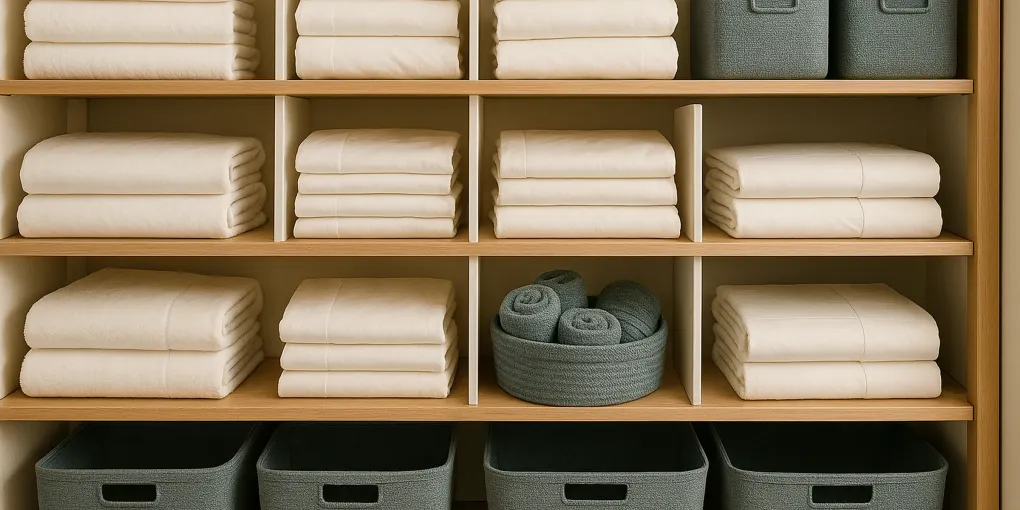
The mechanical foundation of linen closet organization is the right combination of shelf dividers and bins. Without physical boundaries on shelves, folded items gradually migrate horizontally until piles topple and categories blend together. Shelf dividers prevent this by creating permanent category zones on each shelf.
Shelf dividers that clamp onto the shelf edge with spring tension install in under a minute with no tools. Position them to create three or four distinct zones on each shelf — one for each towel type, for example (bath towels, hand towels, washcloths), or one per bedroom’s sheet set. The divider physically prevents a stack from falling into an adjacent category zone even when the closet is accessed quickly and carelessly.
For shelves storing sheet sets, blankets, and items better suited to containers, rectangular labeled bins provide the same function as dividers while also protecting contents from dust and adding a visual uniformity that makes the closet feel organized at a glance. Clear or mesh-front bins allow identification of contents without removing the bin from the shelf.
For towels, consider whether folded or rolled storage suits your household better. Rolling allows more towels to be stored on a shelf and makes each individual towel visible and accessible. Folding is faster for most people, which matters when the goal is maintenance compliance. The objectively superior method is the one your household will actually use after the first week.
Step 5: Build the Laundry-to-Closet Habit
The linen closet organization system is only as good as the habits that restore it after each laundry cycle. The most common breakdown point is not the initial organization but the moment clean laundry comes out of the dryer and needs to be put away.
Make the return process as easy as the retrieval process. Every category should have enough space that returning a folded towel or a sheet bundle requires no reorganization of surrounding items. An overstuffed closet is one where returning laundry is harder than pulling items out, which guarantees that items will be stacked on top or shoved in carelessly.
Fold and sort linens immediately after the dryer cycle rather than creating an intermediate pile that gets carried into the closet en masse. Taking 90 seconds at the dryer to fold correctly means the closet return takes 30 seconds rather than five minutes of trying to manage a heap of tangled textiles.
For households with children old enough to participate, involving them in linen folding and return is both a practical help and a habit-building opportunity. Children who regularly participate in household organization tasks from an early age develop organization skills and attitudes that carry into adulthood. The linen closet is a low-stakes environment for building these habits.
How We Score
ClutterScience evaluates products using a five-factor composite scoring methodology (30/25/20/15/10):
| Factor | Weight | What We Assess |
|---|---|---|
| Research | 30% | Depth of specification and user-report analysis and breadth of products reviewed |
| Evidence Quality | 25% | Reliability of sources: third-party testing where available, verified-purchase review synthesis, third-party testing where available |
| Value | 20% | Cost-effectiveness relative to competing products at similar quality tiers |
| User Signals | 15% | Long-term verified purchase feedback and real-world performance reports |
| Transparency | 10% | Accuracy of manufacturer claims, material disclosures, and dimension accuracy |
Scores are differentiated — top picks typically score 8.5–9.5, mid-tier 7.0–8.4, and weak options below 7.0.
Product Recommendations
For linen closet organization, these products deliver the best results:
Richards Homewares Linen Closet Shelf Dividers (Set of 6)
Best for: Creating category zones on existing linen closet shelves $18–24. Amazon verified purchasers highlight the strong spring-tension mount that stays in place through years of daily use without requiring tools or permanent installation.
| Criterion | Weight | Score |
|---|---|---|
| Capacity & Dimensions | 30% | 8.9/10 |
| Material Quality | 25% | 8.7/10 |
| Ease of Assembly & Use | 20% | 9.4/10 |
| Long-Term Value | 25% | 8.8/10 |
| Composite Score | 8.9/10 |
Lifewit Fabric Storage Bins with Labels (Set of 6)
Best for: Sheet set organization by bed size with clear labeling $24–32. Purchasers note that the label window on the front of each bin allows custom labels to be swapped without rebuying bins as household needs change, and the fabric construction is softer on stored linens than rigid plastic bins.
| Criterion | Weight | Score |
|---|---|---|
| Capacity & Dimensions | 30% | 9.0/10 |
| Material Quality | 25% | 8.6/10 |
| Ease of Assembly & Use | 20% | 9.1/10 |
| Long-Term Value | 25% | 8.7/10 |
| Composite Score | 8.9/10 |
Zober Cedar Blocks for Storage (20-Pack)
Best for: Maintaining freshness and preventing mustiness in linen closets $14–18. Verified buyers report a noticeable difference in closet freshness after adding cedar blocks, particularly in closets with limited airflow. Cedar also deters moths and other textile pests naturally.
| Criterion | Weight | Score |
|---|---|---|
| Capacity & Dimensions | 30% | 7.5/10 |
| Material Quality | 25% | 8.9/10 |
| Ease of Assembly & Use | 20% | 9.8/10 |
| Long-Term Value | 25% | 8.5/10 |
| Composite Score | 8.6/10 |
Maintenance: Keeping Your Linen Closet Organized
The linen closet is organized in one dedicated session and maintained through two simple routines: a two-minute tidy after each laundry day, and a 30-minute quarterly review. These two habits, practiced consistently, are enough to keep the closet functional indefinitely without additional large-scale reorganization efforts.
After laundry day, return all clean linens to their designated zones. Do not create a “later pile” — the pile always becomes permanent. Two minutes at the laundry stage saves 20 minutes of chaos management later. If returning items to the correct zone is consistently difficult (the bin is always too full, the shelf divider keeps moving), that is a signal to adjust the system, not to abandon the habit.
Quarterly, spend 30 minutes doing a light inventory. Check for towels that have become threadbare and should be retired, sheet sets that are no longer being used, and categories that have drifted out of their zones. The quarterly check is also the time to implement seasonal bedding rotation — swapping heavy winter comforters for lighter summer bedding, or bringing out extra blankets as temperatures drop.
The biggest long-term threat to linen closet organization is inventory creep — the gradual accumulation of more linens than the closet is designed to hold. Every attractive towel set on sale, every gifted set of sheets, every extra blanket adds to the inventory. Building in a one-in-one-out rule helps: when a new set of sheets arrives, an older set departs. This keeps the closet at a sustainable capacity and makes every laundry day a two-minute task rather than a half-hour puzzle.
Frequently Asked Questions
- The bundle method — folding the flat sheet and pillowcases inside the fitted sheet — keeps sets together and eliminates the need to hunt for matching pieces. Stand bundles upright like books rather than stacking flat, which makes every set visible and retrievable without disturbing others.
- Two to three sets per bed is the standard recommendation — one on the bed, one clean and ready, and one optional backup. More than three sets per bed is unnecessary for most households and leads to closet overcrowding.
- Both work, but rolling is more space-efficient and allows more towels to be stored visibly. However, folding is faster for most people, which affects compliance. Choose the method your household will actually maintain — a second-best method used consistently beats a perfect method abandoned after a week.
- Ensure all linens are completely dry before storing. Avoid overstuffing, which reduces air circulation. Cedar blocks or sachets of dried lavender help maintain freshness without chemicals. Leaving a small gap between items at the back of the shelf encourages airflow.
- A quarterly review is sufficient for most households — usually coinciding with seasonal bedding changes. A weekly two-minute tidy after laundry is folded prevents gradual entropy between quarterly reviews.